


 Location
 Login
Login
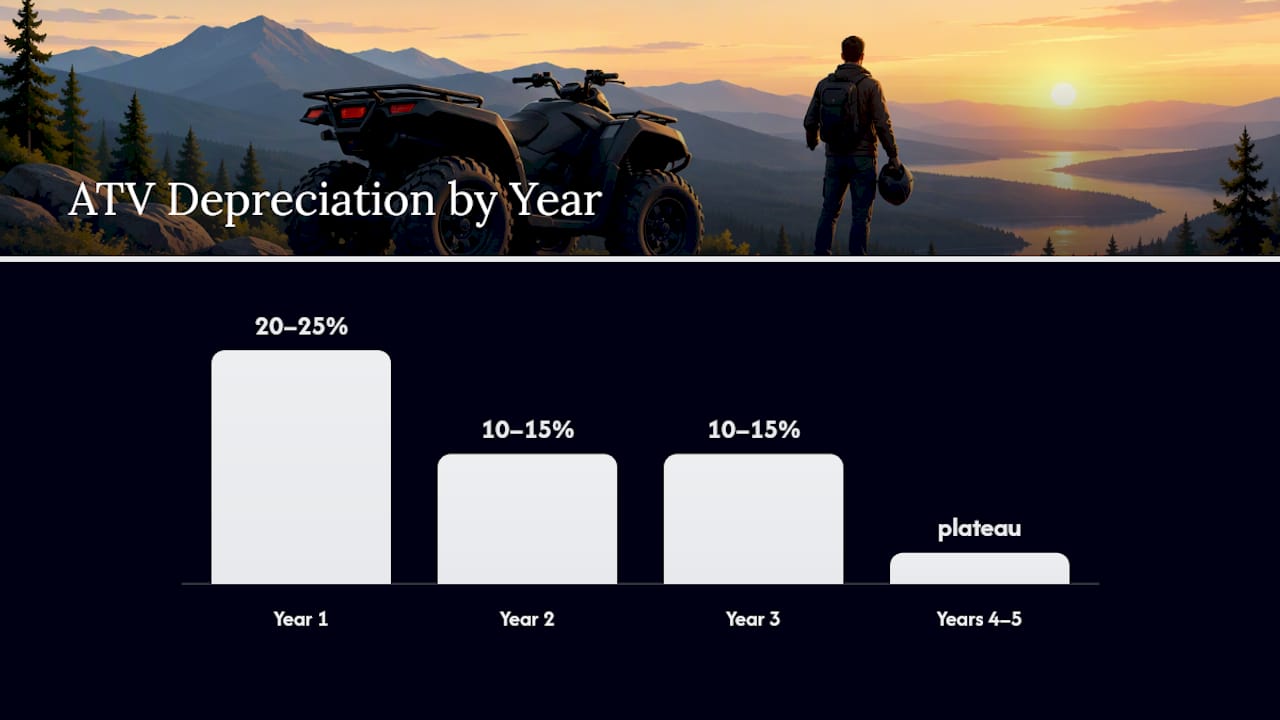
Most ATVs lose 20% to 25% of their value in the first year, then settle into a steadier decline of 10% to 15% annually before leveling off around the three to five year mark. The single biggest lever you control isn’t the brand you buy or the color you pick. It’s documentation. An ATV with logged maintenance and a clearly tracked hour meter routinely sells for more than an identical machine with no paper trail.
TL;DR:
- ATVs with fewer than 100 hours tend to retain value better than those with over 500 hours, regardless of their age.
- Brand reputation and parts availability, especially for Honda and Yamaha, significantly influence long-term resale value.
- Proper maintenance records and documented service history can increase ATV value by hundreds or thousands of dollars at resale.
- Private-party sales generally yield 25% to 40% more money than dealer trade-ins, making them more profitable if you have time to sell yourself.
- Seasonal demand impacts resale prices, with spring and early summer fetching higher prices and late fall or winter prices often softening.
Table of Contents
- How ATV Depreciation Rates Break Down Over Time
- What Actually Moves the Needle on ATV Value
- How the IRS Treats ATV Depreciation for Business Use
- How to Estimate What Your ATV Is Worth Right Now
- Getting the Most Money When You Sell
- Where to Check ATV Values Before You Buy or Sell
- Why Import Junkies’ Pricing Data Backs This Guide
- How Financing and Leasing Change Your Depreciation Math
- Mistakes That Quietly Drain Your ATV’s Value
- New vs. Used: Which One Actually Makes Financial Sense
- Depreciation Differences Across ATV Categories
- Balancing Resale Value Against Actually Using the Machine
- Ready to Compare Real ATV Pricing?
- Sources
- FAQ
How ATV Depreciation Rates Break Down Over Time
The moment you ride a new ATV off the trailer, it stops being “new” in the eyes of every future buyer, and the price gap between new and used shows up almost immediately. Dealers know this, which is why trade-in offers on machines with fewer than 50 hours on them still come in well below MSRP.
After year one, the depreciation curve doesn’t stop, but it flattens. Years two and three typically see another 10% to 15% shaved off the value annually, largely tied to accumulating hours and general wear. By year four or five, though, most well-maintained ATVs hit a plateau. The machine has proven it’s reliable (or it hasn’t), the major failure points have either shown up or stayed quiet, and buyers start pricing it more on condition than on age.
Utility ATVs in the 300cc to 700cc range hold up differently than sport models. Utility machines have the broadest resale market because they appeal to hunters, ranchers, and weekend trail riders alike, so demand stays fairly consistent year round. Sport ATVs are more of a niche product, built for speed rather than hauling, and their resale pool is smaller. UTVs and side-by-sides sit in their own category entirely: they carry the highest absolute resale values of the group, even though their percentage-based depreciation isn’t dramatically different.
A few patterns show up across nearly every valuation source:
- New ATV prices span roughly $3,000 for a used entry-level unit to $25,000 or more for a new premium model, and that spread widens the depreciation gap at the top end.
- Machines with fewer than 100 hours retain value noticeably better than those pushing 500 hours or more, regardless of age on paper.
- Sport ATVs depreciate faster in absolute dollars during the first two years, then slow down once they’re no longer competing with the newest models on the showroom floor.
- UTVs depreciate at a comparable percentage rate to utility ATVs but lose more in raw dollars because their starting price is higher.
Here’s a number worth sitting with: private-party sales typically fetch 25% to 40% more than a dealer trade-in on the same machine. If you’ve got the patience to sell it yourself, that gap is real money, often the difference between covering your next purchase outright and needing extra financing to bridge it.
What Actually Moves the Needle on ATV Value
Brand loyalty isn’t just marketing. It’s measurable in resale prices. Search Shop’s analysis of ATV valuation points out that Honda and Yamaha units tend to hold value better long term, largely because of dealer network density and parts availability. If a buyer knows they can walk into nearly any town and find OEM parts or a certified mechanic, they’ll pay more upfront and worry less about ownership costs down the line. Lesser-known import brands, by contrast, often carry a steeper depreciation curve simply because resale buyers factor in the hassle of sourcing parts.
Hours and mileage matter more than the odometer number itself. An ATV with 200 hours that’s spent mostly hauling feed at low RPM has a different wear profile than one with 200 hours of hard trail riding. Buyers who know what they’re looking at will ask about usage type, not just the number on the gauge. If you’re unsure how your hours translate to real wear, our guide to ATV hours versus miles breaks down how to read that number the way an appraiser would.
Maintenance records function almost like a credit score for your machine. A stack of oil change receipts, a documented valve adjustment, and a note about when the CVT belt was replaced can be worth hundreds, sometimes thousands, of dollars at sale time compared to an identical unit with zero paperwork. Buyers pay for certainty. A record shows them exactly what they’re buying instead of asking them to gamble.
Modifications are a mixed bag. Some additions genuinely help:
- Winches, skid plates, and upgraded racks tend to add value because they’re functional and desired by the next owner.
- Aftermarket exhaust systems, lift kits, and tuned engines often hurt resale because buyers worry about reliability and warranty voids.
- Cosmetic wraps or custom paint rarely add dollar-for-dollar value and can actually shrink your buyer pool if the look is too specific.
Market demand shifts with the seasons, and it’s not subtle. Spring and early summer see the highest resale prices as buyers gear up for trail season, while late fall and winter (outside snow-heavy regions where UTVs with plows spike in demand) tend to soften prices across the board.
Pro Tip: If you’re planning to sell within the next year, hold off on any performance modifications. Spend that money on maintenance instead. It pays back more reliably at resale time.
How the IRS Treats ATV Depreciation for Business Use
Market depreciation and tax depreciation are two completely different animals, and mixing them up is one of the more expensive mistakes a small business owner or farmer can make. The IRS doesn’t care what your ATV is actually worth on the used market. It cares about recovery periods, asset classification, and how the machine is used.
For business or farm use, ATVs are generally treated as a form of equipment with a defined depreciation schedule under IRS rules, and the IRS guidance on Section 179 and depreciation outlines how businesses can accelerate those deductions. Section 179 allows qualifying businesses to deduct the full purchase price of equipment in the year it’s placed into service, rather than spreading it across several years. Bonus depreciation works alongside it, often covering a percentage of the remaining cost not deducted under Section 179.
That said, these accelerated deductions come with real limits. Eligibility depends on how the ATV is used, the size of your business, and annual deduction caps that change with tax law updates. This is not a blanket write-it-all-off situation.
A few things matter more than people expect:
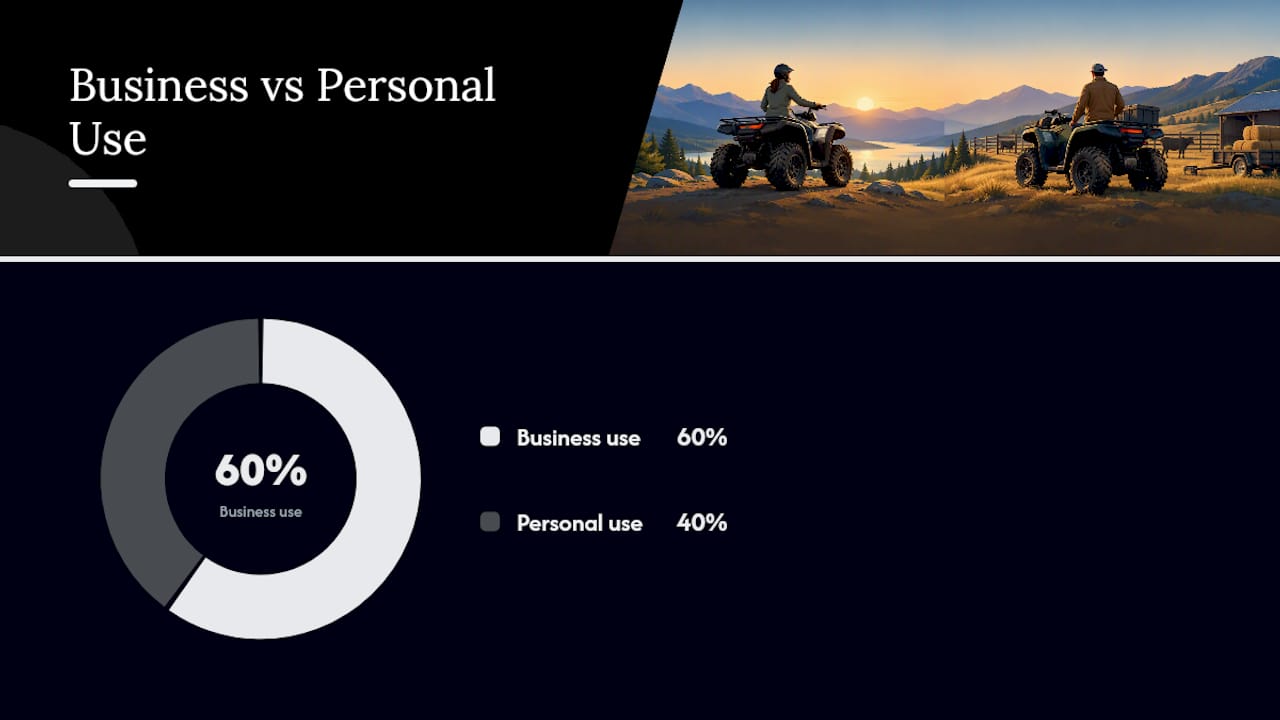
- If you use the ATV for both personal and business purposes, only the percentage tied to business use is deductible. A machine used 60% for ranch work and 40% for weekend riding only qualifies for that 60% share.
- Recordkeeping for business use hours or mileage is what supports your deduction if the IRS ever asks questions.
- Tax depreciation schedules don’t reflect market value. A machine fully depreciated on paper can still be worth several thousand dollars if you decide to sell it.
None of this replaces a conversation with a tax professional who knows your specific filing situation. Section 179 eligibility, income limits, and business structure all change the math, and getting it wrong costs more than the deduction was worth.
How to Estimate What Your ATV Is Worth Right Now
Start with the two names every appraiser and dealer trusts: Kelley Blue Book’s ATV sport values and J.D. Power’s ATV valuation tool (the platform that absorbed NADA Guides). Don’t be surprised when they don’t match exactly. KBB tends to lean toward consumer-facing retail and private-party estimates, while J.D. Power’s figures are the ones dealers reference most often for trade-in offers. Treat the gap between them as your negotiating range, not a sign that one tool is wrong.
Here’s a repeatable process that gets you to a defensible number:
- Pull both baseline values. Note the KBB private-party estimate and the J.D. Power trade-in figure for your exact model year and trim.
- Collect three to five local comparables. Check ATV Trader and Facebook Marketplace listings for the same or similar model within a reasonable radius, and note asking prices, not just listed prices.
- Adjust for hours and condition. If your comparables average 150 hours and yours has 400, adjust downward. If yours has service records and theirs don’t mention any, adjust upward.
- Decide your channel and adjust again. Private-party sales often bring in 25% to 40% more than a dealer trade-in, so factor that gap into your expectation before you commit to a selling method.
- Get a professional appraisal for high-value or disputed situations. This matters most for estate settlements, divorce proceedings, or insurance disputes, where a documented, third-party number carries more weight than a printout from a valuation website.
Trade-in aggregators that pull from multiple pricing sources can give you a quick sanity check, but they’re built for dealer-side estimates and tend to undershoot what a patient private seller can actually get. Treat them as a floor, not a target.
One thing worth remembering: local market variance is real. An ATV that would sell in three days near an off-road recreation hub might sit for weeks in a market with fewer trails and less demand. National averages give you a starting point, not a guarantee.
Getting the Most Money When You Sell
Preparation earns its keep. A machine that looks and runs like it’s been cared for closes deals faster and at higher prices, and most of the prep work costs far less than the value it adds back.
Before you list anything, run through this checklist:
- Change the oil and filter, even if it’s not technically due, so the machine smells and runs fresh for a test ride.
- Check tire tread and replace anything close to worn out. Bald tires make buyers assume neglect everywhere else.
- Wash the machine thoroughly, including the undercarriage, and take photos in daylight from multiple angles.
- Gather every maintenance receipt you have, even minor ones, and organize them by date.
- Fix small cosmetic issues (a cracked fender, a loose grip) that cost little but signal larger neglect if left alone.
Timing affects your outcome more than most sellers realize. Selling in early spring, before major wear items like belts or tires need replacement, captures buyers gearing up for the season and avoids you eating the cost of parts that won’t pay back at resale. Waiting until a big-ticket item fails puts you in a worse negotiating position, since you’re now selling a machine that needs work instead of one that’s ready to ride.
Channel choice shapes your bottom line as much as condition does. Private sales take longer and require more effort (listing, screening buyers, meeting strangers) but consistently net more money. Dealer trade-ins are fast and convenient, ideal if you’re rolling the value into a new purchase, but come with a built-in discount. Consignment splits the difference: someone else handles the sale, but they take a cut, typically a percentage of the final price.
Pro Tip: Price slightly above your target and mention “firm on maintenance records” in your listing. Buyers who value documentation will pay for it, and it filters out lowball offers before they waste your time.
Where to Check ATV Values Before You Buy or Sell
Every valuation method has strengths and blind spots, so cross-referencing a few sources gets you closer to an honest number than trusting any single one.
- Kelley Blue Book gives retail, private-party, and trade-in estimates side by side, making it a solid starting baseline for ATV sport models.
- J.D. Power (formerly NADA Guides) reflects the dealer perspective most closely, since that’s who built the industry-standard trade-in figures dealerships still reference.
- HowMuchIsItWorth.app offers an instant AI-driven estimate that factors brand, condition, and engine size, useful for a quick gut check before deeper research.
- Appraise My Bike provides year-over-year depreciation context that’s especially useful for owners trying to time a sale.
- ATV Trader and Facebook Marketplace show what buyers are actually asking (and sometimes accepting) in your specific region, which no national average can replicate.
Why Import Junkies’ Pricing Data Backs This Guide
Getting ATV depreciation right requires seeing real transactions, not just theoretical percentages. Importjunkies operates a direct-to-public catalog of new and used off-road vehicles, which means pricing patterns here reflect actual buyer behavior rather than guesswork. Our breakdown of current ATV prices shows how MSRP, dealer markups, and out-the-door costs interact, which directly shapes how steep that first-year depreciation hit tends to be.
We’ve also put together a practical guide on reading hours versus miles, since that distinction trips up more buyers and sellers than almost anything else in a valuation conversation. Combining wholesale-level catalog experience with straightforward, no-nonsense pricing transparency is what shapes the advice in this guide. It’s not theory. It’s what shows up in the listings every day.
How Financing and Leasing Change Your Depreciation Math
Financing an ATV means you’re paying interest on a machine that’s losing value faster than your loan balance drops, at least in the early months. If you put little to nothing down, you can easily find yourself owing more than the ATV is worth for the first year or two, a position commonly called being underwater on the loan. That’s not a reason to avoid financing altogether, but it does mean a bigger down payment protects you if you need to sell or trade in earlier than planned.
Leasing works differently, and it’s less common for ATVs than for cars, but where it’s available, the depreciation calculation gets baked into your monthly payment upfront. The leasing company estimates the residual value at lease end and charges you for the difference between that number and the purchase price. If actual depreciation ends up steeper than projected (say, because of high hours or hard use), you likely won’t feel it directly since the residual was already fixed. But go over your mileage or hour allowance, and the penalties can erase any savings the lease offered.
Whether you finance or lease, understanding true ownership costs beyond the sticker price, including fuel or charging, maintenance, and insurance, gives you a much clearer picture of whether a purchase makes financial sense over a three to five year holding period.
Mistakes That Quietly Drain Your ATV’s Value
Skipping oil changes is the most common one, and it’s also the most expensive over time. Engines that run low on clean oil wear out internal components faster, and that wear shows up as expensive noises during a buyer’s test ride, tanking your negotiating position instantly.
Ignoring small issues until they become big ones is a close second. A slightly loose chain or a worn belt costs very little to fix immediately but can cascade into drivetrain damage if left alone for a season. Buyers notice deferred maintenance, and they price accordingly, often more aggressively than the actual repair would cost.
Storing the ATV outside without covering it accelerates cosmetic and mechanical decay through UV damage, moisture intrusion, and pest nesting in wiring harnesses. Throwing away maintenance receipts or never tracking service dates removes your best resale asset before you even list the machine. And modifying an ATV heavily for personal preference, while fun to ride, shrinks your buyer pool and often costs more to modify than it adds back at sale.
New vs. Used: Which One Actually Makes Financial Sense
Buying new gets you the warranty, the latest safety features, and the satisfaction of picking your exact configuration. It also means you’re the one absorbing that steep 20% to 25% first-year hit the moment you take ownership. If you plan to keep the machine for eight to ten years or more, that upfront cost gets spread thin and matters less over time.
Buying used, particularly a machine in the one to three year range, lets someone else eat the worst of the depreciation curve while you still get a relatively low-hours, well-maintained unit. The tradeoff is a shorter or expired warranty and less certainty about how the machine was actually used before you owned it. That’s exactly why maintenance records and hour-meter honesty matter so much on the used market. Our first-time buyer’s checklist walks through exactly what to inspect before handing over payment on a used unit.
Depreciation Differences Across ATV Categories
Utility ATVs depreciate the most predictably because their resale market is broad and consistent. A 400cc to 700cc utility machine from a well-known brand tends to follow the standard curve closely: steep first year, moderating afterward, plateau by year four or five.
Sport ATVs follow a choppier path. Their resale pool skews younger and more performance-focused, so demand can spike or dip based on trends and available new models. A sport ATV that’s two years old might depreciate faster in dollar terms early on, simply because newer competing models keep arriving with better specs.
UTVs and side-by-sides carry the highest absolute resale values in the category, and while their percentage depreciation isn’t wildly different from utility ATVs, the dollar amounts involved are bigger in both directions. A well-kept UTV with a plow attachment, like the utility models Import Junkies carries, can hold surprisingly strong value in regions where snow removal or hauling capacity stays in demand year round.
Balancing Resale Value Against Actually Using the Machine
Chasing maximum resale value at the expense of actually riding your ATV misses the point of owning one. If a machine gets you to the trails, hauls feed, or plows your driveway reliably for six or seven years, the utility you got out of it often outweighs whatever extra you’d have banked from selling sooner.
Careful maintenance slows depreciation. It doesn’t stop it. Expecting a flawlessly documented ATV to sell for anywhere near what you paid is unrealistic, and chasing that outcome can lead to holding onto a machine longer than it makes sense to, just to avoid “losing” on paper.
A better approach: track your actual ownership costs (fuel, maintenance, insurance) against what you’d spend replacing the machine, and let that comparison guide your timeline instead of a resale number alone.
— Gary
Ready to Compare Real ATV Pricing?
Some e-commerce platforms sell directly to the public, which means the prices you see may reflect wholesale positioning instead of a dealer markup layered on top of a manufacturer’s suggested price. That matters here specifically because so much of what protects your resale value later starts with what you pay and what you know about the machine going in.
Browsing a transparent catalog with clear specs and pricing means fewer surprises down the road. You know what you paid, you know the configuration, and you’re not guessing about hidden dealer fees that inflate your starting cost and widen that first-year depreciation gap. Whether you’re eyeing a utility ATV for property work or a UTV with a plow setup for winter, Importjunkies’ full inventory of motorsports and utility vehicles is worth checking before you commit to a purchase elsewhere. If financing questions come up, it can be helpful to consult with a knowledgeable team to walk through options directly. Take a look at current listings, compare specs against what you’ve learned here, and reach out if you want help matching a machine to your actual use case rather than just the sticker price.
Sources
For anyone digging deeper into ATV values, these are the tools and references that back the numbers in this guide: the IRS guidance on Section 179 and depreciation for tax treatment questions, Kelley Blue Book’s ATV sport values and J.D. Power’s ATV valuation page for baseline market pricing, and HowMuchIsItWorth.app alongside Appraise My Bike for instant estimates and depreciation timing guidance. Cross-checking two or three of these before you buy or sell keeps you from anchoring to a single number that might not reflect your local market.
- IRS guidance on Section 179 and depreciation
- J.D. Power — ATVs new and used values
- Understanding ATV depreciation and when to sell | Appraise My Bike
- How much is my ATV worth? — Free AI ATV value estimator
FAQ
What Is the Depreciable Life of an ATV for Tax Purposes?
For business or farm use, ATVs are generally treated as equipment with a set recovery period under IRS depreciation rules, though the exact classification depends on how the machine is used. Section 179 and bonus depreciation can allow a business to deduct much of the cost in the first year instead of spreading it out, subject to eligibility limits. A tax professional should confirm the correct treatment for your specific filing.
What Is the Typical Depreciation Rate for a Four-Wheeler?
Most ATVs lose 20% to 25% of their value in the first year, then depreciate another 10% to 15% annually before leveling off around year three to five. Brand, hours, and maintenance history all shift where an individual machine lands within that range.
Which Vehicles Depreciate the Fastest?
Among powersports vehicles, sport-oriented models with smaller resale pools and rapidly changing model years tend to depreciate faster in the first two years than utility-focused machines. Across the broader vehicle market, luxury cars and electric vehicles with fast-evolving technology are frequently cited as the steepest depreciators, though ATVs generally depreciate more predictably than either category once they pass the three-year mark.
Do Four-Wheelers Hold Their Value Well?
Utility ATVs hold value reasonably well compared to many other powersports categories, largely because demand stays consistent across hunting, ranch, and recreational buyers. Well-known brands with strong parts networks, like Honda and Yamaha, tend to retain value better long term than lesser-known import brands.
Is It Better to Sell an ATV Privately or Trade It In?
Private sales typically bring in 25% to 40% more than a dealer trade-in on the same machine, though they require more time and effort to list and negotiate. Trade-ins are faster and simpler, making them a reasonable choice if convenience matters more than maximizing your final sale price.


