


 Location
 Login
Login
For most U.S. buyers, a lifted 48V electric golf cart covers the majority of typical beach use, and the 48V Electric Golf Cart 4 Seater Lifted Renegade+ 2.0 from Importjunkies is the strongest starting point. It combines a steel frame with corrosion-resistant coating, a sealed 48V AC electric motor, and factory lift clearance that handles packed sand and firm coastal paths without modification. If your routes include repeated deep-dune climbing or heavy hauling, step up to the 400cc 4x4 UTV With Snow Plow & VX Dump Bed, which adds true four-wheel drive and a gas engine with real pulling torque. For single-rider fun or a compact beach runabout, the 200cc ATV With Snow Plow is an affordable entry point that swaps to sand tires easily.
Table of Contents
- What are the best vehicles for beach riding right now?
- How do you pick the right beach vehicle using the 80% rule?
- Which technical features actually matter for sand and salt air?
- How do you outfit, maintain, and store a beach vehicle?
- What do beach vehicles actually cost to buy, modify, and maintain?
- Importjunkies has beach-ready vehicles in stock now
- Key Takeaways
- Why these platforms make sense for coastal riding
- Where to verify specs, test-drive, and check beach access rules
What are the best vehicles for beach riding right now?
Importjunkies carries seven models that map directly to beach and coastal use. Each one suits a different rider profile, terrain type, or business need.
- 48V Electric Golf Cart 4 Seater Renegade Edition — Best for paved beach-town paths and campground loops; 2WD electric, quiet operation, easy to customize with sand tires and sealed connectors.
- 48V Electric Golf Cart 4 Seater Silver Renegade X — Same proven 48V platform in a premium trim; suits buyers who want a guest-facing vehicle that still handles compacted coastal terrain.
- 48V Electric Golf Cart 4 Seater Lifted Renegade+ 2.0 — Best all-around beach cart; factory lift clearance, wider tire fitment, and sealed electrics make it the easiest platform to take straight to the shore.
- LE Doorless Coco Coupe Electric Golf Car — Beach Edition LSV built for guest transport; 60V motor, open-air doorless design, and a compact footprint that fits narrow coastal paths.
- 200cc ATV With Snow Plow — Best single-rider sand option; automatic transmission with reverse, light enough to float over soft sand with low-psi tires.
- 400cc 4x4 UTV With Snow Plow & VX Dump Bed — Best for deep sand, hauling, and beachfront property work; true 4WD gas platform with a dump bed for serious utility.
- Trailmaster 200x Hurricane Mini Bike — Compact single-rider option for light coastal trails and campground use; gas-powered with a simple, serviceable drivetrain.
The Lifted Renegade+ 2.0 and the 4x4 UTV are the easiest platforms to customize with lift kits, sand tires, and sealed electrical packages. The Coco Coupe Beach Edition ships already oriented toward coastal use.
How do you pick the right beach vehicle using the 80% rule?
The rule is straightforward: identify what your vehicle will do most of the time, then buy for that use. If most of your riding is on firm, compacted sand, paved beach-town paths, or maintained coastal property routes, a golf cart is the right call. If you regularly hit deep loose sand, steep dunes, or need to haul heavy loads across rough terrain, a UTV or side-by-side is the better platform.
What routes will you actually ride?
Walk your intended routes before you buy. A beach path that looks flat on a map can have soft pockets, creek crossings, or grade changes that demand more clearance than a standard cart provides. If 80% of your riding stays on packed sand or pavement, a lifted electric cart handles it. If your routes include loose dune faces, budget for a 4WD UTV.
How many passengers and how much cargo?
Four-seat carts handle family transport well on firm ground. Once you add cargo weight, a dump bed, or towing, the 4x4 UTV’s payload and torque advantage becomes real. Payload and towing differences between carts and UTVs are significant enough that choosing the wrong platform costs you in breakdowns, not just performance.
Red flags that point to a UTV
Three conditions should push you straight to the 4x4 UTV: repeated dune climbing, hauling loads over 400 lbs across soft sand, or operating in a commercial beachfront fleet where downtime is expensive. A golf cart asked to do UTV work wears out faster and fails in ways that are costly to fix.
Pro Tip: Before you buy, rent or demo the vehicle type you’re considering on sand similar to your actual routes. One afternoon on a rental tells you more than any spec sheet.
Which technical features actually matter for sand and salt air?
Frame material and corrosion resistance
Aluminum frames and galvanized steel with anti-corrosion coatings are the two standards worth demanding. Bare steel corrodes fast in salt air. Aluminum costs more upfront but holds up far longer without painting or sealing. If a cart ships with a steel frame, ask specifically about the coating process and whether stainless fasteners are used throughout.
Tires and flotation
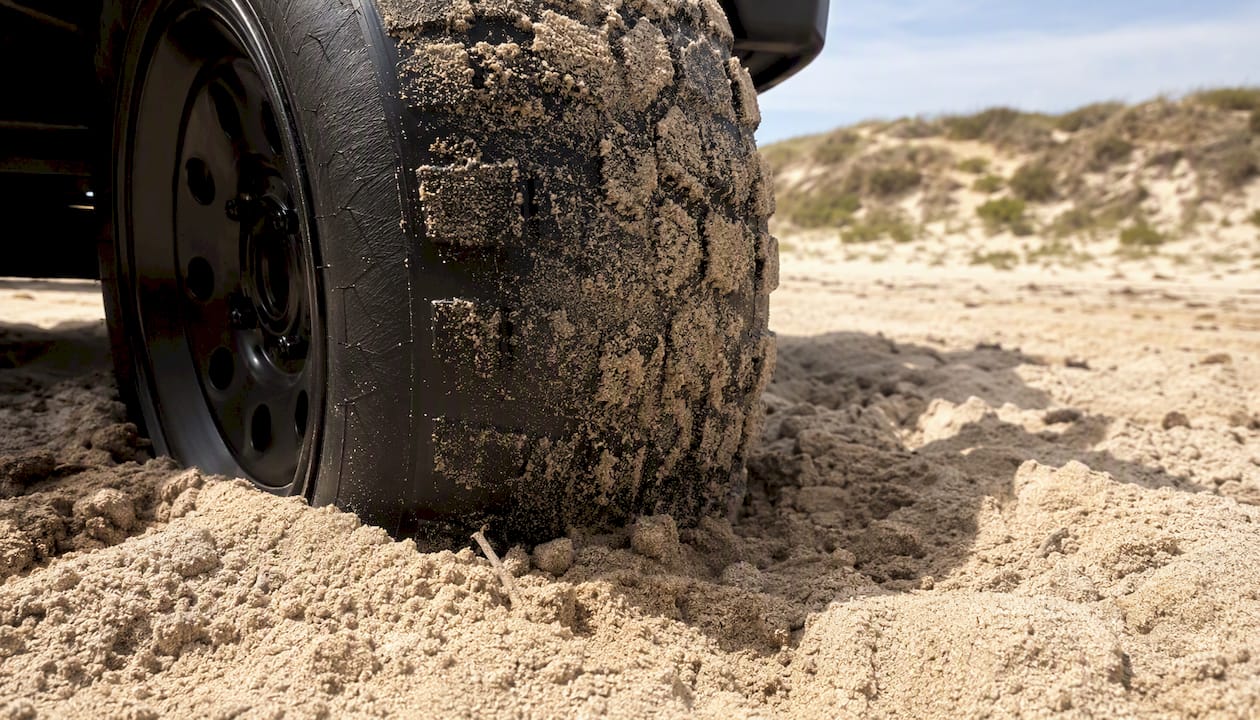
Wide, low-pressure sand tires work by spreading the vehicle’s weight across a larger footprint, which keeps the vehicle floating on top of soft sand rather than digging in. A narrow tire at standard pressure sinks; a wide tire aired down to low PSI floats. This is the single cheapest upgrade with the biggest real-world impact on sand performance.
Ground clearance and lift
A moderate lift kit is recommended for serious beach work to increase ground clearance and accommodate wider tires. Standard golf cart clearance is enough for packed sand, but a 4-inch lift gives you the tire clearance to run wider rubber and clear soft-sand ruts. Six inches is appropriate for dune-adjacent terrain.
Drive type and traction
High-torque 2WD with the right tires handles most packed-sand conditions. Four-wheel drive becomes necessary when you’re in loose, deep sand or climbing grades. A locking differential on a 2WD platform extends its range considerably, but it still won’t match a true 4WD UTV on soft dune faces.
Electric vs. gas for coastal use
Sealed AC electric motors are quieter, require less maintenance, and produce instant torque from a stop, which is exactly what you need to pull out of soft sand. The trade-off is limited range per charge depending on terrain and load. Gas engines offer longer range and easier refueling but need more attention to venting and corrosion protection on carburetors and exhaust. Sealed electric motors are fully competitive with gas in torque output when properly rated and installed.
Key spec to check: IP-rated controllers, sealed wiring harnesses, and stainless hardware are non-negotiable for any electric vehicle used near saltwater. A controller failure from moisture intrusion is an expensive repair.
Beachfront fleet operators consistently specify enhanced anti-corrosion packages and sealed electrical systems as their top two requirements for coastal uptime.
How do you outfit, maintain, and store a beach vehicle?
Setup after purchase
Start with tires: swap to wide sand tires and set pressure to 8–12 PSI before your first beach run. Add a 4–6 inch lift if the platform supports it. Seal any exposed electrical connectors with dielectric grease, and route wiring harnesses away from the undercarriage where salt spray concentrates. A front-mounted winch is worth adding if you plan to ride soft sand alone.
After every beach trip
Post-trip rinsing is the single most effective corrosion prevention step. Pressure-wash the undercarriage and chassis with fresh water immediately after each ride. Use a salt-neutralizing cleaner on the frame and suspension components. Inspect fasteners for surface rust, lubricate pivot points, and check battery terminals for corrosion buildup.
Pro Tip: Keep a 5-gallon garden sprayer filled with fresh water in your trailer. A two-minute undercarriage rinse at the beach exit prevents most of the salt damage that builds up over a season.
Off-season storage
Disconnect and store batteries at 50–80% charge in a climate-controlled space. Cover the vehicle and elevate it off concrete if possible. Apply a light coat of corrosion inhibitor to exposed metal surfaces before storage. Gas models need a fuel stabilizer in the tank and a carburetor drain if stored more than 60 days.
What do beach vehicles actually cost to buy, modify, and maintain?
Budget planning matters as much as the vehicle choice. The table below shows typical relative price ranges by platform type, typical modification costs for sand use, and the buyer profile each fits.
| Platform | Est. Vehicle Price | Sand Mod Cost | Annual Maintenance (Coastal) | Best For |
|---|---|---|---|---|
| Base electric golf cart | — | — | — | Paved/compacted paths, casual family use |
| Lifted electric cart (e.g., Renegade+ 2.0) | — | — | — | Packed sand, beach-town routes, small fleets |
| 200cc ATV | — | — | — | Single-rider, light dune access, budget entry |
| 400cc 4x4 UTV | — | — | — | Deep sand, hauling, commercial beachfront ops |
Anti-corrosion packages added at purchase typically cost $200–$600 but reduce long-term parts replacement and downtime significantly. Buying a platform with factory sealing and corrosion-resistant coating costs more upfront and less over three to five years of coastal use. Smaller UTVs and electric carts are more appropriate for short-range beach mobility than full-size off-road trucks, and their lower operating costs reflect that.
Importjunkies has beach-ready vehicles in stock now
Importjunkies sells direct to the public at wholesale pricing, which means you pay less than retail without sacrificing spec quality. The Lifted Renegade+ 2.0 ships with factory lift clearance and is ready for sand tires out of the box. The Renegade Edition is the right starting point if you want a base platform to customize with your own lift and tire package. For buyers who need 4WD and hauling capacity, the 400cc 4x4 UTV is in stock and ready to configure.

You can check current inventory, request a customization quote for anti-corrosion packages or lifted configurations, or contact the Importjunkies team directly at importjunkies.com to get pricing on the exact setup you need.
Key Takeaways
A lifted 48V electric golf cart handles most U.S. beach riding needs, but buyers who regularly tackle deep sand or heavy hauling should step up to a 4x4 UTV with sealed electronics and corrosion-resistant hardware.
| Point | Details |
|---|---|
| Apply the 80% rule | Match your vehicle to what you’ll do most: golf cart for firm paths, 4x4 UTV for deep sand and hauling. |
| Prioritize three features | Aluminum or coated frame, wide low-psi sand tires, and sealed electrical components are the make-or-break specs. |
| Rinse after every trip | A fresh-water undercarriage flush immediately after each beach run prevents most long-term salt corrosion. |
| Budget for mods | Add for sand tires, lift, and sealing on top of the vehicle price depending on platform. |
| Importjunkies starting point | The Lifted Renegade+ 2.0 and 400cc 4x4 UTV cover the two main beach use cases at direct wholesale pricing. |
Why these platforms make sense for coastal riding
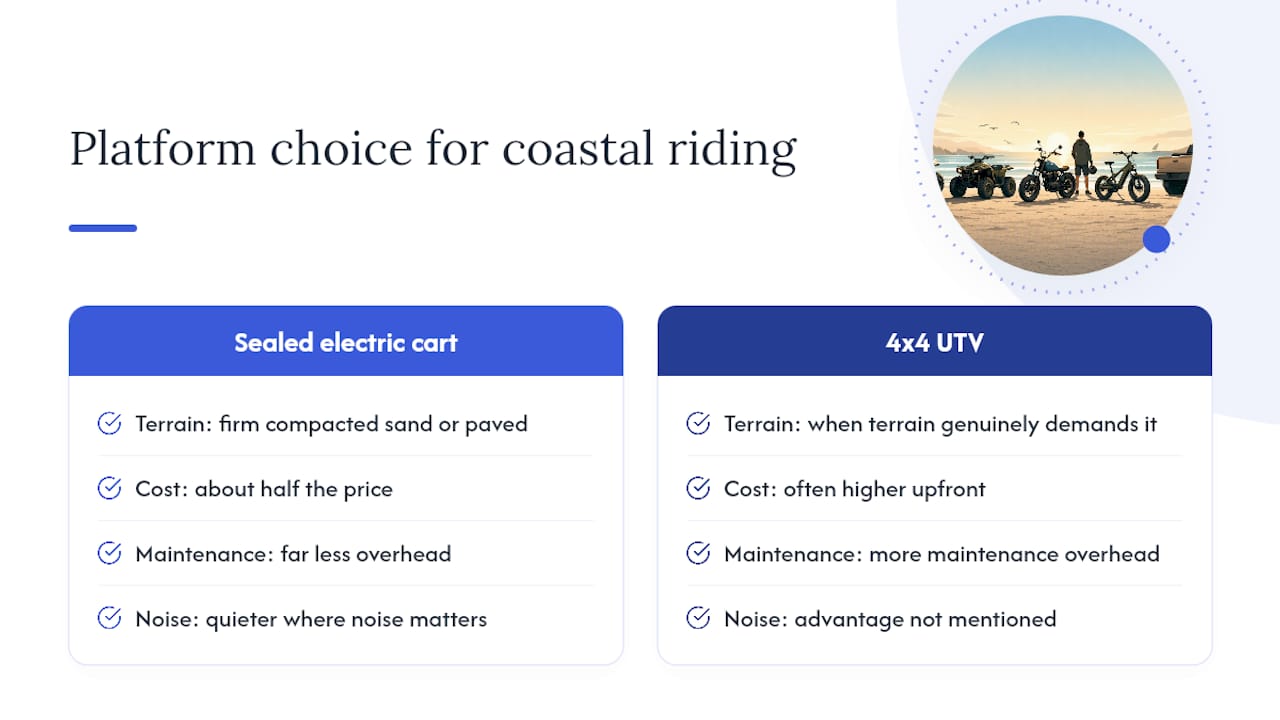
The conventional wisdom in off-road buying is to go bigger and more capable than you think you need. For beach riding, that logic often leads buyers to overspend on a full-size UTV when a well-configured lifted cart would have done the job for half the price and with far less maintenance overhead.
The 80% rule cuts through that. Most beach riders, including small-business operators running beachfront property routes, spend the majority of their time on firm, compacted sand or paved paths. A sealed electric cart with a proper lift and sand tires handles that terrain reliably, costs less to run, and is quieter in environments where noise matters. The 4x4 UTV earns its place when the terrain genuinely demands it, not as a default.
What buyers underestimate is the ongoing cost of ignoring corrosion protection. A vehicle that costs $1,000 less upfront but lacks sealed connectors and a treated frame can easily cost more in repairs within two seasons of coastal use. The anti-corrosion package is not an upsell. It is the purchase decision that determines whether your vehicle is still running well in year four.
Importjunkies’ lineup covers both use cases at direct-to-public pricing, with platforms that are designed to accept the mods that actually matter for sand. That combination of price, availability, and customization flexibility is what makes them the practical choice for this buyer.
Where to verify specs, test-drive, and check beach access rules
- 5 Best Beach Golf Carts: Built For Sand & Salt — Detailed spec guidance on frame materials, lift kits, and electric motor sealing for coastal use.
- Golf Cart vs Side-by-Side: Cost, Towing & Use Cases — Use-case comparison to verify whether a cart or UTV fits your terrain and load requirements.
- Customize your golf cart: complete personalization guide — Importjunkies’ own guide to lift kits, sand tires, and anti-corrosion packages.
- Electric Golf Cart vs Gas: Which Wins? — Motor comparison with notes on sealing and battery care relevant to salt-air environments.
This article provides general purchasing and maintenance guidance. Verify current beach access regulations with your local authority and consult a qualified technician for vehicle modifications before use.
Recommended
- Must-Have Recreational Vehicles 2026: Top Picks Guide – Saferwholesale || Import Junkies || Great Sports
- Best Scooters for Beginners: Your 2026 Buying Guide – Saferwholesale || Import Junkies || Great Sports
- What makes a good outdoor scooter: your 2026 buying guide – Saferwholesale || Import Junkies || Great Sports
- Must-Have Features in UTVs: Your 2026 Buyer’s Guide – Saferwholesale || Import Junkies || Great Sports


