


 Location
 Login
Login
TL;DR:
- Choosing the correct car lift capacity involves calculating the total weight, including fluids and modifications, and adding a safety margin. Manufacturers base ratings on engineering standards, and improper installation or weight distribution can reduce actual safe capacity. Buying a lift one tier higher than the heaviest expected vehicle ensures safety, longevity, and operational flexibility.
Car lift weight capacity is the engineered safety limit defining the maximum load a lift can safely support under ideal conditions, including the full vehicle weight plus fluids, cargo, and any modifications. This car lift weight capacity guide covers how ratings are calculated, why safety margins matter, and how to match lift capacity to your specific vehicles. Whether you run a home garage, a busy independent shop, or a small fleet operation, choosing the wrong lift capacity creates real risk. The industry standard is clear: size up, never down.
How are car lift weight capacities rated and tested?
Car lift capacity ratings come from engineering design limits, not arbitrary numbers. Manufacturers calculate the maximum load based on hydraulic system pressure, structural steel ratings, and the mechanical limits of the lift’s columns, arms, and locking mechanisms. Every component in the system contributes to the final posted rating.
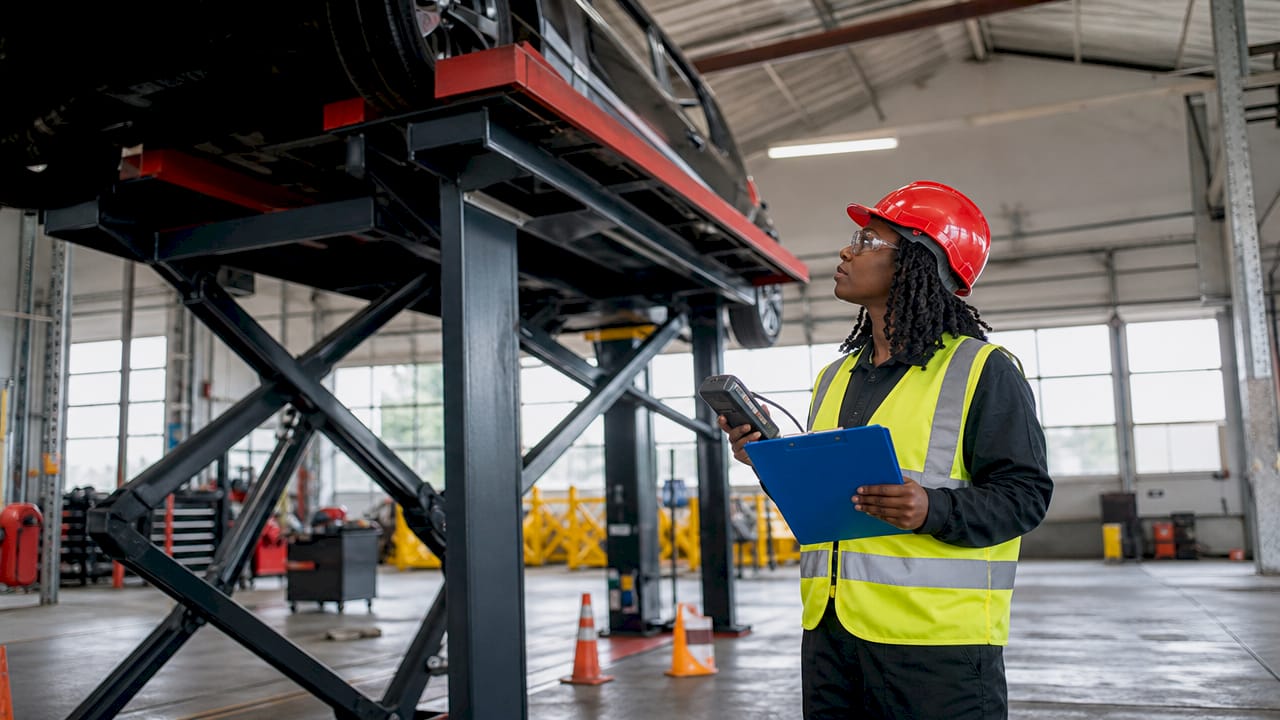
Testing standards require lifts to hold well beyond their rated load before failure. Lifts are engineered with safety factors ranging from 2:1 to 4:1, meaning a 10,000-lb lift may not structurally fail until it holds 20,000–40,000 lbs. That buffer exists to protect against unexpected dynamic loads, not to give you extra operating room. The posted capacity is your hard ceiling.
Weight distribution adds another layer of complexity that most buyers overlook. On a two-post lift, the total load spreads across four arms, and each arm carries its own individual weight limit. Improper vehicle placement or front-heavy designs can overload individual arms even when the total vehicle weight falls under the lift’s rated capacity. A truck with a heavy diesel engine up front can max out the front arms while the rear arms carry far less.
Installation quality directly affects how much of that rated capacity you can actually use. Proper installation on the correct foundation is non-negotiable. Concrete thickness, reinforcement, and anchor bolt depth all determine whether the lift performs to its rated spec. A lift anchored in undersized concrete effectively operates at a reduced safe capacity, regardless of what the nameplate says.
Pro Tip: Before you buy, check the manufacturer’s anchor bolt and concrete spec sheet. A 10,000-lb lift installed in 3-inch concrete without rebar is not a 10,000-lb lift in practice.
- Hydraulic and structural limits set the rated capacity
- Safety factors of 2:1 to 4:1 are engineering buffers, not operating margins
- Per-arm limits on two-post lifts can be exceeded before total capacity is reached
- Foundation quality directly limits real-world safe capacity
What factors must be considered when calculating the required lift capacity?
The biggest mistake mechanics and shop owners make is confusing curb weight with total lifted weight. Curb weight is the vehicle as it sits from the factory with standard fluids. Total lifted weight includes everything on and in the vehicle when it goes up on the lift.
A lift’s weight capacity accounts for vehicle weight plus fluids, modifications, accessories, cargo, and any tools left inside during servicing. A full tank of diesel fuel alone adds 150–200 lbs. Aftermarket bumpers, winches, roof racks, and skid plates add more. If you regularly service modified trucks or overlanding rigs, you need to account for every pound.
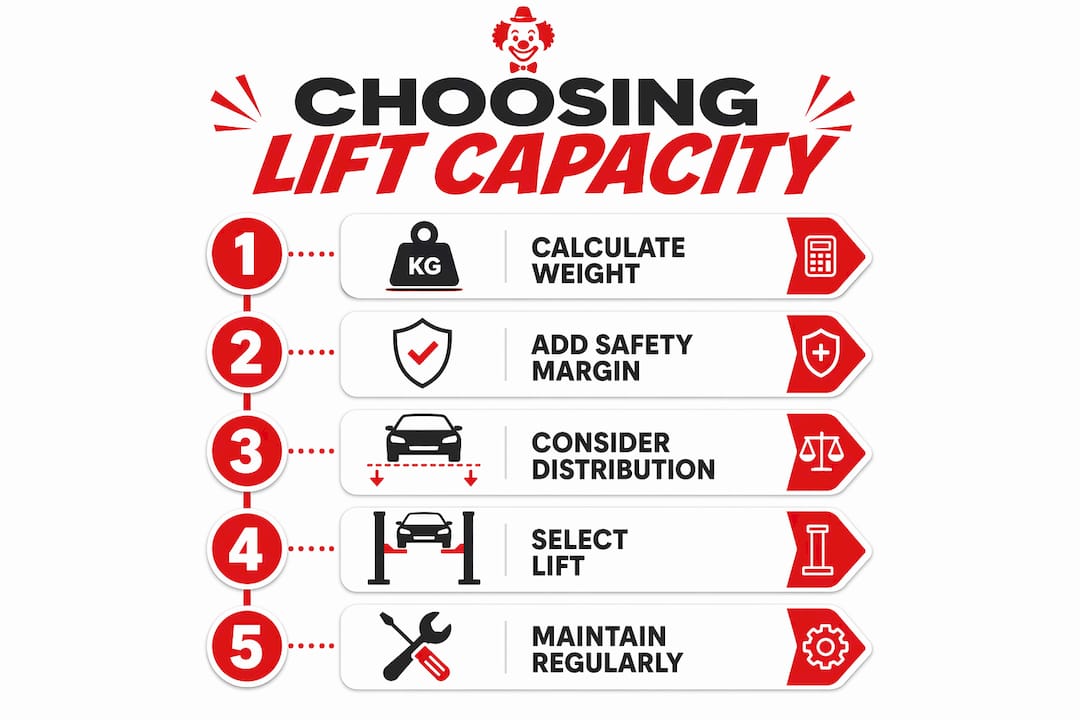
Use this calculation process to arrive at a safe minimum lift rating:
- Find the GVWR. The Gross Vehicle Weight Rating appears on the door jamb sticker and in the owner’s manual. It represents the maximum loaded weight the manufacturer certifies for that vehicle.
- Add aftermarket weight. List every non-factory component: steel bumpers, lift kits, heavy wheels and tires, winches, and cargo drawers. Estimate conservatively high.
- Account for service loads. A full fuel tank, coolant, and any tools or gear left in the vehicle during service all count toward the lifted weight.
- Apply the safety margin. Industry standards recommend a 20–25% safety margin above the calculated total weight. A vehicle with a 8,000-lb total load requires a lift rated for at least 10,000 lbs.
- Check weight distribution. If the vehicle is front-heavy or rear-heavy, verify that the per-arm limits on your lift can handle the heavier end.
Pro Tip: Pull the VIN on every vehicle you service regularly and record the GVWR. Build a simple spreadsheet with the heaviest configuration you expect for each model. That number drives your lift purchase, not the base curb weight.
Uneven weight distribution common in diesel trucks and EVs can reduce effective lift capacity by 20–30%, requiring careful placement and possible capacity upgrades. Electric vehicles carry heavy battery packs low and toward the center or rear, which shifts the load profile compared to a traditional gas vehicle of similar curb weight.
How to choose the right car lift capacity for your vehicles
Selecting the right vehicle lift load capacity starts with the heaviest vehicle you expect to service, not the average. Experts advise sizing lifts for worst-case vehicle weight plus the safety margin. That single principle eliminates most bad lift purchases.
The auto lift buying guide from Importjunkies breaks down vehicle classifications clearly, and the capacity tiers align with those categories:
| Vehicle class | Typical weight range | Recommended lift capacity |
|---|---|---|
| Passenger cars, small SUVs | Up to 5,500 lbs | 9,000–10,000 lbs |
| Full-size SUVs, half-ton trucks | 5,500–7,000 lbs | 11,000–12,000 lbs |
| 3/4-ton trucks, heavy SUVs | 7,000–8,500 lbs | 12,000–14,000 lbs |
| 1-ton trucks, dually pickups | 8,500–10,000 lbs | 14,000–18,000 lbs |
| Commercial vehicles, box trucks | 10,000+ lbs | 18,000+ lbs |
Vehicle classification for lift selection shows that 9,000–10,000-lb lifts fit cars and small SUVs, while 11,000–12,000-lb lifts are the minimum for full-size and 3/4-ton trucks. A 12,000-lb lift is comfortable for vehicles up to about 9,600 lbs GVWR when you apply the standard safety margin.
Lift type also affects your capacity decision. Two-post lifts offer the best undercarriage access and work well for most passenger vehicles and light trucks. Four-post lifts distribute weight more evenly and handle heavier vehicles with less concern about arm load limits. Scissor lifts work well for alignment and tire work but typically carry lower capacity ratings than two-post or four-post designs. Review the types of auto lifts available before committing to a configuration.
Plan for the vehicles you will service in three to five years, not just today. Trucks are getting heavier. Electric trucks like the Ford F-150 Lightning and Rivian R1T weigh significantly more than their gas equivalents. Buying a lift with operational headroom today avoids a costly replacement when your vehicle mix shifts.
- Size for your heaviest anticipated vehicle, not your average vehicle
- Apply the 20–25% safety margin to your calculated total load
- Match lift type to your primary service tasks and vehicle profile
- Plan for heavier future vehicles, especially electric trucks and commercial units
Common mistakes and safety risks when working near capacity limits
Working near a lift’s rated capacity is where most shop accidents originate. The risks are not theoretical. A lift operating at or above its rated load faces accelerated wear on hydraulic seals, locking mechanisms, and structural welds. Over time, that wear reduces the actual safe capacity below the nameplate rating.
Operating lifts with arms extended to maximum length can reduce the structural weight rating and should be avoided for heavy or unbalanced vehicles. Multi-stage arms offer better flexibility for safe positioning. When you extend a single-stage arm to its full reach to clear a wide rocker panel, you create a longer lever arm that multiplies the stress on the column connection point.
The most common positioning error is centering the vehicle by eye rather than by weight. A truck with a snowplow prep package, a heavy front bumper, and a full fuel tank can have 60% of its weight over the front axle. Placing the front lift arms at the standard position without checking per-arm limits puts you in a dangerous situation even if the total vehicle weight is within the lift’s rating.
Pro Tip: Use a portable axle scale to measure front and rear axle weights on any vehicle you are unsure about. They cost less than $200 and give you exact numbers before the vehicle goes up.
- Never exceed the posted capacity, even briefly
- Avoid maximum arm extension on heavy or unbalanced vehicles
- Position vehicles by weight distribution, not visual center
- Inspect lift locking mechanisms and hydraulic seals on a regular schedule
- Follow manufacturer requirements for concrete foundation and anchor bolt torque
Regular maintenance keeps a lift performing to its rated spec. Hydraulic fluid degradation, worn locking pawls, and corroded cables all reduce effective capacity without changing the nameplate number. Build a monthly inspection checklist and document it. The auto lift safety standards guide from Importjunkies covers compliance requirements and inspection intervals in detail.
Key takeaways
Selecting the right car lift capacity requires calculating total lifted weight, applying a 20–25% safety margin, and sizing for the heaviest vehicle you will ever service.
| Point | Details |
|---|---|
| Safety margin is mandatory | Add 20–25% above total vehicle weight to determine minimum lift capacity. |
| Total weight beats curb weight | Include fluids, cargo, modifications, and tools when calculating the load. |
| Per-arm limits matter | On two-post lifts, verify arm load limits for front-heavy or rear-heavy vehicles. |
| Size for your heaviest vehicle | Buy for worst-case load, not your typical or average vehicle weight. |
| Foundation quality affects capacity | Proper concrete thickness and anchor installation are required to reach rated capacity. |
What I’ve learned from watching shops get this wrong
Gary here. After years of watching mechanics and shop owners make lift decisions, the pattern is consistent. The mistake is almost never buying a lift that is too strong. It is always buying one that is just barely enough.
The logic sounds reasonable at the time. “My heaviest truck is 7,200 lbs, so a 9,000-lb lift covers me.” That math ignores the aftermarket bumper, the full fuel tank, the toolbox bolted in the bed, and the 20–25% safety margin the industry recommends. Suddenly that 9,000-lb lift is working at 95% of its rated capacity on a regular basis. Components wear faster. Locking mechanisms develop play. The lift that should last 20 years starts showing problems at 8.
The other thing shops consistently underestimate is how their vehicle mix changes. A shop that services mostly sedans today will see more trucks and SUVs in three years because that is where the vehicle market is moving. Electric trucks are already arriving in significant numbers, and they are heavy. A Rivian R1T weighs over 7,000 lbs before you add a single accessory. If your lift was sized for today’s fleet, it may not cover tomorrow’s.
My advice is direct: buy one capacity tier higher than your current calculation requires. The price difference between a 10,000-lb and a 12,000-lb lift is modest compared to the cost of replacing a lift or, worse, dealing with a dropped vehicle. Operational headroom is not a luxury. It is the difference between a lift that works safely for two decades and one that becomes a liability in five years.
— Gary
Quality lifts for every capacity need at Importjunkies
Importjunkies carries a range of certified car lifts built to meet real shop demands, from light-duty home garage setups to commercial-grade units rated for heavy trucks and utility vehicles. If you work on anything from compact cars to full-size dually pickups, there is a lift rated for your load.

The GSI 10,000-lb two-post lift is a strong starting point for shops servicing passenger cars, light trucks, and small SUVs. It meets industry-standard safety margins for vehicles up to about 7,500–8,000 lbs GVWR. For shops that also handle utility vehicles, ATVs, or specialty equipment, Importjunkies offers a full product catalog with detailed specifications so you can confirm the fit before you buy. Check the full lift selection at importjunkies.com and match your capacity needs to a certified, shop-ready unit.
FAQ
What is a car lift weight capacity rating?
A car lift weight capacity rating is the maximum load the lift can safely support under proper operating conditions, including the vehicle plus all fluids, cargo, and modifications. It is an engineered limit set by the manufacturer based on hydraulic and structural design.
How much safety margin should I add to my vehicle’s weight?
Industry standards recommend a 20–25% safety margin above the total calculated vehicle weight. A vehicle with a 8,000-lb total load requires a lift rated for at least 10,000 lbs.
Can I exceed a lift’s rated capacity if it has a high safety factor?
No. Safety factors of 2:1 to 4:1 are engineering buffers built into the design, not additional operating room. Exceeding the posted capacity creates immediate safety risk and accelerates component wear.
What lift capacity do I need for a full-size truck?
Full-size half-ton trucks require a minimum 11,000–12,000-lb lift. Three-quarter-ton and one-ton trucks need 14,000 lbs or more, especially when modified or loaded. Always base your selection on GVWR plus aftermarket weight, not the factory curb weight.
Does vehicle weight distribution affect lift safety?
Yes. Uneven weight distribution in diesel trucks and EVs can reduce effective lift capacity by 20–30% on the heavier axle. Verify per-arm limits on two-post lifts before raising any front-heavy or rear-heavy vehicle. You can also explore underbody lighting considerations for lifted trucks to understand how vehicle modifications affect service requirements.
Recommended
- Auto Lift Buying Guide 2026: Choose Right, Work Safe – Saferwholesale || Import Junkies || Great Sports
- Types of Auto Lifts: Mechanic’s Guide for 2026 – Saferwholesale || Import Junkies || Great Sports
- Auto Lift Safety Standards: A 2026 Compliance Guide – Saferwholesale || Import Junkies || Great Sports
- GSI - Commercial 10,000 LB Automotive Lift 2 Post Vehicle Lift Car Aut – Saferwholesale || Import Junkies || Great Sports


