


 Location
 Login
Login
TL;DR:
- Low-speed vehicles are purpose-built for various course roles beyond golf carts, offering safety features and street legality. They enhance operational efficiency in grounds maintenance, guest transport, security, and event logistics, especially on properties with high traffic. Proper role separation, safety policies, and maintenance practices are essential for maximizing fleet longevity and safety.
Low-speed vehicles (LSVs) are the purpose-built fleet workhorses that golf courses and similar properties rely on for groundskeeping, guest transport, security patrols, event logistics, ADA shuttling, and food and beverage service. Regulated under FMVSS 500 with a typical top speed up to 25 mph and street-legal on roads with speed limits up to 35 mph, LSVs occupy a distinct legal category above a standard golf cart and below a full utility truck. The role of low-speed vehicles on courses goes well beyond simple player transport.
Core LSV roles on a golf course or similar property:
- Grounds and turf maintenance transport
- Beverage and food service loops
- Guest and hospitality shuttles
- Security and ranger patrols
- Event setup, teardown, and logistics
- ADA-compliant accessible transport
- First-aid and emergency response staging
TL;DR: If you operate a course, resort, or large campus with multiple daily shifts and mixed guest/staff traffic, a purpose-built LSV fleet is worth the investment. Courses running only a few carts for player use can hold off; operations-heavy facilities will see the clearest return.
Table of Contents
- What makes an LSV different from a golf cart under U.S. law?
- LSV vs. golf cart vs. UTV: which vehicle fits which course role?
- What specific jobs do LSVs handle on a course day-to-day?
- Safety and operational rules that reduce liability and downtime
- What to evaluate before you buy or lease a course LSV fleet
- When an LSV is the wrong tool for the job
- Key Takeaways
- A course operator’s view on making LSVs work day-to-day
- Importjunkies has the LSVs your course operations need
- Useful sources for deeper reading
What makes an LSV different from a golf cart under U.S. law?
The distinction matters more than most operators realize. Under FMVSS 500, NHTSA defines a low-speed vehicle as any four-wheeled motor vehicle (other than a motorcycle) whose top speed does not exceed 25 mph. A traditional golf cart, by contrast, tops out at 15 mph or less and is not classified as a motor vehicle at all under federal rules, which means it carries no VIN, no title, and no federal safety-equipment requirements.
An LSV must be equipped with:
- Seat belts for all seating positions
- Headlamps, taillamps, and stop lamps
- Front and rear turn signal lamps
- Rear reflex reflectors
- A windshield
- A parking brake and rearview mirror
- A speedometer
- A VIN and the ability to be titled and registered
FMVSS 500 in plain language: “A low-speed vehicle would be any motor vehicle, other than a motorcycle, whose top speed does not exceed 25 mph. LSVs would be equipped with certain basic items of motor vehicle safety equipment, such as seat belts, in lieu of complying with the Federal [standards for] existing vehicle types.” — NHTSA rulemaking, 62 FR 1086
State rules vary significantly on top of this federal baseline. In 35 states, LSVs may operate on roads posted up to 35 mph; a handful of states set lower limits, and a couple allow higher-speed road use. Before deploying LSVs on any public road adjacent to your property, confirm your state DMV rules and any local ordinances. Registration, titling, and insurance requirements also differ by state, so check with your insurer and local DMV before putting a new unit into service. For a quick primer on street-use basics, Importjunkies has a dedicated explainer worth bookmarking.

LSV vs. golf cart vs. UTV: which vehicle fits which course role?
Choosing the wrong vehicle class for a task costs you money in maintenance, turf damage, and downtime. Here is how the three categories stack up on the axes that matter most for course operations.
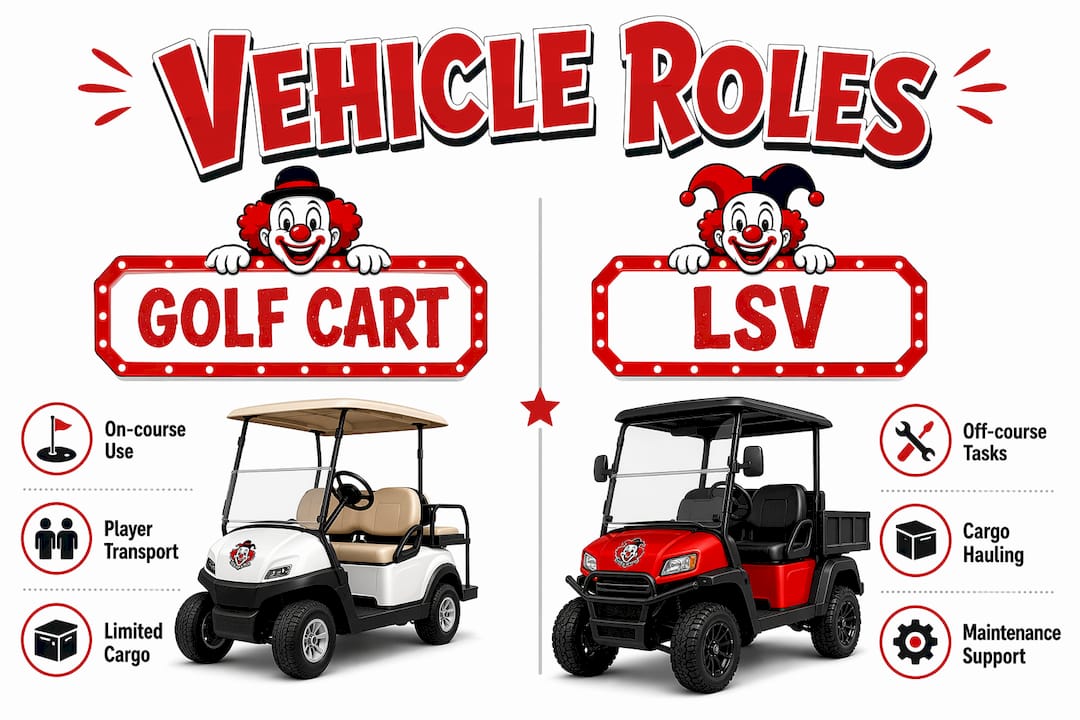
| Feature | Golf Cart | LSV | UTV/Utility Vehicle |
|---|---|---|---|
| Federal classification | Not a motor vehicle (≤15 mph) | Motor vehicle (FMVSS 500) | Motor vehicle (full standards) |
| Typical top speed | 15 mph | 25 mph | — |
| Street-legal (public road) | No (without upgrades) | Yes, on roads ≤35 mph posted | Varies; often off-road only |
| VIN / registration | No | Yes | Yes |
| Payload / cargo options | Minimal | Moderate (beds, enclosed cabs) | High (heavy beds, towing) |
| Guest-facing comfort | High | High to moderate | Low |
| Turf impact | Low | Low to moderate | Moderate to high |
LSVs come with automotive-style safety equipment and a VIN, which many golf carts lack entirely without costly modification. UTVs handle heavy payloads and rough terrain but are overkill for most on-property transport and can damage turf.
Decision guidance by role:
- Player transport on fairways: Golf cart. Lowest turf impact, purpose-built for the task.
- Guest shuttles between clubhouse, parking, and facilities: LSV. Street-legal, comfortable, and ADA-configurable.
- Grounds and maintenance: LSV with cargo bed or dump bed. Better payload than a cart, less turf damage than a UTV.
- Security and ranger patrols: LSV. Faster than a cart, street-legal for perimeter roads.
- Heavy equipment hauling or snow removal: UTV or dedicated utility truck.
What specific jobs do LSVs handle on a course day-to-day?
The role of low-speed vehicles on courses is most visible when you map each task to a vehicle configuration. Courses that treat LSVs as a single-purpose asset underuse them; the ones that assign specific configurations to specific roles get the most out of their fleet.
- Groundskeeping and turf maintenance: Cargo-bed LSVs carry fertilizer, seed, hand tools, and irrigation parts across the property without the weight penalty of a pickup truck. Early morning maintenance windows benefit from electric LSVs’ quiet operation and zero tailpipe emissions, which avoids disturbing wildlife and early-arriving guests.
- Beverage and food service: Refrigerated or insulated-compartment LSVs run continuous loops to keep players supplied without pulling golf carts off the course for non-play tasks.
- Guest and hospitality shuttles: Four-seat LSV configurations move guests between parking areas, the clubhouse, the pro shop, and event spaces. LSVs are easier to enter and exit than many vehicles, which matters for older guests and resort visitors who may have mobility considerations.
- Security and ranger patrols: A ranger in an LSV can cover perimeter roads legally, respond faster than a cart, and carry a radio and first-aid kit without sacrificing mobility.
- Event logistics: Setup and teardown crews use cargo LSVs to move chairs, signage, AV equipment, and catering supplies across the property without blocking guest areas with full-size trucks.
- ADA and accessible transport: Wider-body LSVs with low step-in heights and grab handles serve guests who cannot walk long distances, meeting ADA spirit without requiring a dedicated para-transit vehicle.
- Medical response and first-aid staging: A dedicated LSV stocked with a first-aid kit, AED, and emergency supplies can reach any point on the property faster than waiting for an ambulance to navigate the course.
Purpose-built LSVs offer configurations including dump beds, enclosed cargo bodies, and beverage compartments that prevent overloading and protect tools from weather.
Pro Tip: Reserve your golf carts strictly for on-course player use. Assigning LSVs to every off-course task protects your cart fleet from accelerated wear, reduces turf compaction from heavier utility loads, and keeps the guest experience clean.
Safety and operational rules that reduce liability and downtime
The direct recommendation: implement driver training before any employee operates an LSV, set written speed and path policies, and build a daily pre-shift inspection into your schedule. Those three steps alone eliminate the majority of preventable incidents on course properties.
- Driver training and authorization: Every operator should complete a documented training session covering vehicle controls, load limits, passenger rules, and emergency procedures. Keep training records on file.
- Daily pre-shift inspection: Check tire pressure, battery charge level, brake function, lights, and seat belts before the first run of the day. A maintenance checklist keeps this consistent across staff.
- Battery management: Match battery capacity to your longest expected loaded shift, not your average day. Operators who size for the average day risk mid-shift runouts when a tournament or event pushes usage higher than normal.
- Speed and path policy: Post maximum speeds on cart paths and in high-pedestrian zones. Designate separate lanes or times for vehicle and pedestrian traffic where paths converge near the clubhouse or event spaces.
- Payload and towing limits: Never exceed the manufacturer’s rated payload. Overloaded LSVs handle poorly and accelerate battery drain.
- Telematics and geofencing: GPS tracking lets fleet managers monitor vehicle location, speed, and battery state in real time. Geofencing alerts you when a vehicle leaves a designated zone, which is useful for security units and borrowed vehicles.
- Seat belts and passenger limits: Enforce seat belt use and posted passenger limits on every trip. These two rules are your clearest liability-reduction tools.
- Incident recordkeeping: Log every incident, near-miss, and maintenance issue. That documentation protects you if an insurance claim arises.
Speed control is not just a policy preference. At 25 mph, the risk of a pedestrian fatality in a collision is substantially lower than at higher vehicle speeds, which is a core safety rationale for LSV deployment on pedestrian-heavy properties like golf courses and resorts.
Pro Tip: Stage a fully charged backup LSV for each high-demand role (beverage service, shuttle) during tournaments. One vehicle going down mid-event creates a bottleneck that a spare unit eliminates entirely.

What to evaluate before you buy or lease a course LSV fleet
Answer first: prioritize role fit and uptime over sticker price. A cheaper unit that cannot complete your longest loaded shift costs more in the long run than a properly spec’d vehicle bought at full price.
Procurement checklist:
- Payload capacity: Match the bed or cab rating to the heaviest load the vehicle will carry in a single trip.
- Battery chemistry and range: Lithium-ion packs charge faster and hold capacity longer than lead-acid, but cost more upfront. Size for your longest day.
- Charging infrastructure: Count your outlets, calculate charge time per unit, and confirm your electrical panel can handle simultaneous charging for the full fleet.
- Cab and bed configuration: Enclosed cabs protect tools and electronics year-round; dump beds simplify debris removal; beverage compartments require refrigeration hookups.
- Warranty and service network: Confirm the manufacturer has a service partner within a reasonable distance. Downtime waiting for parts is a real operational cost.
- Customization options: Lockable toolboxes, roof-mounted lighting, and custom livery all affect both utility and guest perception.
- Insurance and registration: Budget for titling, annual registration fees, and commercial vehicle insurance for any LSV that will operate on public roads.
Electric vs. gas trade-off: Electric LSVs cost less to operate and maintain than equivalent combustion vehicles over time, with lower fuel and service expenses. The upfront cost of charging infrastructure is the main barrier, but most courses recover it within a few seasons of reduced fuel spend.
Pilot-test sequence before full fleet deployment:
- Define the specific roles the pilot unit will cover and the metrics you will track (uptime, battery cycles, incidents, driver feedback).
- Run the pilot for a full season, including at least one high-demand event.
- Review data against your baseline before committing to fleet-wide procurement.
For broader fleet design guidance, Importjunkies has a detailed post on selecting vehicles for your golf course that covers spec priorities and common buying mistakes.
When an LSV is the wrong tool for the job
LSVs solve a lot of problems on course properties, but they have real limits you should plan around before committing to a fleet.
- Speed and road restrictions: LSVs are not legal on highways or roads posted above 35 mph in most states. If your property requires crossing or traveling on higher-speed roads, you need a different vehicle class.
- Crash protection: LSVs are not required to meet the crash-test standards that apply to passenger cars. Air bags, crumple zones, and side-impact protection are absent on most units. Operating on mixed-traffic roads at the upper end of the legal speed range carries real occupant risk.
- Weather exposure: Open-cab LSVs are uncomfortable in rain, cold, or extreme heat. Enclosed cabs solve this but add cost and reduce cargo visibility.
- Range and payload constraints: A heavily loaded LSV running a long shift will drain its battery faster than spec sheets suggest. Without proper planning, mid-shift downtime is a genuine risk.
- Local ordinance restrictions: Some municipalities impose additional rules beyond state law, including permit requirements, designated route restrictions, or outright prohibitions on certain property types. Always verify with your local authority before purchasing.
Key Takeaways
LSVs are most valuable on courses when assigned to specific off-course roles, sized correctly for battery range, and operated under a written safety and maintenance policy.
| Point | Details |
|---|---|
| Role fit drives ROI | Assign LSVs to off-course tasks; reserve golf carts for fairway play to protect turf and extend asset life. |
| FMVSS 500 is the baseline | LSVs require a VIN, seat belts, lights, and registration; confirm your state DMV rules before road use. |
| Battery sizing matters | Size battery capacity for your longest loaded shift, not your average day, to avoid mid-shift runouts. |
| Mixed fleets outperform single-type fleets | Operators using LSVs for utility and carts for play report better asset longevity and efficiency. |
| Importjunkies for sourcing | Importjunkies offers 4-seat electric LSVs and utility configurations suited to guest shuttling and grounds work. |
A course operator’s view on making LSVs work day-to-day
The biggest mistake I see courses make is buying LSVs and then using them the same way they use golf carts. That defeats the purpose entirely. The real gain comes from role separation: golf carts stay on the course for players, and LSVs handle everything else. Once you draw that line clearly, the operational picture changes fast.
Scheduling matters as much as the vehicles themselves. A well-run course stages LSVs by shift: maintenance units go out at dawn for turf work, beverage units start at tee time, shuttle units run continuously from parking to the clubhouse, and a security unit covers the perimeter from late afternoon through close. That sequencing keeps every vehicle doing the job it was configured for, which extends battery life and reduces wear.
Telematics is underused on most course fleets. Even a basic GPS system gives you real-time battery state, location, and speed data. Track those three metrics for a season and you will know exactly where your fleet is underperforming before it becomes a guest-facing problem. Pair that with a simple incident log and you have the documentation you need for insurance and for making the case to ownership when it is time to expand the fleet.
Importjunkies has the LSVs your course operations need
If you have worked through the roles, specs, and trade-offs in this guide, the next step is finding the right units. Importjunkies sells 4-seat electric LSVs and utility configurations directly to course operators, resorts, and facility managers at wholesale pricing, with no dealership markup.

For guest shuttling and hospitality, the 48V 4-Seat Renegade Edition gives you the passenger capacity and electric range to run continuous loops without mid-shift charging stops. If your property has uneven terrain or off-path maintenance routes, the Lifted Renegade+ 2.0 adds ground clearance for light off-path work while keeping the same 48V electric platform. Browse the full lineup at Importjunkies or contact the team directly for fleet pricing and configuration questions.
Useful sources for deeper reading
- FMVSS 500 rulemaking — govinfo.gov: The original NHTSA rulemaking that established the LSV category, speed thresholds, and required safety equipment. Primary source for regulatory questions.
- Expanding Affordable E-Mobility Options: Low-Speed Vehicles — BTS/ROSAP: Federal research on LSV use cases, state road-use rules, and municipal fleet integration. Covers the 35-state road-use limit and infrastructure considerations.
- Impacts of Low-Speed Vehicles on Transportation Infrastructure and Safety — PDX Scholar: Academic safety analysis of LSV operating environments, crash protection limits, and state regulation consistency.
- LSVs: The Unexpected EV Government Fleets Need — Government Fleet: Practical fleet-operator perspective on LSV adoption, mixed-fleet strategy, and pedestrian safety rationale.
- Choosing the Best Golf Course Utility LSV — Vantage Vehicle: Procurement-focused guide covering battery sizing, configuration options, and role-fit decisions for course operators.
- Why Should Clubs Keep Golf Carts on the Course? — Club & Resort Business: Operator-level case for role separation between golf carts and LSVs, with sustainability and efficiency context.
- Street-Legal Golf Carts vs. Traditional Carts — Coastal Cruising Carts: Clear breakdown of the equipment and legal differences between street-legal LSVs and standard golf carts.
- Low-Speed Vehicles Help Older Drivers — AARP: Accessibility and demographic context for LSV adoption, relevant for ADA and guest-experience planning.
- What Is a Low Speed Vehicle? Street-Use Basics — Importjunkies: Internal explainer on LSV definitions, street-use rules, and how they differ from golf carts.
- How Electric Vehicles Transform Golf Facility Operations — Importjunkies: Covers electrification benefits and operational impacts for course fleets.
- Common Golf Cart Fleet Mistakes to Avoid — Importjunkies: Operational pitfalls and lessons from real fleet deployments, useful for procurement planning.
Recommended
- What Is a Low Speed Vehicle? Street-Use Basics – Saferwholesale || Import Junkies || Great Sports
- The Role of Scooters in Course Operations – Saferwholesale || Import Junkies || Great Sports
- How to select the best vehicles for your golf course – Saferwholesale || Import Junkies || Great Sports
- Essential safety standards for golf carts: operator’s guide – Saferwholesale || Import Junkies || Great Sports


