


 Location
 Login
Login
In most U.S. states, you only need a helmet by law if you’re under 18 and riding an electric scooter, though a handful of states require one for every rider regardless of age. Local ordinances can tighten that rule the moment you cross a city line, so the state answer isn’t always the full answer.
The legal picture breaks into three patterns you’ll see repeated across all 50 states and D.C.:
- Universal helmet laws — every rider, every age, no exceptions written into the statute.
- Age-based helmet laws — helmets required only under a specific age, commonly 16, 17, or 18.
- No statewide rule — the state stays silent, which leaves the door open for cities to set their own requirement.
| Rule category | What it means | Typical states |
|---|---|---|
| Universal | Helmet required for all riders, all ages | Small minority of states |
| Age-based | Helmet required only under a set age (usually 16–18) | Majority of states |
| No state rule | State law is silent; check city ordinance | Remaining states, plus much of the local patchwork |
Electric scooters are legal to ride in 48 U.S. states as of mid-2026, but helmet obligations underneath that legality vary sharply by state and even by zip code.
Pro Tip: Pull up your state’s official vehicle code or DMV scooter page first, then search “[your city] municipal code e-scooter” before you ride somewhere new. A five-minute search beats a citation.
Key Takeaways
State helmet laws for scooters depend more on age and vehicle classification than on any single national standard, and city ordinances frequently override a silent or permissive state law.
| Point | Details |
|---|---|
| Age-based rules dominate | Most states require helmets only for minors, typically under 16 or 18, not for adult riders. |
| Oregon requires helmets for all ages | ORS 814.534 mandates headgear for every motor assisted scooter operator, with a waivable $25 first-offense fine. |
| Vehicle classification changes the rule | Whether your device counts as an electric kick scooter, motor assisted scooter, or moped determines which helmet standard applies. |
| Cities can be stricter than states | Where state law is silent, local municipal codes and shared-scooter program rules often fill the gap. |
| Helmets matter beyond the legal minimum | CPSC and ASTM F2641 standards guide safe helmet choice regardless of your state’s specific age cutoff. |
Table of Contents
- Scooter Helmet Laws by State: The Complete Breakdown
- What Legally Counts as a Scooter, and Why It Changes the Helmet Rule
- What Happens If You Get Cited for No Helmet?
- How Do You Check the Scooter Helmet Rule Where You Live?
- Why Wear a Helmet Even Where the Law Doesn’t Require One?
- Import Junkies’ Take on Scooter Helmet Safety
- Sources
Scooter Helmet Laws by State: The Complete Breakdown
Every state defines its scooter helmet rule a little differently, and the terminology in the statute (motor assisted scooter, electric personal assistive mobility device, low-power scooter) often matters more than the plain-English label most riders use. Below is a working snapshot of where each state stands. Because legislatures amend these codes regularly, always confirm the current text at the linked source before you rely on it.
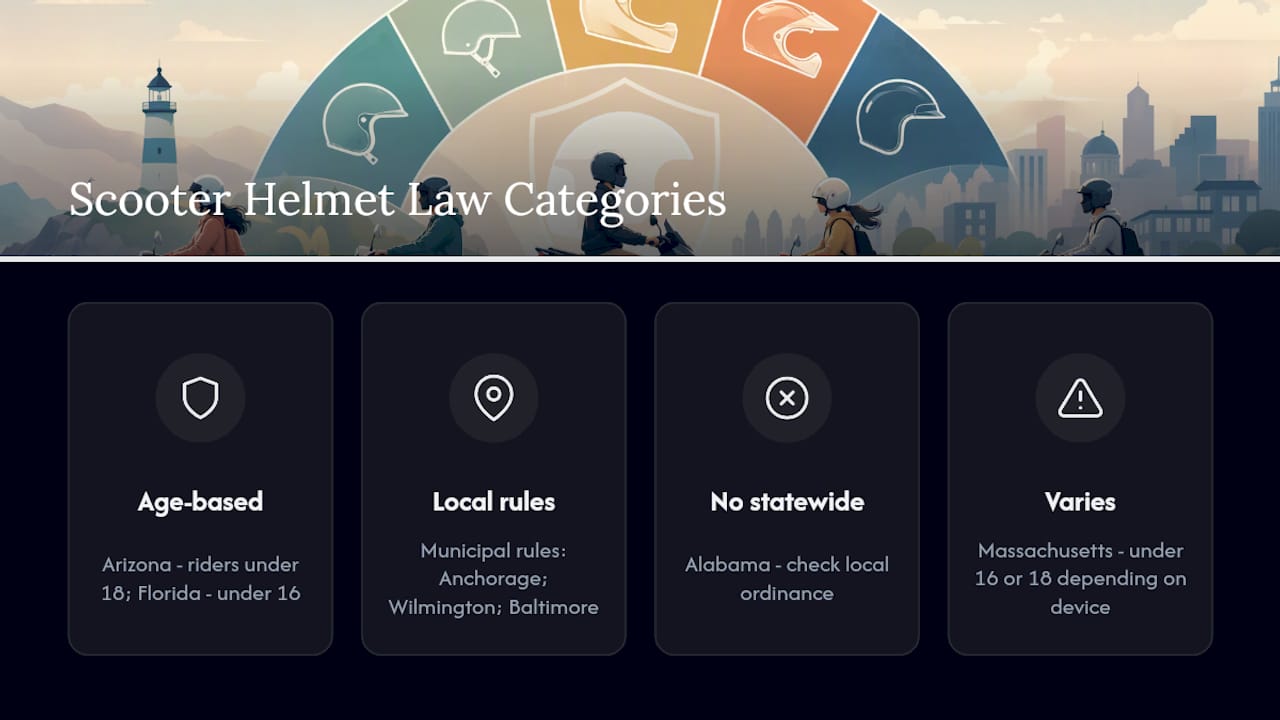
Alabama — No statewide scooter-specific helmet statute; check local ordinance where you ride.
Alaska — No dedicated e-scooter helmet law on the books; municipalities such as Anchorage set their own rules.
Arizona — Age-based: riders under 18 must wear a helmet.
Arkansas — No statewide requirement identified; verify city code before riding.
California — Age-based: helmets required for riders under 18 on motorized scooters.
Colorado — Colorado’s low-power scooter guidance clarifies classification and licensing questions, but the state does not impose a universal adult helmet mandate.
Connecticut — Age-based rule applies to minors operating motorized scooters.
Delaware — No statewide scooter helmet statute; local rules govern in cities like Wilmington.
Florida — Age-based: riders under 16 must wear a helmet.
Georgia — Age-based: helmet required for operators under 16.
Hawaii — No statewide scooter-specific helmet law; check county ordinances.
Idaho — No statewide requirement identified.
Illinois — No statewide scooter helmet mandate; Chicago and other cities layer on their own program rules.
Indiana — No statewide requirement identified; check locally.
Iowa — No statewide requirement identified.
Kansas — No statewide requirement identified.
Kentucky — No statewide requirement identified; check municipal code.
Louisiana — Age-based rule applies to minors.
Maine — Age-based: riders under 18 must wear a helmet.
Maryland — No statewide scooter-specific helmet law; Baltimore has its own shared-scooter program rules.
Massachusetts — Age-based: riders under 16 or 18 depending on device classification must wear a helmet; verify against current code.
Michigan — Age-based rule for minors.
Minnesota — Age-based rule for minors operating motorized scooters.
Mississippi — No statewide requirement identified.
Missouri — No statewide requirement identified.
Montana — No statewide requirement identified.
Nebraska — No statewide requirement identified.
Nevada — Age-based rule for minors.
New Hampshire — No statewide requirement identified; check locally.
New Jersey — Age-based rule for minors operating low-speed electric scooters.
New York — Age-based: New York’s Vehicle and Traffic Law §1286 requires helmets for 16 and 17-year-old electric scooter operators, with fines up to $50 that a court may waive if the rider shows proof of purchasing or renting a compliant helmet before the court date.
North Carolina — No statewide scooter-specific helmet statute identified.
North Dakota — No statewide requirement identified.
Ohio — Age-based rule for minors.
Oklahoma — No statewide requirement identified.
Oregon — Universal: ORS 814.534 requires protective headgear for any motor assisted scooter operator on a highway or premises open to the public, with no age exception. The statute sets a presumptive first-offense fine of $25, waivable if the rider proves ownership of qualifying headgear.
Pennsylvania — No statewide requirement identified; check city code, particularly in Philadelphia and Pittsburgh.
Rhode Island — Age-based rule for minors.
South Carolina — No statewide requirement identified.
South Dakota — No statewide requirement identified.
Tennessee — Age-based rule for minors.
Texas — No statewide scooter-specific helmet mandate; Austin and other cities regulate through shared-scooter permits.
Utah — Age-based rule for minors.
Vermont — No statewide requirement identified.
Virginia — Age-based rule for minors.
Washington — No statewide scooter-specific helmet law; Seattle sets its own shared-mobility program requirements.
West Virginia — No statewide requirement identified.
Wisconsin — No statewide requirement identified.
Wyoming — No statewide requirement identified.
District of Columbia — Age-based rule applies to minors under D.C.'s shared-mobility regulations.
Where the table says “no statewide requirement identified,” that doesn’t mean scooters are unregulated. It means the helmet question shifts to whoever runs the city you’re riding in, and that layer of law changes far more often than state statutes do.
What Legally Counts as a Scooter, and Why It Changes the Helmet Rule
The word “scooter” covers at least three distinct legal categories, and which one your ride falls into often decides whether a helmet law even applies to you. An electric kick scooter is generally a stand-up, no-seat device under a set speed and wattage threshold, the category most state e-scooter statutes describe. A motor assisted scooter (Oregon’s statutory term) usually means a low-speed device that may or may not require pedals. A moped or motor scooter, by contrast, typically has a seat, higher top speed, and often needs registration, insurance, and a motorcycle-style DOT-rated helmet, not a bicycle helmet.
Classification usually turns on a few concrete factors:
- Top speed (many statutes draw the line around 15 to 20 mph).
- Motor power output in watts.
- Whether the vehicle has a seat versus a standing deck.
- Whether the state requires registration, a license plate, or insurance.
Cross one of those thresholds and you can shift from “e-scooter statute” territory into full moped or motorcycle helmet law, where the standard required is stricter. Reviewing how street-legal scooters get classified is worth doing before you assume your model falls under the lighter-touch e-scooter rules.
Pro Tip: Check your owner’s manual for the manufacturer’s stated top speed and motor wattage, then match those numbers against your state’s statutory definitions before you decide which helmet rule applies to you.
What Happens If You Get Cited for No Helmet?
Most helmet statutes build in some flexibility, and it’s worth knowing what that looks like before you’re standing on the side of the road with an officer. Common exceptions and enforcement patterns include:
- First-offense waivers. New York’s law lets a court waive the fine if you show proof you purchased or rented a compliant helmet before your court date.
- Modest fine amounts. Oregon’s statute sets a presumptive $25 fine for a first offense, also waivable with proof of headgear ownership, according to ORS 814.534.
- Age-based exemptions. Riders above the statutory cutoff (often 16 or 18) simply aren’t covered by the helmet requirement in age-based states, even though the same statute may still regulate speed or sidewalk use.
None of that changes what the law says just because enforcement looks inconsistent on the street. Oregon’s statute applies to any operator on a public roadway or open premises, regardless of how many other riders you see without helmets that day; visible non-compliance is not the same as legal permission.
Pro Tip: If you’re cited and your state allows a waiver, keep your receipt from purchasing or renting a helmet that meets your state’s standard, and bring it to your court date or the address listed on the citation.
How Do You Check the Scooter Helmet Rule Where You Live?
Confirming your exact obligation takes about two minutes if you follow this order:
- Identify your vehicle’s legal class. Check your owner’s manual for top speed and motor wattage, then compare against your state’s statutory definitions for electric kick scooter, motor assisted scooter, or moped.
- Search your state DMV site or state code. Use terms like “[your state] motor assisted scooter helmet statute” or check your state DMV’s motorcycle and scooter page directly.
- Search your city’s municipal code. Try “municipal code e-scooter” plus your city name, or check your local transportation department’s shared-mobility program rules.
- Call if you’re still unsure. A city transportation department or your local police non-emergency line can usually confirm current local rules on the spot.
Save a screenshot or bookmark of whatever official page you find. If you ever need to contest a citation, having the exact statute or DMV language on hand makes your case a lot easier to argue.
Why Wear a Helmet Even Where the Law Doesn’t Require One?
Legal minimums and safety recommendations are two different things, and conflating them is where a lot of riders get hurt. Head injuries remain among the most common and severe injuries reported in scooter crashes, which is exactly why safety advocates recommend helmet use on every ride, regardless of what your specific state statute requires.
Helmet standards you’ll see referenced in both product labeling and, occasionally, statutory language include:
- CPSC standards — the Consumer Product Safety Commission’s voluntary helmet standards apply to recreational and bicycle-style helmets, the category most electric kick scooter riders should look for.
- ASTM F2641 — this consumer safety specification sets performance requirements for recreational powered scooters intended for children and adolescents, relevant if you’re buying for a younger rider.
- DOT-rated helmets — required for moped and motor scooter classes where the vehicle qualifies as a motor vehicle under state law.
- Snell and ECE — additional voluntary certifications some riders choose for extra impact protection beyond the legal minimum.
Before you ride, confirm your helmet fits snugly, sits level (not tilted back), and carries the certification label matching your scooter’s actual vehicle class, not just whichever helmet was already in your closet.
Import Junkies’ Take on Scooter Helmet Safety
We recommend a helmet for every scooter ride Import Junkies customers take, full stop, regardless of whether your state’s statute technically requires one. If you’re riding an electric kick scooter, a CPSC-compliant recreational helmet is the right call. Step up to a moped-class motor scooter, and you should be reaching for a DOT-rated helmet instead, since the higher speeds involved change the impact forces a helmet needs to absorb.
Our scooter safety guide covers fit checks and riding habits in more depth, and our breakdown of street-legal scooter requirements will help you confirm exactly which class your model falls into before you assume a lighter helmet standard applies.
Shopping for a new ride? Our 500-watt electric motor scooter is a solid option if you want pedal-assist flexibility along with a legally classifiable motor scooter build.
Sources
Confirm any rule mentioned here against the primary source before you rely on it, since state legislatures amend these statutes regularly:
- Electric Scooter Laws by State (2026): Quick Reference
- New York Vehicle and Traffic Law §1286 (Operators to Wear Protective Headgear)
- Colorado DMV — Low-power scooter guidance
- CPSC — Recreational helmet voluntary standards
- ASTM F2641-24 — Consumer safety specification for recreational powered scooters and pocket bikes
Always pair a state-level search with your specific city’s municipal code, since that’s where most of the day-to-day helmet requirement gaps actually get filled.
This article is general information, not a substitute for advice from a qualified lawyer. Consult a qualified legal professional about your own circumstances before acting on anything here.
Recommended
- Scooter safety guide: how to ride safely and legally – Saferwholesale || Import Junkies || Great Sports
- How to Register a Scooter: Your 2026 Step-by-Step Guide – Saferwholesale || Import Junkies || Great Sports
- Are Electric Scooters Street Legal in the US? – Saferwholesale || Import Junkies || Great Sports


