


 Location
 Login
Login
Yes, you can make a UTV street legal in most of the country, but the rules shift hard from state to state. Roughly 20 states allow full street-legal registration, another 25 allow limited road use under specific conditions, and a handful restrict it outright. Before you buy a single part, check your state DMV’s statute on off-road or utility vehicles, and confirm your county ordinance doesn’t override it.
TL;DR:
- Most states require DOT-certified headlights, taillights, turn signals, horn, mirror, and license plate light for street-legal UTVs, but additional equipment depends on local rules.
- About 20 states allow full registration, 25 permit limited road use, and 5 to 9 states restrict UTVs to off-road or private land only; verify your state’s current regulations directly.
- Passing inspection hinges on installing weatherproofed wiring, mounting parts securely, and meeting tire and noise standards, with common failures including unstamped tires or loose wiring.
- Completing paperwork involves proof of ownership, safety inspection, DMV registration, and liability insurance, with some owners registering out of state to simplify titling procedures.
- Non-compliance penalties can include fines, vehicle impoundment, suspension of registration, and insurance denial, so adhering strictly to equipment and documentation requirements is crucial.
Table of Contents
- Core Equipment Checklist: The Parts Most States Require
- Which States Let UTVs Drive on Public Roads?
- Getting the Paperwork Done: Title, Registration, Inspection, and Insurance
- Installation Tips and Common Inspection Failures
- Where This Guide Comes From
- Penalties for Non-Compliance With Street-Legal Requirements
- Do Side-by-Sides Face Different Rules Than Other UTVs?
- The Honest Take on Making a UTV Street Legal
- Buy a UTV Built for the Road Ahead
- Where to Verify Your State’s Exact Rules
- Sources
- FAQ
Core Equipment Checklist: The Parts Most States Require
Every state that allows street-legal UTVs shares a common baseline of equipment. These are the parts that show up on nearly every inspection sheet, and skipping even one usually means a failed inspection or a ticket down the road.
The standard list includes headlights with functioning high and low beams, taillights and brake lights, front and rear turn signals, a horn audible from a reasonable distance, at least one rearview mirror, and a license plate light and mount.
Beyond that baseline, requirements start to diverge. Some states want a windshield and working wipers, DOT-rated tires, functioning seatbelts, a speedometer, or a muffler that meets a specific noise limit. Confirm these variable items with your DMV before you spend money, because a part that satisfies one state’s inspector can flag another’s.
Inspectors also watch for red flags that have nothing to do with a missing part: an exhaust that’s clearly too loud, off-road tires with no DOT stamp, or aftermarket accessory lights in colors your state doesn’t allow on public roads (blue and red are almost universally banned for civilian vehicles). Installation quality matters just as much as the part itself. A $12 turn signal kit with exposed wiring will fail an inspection just as fast as having no signals at all.
Pro Tip: Buy DOT/FMVSS-108 stamped lighting whenever your state requires it. A DOT/FMVSS 108-compliant license plate light with a waterproof housing survives inspection and weather better than a generic part with no certification stamped on the housing.
Which States Let UTVs Drive on Public Roads?
The national picture breaks into three tiers, and knowing which one your state falls into changes everything about how you plan a build.
About 20 states currently allow full street-legal registration for UTVs, meaning a properly equipped machine can travel most public roads the same way a low-speed vehicle would. Around 25 states allow limited road use instead, typically restricting UTVs to certain road classes, daylight hours, or specific counties that have opted in. A smaller group of 5 to 9 states restrict or prohibit on-road UTV use almost entirely, sometimes limiting them to designated trails or private land only.
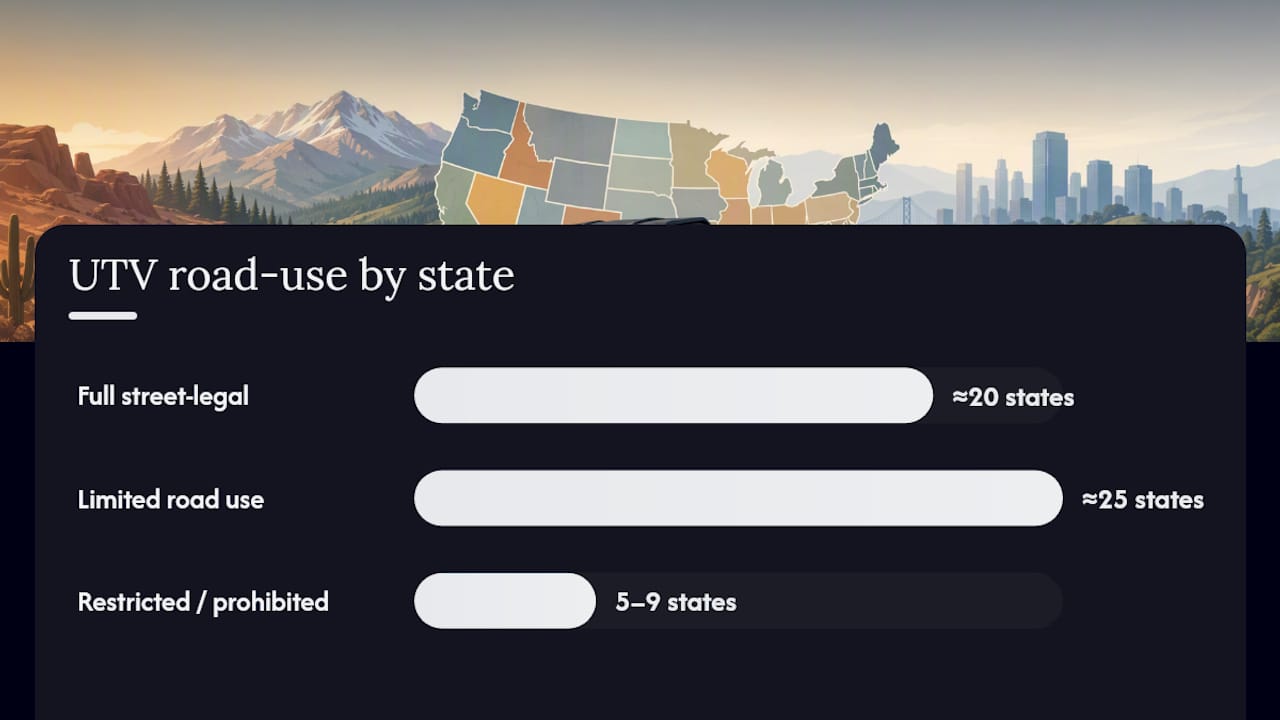
States with permissive frameworks (commonly cited examples include Arizona, Wyoming, and Utah) tend to treat UTVs similarly to ATVs already legal for road crossing, with registration handled through the same DMV process as other off-highway vehicles. States on the restrictive end often classify UTVs strictly as recreational off-road vehicles with no path to a road-legal title, no matter how many parts you bolt on. Treat any state list you find online as a starting point, not gospel. Legislatures update these statutes often enough that a guide from even a year ago can be out of date.
Here’s how to verify your state’s actual rule instead of trusting a forum post:
- Search your state DMV’s website for “UTV,” “ORV,” “all-terrain vehicle equipment,” or “street-legal off-highway vehicle.”
- Pull the actual state code section, not just a summary page. Statutes typically spell out the exact equipment list and any weight or speed limits.
- Call or check your county clerk’s site for local ordinances. Street-legal status is a local classification as much as a state one, and a county can restrict what the state allows.
- If you’re near a state line and plan to cross it regularly, check both states’ requirements. What’s legal in one can get you cited fifty feet over the border.
Getting the Paperwork Done: Title, Registration, Inspection, and Insurance
Once the equipment is installed, the administrative side follows a fairly predictable order in most states that allow street-legal registration. The typical sequence looks like this:
- Confirm your state’s exact equipment and paperwork requirements before installing anything, since some states want inspection before registration and others reverse that order.
- Install the required parts and gather proof of ownership, usually a manufacturer’s certificate of origin or a bill of sale if the UTV is used.
- Pass any required safety or equipment inspection, where an officer or licensed station checks lights, signals, and mounting.
- Submit for title and registration through your state DMV, paying the applicable titling and plate fees.
- Secure liability insurance that meets your state’s minimum coverage, then get your plate.
Some owners register out of state, Montana being the most common example, to simplify titling. That route addresses paperwork, not driving privileges. It doesn’t override your home state’s road-use rules or equipment requirements, so you can still get cited for driving an out-of-state-registered UTV that doesn’t meet your local equipment law. Realistic timelines run anywhere from same-day at a DMV counter to several weeks if your state requires a separate inspection appointment.
Installation Tips and Common Inspection Failures
Most failed inspections trace back to the same handful of mistakes. Missing DOT stamps on tires or lights top the list, followed by obstructed lenses, loose mounts that rattle at speed, and wiring that was never properly weatherproofed to begin with.
Installation quality is often the deciding factor between a rig that passes and one that gets sent back for rework. A few habits prevent most of this:
- Use sealed, weatherproof connectors on every light and signal circuit.
- Mount LED modules with metal brackets or locking fasteners, not zip ties, since vibration at highway speeds loosens anything less secure.
- Test the whole electrical system at speed before your inspection appointment, not after.
- Keep printed copies of your registration and inspection paperwork in the vehicle when crossing state lines.
Pro Tip: If you ride trails on Forest Service or BLM land in addition to street use, check the area’s equipment rules separately. Some require spark arrestors regardless of your street-legal status.
Cross-state travel adds another layer. A UTV registered and equipped for Arizona roads might not meet Colorado’s requirements the moment you cross into a different county on a road trip, so know the local speed limits and equipment law for anywhere you plan to actually drive, not just where you titled the vehicle.
Where This Guide Comes From
This guide draws on state statute language, DMV equipment lists, and installation guidance compiled from UTV compliance resources across the industry, cross-checked against Import Junkies’ own registration and safety content for off-road vehicles. Owners repeatedly make the same mistakes: skipping the license plate light because it seems minor, buying uncertified lights to save money, or assuming Montana registration solves a road-use problem it doesn’t touch. Import Junkies’ guides on registering off-road vehicles and utility vehicle registration steps walk through the same paperwork sequence in more depth for readers who want the full DMV checklist.
Penalties for Non-Compliance With Street-Legal Requirements
Driving an unregistered or improperly equipped UTV on a public road typically brings the same category of penalty as driving any other unregistered vehicle: a citation, a fine, and in some states, impoundment until you bring the vehicle into compliance. Fine amounts vary widely by state and by which specific violation triggered the stop, from a simple equipment fix ticket to a more serious charge if the UTV was uninsured.
Insurance lapses carry their own consequences separate from the equipment fine. Most states that allow street-legal UTVs require the same liability minimums as passenger vehicles, and driving without that coverage can mean a suspended registration on top of the citation itself.
Repeat violations tend to escalate. A first offense in many jurisdictions is a warning or a low fine tied to fixing the equipment, but a UTV cited multiple times for the same missing part, or one involved in an accident while out of compliance, can face registration revocation or a mandatory court appearance. Insurance claims add another risk entirely. If your UTV isn’t properly registered or equipped at the time of a crash, your insurer may deny the claim outright, leaving you responsible for damages that a compliant vehicle would have had covered.
The safest approach is treating your state’s equipment list as a floor, not a suggestion. Fixing one missing part after a citation costs far less than the fine, the potential impoundment fee, and the risk of a denied insurance claim stacked together.
Do Side-by-Sides Face Different Rules Than Other UTVs?
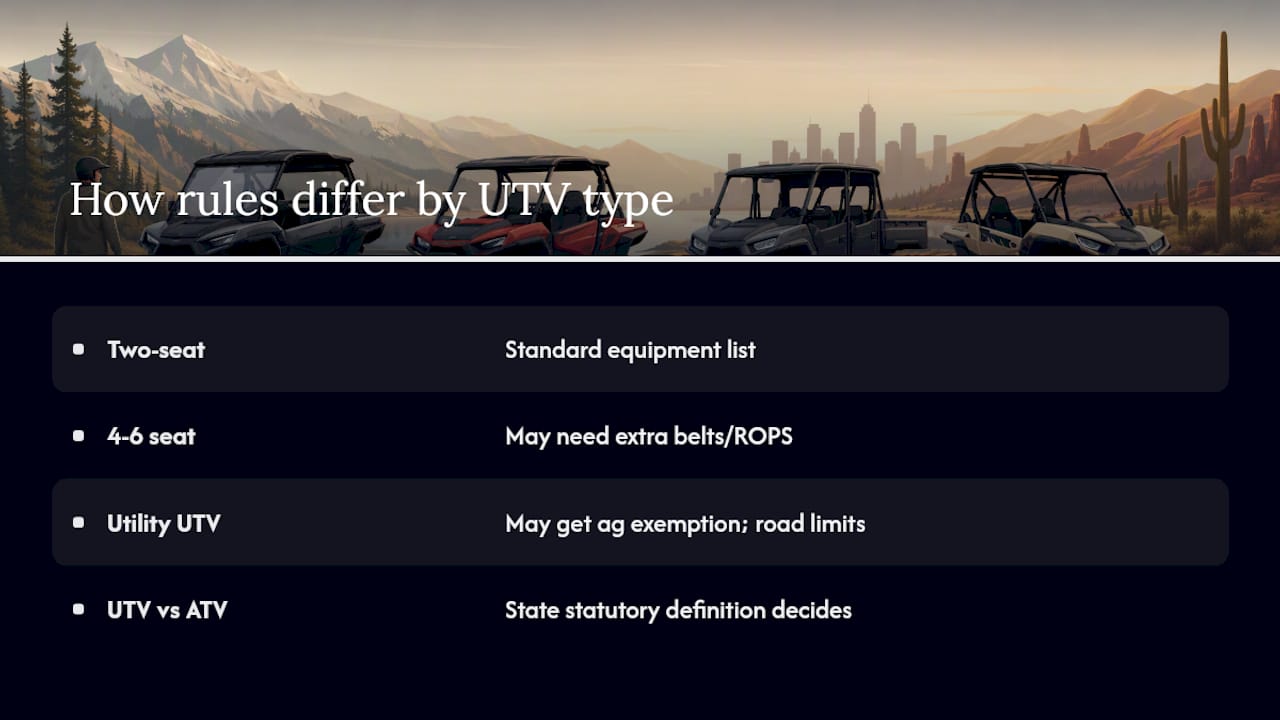
Most state statutes group UTVs, side-by-sides, and multi-passenger off-highway vehicles under one broad definition, but a few meaningful distinctions show up depending on seating capacity, weight, and intended use.
Two-seat side-by-sides, the most common configuration on the road, generally face the standard equipment list covered earlier: lights, signals, mirror, horn, and a plate light. Four and six-seat UTVs sometimes trigger additional seatbelt or rollover protection requirements simply because they carry more passengers, and a few states apply stricter weight limits before a multi-seat UTV qualifies for street-legal registration at all.
Utility-focused UTVs built with dump beds or plow attachments, common on farms and small commercial properties, occasionally fall under a separate agricultural or utility-vehicle exemption that changes the registration process entirely. That exemption can mean lighter paperwork for on-farm use but stricter limits on how far the vehicle can travel on public roads between properties.
Then there’s the classification question that trips up a lot of new owners: some states draw a hard line between a UTV/ROV (recreational off-highway vehicle) and an ATV, applying different equipment lists to each even though the vehicles look similar in a driveway. If your machine straddles that line, like a compact side-by-side marketed as either, your state’s exact statutory definition (not the manufacturer’s marketing category) determines which rulebook applies. That’s one more reason to pull the actual state code section rather than relying on a general guide — this one included — as your final word.
The Honest Take on Making a UTV Street Legal
Most advice on this topic treats street-legal conversion like a shopping list: buy lights, buy a horn, done. That’s backwards. The paperwork sequence and the local ordinance check matter more than the parts themselves, because a perfectly equipped UTV registered under the wrong assumptions still gets you cited.
The conventional advice also underplays installation quality. A cheap turn signal kit that vibrates loose at 45 miles per hour doesn’t just look bad. It fails you at the exact moment an officer is deciding whether to write a ticket. Spend the extra money on DOT-rated parts and secure mounts before you spend it on anything cosmetic.
If you’re starting from scratch, prioritize in this order: confirm your state and county rules first, install certified equipment second, and handle title, insurance, and plates third. Skipping straight to parts because they’re the fun part of the project is how owners end up with a UTV that looks road-ready but isn’t, legally, anywhere close.
— Gary
Buy a UTV Built for the Road Ahead
You can find a straighter path to street-legal ownership than piecing together a build from mismatched parts across three different retailers. Many catalogs offer UTVs and utility vehicles sold direct, often at wholesale pricing, helping avoid agency markup on a machine you could source yourself.
If you’re still shopping for the base vehicle, the 48V Electric Golf Cart 4 Seater Renegade Edition Utility Golf UTV gives you a four-seat platform that’s a common starting point for owners converting to street-legal use. For readers who already understand what factory features come standard versus what you’ll need to add, the buyer’s guide to must-have UTV features is worth a read before you check out.
One honest reminder: buying compliant parts or a well-equipped vehicle from Import Junkies doesn’t replace your state DMV paperwork or inspection. Browse the UTV category, or contact customer support with compatibility questions, then take the equipment to your state’s registration process to finish the job.
Where to Verify Your State’s Exact Rules
- Your state DMV’s official off-highway or utility vehicle statute page
- Your state code, searched directly for “UTV,” “ORV,” or “street-legal equipment”
- Your county clerk’s office for local ordinances
- U.S. Forest Service or BLM guidance if you ride on federal land, since trail-specific equipment rules like spark arrestors can apply regardless of street-legal status
Sources
- UTV Street Legal States 2026
- Make a UTV street legal (Dirt Legal)
- Can You Make Your UTV Street Legal? The Complete 2026 Guide - Side By Side Sports
FAQ
What States Allow UTVs to Be Street Legal?
About 20 states allow full street-legal registration for UTVs, roughly 25 allow limited road use under specific conditions, and 5 to 9 states restrict or prohibit on-road use. Check your state DMV’s off-highway vehicle statute for the exact rule where you live.
Can You Ride a UTV on the Road in South Carolina?
South Carolina falls into the limited-use category for most UTVs, generally restricting on-road operation to specific circumstances like crossing a road or short trips near a residence rather than open highway travel. Confirm the exact conditions with the South Carolina DMV before riding, since local ordinances can add further restrictions.
How Do You Get a UTV Street Legal in Ohio?
Ohio allows UTV registration for road use under its off-highway motorcycle and ATV statutes, which require the standard equipment list (lights, signals, mirror, horn, plate light) plus a valid title and registration through the Ohio Bureau of Motor Vehicles. Local townships can add restrictions on top of the state rule, so check your county before assuming statewide access.
Can You Make a UTV Street Legal in Florida?
Florida permits street-legal UTV use on certain roads when the vehicle carries the required equipment and is registered, though many counties enforce speed limits and restrict access on higher-speed roads. Confirm your specific county’s ordinance, since Florida’s rule leaves significant room for local variation.
What Equipment Do You Need First for Street Legality?
Start with headlights, taillights, brake lights, front and rear turn signals, a horn, a mirror, and a license plate light, since these are the items nearly every state requires. Confirm variable items like windshields, DOT tires, and seatbelts with your specific state before finishing the build.


