


 Location
 Login
Login
TL;DR:
- Most small garages should choose between low-profile two-post lifts, mid-rise scissor lifts, or single-post parking stackers, based on ceiling height, bay width, and slab strength. Proper measurement of garage dimensions and slab conditions is essential before selecting a lift to ensure fit and safety; certifications like ALI Gold Label are crucial for permanent installations. Portable and budget lifts offer flexibility but lack certification and full service capabilities, making them suitable for renters or occasional use.
For most small garages, the three lift types that actually fit are low-profile two-post lifts, mid-rise scissor lifts, and single-post parking stackers. Each one solves a different constraint: low columns for tight ceilings, compact footprint for narrow bays, or vertical stacking for pure parking efficiency. Before you shop by brand or price, measure your ceiling height, slab thickness, and bay width — those three numbers will eliminate half the market immediately.
Quick shortlist:
- Importjunkies residential parking and compact lift options — a direct-to-consumer source with residential parking lifts, portable stackers, and compact four-post units, plus buying support to match your garage dimensions to the right product
- Low-profile two-post category (BendPak GrandPrix / GP series, Forward Lift Two-Post) — fits ceilings as low as low residential ceilings while still giving you real working height under the car
- Single-post / one-post parking stacker (Kettp 2O, Autostacker) — the smallest lateral footprint of any permanent lift, with full side-door access on both stacked vehicles
One firm caveat: a permanent lift requires a concrete slab rated at 4,000+ PSI and a minimum thickness that varies by lift type. If your slab is thinner or softer, budget for concrete work before you budget for the lift itself.
Table of Contents
- What are the best compact garage lifts right now?
- Which lift type fits your specific garage situation?
- How do you measure and prepare your garage for a lift?
- Pros and cons of each space-saving lift type
- How these picks were chosen
- What do warranties actually cover on garage lifts?
- Key Takeaways
- The detail most buyers overlook when choosing a garage lift
- Importjunkies carries the space-saving lifts you actually need
- Useful sources and certifications to check before you buy
What are the best compact garage lifts right now?
The table below covers every major category and named model relevant to small U.S. garages. Importjunkies leads as the publisher’s featured option; remaining entries follow in category order.
| Lift / Category | Best For | Min. Ceiling Height | Footprint / Bay Width | Lifting Capacity | Max Rise | Install Complexity | Approx. Cost (Unit + Install) | Warranty / Support |
|---|---|---|---|---|---|---|---|---|
| Importjunkies — residential parking & compact lifts | Homeowners wanting one vendor for buying guidance, inventory, and install referrals | Varies by model | Varies by model | Varies by model | Varies by model | Low–High (model-dependent) | Budget to premium range | Varies by product |
| Low-profile two-post category | Home mechanics needing working access under the car in lower ceilings | low residential ceilings (GP-7LCS) / 10 ft (GP-7LC) | typical single-car bay widths | typical capacity of most residential vehicles | — | Moderate; requires anchor bolts, 4,000+ PSI slab | $2,500+ install | Manufacturer warranty; typically 1–3 yr structural |
| BendPak GrandPrix GP-7LCS | Garages with low residential ceilings needing a permanent two-post lift | low residential ceilings | Compact column profile | rated for typical residential vehicle weights | substantial lifting height | Moderate; professional install recommended | ~$3,000–$4,000 | BendPak limited warranty |
| BendPak GrandPrix GP-7LC | 10 ft ceilings; homeowners who want more rise than the GP-7LCS | 10 ft | Compact column profile | rated for typical residential vehicle weights | extended lifting height | Moderate | ~$3,000–$4,000 | BendPak limited warranty |
| Forward Lift Two-Post Lift | Full-service home mechanics with standard ceiling height | 11 ft+ | Standard two-post bay | 10,000 lb | Full rise | Moderate–High | $3,500–$5,000 | Forward Lift warranty |
| Mid-rise scissor lift category | Moderate working height with minimal overhead structure | 9–10 ft | Compact; drive-on platform | 7,000–10,000 lb typical | 36–48 in | Low–Moderate; some portable, some anchored | $1,500+ install | Varies by brand |
| Katool X77 Commercial-Grade Scissor Auto Lift | Serious DIYers wanting commercial-spec scissor performance | low residential ceilings+ | Drive-on platform | — | — | Moderate | ~$2,500–$3,000 | Manufacturer warranty |
| APlusLift Mid Rise Scissor Lift | Budget-conscious home mechanics needing mid-rise access | low residential ceilings+ | Drive-on platform | 7,000–heavy-duty capacity range | ~36 in | Low–Moderate | — | Limited manufacturer warranty |
| MaxJax Mid-Rise 2-Post Car Lift | Low-ceiling garages needing portable two-post flexibility | 7 ft 6 in | Minimal; portable columns | 7,000–heavy-duty capacity range | 48 in | Low; semi-portable, anchor optional | — | MaxJax warranty |
| Single-post / one-post parking stacker category | Narrow bays, car condos, renters needing max side access | 11–12 ft (stacking height dependent) | Single column; minimal side intrusion | rated for most sedans and compact SUVs | Vehicle-stack height | Moderate; floor anchor required | $3,000–$5,000 | Varies by brand |
| Kettp / Autostacker 2O single-post parking lift | Narrow bays where side-door access on both cars is non-negotiable | 11–12 ft | Single column only | rated capacity for typical sedans and compact SUVs | Vehicle-stack height | Moderate | ~$4,000–$5,000 | Kettp manufacturer warranty |
| Autostacker (BendPak) | Residential and commercial parking; collapsible platform | 11–12 ft | Fully collapsible platform | Up to 8,000 lb | Vehicle-stack height | Moderate | — | BendPak warranty |
| Low-profile four-post parking lift category | Parking/storage-first; easy drive-on, long-term stability | 10–11 ft | Wider footprint; 4 posts | capacity suited for SUVs and trucks | 36–48 in | Low–Moderate; drive-on, anchor optional on some | $2,000–$4,000 | Varies by brand |
| Forward Lift Light-Duty Storage Lift | Light-duty parking storage in a compact four-post format | 10 ft | Compact four-post | 8,000 lb | — | Low | ~$2,500–$3,000 | Forward Lift warranty |
| Forward Lift Four-Post Lift | Standard four-post parking with higher capacity | 10–11 ft | Standard four-post | 8,000 lb | — | Low–Moderate | ~$3,000–$4,000 | Forward Lift warranty |
| Importjunkies GSI 8,000 lb 4-Post Lift | Parking and storage with portable-style setup | 10–11 ft | Four-post platform | 8,000 lb | — | Low | Direct-to-consumer pricing | Included warranty |
| Portable / underbody lifts and in-ground ramps | Renters or occasional mechanics who cannot anchor permanently | 7 ft+ | Minimal; stored away | 2,000–7,000–heavy-duty capacity range | 12–24 in | Very Low; no anchoring | $150–$700 | Limited; varies |
| Black Widow Hydraulic Underbody Access Car Lift with Ramp | Quick underbody access without a permanent install | 7 ft+ | Compact ramp footprint | Up to 7,000–heavy-duty capacity range | — | Very Low | — | Limited manufacturer warranty |
| SuxiDi Hydraulic Vehicle Ramps | Budget-first occasional use; no slab modification | 7 ft+ | Ramp only | — | ~12 in | None | ~$150–$300 | Limited |
| Aecojoy Portable Car Lift | Temporary service or storage in rental garages | 7 ft+ | Compact portable frame | — | — | Very Low | ~$400–$700 | Limited manufacturer warranty |
Note on ANSI/ALI certification: When buying a permanent lift, look for the ALI Gold Label or ANSI/ALI ALCTV certification mark. This signals the lift has been independently tested for structural and safety compliance. BendPak and Forward Lift both carry ALI-certified models. Portable and budget-tier lifts often lack this certification — factor that into your risk assessment.
Which lift type fits your specific garage situation?
Your garage’s physical constraints narrow the field faster than any spec sheet. Here is how to match your situation to the right category.
Scenario 1: low residential ceilings ceiling with a narrow single-car bay
This is the tightest common residential scenario. A standard two-post lift is out. Your realistic options are the BendPak GP-7LCS (fits low residential ceilings ceilings with a substantial lifting height rise), a mid-rise scissor lift like the APlusLift or Katool X77, or the MaxJax portable two-post system, which can operate in ceilings as low as 7 ft 6 in. The low-profile two-post designs trade maximum rise for ceiling compatibility — you get real working height, just not the full 6 ft of a shop lift.
Scenario 2: 10–11 ft ceiling, standard single-car width
This opens up the most options. The BendPak GP-7LC fits a 10 ft ceiling and delivers extended lifting height rise. A mid-rise scissor lift works here too, and a low-profile four-post parking lift becomes viable for storage. If you want to double your parking capacity, a single-post stacker like the Kettp 2O or Autostacker fits this ceiling range with the required ceiling height of 11–12 ft for safe stacking clearance.
Scenario 3: Parking and storage only, no under-car work
A four-post parking lift is the right tool. Drive-on access, stable platform, no need for arm positioning. The Importjunkies GSI 8,000 lb four-post lift handles this well, and the Forward Lift Light-Duty Storage Lift covers the same use case at a lighter capacity. Neither requires the same anchor-bolt investment as a two-post service lift.
Scenario 4: Rented garage or car condo — no permanent slab modification
Portable and stacker-style lifts are often the only viable option here. The MaxJax can be semi-permanently anchored or used with surface plates. The Importjunkies electric stacker (2,200 lb capacity) suits light vehicles and motorcycles in narrow bays. Black Widow underbody ramps and SuxiDi ramps require zero slab work at all.
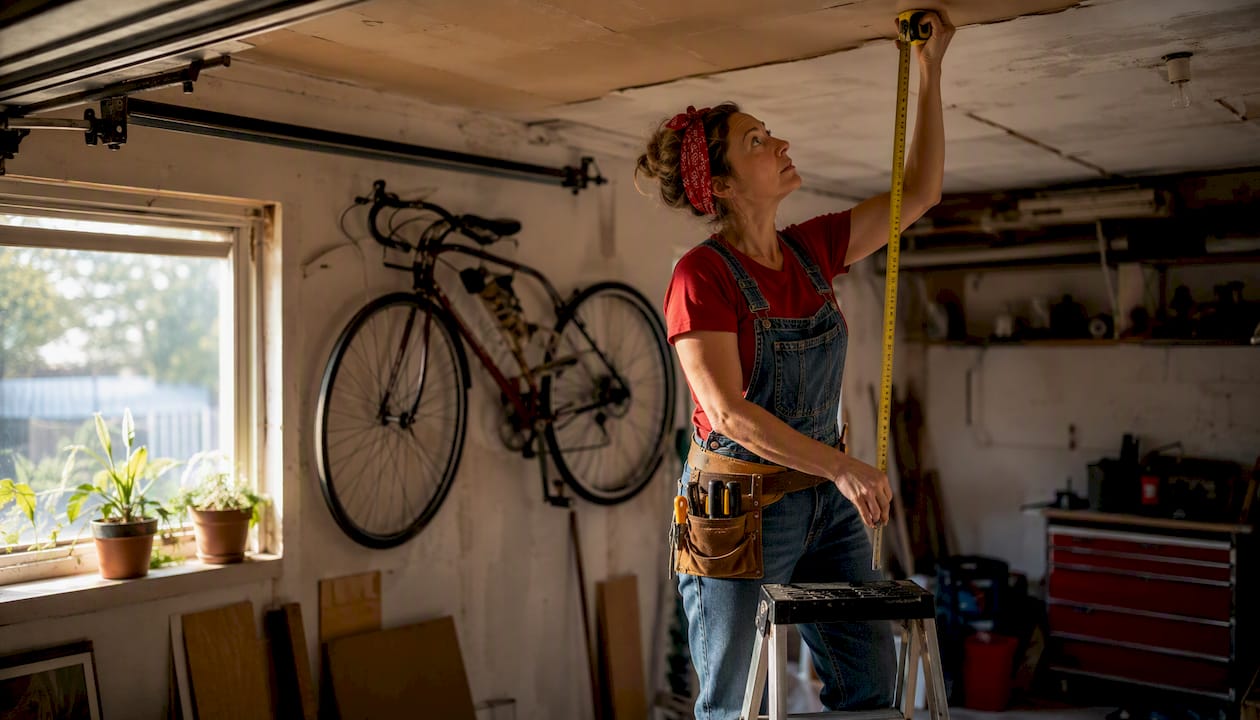
Pro Tip: Before committing to any lift category, measure your vehicle’s door swing radius at full open, not just the body width. A car that fits a low residential ceilings bay on paper can block a two-post column when the door opens — that clearance check takes two minutes and can save you from a return.
How do you measure and prepare your garage for a lift?
Getting the right lift installed correctly comes down to four measurements and a short list of questions to ask before you place an order.
Measuring checklist
- Ceiling height — measure from the finished floor to the lowest obstruction (garage door track, beam, or HVAC duct). This is your hard ceiling limit.
- Bay width — measure the usable width between walls or obstructions, not just the door opening. Two-post lifts need clear column placement on both sides of the vehicle.
- Bay depth — measure front to back. Four-post and scissor lifts need ramp run-out space at the drive-on end.
- Slab thickness and condition — most permanent lifts require a minimum 4 in concrete slab at 3,000–4,000+ PSI. Tap the slab for hollow spots and check for cracks near anchor zones.
- Vehicle wheelbase and width — compare your vehicle’s wheelbase against the lift’s arm reach, and its width against the lift’s column spacing. The Importjunkies auto lift buying guide includes a measurement checklist you can print and use on-site.
- Electrical supply — most two-post and scissor lifts run on 110V or 220V single-phase. Confirm your panel has the right circuit available before delivery.
Installation requirements by category
| Lift Category | Min. Slab Thickness | Min. Concrete PSI | Anchor Type | Electrical | Professional Install? | Typical Timeline |
|---|---|---|---|---|---|---|
| Low-profile two-post | 4 in | 3,500–4,000 PSI | Anchor bolts | 110V or 220V | Recommended | 1–2 days |
| Mid-rise scissor | 3–4 in | 3,000 PSI | Optional or none | 110V or 220V | DIY-feasible | Half day to 1 day |
| Single-post stacker | 4–6 in | 4,000+ PSI | Heavy anchor bolts | 110V or 220V | Recommended | 1–2 days |
| Four-post parking | 3–4 in | 3,000 PSI | Optional on some | 110V | DIY-feasible | Half day to 1 day |
| Portable / underbody | None required | N/A | None | None or 110V | DIY | Under 1 hour |
Questions to ask any seller or installer
- What concrete PSI and thickness does this specific model require, and will you inspect my slab before installation?
- Does the lift carry ALI Gold Label or ANSI/ALI ALCTV certification?
- What permits does my county or municipality require for a permanent lift installation?
- What is the full warranty coverage — structural, hydraulic, and electrical — and who handles claims?
- Can this lift be relocated if I move, and what does that involve?
Concrete work, if your slab needs upgrading, typically adds $500–$2,500 to the project cost depending on the area and thickness required. Permits vary by jurisdiction but are often required for permanent anchored lifts. Budget for both before finalizing your lift choice.
Pros and cons of each space-saving lift type
Low-profile two-post lifts (BendPak GP series, Forward Lift Two-Post)
Pros:
- Fits ceilings as low as low residential ceilings (GP-7LCS) while still delivering several feet of working rise
- Full under-vehicle access for suspension, exhaust, and drivetrain work
- 7,000–10,000 lb capacity handles most cars, crossovers, and light trucks
- ALI-certified models available from BendPak and Forward Lift
Cons:
- Requires anchor bolts and a quality slab; not renter-friendly
- Columns occupy floor space on both sides of the vehicle
- Professional installation is strongly recommended
- Not ideal for very low sports cars without adapter pads
Best for: Home mechanics who do regular service work and have at least a low residential ceilings ceiling.
Mid-rise scissor lifts (APlusLift, Katool X77, MaxJax Mid-Rise)
Pros:
- Drive-on entry; no arm positioning required
- Works in ceilings as low as low residential ceilings with no overhead structure
- Some models are semi-portable or require minimal anchoring
- Good for oil changes, brake work, and tire rotations
Cons:
- Maximum rise of 36–48 in limits access for deep suspension or exhaust work
- Platform width can be tight for wide-track vehicles
- Lower-end models may lack ALI certification
Best for: Owners who need moderate working height and want a simpler setup than a two-post lift. The car lift weight capacity guide can help you match your vehicle’s weight to the right scissor lift class.
Single-post / one-post parking stackers (Kettp 2O, Autostacker)
Pros:
- Smallest lateral footprint of any permanent lift
- Full side-door access on both stacked vehicles at all times
- Fully collapsible platforms on some models (Autostacker) allow normal single-level parking when not stacking
- Ideal for car condos and narrow urban garages
Cons:
- Requires 11–12 ft ceiling height for safe stacking clearance
- Heavier anchor requirements than four-post lifts
- Not a service lift; no under-vehicle access
- Higher per-unit cost than four-post parking lifts
Best for: Narrow bays where doubling parking capacity is the goal and side-door access on both cars is non-negotiable. The Kettp 2O handles up to rated capacity for typical sedans and compact SUVs per vehicle, which covers most sedans and compact SUVs.
Low-profile four-post parking lifts (Forward Lift, Importjunkies GSI 8,000 lb)
Pros:
- Easiest drive-on experience; no arm or pad positioning
- Stable platform for long-term storage
- 7,000–heavy-duty capacity range capacity suits SUVs and trucks
- Some models require no anchoring
Cons:
- Largest floor footprint of any lift type
- No under-vehicle access without a separate rolling jack
- Requires more bay depth than a two-post lift
Best for: Parking and long-term storage where simplicity and stability matter more than service access. SUV and truck owners benefit most from the higher capacity.
Portable and underbody lifts (Black Widow, SuxiDi, Aecojoy)
Pros:
- Zero slab modification required
- Lowest upfront cost ($150–$700 for most models)
- Fully portable; store when not in use
- Works in any ceiling height
Cons:
- Limited rise (12–24 in); not suitable for full service work
- Lower capacity than permanent lifts
- No stacking capability
- Not appropriate for frequent or heavy-duty use
Best for: Renters, occasional mechanics, or anyone who needs temporary access for oil changes and basic inspections without a permanent install.
How these picks were chosen
Every lift and category in this guide was evaluated against criteria a homeowner can actually verify before buying.
Selection criteria:
- Clearance fit: Does the lift work in a 9–11 ft residential ceiling without modification?
- Footprint: Can it fit in a standard single-car bay (roughly 10–12 ft wide) without blocking door swing?
- Capacity: Does it handle the vehicle weight classes most homeowners drive, from compact cars to full-size SUVs?
- Certification: Does the manufacturer offer ALI Gold Label or ANSI/ALI ALCTV certification on the model in question?
- Installation feasibility: Can a motivated homeowner install it safely, or does it require a professional?
- Cost and value: Is the unit price and estimated installation cost proportionate to the lift’s capability and expected lifespan?
Primary sources used include manufacturer specification pages (BendPak, Forward Lift, Kettp, Autostacker), Importjunkies product listings and buying guides, and the ALI (Automotive Lift Institute) certification database for safety compliance signals.
“Space-first decisions beat brand-first decisions in small garages: ceiling and aisle width determine feasible lift classes more quickly than price alone. Measure before you shop — the numbers will eliminate half the market in five minutes.” — Importjunkies Auto Lift Buying Guide
The types of auto lifts guide on Importjunkies covers the full trade-off breakdown between two-post, four-post, scissor, and portable options for home use, and is worth reading before you finalize your category choice.
What do warranties actually cover on garage lifts?
Warranty terms vary more than most buyers expect, and the gaps matter when something goes wrong two years after installation.
Structural warranty covers the frame, columns, and platform against manufacturing defects. BendPak offers a limited lifetime structural warranty on most of its lifts, which is among the strongest in the residential market. Forward Lift provides multi-year structural coverage on its certified models. Budget-tier brands typically offer one year on structural components.
Hydraulic and mechanical warranty covers the cylinder, pump, and drive components. Most manufacturers offer one to three years on hydraulic systems. This is the component most likely to need service in a residential setting, so the duration and service-network coverage matter. Ask specifically whether the warranty covers labor costs or parts only.
Electrical warranty covers the motor, control box, and wiring. Coverage is typically one year across most brands, including BendPak and Forward Lift. Portable lifts from brands like Black Widow and Aecojoy generally offer 90 days to one year on electrical components.
What voids a warranty: Installing on a slab that does not meet the manufacturer’s minimum PSI or thickness spec is the most common warranty-voiding condition. Exceeding the rated capacity, using non-approved accessories, or having the lift installed by an uncertified technician can also void coverage. Get the installer’s credentials in writing before the job starts.
Handling a claim: For BendPak and Forward Lift, claims go through their authorized dealer or distributor network. Keep your purchase receipt, installation documentation, and any slab inspection records. For direct-to-consumer brands, claims typically go through the seller’s customer service channel. Importjunkies provides customer service contact options to support post-purchase questions and warranty coordination on products sold through the site.
Key Takeaways
Ceiling height, slab condition, and bay width determine which lift category is physically possible in your garage — measure all three before comparing brands or prices.
| Point | Details |
|---|---|
| Measure first, shop second | Ceiling height, bay width, and slab PSI eliminate most options before price enters the conversation. |
| Low-profile two-post for service work | BendPak GP-7LCS fits low residential ceilings with substantial lifting height of rise; GP-7LC fits 10 ft ceilings with extended lifting height of rise. |
| Single-post stackers for narrow parking | Kettp 2O and Autostacker require 11–12 ft ceiling height and provide full side-door access on both stacked vehicles with the smallest lateral footprint. |
| Slab prep is a hidden cost | Permanent lifts require 4,000+ PSI concrete; slab upgrades can add $500–$2,500 to the total project cost. |
| Importjunkies for direct-to-consumer buying | Importjunkies carries residential parking lifts, compact four-post units, and electric stackers with buying support to match your garage dimensions. |
The detail most buyers overlook when choosing a garage lift
There is a tendency to start the lift-buying process by comparing brand names and price tags. The better approach is to treat your garage as a fixed constraint and let the dimensions do the filtering. A low residential ceilings ceiling does not care how well-reviewed a lift is — it either fits or it does not.
What surprises many buyers is how much the vehicle itself matters beyond just its weight. A low-slung sports car with a front air dam needs a low-profile drive-on ramp or a scissor lift with a shallow approach angle. A lifted truck or SUV needs a lift with enough arm reach to clear the running boards and reach the frame rails. The lift kit clearance principles that apply to small utility vehicles — approach angle, ramp length, wheel offset clearance — translate directly to how a mid-rise scissor lift handles a low-stance car. The geometry is the same problem at a different scale.
The other overlooked factor is door swing. Most buyers measure their vehicle’s width and compare it to the lift’s column spacing. Few measure the door swing radius at full open and check whether it clears the column. That gap is where frustrating post-install surprises happen.
Pro Tip: Tape the column positions on your garage floor before the lift arrives. Park your car in position, open every door fully, and walk the clearance. If a door hits the tape, you need a different column spacing or a different lift category entirely.
Importjunkies carries the space-saving lifts you actually need
If you have done the measuring and know your category, Importjunkies sells residential parking lifts, compact four-post units, and electric stackers directly to the public at wholesale pricing — no dealer markup, no long lead times on standard inventory.
The GSI 8,000 lb four-post lift handles parking and storage for most cars, crossovers, and light trucks. The electric stacker suits narrow bays and light vehicles where a full four-post lift is too wide. Every purchase comes with product specifications, warranty documentation, and access to customer service for fit and installation questions. If you are not sure which model matches your ceiling and slab, contact Importjunkies directly — the team can help you confirm dimensions before you order, which is a faster path than returning a lift that does not fit.
Browse the full lift selection at importjunkies.com and use the buying guide to confirm your measurements before checkout.
Useful sources and certifications to check before you buy
Use these resources to verify specs, confirm certifications, and read installation requirements directly from manufacturers and standards bodies.
| Resource | What It Covers |
|---|---|
| Importjunkies Auto Lift Buying Guide | Measurement checklist, installation steps, warranty questions, and cost guidance for residential lifts |
| Importjunkies Types of Auto Lifts Guide | Category trade-offs: two-post, four-post, scissor, and portable lifts for home use |
| Importjunkies Car Lift Weight Capacity Guide | Capacity classes and which vehicle types each class supports |
| BendPak GP-7LCS product page | Full specs for the low residential ceilings ceiling two-post lift: rated for typical residential vehicle weights capacity, substantial lifting height rise, column height |
| BendPak GP-7LC product page | Specs for the 10 ft ceiling variant: rated for typical residential vehicle weights capacity, extended lifting height rise |
| Kettp 2O single-post parking lift | Single-column stacker specs: rated capacity for typical sedans and compact SUVs capacity, full side-door access |
| Autostacker by BendPak | Fully collapsible residential and commercial parking lift specs and configurations |
| Forward Lift product pages | Two-post and four-post lift specs with ALI certification details |
| Importjunkies Portable Car Lift Guide | When portable lifts make sense; anchoring trade-offs and renter considerations |
| Golf Cart Lift Kit Clearance Guide — GOLFCARTSTUFF.COM™ | Drive-on clearance and ramp geometry principles applicable to low-profile lift selection |
On certifications: The Automotive Lift Institute (ALI) Gold Label program is the primary independent safety certification for vehicle lifts sold in the United States. Look for the ALI Gold Label on any permanent lift you consider. The ALI website maintains a searchable database of certified models. Local permit requirements for permanent anchored lifts vary by county and municipality — check with your local building department before installation, particularly for two-post and stacker lifts that require anchor bolts.
Recommended
- Auto Lift Buying Guide 2026: Choose Right, Work Safe – Saferwholesale || Import Junkies || Great Sports
- Types of Auto Lifts: Mechanic’s Guide for 2026 – Saferwholesale || Import Junkies || Great Sports
- What Is a Portable Car Lift? a DIY Buyer’s Guide – Saferwholesale || Import Junkies || Great Sports
- What Is a Four Post Lift? Your 2026 Buyer’s Guide – Saferwholesale || Import Junkies || Great Sports


