


 Location
 Login
Login
Protecting your golf cart, ATV, UTV, or electric scooter during storage comes down to five non-negotiable steps: prep the battery for its chemistry type, change the oil or treat the fuel on gas engines, relieve tire and suspension load, clean and cover the vehicle with a breathable material, and run a monthly check while it sits idle. Skip any one of these and you risk sulfation in lead-acid packs, varnished fuel lines, flat-spotted tires, or corrosion that turns a simple spring startup into a costly repair bill.
Quick storage sequence:
- Fully charge the battery, then disconnect the main negative terminal (or remove the pack entirely for lithium)
- Change the oil on gas engines; add fuel stabilizer and run the engine to circulate it
- Inflate tires to the manufacturer’s recommended pressure, then lift on jack stands if storing longer than 60 days
- Wash the vehicle, apply a corrosion inhibitor to exposed metal, and set rodent deterrents
- Cover with a breathable, fitted cover and store indoors when possible
- Schedule a monthly voltage check and visual inspection
Key Takeaways
Proper off-season storage for golf carts, ATVs, UTVs, and electric scooters requires battery prep matched to chemistry type, an oil change on gas engines, tire load relief, a breathable cover in a dry location, and monthly checks throughout the storage period.
| Point | Details |
|---|---|
| Battery prep is non-negotiable | Charge lead-acid to full charge before disconnecting; store LiFePO4 at about half charge SOC and disconnect the pack. |
| Oil change before storage | Used oil contains acidic byproducts that corrode engine internals over months of inactivity. |
| Relieve tire and suspension load | Lift on jack stands for storage over 60 days; move the vehicle every 4–6 weeks if lifting isn’t possible. |
| Breathable cover and moisture control | Use a fitted fabric cover, not a plastic tarp; add desiccants and store on a mat or pallet. |
| Importjunkies for vehicles and upgrades | Browse direct-to-public pricing on electric carts, ATVs, and UTVs at Importjunkies when storage costs exceed the vehicle’s value. |
Table of Contents
- What are the best practices for cart storage before you park it?
- How do you protect your battery during long-term storage?
- How should you winterize a gas engine before storage?
- How do you prevent flat spots and tire damage during storage?
- What storage environment and cover give the best protection?
- What should you check every month while the vehicle is in storage?
- How do you safely recommission a stored vehicle?
- What mistakes do owners most often make during storage?
- Why you can trust this storage guidance
- What storage really comes down to, from someone who’s seen the failures
- Ready to gear up your cart for storage or the next season?
- Sources
What are the best practices for cart storage before you park it?
A single focused afternoon is all it takes to put your vehicle away correctly. Work through these steps in order:
- Wash and dry the vehicle completely. Dirt and moisture left on surfaces accelerate corrosion. Pay attention to the undercarriage and wheel wells.
- Inspect for leaks. Check brake lines, fuel lines, and the differential. Fix anything that’s dripping before storage, not after.
- Change the oil and filter on gas-powered ATVs, UTVs, and gas carts. Used oil carries acidic byproducts that corrode internal components over months of inactivity.
- Top off all fluids — coolant, brake fluid, and differential fluid — to the correct levels.
- Inflate tires to the manufacturer’s recommended storage pressure.
- Apply pest deterrents. Place peppermint oil-soaked cotton balls near the engine bay or use bait stations around the storage perimeter.
- Lock and secure the storage location. A cable lock through the frame adds a second layer of theft deterrence besides the door lock.
Safety note: When handling fuel, work in a ventilated area away from open flames. When jacking or lifting the vehicle, use rated jack stands on a level surface — never rely on a floor jack alone.
Pro Tip: If you’re short on time, prioritize the battery and oil change first. Those two steps prevent the most expensive failures. Tire inflation and covering can follow the same day or the next morning.
How do you protect your battery during long-term storage?
Battery neglect is the single most common cause of post-storage failures, and the right approach depends entirely on chemistry.
Lead-acid (flooded and AGM) batteries
Hydrocell’s storage guidance is clear: store batteries in a cool, dry, frost-free location, fully charged and disconnected from the cart, and check them monthly. A partially discharged lead-acid battery left in cold temperatures risks freeze damage and sulfation, a crystalline buildup on the plates that permanently reduces capacity.
Disconnect the main negative cable first, then the positive. Clean the terminals with a baking soda solution, rinse, dry, and apply a terminal protectant spray. For flooded batteries, Impact Battery recommends adding distilled water only after a full charge, because electrolyte levels rise during charging and adding water beforehand causes overflow and mineral contamination. Use distilled water exclusively — tap water introduces minerals that degrade the plates.
Connect a smart maintainer (Battery Tender Plus or a comparable unit) if the battery stays in the vehicle. A smart maintainer holds the pack at full charge without overcharging. For more on golf cart battery types and their specific care requirements, Importjunkies has a detailed breakdown.
LiFePO4 (lithium) batteries
Lithium packs tolerate storage better than flooded lead-acid but still need attention. Avoid charging a lithium pack below freezing unless the battery management system (BMS) is rated for cold-temperature charging — doing so risks lithium plating, which permanently damages cells.
Monthly battery check: Verify voltage with a multimeter or check the maintainer’s status light. Flooded batteries below 12.4V (for a 12V unit) need a recharge. Inspect for corrosion at the terminals and check water levels on flooded cells after any recharge.
Safety note: Always charge in a ventilated space. Hydrogen gas from charging lead-acid batteries is flammable — no open flames, no sparks near the charging area.
How should you winterize a gas engine before storage?
Gas ATVs, UTVs, and gas-powered carts need specific engine and fuel prep. Skipping these steps leads to varnished carburetors, gummed injectors, and internal corrosion that can require a full engine teardown.
Oil and filter change: Atv changing the oil before storage because used oil contains contaminants and acidic byproducts that corrode internal components when left sitting for months. Fresh oil provides a protective film on metal surfaces throughout the storage period.
Fuel treatment options:
- Add fuel stabilizer and run the engine: Pour a fuel stabilizer (Sta-Bil or equivalent) into a full tank, then run the engine for 10–15 minutes to circulate the treated fuel through the carburetor and injectors. WD Electronics’ winterizing guide recommends this approach for UTVs stored over winter.
- Drain the fuel system: Drain the tank, run the engine until it stalls, and remove the float bowl on carbureted engines. This eliminates varnish risk entirely but leaves fuel system components dry and more susceptible to seal degradation.
Stabilizer is the easier choice for most owners. Draining makes more sense for storage exceeding six months.
Fogging: For long-term storage, spray fogging oil into the carburetor or throttle body while the engine is running, then shut it off. The oil coats cylinder walls and prevents rust during idle months.
Coolant check: Verify antifreeze concentration with an inexpensive tester. For vehicles stored in climates where temperatures drop below 32°F, the coolant must protect to at least 10°F below the expected low. Use the manufacturer’s specified coolant type — mixing types degrades inhibitor packages. For engine bay cleaning and ceramic protection before storage, that step pairs well with the oil change.
How do you prevent flat spots and tire damage during storage?
Tires left under the full weight of a vehicle for months develop flat spots — areas where the contact patch deforms and the sidewall stiffens. In cold weather, this happens faster.
- Lift on jack stands if storing longer than 60 days. Position stands under the frame rails at the manufacturer’s jack points and remove all load from the tires.
- If lifting isn’t practical, inflate tires to the upper end of the recommended range (not above the max sidewall rating) and move the vehicle a few feet every 4–6 weeks to shift the contact patch.
- Rotate or reposition tires every three months on long-term storage to distribute any deformation.
- Avoid parking on bare concrete in freezing conditions. A rubber mat or piece of plywood under the tires reduces cold-soak and moisture absorption.
Pro Tip: For short storage under 30 days, correct inflation pressure and a breathable cover are usually enough. Reserve the jack stand setup for anything going into storage from October through March.
Leave the parking brake disengaged during long-term storage. A seized parking brake cable is a common spring surprise — use wheel chocks on a level surface instead.
What storage environment and cover give the best protection?
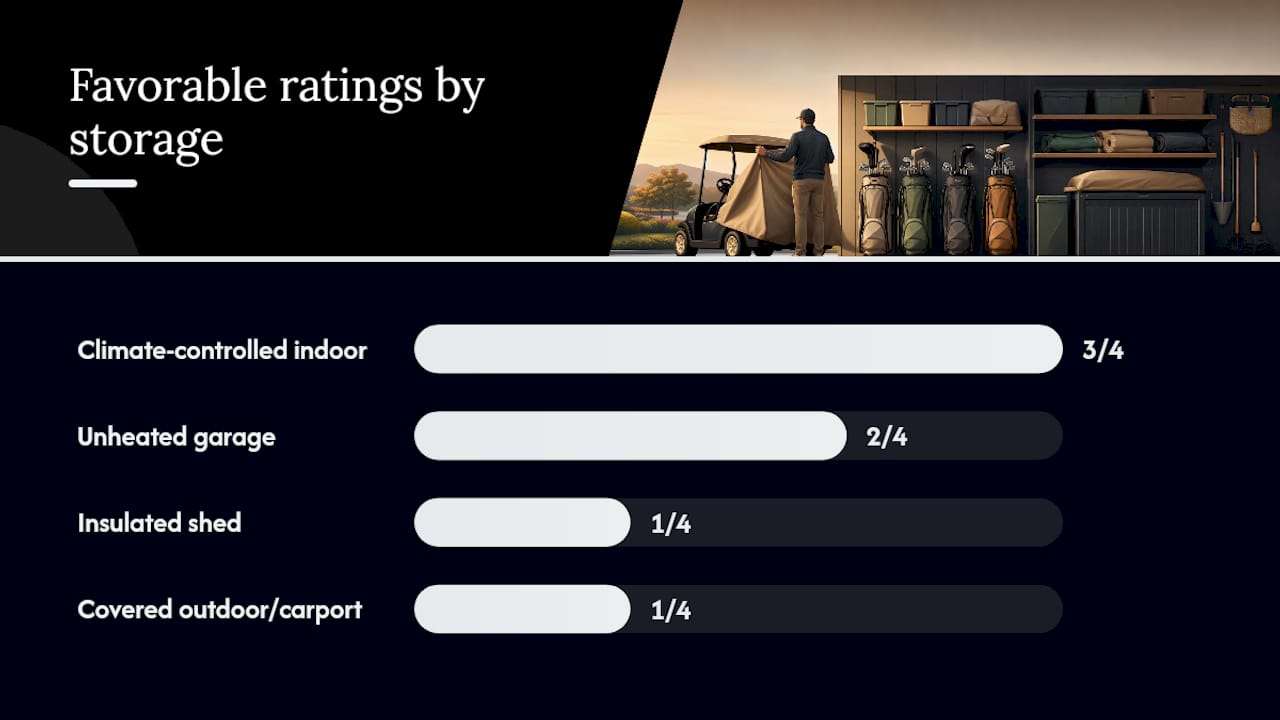
Indoor climate-controlled storage is the gold standard. It eliminates temperature swings, UV exposure, humidity cycling, and most theft and rodent risk. An unheated garage is the next best option and handles the majority of U.S. climates adequately.
| Environment | Temp Control | Humidity Risk | Rodent Risk | Theft Risk |
|---|---|---|---|---|
| Climate-controlled indoor | High | Low | Low | Low |
| Unheated garage | None | Moderate | Moderate | Low |
| Insulated shed | Minimal | Moderate | Moderate | Moderate |
| Covered outdoor/carport | None | High | High | High |
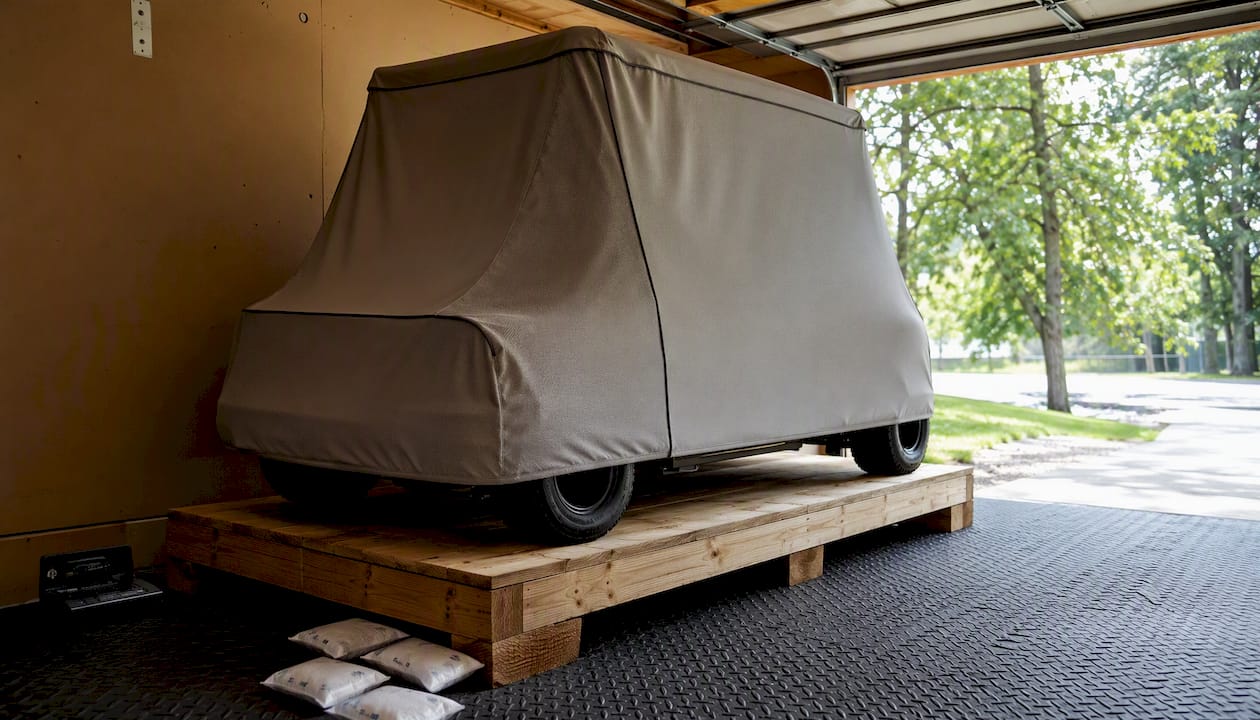
Cover selection: Use a breathable, fitted fabric cover — not a plastic tarp. Golfcartgears recommends breathable covers and moisture absorbers to limit condensation inside the cover. Plastic tarps trap moisture against the vehicle’s surfaces, accelerating corrosion and mold on seat materials.
Moisture control: Place the vehicle on a rubber mat or wooden pallet to break contact with cold concrete. Add DampRid containers or silica gel desiccant packs inside the covered area. In an unheated garage, a small electric dehumidifier set to 45–50% relative humidity makes a meaningful difference.
Rodent prevention: Seal any gaps in the storage structure. Stuff steel wool into exhaust openings and air intakes (tag them so you remember to remove it at startup). Place peppermint oil-soaked cotton balls near the engine bay and set snap traps along the walls. Rodents chew wiring harnesses, and that damage rarely shows up until the first start of the season.
What should you check every month while the vehicle is in storage?
Monthly checks take about 15 minutes and catch problems before they compound.
- Battery voltage or maintainer status. A flooded lead-acid pack reading below 12.4V per 12V unit needs a recharge. Check the maintainer’s indicator light if one is connected.
- Tire pressure. Pressure drops roughly 1 PSI per 10°F temperature drop. Reinflate to the recommended storage pressure.
- Visual inspection for leaks. Look under the vehicle for new fluid spots on the floor.
- Pest activity. Check for droppings, chewed wiring, or nesting material. Reset traps if triggered.
- Condensation and corrosion. Lift the cover and look for moisture on metal surfaces. Wipe down and reapply corrosion inhibitor if needed.
Log each check with a date. If a battery requires recharging more than once between monthly checks, that’s a signal the pack is losing capacity and may need replacement before the next season. See the golf course vehicle maintenance checklist for a printable format that adapts well to personal vehicle storage.
How do you safely recommission a stored vehicle?
Before the first start after storage, work through this sequence:
- Visual inspection: Check for rodent damage to wiring, hoses, and seat foam. Look for fluid leaks. Confirm the exhaust is clear (remove any steel wool plugs).
- Battery: Reconnect terminals (positive first, then negative). If voltage is low, slow-charge before attempting to start. A load test at an auto parts store confirms whether the pack has adequate capacity.
- Tires: Inflate to operating pressure and inspect sidewalls for cracking or flat spots. A tire with visible sidewall cracking should be replaced before riding.
- Fuel system (gas engines): Replace the fuel filter if stabilizer was used or fuel was drained. Fill with fresh fuel. Check oil level and condition.
- Brakes: Test brake operation before moving under power. Check fluid level and look for spongy pedal feel.
- Test ride: Run a slow, short loop in a safe area. Listen for unusual noises, check steering response, and verify lights and horn function.
For a detailed inspection sequence, the used golf cart inspection guide from Importjunkies covers the same checkpoints in depth.
What mistakes do owners most often make during storage?
Leaving the battery connected. Controllers, clocks, and accessories draw small amounts of current continuously. Over three to four months, that parasitic drain depletes even a healthy pack and causes sulfation in lead-acid batteries. Fix: disconnect the main negative cable or remove the pack entirely and store it indoors.
Using a plastic tarp as a cover. Tarps trap moisture and create a greenhouse effect that accelerates corrosion and mold. If you find a vehicle stored under a plastic tarp, remove it immediately, dry the surfaces, and replace it with a breathable fitted cover.
Leaving fuel untreated. Untreated gasoline begins to degrade in as little as 30 days, leaving varnish deposits in the carburetor and fuel lines. If you missed the stabilizer step before storage, add stabilizer now, run the engine for 10–15 minutes, and monitor for rough idle at startup.
Common post-storage failures and quick fixes:
- No-start on an electric cart: Check battery voltage first. A pack below 10V per 12V unit may need a slow recovery charge or replacement.
- Rough idle or no-start on a gas engine: Drain the float bowl and replace the fuel filter. A carburetor cleaning kit handles most varnish deposits.
- Flat-spotted tires: Drive slowly for 10–15 minutes to warm the rubber. Mild flat spots often self-correct. Severe deformation or cracking means replacement.
- Electrical gremlins: Inspect every connector for corrosion. Dielectric grease on reconnected terminals prevents recurrence.
When a no-start persists after battery and fuel checks, or when you find chewed wiring, take the vehicle to a qualified technician. Electrical diagnosis on a damaged harness is not a DIY job.
Why you can trust this storage guidance
The recommendations throughout this guide draw on a short list of authoritative sources:
- Hydrocell’s battery storage guide — covers lead-acid freeze risk, sulfation prevention, and monthly check protocols.
- Impact Battery’s maintenance guide — the source for the distilled-water-after-charging rule and terminal care.
- Atv — frames the pre-storage oil change as one of the highest-return maintenance steps for gas engines.
- WD Electronics’ UTV winterizing guide — practical fuel stabilizer and battery tender steps for side-by-sides.
- Importjunkies’ own blog resources — including battery type guides, utility vehicle maintenance content, and safety standards guides, which inform the recommissioning and safety sections.
Scope note: This guide covers owner-level storage and winterization for golf carts, ATVs, UTVs, and electric scooters. It does not replace manufacturer service manuals or professional technician diagnosis. When a vehicle shows signs of fuel system damage, electrical harness failure, or brake system issues after storage, consult a qualified service technician before operating it.
What storage really comes down to, from someone who’s seen the failures
The owners who skip storage prep almost always regret it in the same three ways: a dead battery that won’t hold a charge, a gummed-up carburetor on a gas engine, or a set of tires that need replacement after one winter. None of those failures are expensive to prevent. All of them are expensive to fix.
If you’re working with a limited budget, spend it in this order: a smart battery maintainer first, fresh oil and a fuel stabilizer second, and a breathable cover third. Those three investments cover the majority of storage damage. Climate-controlled indoor storage is ideal, but a clean, dry garage with a good cover and a maintainer running gets you most of the way there.
The one thing that surprises owners most is how quickly a lead-acid battery sulfates when left partially discharged in cold weather. That’s not a $30 fix. A replacement pack for a 48V golf cart is a significant expense. The maintainer pays for itself the first time it saves a battery.
Ready to gear up your cart for storage or the next season?
Proper storage prep keeps your vehicle ready to ride when the season opens — but sometimes the right move is upgrading the machine itself. Importjunkies sells direct to the public at wholesale pricing, which means you get competitive prices on 48V electric golf carts, ATVs, UTVs, and electric scooters without the dealership markup.
If you’re storing a vehicle that’s already showing its age, this is a good time to compare what a replacement would cost against another season of repairs. Importjunkies carries the Renegade X Edition and the Lifted Renegade+ 2.0, along with gas UTVs and electric scooters. Browse the full catalog or contact the Importjunkies support team to find the right vehicle for your needs.
Sources
- How to Store Golf Cart Batteries in the Winter - HYDROCELL
- Golf Cart Battery Maintenance Guide: Charging, Watering & Care Tips
- Atv
- How to Winterize Your UTV for Storage or Winter Riding – WD Electronics
Recommended
- What Makes a Cart Commercial Grade: A Buyer’s Guide – Saferwholesale || Import Junkies || Great Sports
- Types of Commercial Utility Carts: A Business Buyer’s Guide – Saferwholesale || Import Junkies || Great Sports
- Reducing Golf Cart Operating Costs: A Manager’s Guide – Saferwholesale || Import Junkies || Great Sports
- Bulk buying for golf courses: Maximize savings and efficiency – Saferwholesale || Import Junkies || Great Sports


