


 Location
 Login
Login
The usable ceiling height for a car lift is the distance from your floor to the lowest fixed obstruction, not the raw height of your ceiling deck. That number determines everything.
Here’s the quick math: vehicle height + manufacturer’s maximum lift rise + a safety buffer of 6 to 12 inches = your minimum usable ceiling height.
Rough benchmarks by lift family:
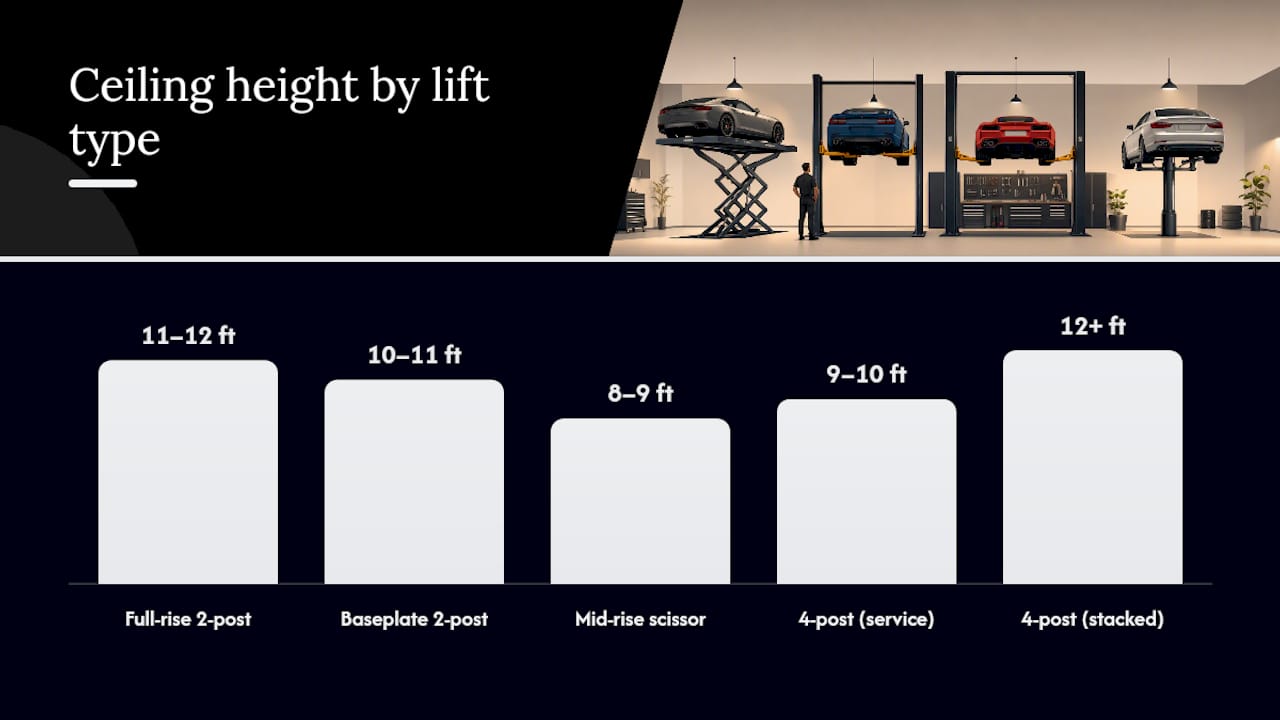
- Full-rise 2-post: 11 to 12 feet
- Baseplate/low-profile 2-post: 10 to 11 feet
- Mid-rise scissor or portable: 8 to 9 feet
- 4-post (service work): 9 to 10 feet
- 4-post (storage, stacked vehicles): 12 feet or more
If your garage falls short of these numbers, you’re not out of options. You just need a different lift family, and the rest of this guide will show you which one.
Key Takeaways
Usable ceiling height, not nominal ceiling height, determines which car lift fits your garage and how it should be installed.
| Point | Details |
|---|---|
| Measure to the lowest obstruction | Door tracks, openers, and lights often cut several inches to over a foot off usable height. |
| Use the fit formula | Vehicle height plus lift rise plus a 6 to 12 inch buffer equals your minimum ceiling need. |
| Match lift type to ceiling band | Full-rise 2-post needs 11 to 12 feet; scissor and portable lifts work down to 8 to 9 feet. |
| Check slab thickness before anchoring | Roughly 4 inches of solid concrete is the common threshold for safe 2-post anchoring. |
| Consider Importjunkies for tight garages | Importjunkies offers lift and utility equipment options suited to garages under 12 feet. |
Where can you verify exact lift specs before buying?
Always confirm model-specific numbers directly against the manufacturer’s installation manual rather than a marketing page.
- Check overall height and collapsed column height in the manual
- Confirm required anchor torque and anchor type for your slab
- Review our auto lift buying guide and safety compliance guide for installation standards
Table of Contents
- What ceiling height do different lift types actually need?
- How do you calculate the ceiling height you need?
- Do garage door tracks and lights count as ceiling height?
- Can you install a car lift on 4-inch concrete?
- Sources
What ceiling height do different lift types actually need?
Every type of auto lift has its own relationship with your garage ceiling, and the differences are bigger than most first-time buyers expect. A full-rise 2-post lift with tall overhead columns commonly measures 111 to 145 inches tall, which is why most installers won’t recommend one below a 12-foot ceiling. Baseplate 2-post models trade some rigidity for a shorter column and can often squeeze into a 10 to 11 foot bay.
Mid-rise scissor lifts and portable low-rise units are the workhorses of the low-ceiling garage. They lift a vehicle just high enough for oil changes, tire work, and brake jobs, and they function in garages as short as 8 to 9 feet. The tradeoff is obvious: you lose the standing-room clearance that makes full-rise lifts so useful for undercarriage work or long jobs.
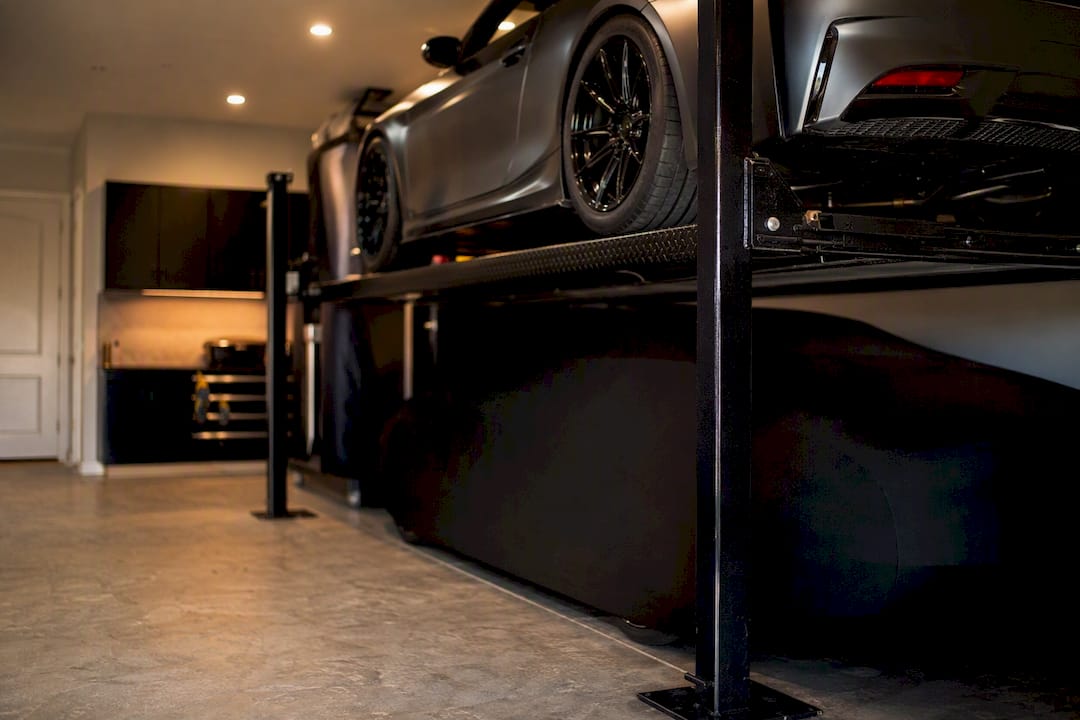
Four-post lifts split into two very different use cases. For service work, figure 9 to 10 feet. For storage, where you’re parking one vehicle above another, the math changes entirely. You need bottom vehicle height plus runway thickness plus top vehicle height plus a clearance buffer, and 12 feet is the common practical minimum for stacking two sedans or an SUV over a sedan.
| Lift type | Typical usable ceiling height needed |
|---|---|
| Full-rise 2-post | 11–12 ft |
| Baseplate/low-profile 2-post | 10–11 ft |
| Mid-rise scissor / portable | 8–9 ft |
| 4-post (service) | 9–10 ft |
| 4-post (storage, stacked) | 12+ ft |
| In-ground | Varies (below-floor pit, less ceiling-dependent) |
Pro Tip: Don’t trust the marketing photo on a spec sheet. Look for two numbers specifically: “collapsed height” (how tall the lift sits when fully lowered, which matters for headroom while you work standing next to it) and “overall height” (the tallest point when raised). Manufacturers bury these in the installation manual, not the product page.
How do you calculate the ceiling height you need?
The formula is simple, but the inputs trip people up. Here’s the full version:
- Measure your vehicle’s tallest point, roof included, with any roof rack, cargo box, or antenna attached.
- Add the lift’s maximum rise as stated in the manufacturer’s installation manual, not a generic marketing number.
- Add a safety buffer, typically 6 to 12 inches, for clearance and comfortable movement.
- Compare the total against your usable ceiling height, measured to the lowest obstruction above the lift’s footprint.
Worked example 1: Sedan on a 2-post lift. A sedan at 58 inches tall, plus a lift rise of 72 inches, plus a 10-inch buffer, equals 140 inches, or roughly 11.7 feet.
Worked example 2: SUV on a 4-post storage lift. A bottom SUV at 70 inches, plus a runway/deck thickness of about 12 inches, plus a top vehicle at 58 inches, plus an 8-inch buffer, equals 148 inches, right at 12.3 feet.
Measure your vehicle height with the manufacturer’s overall and collapsed height specs side by side, and if you’re weighing roof-mounted cargo gear, factor in add-ons like roof bars before you finalize the number, since even a low-profile rack can add two to three inches you’ll forget about until it’s too late.
Do garage door tracks and lights count as ceiling height?
Yes, and this is where most garage measurements go wrong. Your ceiling deck might read 10 feet on a tape measure, but the usable height is whatever hangs lowest inside the lift’s footprint.
Common culprits and typical drop:
- Garage door tracks and torsion hardware: 6 to 14 inches
- Garage door openers: 4 to 8 inches
- Light fixtures and fluorescent housings: 4 to 10 inches
- HVAC ducts and beams: highly variable, sometimes a foot or more
A shop’s nominal ceiling height often overstates the real clearance by a significant margin once you account for these obstructions. That’s why measuring only once, at the center of the garage, isn’t enough. Measure at the corners and along the exact path your lift columns or runways will occupy, and check that the garage door still opens and closes fully once the lift and a raised vehicle are in place.
Pro Tip: Chalk out your lift’s footprint on the floor before you measure overhead. It’s a five-minute step that stops you from underestimating clearance at the one spot that actually matters.
Can you install a car lift on 4-inch concrete?
This is the question that trips up more buyers than ceiling height itself. A 2-post lift relies on tension, pulling up on anchor bolts sunk into your slab, while a 4-post lift relies mainly on compression, spreading the load across its footprint instead of pulling against it.
Many practical guides treat 4 inches of 3,000 PSI concrete as the rough threshold for safe anchoring of a post-mounted 2-post lift. Thinner or cracked slabs change the equation.
- Thinner than 4 inches: consider a reinforced anchor pad or a 4-post lift instead
- Cracked, patched, or unknown-strength slabs: get a professional assessment before anchoring anything
- New construction: pour with lift anchoring in mind from the start, ideally 4.5 inches or thicker with proper rebar
An installer who tells you your slab is borderline isn’t being overly cautious. Pulling anchors out of undersized concrete under a loaded lift is a real failure mode, and it’s far cheaper to pour a new pad than to repair a garage floor after the fact.
How do you choose the right lift and get ready for installation?
Work through this in order:
- Measure your usable ceiling height to the lowest obstruction in the lift footprint.
- Match that number against the lift family ranges above.
- Confirm your tallest vehicle’s height, including racks or lift kits.
- Check slab thickness and condition before committing to a 2-post lift.
- Get an installer quote and check local permit requirements.
Before you call anyone, have these on hand: overall lift height, collapsed column height, maximum rise, anchor type required, and the manufacturer’s installation manual. An installer can move faster, and quote more accurately, when you’ve already done this homework.
Red flags that mean you need a professional include any crack near where anchors will be placed, an unverified slab thickness, or a garage door that won’t clear the raised lift.
What garage lift mistakes do we see most often?
The most common mistake we see is homeowners measuring straight to the ceiling deck and skipping the door track, opener, and light fixture that actually control clearance. The second is forgetting a roof rack or lift kit when checking vehicle height. If your slab is questionable or your ceiling is under 9 feet, bring in a certified installer rather than guessing. For deeper technical detail, our team has covered lift certification standards and safety compliance in separate guides worth reading before you buy.
What if your garage still doesn’t fit a full-size lift?
If your measurements come back tight, you’re not stuck with a workbench and a jack. Importjunkies stocks lift options and utility equipment built for garages that don’t hit the 12-foot mark, and unlike a shop that only pushes full-rise 2-post units, we help you match equipment to the ceiling you actually have.

A mid-rise scissor lift or a baseplate 2-post model can get you real lift access in an 8 to 10 foot bay, and if you’re outfitting the same garage for other equipment, our buying guide for tight garage spaces breaks down what fits where. Import Junkies also carries utility vehicles, ATVs, and specialty equipment for the same buyers who are setting up a home shop, so if you’re outfitting a garage from the ground up, browse our utility vehicle lineup while you’re at it. Take your measurements, check them against the ranges above, and reach out for a quote on the lift that matches your actual garage.
Sources
- How Much Ceiling Height Do You Need for a Car Lift? (Real Numbers) — Elite Garage Tools
- Car Lift Ceiling Height Requirements — Complete Guide (2026) — InnovDepot
- How High Should Your Shop’s Ceiling Be For A Car Lift? — AutoLeap
- Car Lift Ceiling Height Guide (2026): Will a Lift Fit Your Garage? — CarLiftLab
Recommended
- Best Lifts for Small Garage Spaces: 2026 Buyer’s Guide – Saferwholesale || Import Junkies || Great Sports
- Auto Lift Buying Guide 2026: Choose Right, Work Safe – Saferwholesale || Import Junkies || Great Sports
- Best Lifts for Classic Car Storage: 2026 Buyer’s Guide – Saferwholesale || Import Junkies || Great Sports
- Types of Auto Lifts: Mechanic’s Guide for 2026 – Saferwholesale || Import Junkies || Great Sports


