


 Location

 Login

Ebike motors come in two main designs: hub motors, built into the center of the front or rear wheel, and mid-drive motors, mounted at the pedals where the cranks meet the frame. A third type, the friction drive, shows up mostly on bolt-on conversion kits. Which one is right depends on how steep your hills are, how much you want to spend, how much you plan to haul, and how much maintenance you are willing to do. This guide walks through each type in plain terms so you can match a motor to your riding before you shop.
TL;DR
- Hub motors sit in the front or rear wheel. They cost less, don’t wear out your chain, and are common on commuters, folding bikes and complete bikes at lower prices.
- Mid-drive motors sit at the bottom bracket (the pedal axle area) and push through the bike’s gears. They climb steeper hills more efficiently and balance the bike better, but usually cost more.
- Geared hubs favor low-speed pulling power and light weight. Direct-drive hubs favor higher speeds and can support regenerative braking.
- BLDC (brushless DC) is the motor technology inside nearly all of these. It is not a separate type to choose between.
- Match the motor to your terrain and load first, then compare watts, sensors and price.
Table of Contents
- The three placements: front hub, rear hub and mid-drive
- How each motor actually works
- Hub vs. mid-drive: how they compare
- Sensors and power: two specs that change how the motor feels
- Matching a motor to how you ride
- Our perspective on motor choice
- Shop electric bicycles online
- FAQ
- Sources
The three placements: front hub, rear hub and mid-drive
When riders talk about motor types, they are really talking about where the motor sits on the bike. Bicycling groups e-bike drives into three basic variants: mid-drive motors at the center of the frame where the bottom bracket normally sits, hub motors inside the front or rear wheel, and friction drives, which are mostly aftermarket.
The District of Columbia’s official e-bike guide splits hubs by wheel and lists four drive-unit types: front hub, rear hub, mid-drive and a fourth category for other systems. It notes that front-hub systems are common in conversion kits, rear hubs are common on complete e-bikes and are often throttle-capable, and mid-drives are generally pedal-only with typically no throttle.
Front hub motors
A front hub puts the motor in the front wheel. BikeRadar says front-hub motors are common on cheap e-bikes, commuting hybrids, folding bikes and conversion kits. They are simple to add to an existing bike, and a peer-reviewed review in the journal Energies finds they are convenient for maintenance. The trade-off in that same review is front-wheel slippage and steering difficulty, because the motor is pulling the wheel you steer with.
Rear hub motors
A rear hub drives the back wheel. BikeRadar notes these suit hybrids and e-road bikes, look sleek, and benefit from the rider’s weight over the rear wheel for traction. The Energies review says rear-hub motors avoid the slippage problem of front hubs but can unbalance the bike, since the motor adds weight at the back.
Mid-drive motors
A mid-drive sits in the middle of the bike, in the bottom bracket area. BikeRadar says mid-mounted motors turn up on every kind of e-bike and are especially well suited to electric mountain bikes because their weight is central and low. The Energies review calls mid-drives smaller, better balanced, and better at hill climbing than hub motors of the same power, with the downside that they need custom frames and cost more.
How each motor actually works
You do not need an engineering degree to choose well, but a little mechanics explains why the types feel so different on the road.
Mid-drive: power through the chain
According to Bicycling, a mid-drive motor spins a shaft that turns a chainring, adding to your pedaling through the chain. Internal gearing reduces the motor’s hundreds of revolutions per minute to a pedaling cadence of roughly 50 to 80 RPM. Because the power goes through the drivetrain, you can shift gears to keep the motor in its efficient range. That is why mid-drives handle steep climbs well. Cycling UK makes the same point: mid motors use the bike’s gearing to stay at optimal speed, which usually makes them more efficient.
The flip side is that your chain, cassette and chainrings carry extra load. Bicycling notes that mid-drives wear chains faster than hub systems.
Hub motors: power straight to the wheel
In a hub motor, the shaft is the fixed axle and the outer hub shell spins around it to turn the wheel. Tom’s Guide points out that hub motors deliver power quickly and directly to the wheel, while mid-drive power has to travel through the drivetrain and loses some along the way. Your chain only carries your own pedaling, so it is not subject to extra wear from the motor.
Hub motors come in two flavors.
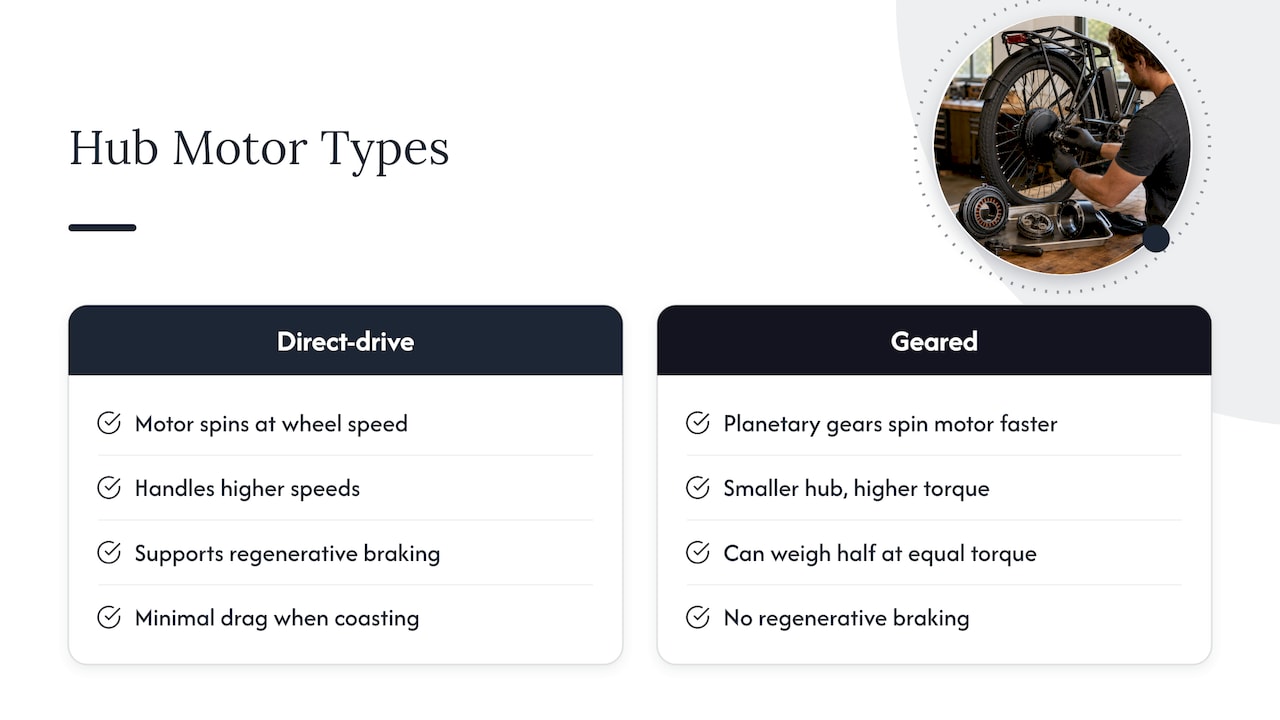
Direct-drive hubs have no moving parts besides bearings. The motor itself spins at wheel speed. Bicycling says these handle higher speeds, can support regenerative braking (the motor feeds a little energy back to the battery when you slow down), and create minimal drag when coasting.
Geared hubs use planetary gears to turn the motor faster than the wheel, which lowers hub size and raises torque. Bicycling says they suit low-speed, high-torque riding and can weigh half as much as a direct-drive hub with equal torque. A freewheel lets them coast freely, though they do not offer regenerative braking. Cycling UK adds that geared hubs are the more common choice on modern bikes because the faster-spinning motor is more efficient and smaller.
Friction drives: the bolt-on option
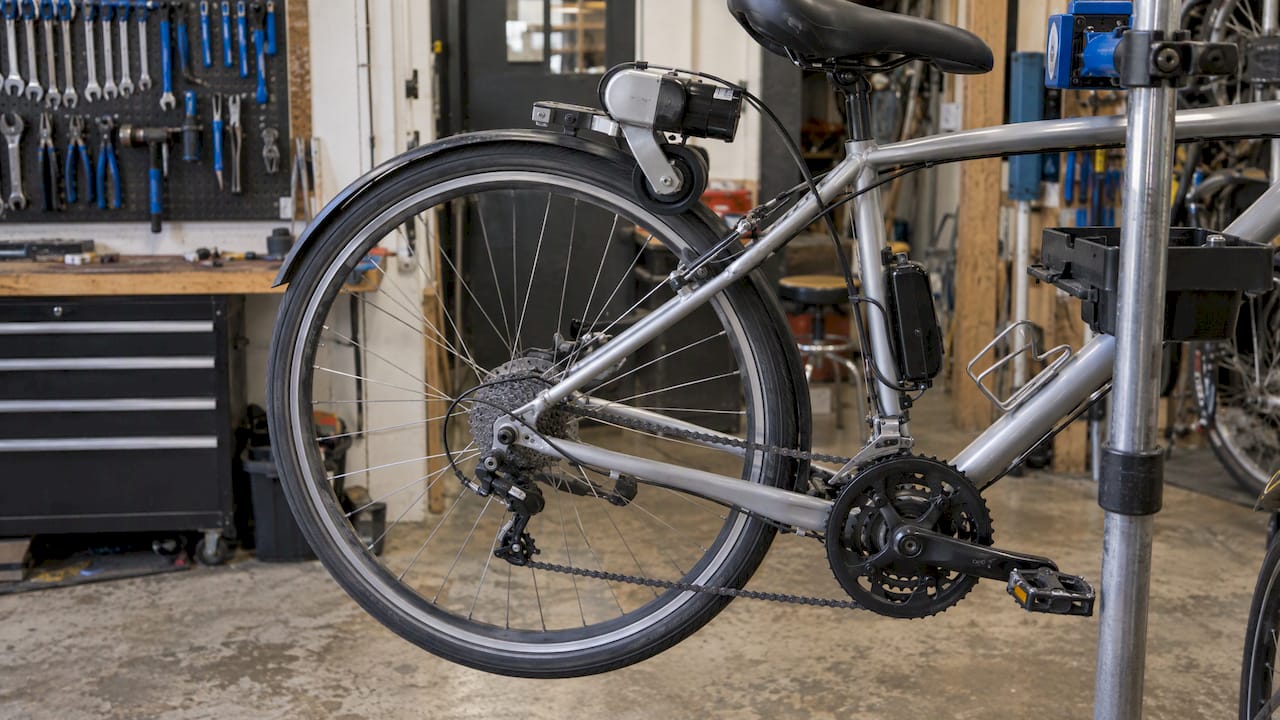
A friction drive is a small motor with a roller that presses against the tire and spins it. Bicycling describes them as mounting below the chainstays, above the seat stays or on the fork’s brake mount. They move easily from bike to bike, but they wear tires faster, and they are cumbersome and less efficient, which is why you do not see them on new complete e-bikes. If you are shopping for a finished bike rather than building one, you can safely focus on hubs and mid-drives.
Where BLDC fits
You will see “BLDC” on spec sheets and in search results, and it is easy to think it is a rival to hub or mid-drive. It is not. Bicycling explains that e-bikes use brushless DC motors, which have no brushes to flip the current direction. Instead, a stator of wound wire acts as an electromagnet against permanent-magnet rotors. The Energies review documents that BLDC motors replaced brushed DC motors for higher reliability, greater power density, lower noise and less maintenance. So a hub motor can be BLDC, and so can a mid-drive. The question to ask is where the motor sits and, for hubs, whether it is geared or direct-drive.
Hub vs. mid-drive: how they compare
| What you care about | Hub motor | Mid-drive motor |
|---|---|---|
| Steep hills | Less efficient climbing | Uses the bike’s gears, so climbs more efficiently |
| Balance and handling | Weight sits in one wheel | Weight is low and central |
| Flat tires | Wheel removal can be tedious | Wheel removal is easier |
| Chain wear | No extra chain wear | Chain wears faster |
| Price | Cheaper, thanks to mass production | Usually costs more |
| Throttle | Often available, especially on rear hubs | Generally pedal-only |
The hill, tire and cost rows come from Bicycling’s comparison, and the throttle row from the D.C. guide above. Both agree on the overall pattern: mid-drives reward riders who climb and ride rough terrain, while hubs reward riders who want a lower price and less drivetrain wear.
Hills and ride feel
If your route has sustained climbs, a mid-drive gives you the advantage of gearing. You can drop to an easier gear and let the motor spin where it works best. Tom’s Guide notes that mountain bikers and road cyclists usually choose mid-drives because the weight is low, centered and not rotational. On flat or rolling commutes, a hub’s direct push feels natural, and the extra efficiency of a mid-drive matters less.
Range and regen braking
Regenerative braking is a direct-drive hub feature, and its range benefit is modest. Bicycling reports that a YouTuber’s measurements found an average 3.5% range gain, with larger gains on hilly routes. The bigger payoff is stopping power on long descents, since regen takes some load off your brakes.
Maintenance and repairs
Think about the two jobs you will do most: fixing flats and replacing drivetrain parts. Hub motors keep your chain healthy but make wheel removal harder. Mid-drives make flats easier but ask more of the chain. The D.C. guide makes the same wheel-removal point. If you ride a lot of miles on a commuter, budget for chain replacement with a mid-drive. If you ride where flats are common, a mid-drive’s easier wheel removal helps.
Sensors and power: two specs that change how the motor feels
Motor type is only part of the ride. How the bike senses your pedaling matters just as much. Cycling UK says mid motors generally use torque sensors that respond in proportion to your effort, while most hub systems use simpler cadence sensors that only detect that you are pedaling. A torque sensor feels like a stronger version of you. A cadence sensor feels like a switch that turns assistance on. We explain the difference in our guide to torque vs. cadence sensors for ebike buyers.
Power rating is the other half. In the U.S., federal rules for low-speed electric bicycles cap the motor at 750 watts, so most riders end up choosing between 500W and 750W. Our breakdown of the 750W federal limit and choosing 500W or 750W shows how that rating plays out on real terrain. Check your state and local rules too, since classes and trail access vary by place.
Matching a motor to how you ride
Commuting and errands on mostly flat ground. A rear or front hub keeps the price down and keeps the drivetrain simple. A throttle-capable hub also helps when you want to get moving from a stoplight without pedaling.
Steep hills or loaded riding. A mid-drive’s use of the gears is the reason to pay more. Bicycling says mid-drives climb steep hills more efficiently, and BikeRadar notes that cargo bikes and e-mountain bikes typically come with higher-spec, higher-torque motor systems.
Trails and rough terrain. Mid-drives’ low, central weight suits technical riding. Heavy hub motors put weight at one wheel, which can change how the bike handles over roots and rocks.
Mixed use on a budget. A geared hub gives low-speed pull for a modest price and weight. If you sometimes cruise at higher speeds, a direct-drive hub holds up better and adds the option of regen.
Fleet or property use. If you run a campground, a resort or a small business and want a few bikes for staff to get around, simplicity matters. Hub-motor bikes have fewer drivetrain wear parts, and the price per bike stays lower across a group purchase.
A quick decision path
- List your steepest regular climb and how long it lasts.
- Decide whether you want a throttle. Hubs commonly offer one, and mid-drives generally do not.
- Set a budget. Mid-drive bikes usually cost more, and the gap should be worth it for your hills.
- Choose a sensor type: torque for natural feel, cadence for simplicity.
- Check the power rating against the 750W federal limit and your local rules.
Our perspective on motor choice
Most buyers who contact us start with the wrong question. They ask which motor is best, when the better question is which motor fits the ground they ride on and the load they carry. A rider with a flat bike path and a daily commute does not need the same machine as someone climbing a hill with groceries or gear.
We built our electric bicycle catalog for that range of riders: recreational riders, small business owners who need easy local transportation, and bargain hunters who want direct pricing without a retail markup. We sell direct to the public, which is how we keep pricing competitive.
Our advice is to read the spec sheet in this order: motor placement, power rating, sensor type, then battery. Put your terrain at the top of the list. Once those line up, price comparisons actually mean something. Our electric bike buying guide goes through the full process.
Gary
Shop electric bicycles online
Once you know which motor layout suits your riding, you can browse our electric bicycles collection and compare models by price, power and specs. One example is the Macfox 48V 750W e-bike X2, listed with a 750-watt rating. We sell online directly to the public, with checkout, wishlist and cart features to keep buying quick, and we offer financing options.
If you need something beyond a bicycle, such as an electric scooter or a utility vehicle, our electric scooters and electric UTVs pages cover those too.
FAQ
What are the different types of ebike motors?
The two main types are hub motors, built into the front or rear wheel, and mid-drive motors, mounted at the pedals. Hub motors split further into geared and direct-drive versions. Friction drives, which spin the tire with a roller, exist mainly as aftermarket kits.
Which motor is best for an e-bike?
There is no single best motor, only the best fit. Mid-drives suit steep hills, rough trails and heavy loads because they use the bike’s gears. Hub motors suit flat commuting and lower budgets, and they spare your chain extra wear.
Which is better, hub motor or BLDC motor?
This is not a real either-or choice. BLDC means brushless DC, which is the motor technology used in both hub and mid-drive e-bikes. The comparison you want is hub versus mid-drive, and for hubs, geared versus direct-drive.
Are geared hub motors better than direct-drive hubs?
It depends on your speed and weight priorities. Geared hubs give strong low-speed torque at a lighter weight. Direct-drive hubs handle higher speeds, coast with minimal drag and can support regenerative braking.
Do I need a throttle?
Only if you want to move without pedaling. Hub-motor bikes, especially rear hubs, often include one. Mid-drive bikes are generally pedal-assist only, so check the spec for a throttle if that matters to you.
Sources
- Electric Bike Motors, Bicycling
- District of Columbia E-Bike Guide
- E-Bike Motor Drive: A Review of Configurations, Energies
- Electric bike motors explained, BikeRadar
- E-bike motor types explained, Tom’s Guide
- Power up: Switch on to e-bikes, Cycling UK


