


 Location
 Login
Login
Most buyers pay about $9,000 to $15,000 for a new golf cart and $4,000 to $9,000 for a quality used one. Finance either purchase and you’re typically looking at $100 to $300 a month, depending on your down payment and credit. Electric carts cost more upfront but usually run cheaper year to year; gas carts cost less to buy but eat into that savings at the pump and in the shop.
Here’s the quick breakdown before we get into what actually drives those numbers:
- New entry-level electric or gas cart: $9,000–$12,000
- New mid-range or premium cart: $12,000–$20,000+
- Quality used cart (3–7 years old): $4,000–$9,000
- Budget or older used cart: $2,000–$4,000
Quick stat: New base carts commonly run about $9,000 to $12,000, with premium and custom builds pushing past $20,000 once you add lift kits, custom wheels, or extended seating.
Key Takeaways
| Point | Details |
|---|---|
| New cart pricing | Entry-level electric or gas carts start around $9,000 to $12,000; premium builds run $12,000 to $20,000+. |
| Used carts hold value in the middle years | Carts aged 3 to 7 years typically sell for $4,000 to $9,000 and offer the strongest value trade-off. |
| Battery choice drives long-term cost | Lithium packs cost $2,178 to $2,700 upfront but outlast lead-acid batteries by several years. |
| Budget beyond the sticker price | Add first-year fees, a battery fund, and insurance to get your real first-year ownership cost. |
| Import Junkies offers ready-to-buy 48V models | The Renegade Edition and its variants give U.S. buyers a direct path to a new electric cart with transparent online pricing. |
Table of Contents
- Golf Cart Prices for New and Used Models in 2026
- What Does a Golf Cart Really Cost to Own?
- How Should You Budget for a Golf Cart Purchase?
- What the Numbers Actually Tell You About Buying Smart
- Sources
Golf Cart Prices for New and Used Models in 2026
Sticker prices vary more than most first-time buyers expect, and the gap usually comes down to three things: powertrain, seating, and how recently the cart left the factory.
New electric carts anchor the market. Entry-level 2 or 4-seat models typically start around $9,000 to $11,000, and that range holds steady across most dealer listings this year. A Club Car Onward 4P starts near $11,299, and once you move into premium lithium-equipped models, prices climb to $11,795 to $11,995 before options. Push into custom trims with lift kits, upgraded wheels, or extended roofs, and you’re often into the $12,000 to $20,000 range.
Gas carts tend to run a bit higher than their electric counterparts at the entry level. Recent market checks put new gas carts averaging $10,000 to $13,000, compared to $9,000 to $11,000 for new electric models. That gap surprises a lot of shoppers who assume gas is always the cheaper starting point. It isn’t, mainly because gas carts need a combustion engine and fuel system that electric models simply skip.
Used pricing splits cleanly by age and condition:
- 1–3 years old: $7,000–$10,000, often with most factory warranty intact
- 4–7 years old: $4,000–$9,000, the sweet spot for value-focused buyers
- 8–12 years old: $2,500–$5,000, expect upcoming battery or drivetrain work
- 12+ years old: $1,500–$3,000, budget for near-term repairs or a battery swap
A used Club Car Precedent, one of the most common resale models, carries a median asking price around $5,450 on most marketplaces, which tells you where the middle of the used market actually sits.
Seating capacity influences price predictably. A 2-seat cart tends to be the most affordable, while 4-seat and 6-seat models add increasing cost due to larger frames and additional hardware. If you’re cross-shopping larger family or group carts, our breakdown of 6-passenger golf cart pricing walks through those numbers in more detail.
Want street-legal capability? Low-speed vehicle (LSV) packages, with turn signals, headlights, mirrors, and a horn, typically add several thousand dollars and can push a starting price into the $12,000 to $16,000 range depending on the equipment bundle.

What Does a Golf Cart Really Cost to Own?
The sticker price is only the entry fee. What you spend keeping a cart running over the next three to five years often adds up to real money, and this is where a lot of buyers get blindsided.
Battery replacement is the single biggest recurring cost, and it splits sharply by battery type. Lead-acid battery banks typically cost $800 to $1,500 to replace and last three to five years under normal use. Lithium packs cost more upfront but last considerably longer and need far less maintenance. Named lithium anchors this year include the Eco Battery 51V 105Ah pack at $2,178 MSRP and the Allied RS Commercial 48V 105Ah pack at $2,700. That’s a real premium over lead-acid, but lithium packs commonly outlast two or three lead-acid replacement cycles, which changes the long-term math in lithium’s favor for anyone keeping a cart five-plus years.
Here’s how annual running costs typically break down:
- Maintenance and tires: $150–$400 per year for routine service, tire wear, and small repairs
- Fuel or charging: electric carts run roughly $0.75 per full charge on a typical 4.0 kWh battery pack at current U.S. residential electricity rates, while a gas cart’s 5.6-gallon fill recently ran about $21.59
- Insurance and registration: $100–$500 per year, higher if your cart is street-legal and requires LSV registration
Add it up and annual ownership costs typically fall between $800 and $2,000 depending on powertrain, usage, and whether you’re carrying insurance. Electric carts generally cost less to run year over year than gas carts, once you set battery replacement aside as its own line item.
Play that forward across five years on a $10,000 electric cart. You might spend $4,000 to $10,000 on operating costs, insurance, and one battery swap, meaning your real five-year cost of ownership lands closer to $14,000 to $20,000, not $10,000. That’s not a reason to walk away from the purchase. It’s a reason to plan for it.
Pro Tip: Set aside a dedicated “battery fund” from day one, roughly $30 to $50 a month if you’re on lead-acid. By the time your battery bank needs replacing, you won’t be scrambling to cover an $800 to $1,500 surprise.
How Should You Budget for a Golf Cart Purchase?
Before you start comparing listings, run through a short checklist. It’ll save you from buying the wrong cart for your actual use case.
- How will you use it? Neighborhood cruising, golf course rounds, hunting or farm work, and job-site hauling all point toward different carts.
- What’s your terrain? Hills and rough ground favor gas or higher-torque electric drivetrains; flat pavement is friendlier to entry-level electric models.
- How long will you keep it? Buyers planning to own for 5+ years often come out ahead with lithium despite the higher upfront cost.
- Do you need street-legal capability? If you’re crossing public roads, you need an LSV package and the registration that comes with it.
- How much maintenance are you willing to do? Gas carts need more hands-on upkeep; electric carts are largely maintenance-free outside battery care.
Once you know what you’re buying, use this formula to figure out what you’re actually spending:
Sticker price + first-year fees (tax, delivery, setup) + battery fund + annual insurance + financing costs = your real first-year cost.
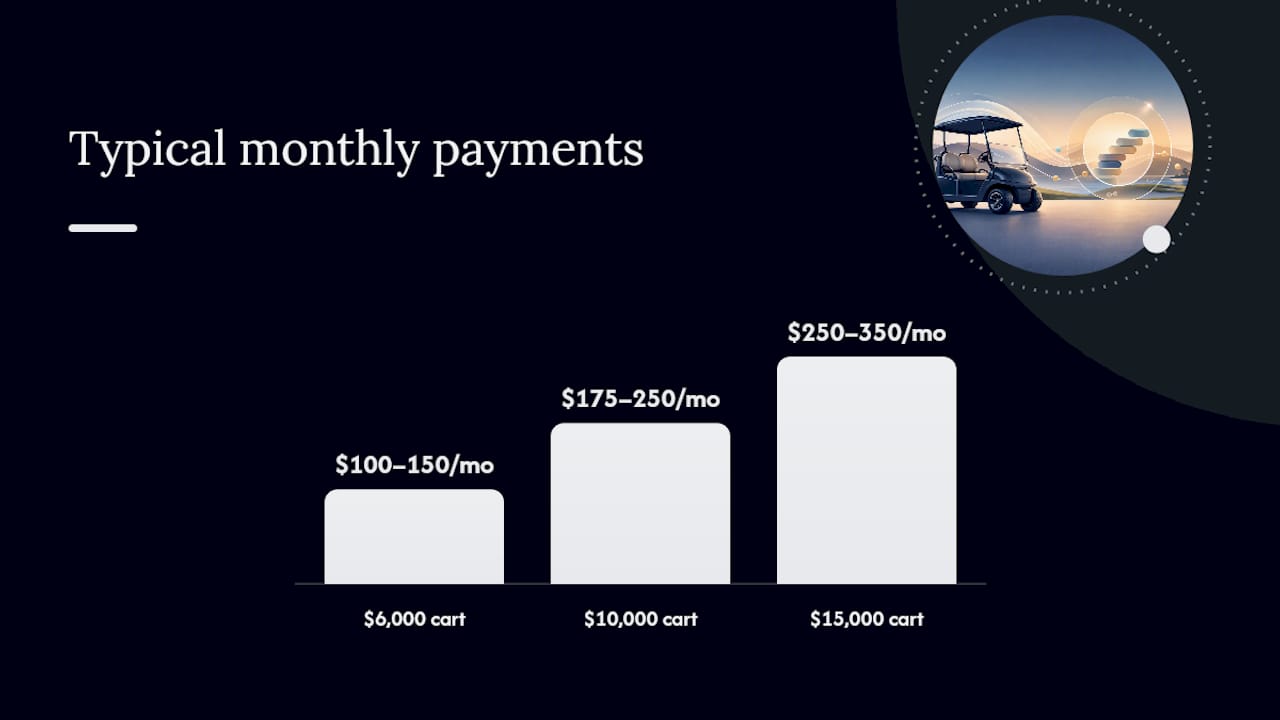
On financing, monthly payments scale predictably with purchase price. For a $6,000 cart, expect roughly $100 to $150 a month on a typical loan term. A $10,000 cart runs closer to $175 to $250 a month, and a $15,000 cart lands around $250 to $350 a month, depending on your down payment, credit profile, and loan length. Watch for origination and documentation fees, which commonly add 1% to 5% to your total loan cost, and ask whether GAP insurance is bundled in or optional. Our guide on financing a golf cart step by step walks through how to compare loan offers so you’re not just accepting the first number a dealer quotes.
Why Trust This Guide?
This guide comes from Gary’s ongoing buyer-cost analysis work for Import Junkies, where pricing research gets translated into practical guides like our smart buyer’s guide to golf carts and our breakdown of electric versus gas golf carts.
Depreciation hits hardest in years one through three. A used cart in the three-to-five-year window often gives you the best value trade-off, assuming you’re comfortable with reduced remaining warranty coverage.
That’s not a guess. It reflects how resale values and ownership costs actually track once you move past the first few years of ownership.
- Import Junkies’ 48V 4-seater Renegade Edition product page includes full specs and current pricing.
- Deeper reading on feature-driven price differences lives in our 2026 golf cart features guide.
What the Numbers Actually Tell You About Buying Smart
Most price guides stop at the sticker number, and that’s exactly where they fail buyers. The real story is in the gap between what a cart costs to drive off the lot and what it costs to keep running for five years. A $9,000 electric cart and a $10,500 gas cart might look close at checkout, but factor in fuel, maintenance, and a lead-acid battery swap, and the gas cart often ends up the pricier vehicle by year three.
The conventional advice, “buy electric if you want to save money,” isn’t wrong, but it’s incomplete. It matters more whether you’re buying lithium or lead-acid, and whether you’re planning to keep the cart long enough for lithium’s higher upfront cost to pay off. Short-term owners, three years or less, often do fine with lead-acid. Long-term owners almost always come out ahead going lithium, even at $2,000-plus for the pack.
If you take one thing from this guide, prioritize the battery decision over the brand or the cosmetic package. It affects your total cost more than almost anything else you’ll choose.
— Gary
Where to Buy: Import Junkies Options and Next Steps
Import Junkies carries new 48V 4-seat electric golf carts built for exactly the buyers this guide is written for, whether you’re hauling gear around a property or shuttling family and friends around the neighborhood. The Renegade Edition suits recreational buyers who want a straightforward, reliable 4-seater without a steep learning curve. The Silver Renegade X Edition adds styling upgrades for buyers who want their cart to stand out, and the Lifted Renegade+ 2.0 gives you added ground clearance if you’re splitting time between pavement and rougher terrain.
Before you commit to any listing, run the total cost of ownership math from this guide, not just the sticker price. Compare battery type, expected annual maintenance, and financing terms across every cart you’re considering. Browse Import Junkies’ full lineup of 48V electric golf carts to see current specs and pricing, or reach out through Importjunkies to ask about financing options on a specific model.
Sources
- How Much Does a Golf Cart Cost? New, Used & Lithium — Golf Cart Lab
- Golf Cart Cost of Ownership Calculator | GolfCartSearch
- How Much Does A New Golf Cart Cost? — GolferHive
Recommended
- 6 Passenger Golf Cart Price: What to Expect – Saferwholesale || Import Junkies || Great Sports
- Golf cart features: a complete buyer’s guide for 2026 – Saferwholesale || Import Junkies || Great Sports
- Golf Cart Buying Guide for Smart Buyers – Saferwholesale || Import Junkies || Great Sports
- Are Golf Carts Worth Buying? Real Cost Breakdown – Saferwholesale || Import Junkies || Great Sports


