


 Location
 Login
Login
A golf cart warranty typically covers factory defects in major components: the motor, controller, frame, and electrical system, for a set period after purchase. It usually does not cover batteries on the same schedule, accessories, wear items, or damage from accidents or misuse. Terms shift depending on whether the manufacturer, the dealer, or a third-party administrator backs the plan, and battery chemistry (lithium vs. lead-acid) changes the math considerably. Insurance handles a different set of risks entirely: theft, collision, liability.
Before you assume you’re covered for anything, do this:
- Locate the written warranty tied to your cart’s serial number
- Confirm who backs it: manufacturer, dealer, or third-party
- Check whether battery coverage runs on a separate clock
- Note any registration or maintenance requirements that keep it valid
Key Takeaways
Golf cart warranty coverage protects against factory defects in major components, while batteries, accessories, and wear items usually run on separate, shorter terms.
| Point | Details |
|---|---|
| Read the actual document | Locate the written warranty tied to your cart’s serial number before assuming any coverage applies. |
| Batteries run on their own clock | Lithium and lead-acid batteries carry different terms, cycle limits, and prorating rules than the main warranty. |
| Warranty and insurance solve different problems | Warranties fix defects; insurance covers theft, collision, and liability, especially for street-legal or financed carts. |
| Maintenance records protect your claim | Keep service receipts and follow the schedule, since undocumented upkeep is a common reason claims get denied. |
| Compare terms before buying | Import Junkies lists warranty details on product pages so you can check coverage before you commit to a purchase. |
Table of Contents
- What A Standard Golf Cart Warranty Covers
- How Long Does Coverage Actually Last?
- Battery Warranties: Where Lithium And Lead-Acid Diverge
- Exclusions And Hidden Costs In Extended Service Contracts
- Warranty Coverage Versus Golf Cart Insurance
- How To File A Warranty Claim Without Getting Denied
- What Import Junkies Recommends Before You Buy
- An Editorial Take On Warranty Guides That Oversimplify
- Where To Check Warranty Terms Before You Buy
- Sources
What A Standard Golf Cart Warranty Covers
Factory-defect coverage means the manufacturer stands behind flaws in materials or workmanship that show up during normal use, not damage you caused. On a typical golf cart, that usually extends to:
- The electric motor or gas engine
- The controller and speed sensor
- The transaxle and drivetrain
- Steering components
- The onboard charger (for electric models)
- Core electronics and wiring harnesses
Labor coverage is where owners get tripped up. Most manufacturer warranties require repairs at an authorized dealer, and some only reimburse labor performed there, not at your neighborhood mechanic. If you bought your cart from a dealer three states over and moved, or if the nearest authorized shop is an hour away, that restriction turns a “covered” repair into an inconvenient one.
Exclusions follow a predictable pattern across brands. Tires, belts, brake pads, and upholstery are wear items, expected to degrade and rarely covered past the first few months. Cosmetic damage, accident or impact damage, corrosion from neglected storage, and anything traced to non-factory modifications will get a claim denied fast, according to warranty guidance from Golf Cart Search.
Pro Tip: Take a photo of your serial number plate the day you buy the cart and save it with your warranty PDF. Dealers ask for it constantly, and digging through a golf cart’s undercarriage to find it during a claim dispute is nobody’s idea of fun.
How Long Does Coverage Actually Last?
Warranty length isn’t one number. It’s several numbers stacked on top of each other, and they rarely expire at the same time.
- Major components (motor, controller, frame): commonly 1 to 4 years
- Accessories (lights, mirrors, seat covers): coverage periods are generally shorter, varying by warranty
- Lithium batteries: frequently 3 to 8 years depending on the manufacturer, per Golf Cart Search’s warranty breakdown
- Lead-acid batteries: usually covered for a limited period, often with prorated replacement terms after an initial phase
The mismatch matters more than most buyers realize. A cart with a 4-year frame warranty and a 1-year lead-acid battery warranty is really only “fully covered” for that first year. After that, you’re managing two separate coverage clocks, which affects both your repair budget and what you can honestly tell a buyer if you sell the cart used.
Always check whether the term is calendar-based (starts the day you bought it, ends on a fixed date) or usage-based (tied to hours or miles). Some battery warranties are also prorated, meaning a failure at month 30 of a 36-month term gets you partial credit, not a free replacement.
Battery Warranties: Where Lithium And Lead-Acid Diverge
Batteries cause more warranty disputes than any other component, and lithium and lead-acid batteries play by different rules entirely.

Lithium battery warranties tend to advertise longer calendar terms, sometimes matching or beating the cart’s own frame warranty, but they often cap coverage by cycle count or amp-hour throughput rather than time alone. A battery rated for 2,000 cycles that gets charged daily could hit that limit well before the calendar term runs out.
Lead-acid batteries follow the opposite pattern: shorter terms, usually 12 to 18 months, and they’re wear items by nature. Expect prorated replacement, not full coverage, once you’re past the early months.
Before you assume a battery is protected, confirm:
- Whether replacement is full or prorated after a set number of months
- Whether the battery management system (BMS) itself is covered, not just the cells
- Required charging specs and maintenance intervals spelled out in the warranty text
Improper charging habits, letting batteries sit fully discharged for weeks, and aftermarket battery conversions are the leading causes of denied battery claims. Insurers and manufacturers flag these repeatedly as coverage killers, a pattern confirmed in Golf Cart Search’s warranty guide.
Exclusions And Hidden Costs In Extended Service Contracts
Extended warranties and dealer service contracts can look generous on paper while quietly limiting what you’ll actually collect. The exclusions echo the manufacturer warranty: wear items, cosmetic damage, accident damage, neglect, and non-factory modifications are almost universally carved out.
The costs that catch people off guard live in the fine print:
- Per-visit deductibles that apply even to covered repairs
- Transport or pickup fees if the cart can’t be driven to a shop
- Diagnostic charges before any repair work even begins
- Restrictions limiting you to a narrow list of authorized repair centers
A plan with a low monthly premium can still leave you paying hundreds out of pocket if it charges for pickup and diagnostics on every visit. That’s the gap between the advertised price and what you actually spend over the contract’s life.
Pro Tip: Before signing an extended contract, ask directly who backs it: the manufacturer, the dealer, or a third-party administrator like American Cart Care, which offers plans covering labor plus electrical and mechanical components. Also ask whether the contract transfers to a new owner if you sell the cart, and what the cancellation terms look like if you’re unhappy six months in.
Warranty Coverage Versus Golf Cart Insurance
A warranty fixes things that break due to factory defects. Insurance pays when something outside a defect happens: theft, vandalism, a collision, or someone getting hurt. Confusing the two is one of the most common and expensive mistakes owners make.
Standard auto or homeowners policies rarely cover a golf cart fully, and most insurers point owners toward a standalone policy once the cart leaves private property, according to GEICO’s golf cart insurance guidance. State Farm notes that whether you need standalone coverage often depends on where and how you drive the cart, with homeowners policies sometimes offering limited liability on your own property but nothing more.
You likely need dedicated insurance if any of these apply:
- The cart is street legal and registered with your state DMV, a status our guide to street legal golf cart requirements breaks down in detail
- A lender financed the purchase and requires proof of coverage
- Your HOA or gated community mandates it for road use
- You want protection against theft, vandalism, or collision, not just defect repair
Progressive structures its golf cart policies much like auto insurance: liability, collision, comprehensive, and uninsured motorist coverage are all available add-ons worth comparing against what your warranty leaves exposed.
How To File A Warranty Claim Without Getting Denied
- Locate your paperwork first. Find the written warranty and serial number before anything goes wrong, and register the cart with the manufacturer if required. A claim without documentation is a much harder sell.
- Stay current on maintenance. Keep every service receipt and record scheduled maintenance in writing. Manufacturers can and do deny claims when they can’t verify upkeep, especially on batteries and drivetrain components.
- Document the failure immediately. Take timestamped photos, contact the selling dealer or manufacturer directly, and confirm which repair shops count as authorized before you drop the cart off anywhere.
If the dealer who sold you the cart has gone out of business, don’t assume you’re stuck. Contact the manufacturer directly, since factory warranties usually survive a dealer’s closure. Third-party administrators on extended contracts operate independently of any single dealer, and your state’s consumer protection office can point you toward remedies if a warranty holder stops responding altogether.
Pro Tip: A partner resource worth bookmarking is this guide on how auto warranties interact with repairs, which walks through how authorized-service requirements typically work across vehicle categories, golf carts included.
What Import Junkies Recommends Before You Buy
Whether an extended contract makes sense depends on the cart’s age, battery chemistry, and how far you live from an authorized shop. A new lithium-powered cart with strong dealer support nearby often doesn’t need one; a used lead-acid cart bought sight-unseen usually benefits from one.
Before you commit to any purchase, used or new, ask for:
- The warranty PDF, tied to the specific serial number
- A written service-history disclosure from the seller
- Clear rules on whether coverage transfers to you as the new owner
Our guides on inspecting used golf carts and comparing golf cart features go deeper on what to check before you sign anything.
An Editorial Take On Warranty Guides That Oversimplify
Most warranty content treats coverage like a single number: “three years” or “five years,” as if that settles the question. It doesn’t. The real story is three or four overlapping timelines, and the gaps between them are where owners get burned.
The conventional advice tells you to “read the fine print,” which is true but useless without knowing what to look for. What actually matters is narrower: who backs the plan if the dealer disappears, whether your battery chemistry changes the calculation entirely, and whether a claim denial traces back to a maintenance record you never kept.
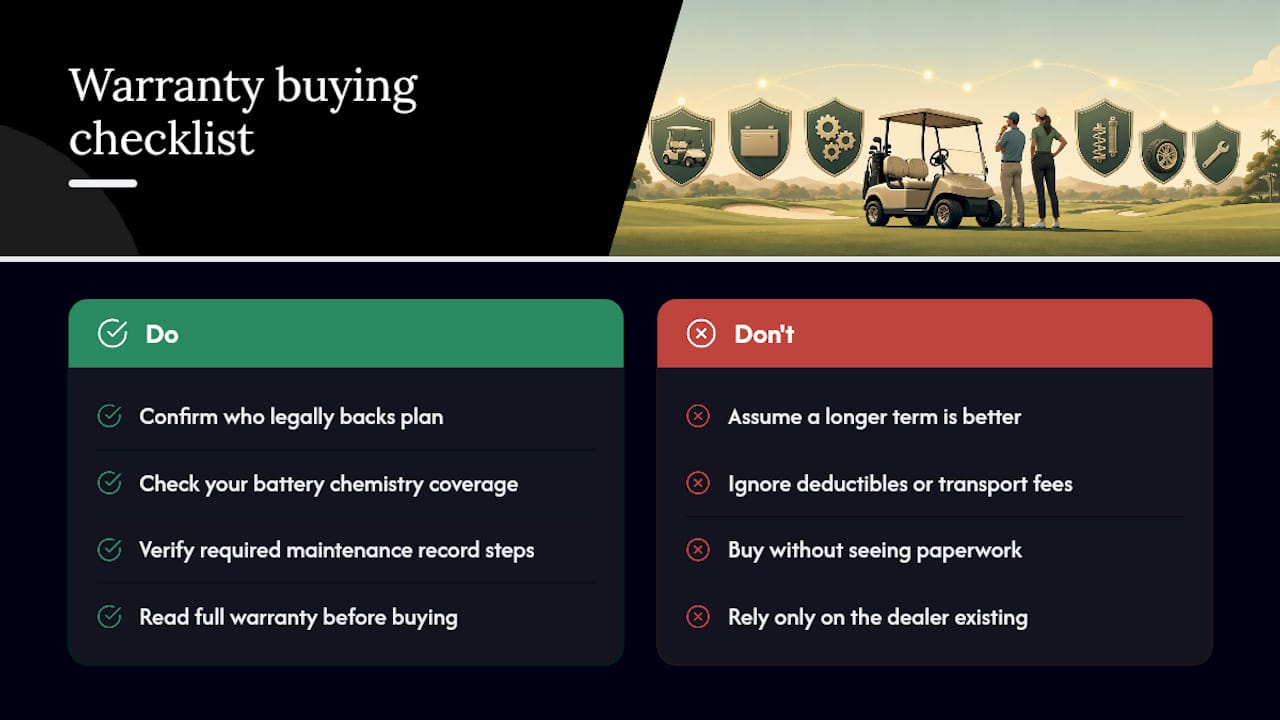
I’d push back on one piece of common wisdom: that a longer headline warranty term is automatically the better deal. A 5-year extended contract loaded with per-visit deductibles and transport fees can cost more over its life than self-insuring and saving for a battery replacement, particularly for buyers of used carts where common wear items are excluded anyway. Age of the cart, your distance from an authorized shop, and how the battery is warrantied should drive that decision, not the number printed on the brochure.
Prioritize the paperwork before the purchase, not after. A warranty you haven’t read is not protection. It’s a guess.
— Gary
Where To Check Warranty Terms Before You Buy
Import Junkies lists warranty terms directly on product pages, so you’re not hunting through a separate PDF hosted somewhere else to find out what’s actually covered on a cart you’re considering.

Take the 48V Electric Golf Cart 4 Seater Renegade Edition as an example: the specs and warranty details sit right on the page, so you can compare battery terms against frame coverage before you ever talk to a salesperson. If you’re weighing a gas model instead, the 400cc GVX Gas Golf Cart UTV 4x4 lists its own coverage the same transparent way.
If anything on a listing looks unclear, our customer support team can help you request written confirmation from the seller before you finalize a purchase, including specifics on whether repairs need to happen at an authorized shop. Browse the current lineup, pull up the warranty section on the model you’re eyeing, and get those questions answered before checkout, not after.
Sources
- GEICO — Golf cart insurance
- State Farm — Do golf carts need insurance?
- Progressive — Golf Cart Insurance
- Golf Cart Search — Golf cart warranty guide 2026
- American Cart Care — Golf Cart and NEV Warranties & extended Service Contracts
Recommended
- Golf Course Vehicle Insurance Explained for Owners and Operators – Saferwholesale || Import Junkies || Great Sports
- Street Legal Golf Cart Requirements Explained – Saferwholesale || Import Junkies || Great Sports
- Golf cart features: a complete buyer’s guide for 2026 – Saferwholesale || Import Junkies || Great Sports
- Fully Enclosed Golf Cart Buyer Guide – Saferwholesale || Import Junkies || Great Sports


