


 Location
 Login
Login
A compact golf course equipment ROI checklist gives you a clear, repeatable way to score every piece of maintenance equipment and decide whether to replace, repair, or hold. Run these six checks on your fleet right now:
- Inventory: Confirm you have a current record for every unit (ID, model, year, serial, accumulated hours).
- Utilization: Calculate what percentage of available hours each machine actually works.
- Maintenance cost: Total all repair and service costs for the past 12 months per unit.
- Downtime loss: Estimate revenue or labor hours lost when each unit was out of service.
- Resale value: Get a current market estimate for each unit at its present condition and hours.
- Financing cost: Confirm remaining loan or lease payments, if any.
Your two immediate next steps: (1) pull or create an equipment inventory spreadsheet with those six fields for every unit, and (2) run a single ROI calculation on your highest-cost item using the formula in Step 2 below.
Quick triage scoring (0–3):
- 0: ROI is positive, maintenance cost is low, downtime is minimal. Hold.
- 1: ROI is marginal, repair costs are climbing. Schedule a full analysis within 30 days.
- 2: ROI is negative or payback exceeds useful life. Plan replacement within 6–12 months.
- 3: Safety failure, chronic downtime, or repair cost exceeds 50% of replacement value. Replace immediately.
Key Takeaways
A complete golf course equipment ROI checklist, run annually and tied to a five-year master plan, is the most reliable way to reduce unplanned downtime, control capital spending, and build board-ready business cases for every replacement decision.
| Point | Details |
|---|---|
| Start with a complete inventory | Record ID, model, year, serial, hours, purchase price, and resale value for every unit before calculating ROI. |
| Use the three core formulas | ROI (%), payback period, and annualized TCO together give a complete picture no single metric can. |
| Run scenario tests before deciding | Test a 10–30% utilization shift and a 20% parts cost increase to confirm whether a unit should be replaced or held. |
| Build and update a five-year plan | Rank replacements by annualized cost impact, safety risk, and downtime exposure; review annually in the off-season. |
| Importjunkies for fleet replacements | Importjunkies offers wholesale-priced electric golf carts and utility vehicles with no fleet minimums for direct purchase. |
Table of Contents
- What does equipment ROI mean for a golf course operation?
- Step 1: How do you build a complete equipment inventory?
- Step 2: How do you calculate equipment ROI, payback, and annualized TCO?
- Step 3: How do you interpret ROI results and run scenario checks?
- Step 4: What are the most effective strategies to improve equipment ROI?
- Step 5: How do you present the equipment business case to owners or a board?
- How do you build a 1–5 year master equipment plan?
- Your printable step-by-step ROI checklist
- What benchmarks should you use to prioritize replacements?
- What risk factors can undermine your equipment ROI?
- Running this checklist in-season takes discipline, not perfection
- Importjunkies has replacement golf carts and utility vehicles ready to order
- Sources
What does equipment ROI mean for a golf course operation?
Equipment ROI, expressed as a percentage, measures the net financial benefit of owning a piece of equipment relative to its total cost. The standard formula is:
ROI (%) = (Net benefit ÷ Total investment) × 100
For golf course maintenance equipment, “net benefit” includes labor savings, rounds protected by reliable conditioning, and avoided outsourcing costs. “Total investment” covers purchase price, financing charges, fuel or energy, maintenance, and disposal costs. A positive ROI means the machine earns more than it costs; a negative ROI means you are subsidizing it.
Two related metrics matter just as much:
- Payback period: How many months or years until cumulative net benefits equal the initial investment. Shorter is better, but a longer payback on a critical-path machine (a fairway mower, for example) may still be justified.
- Total cost of ownership (TCO): The full lifetime cost of a unit, annualized. Operators who frame equipment decisions around TCO — purchase price plus maintenance, leasing costs, and expected lifespan — are consistently more successful at securing capital from owners and boards.
Golf course equipment ROI differs from consumer gear ROI in one critical way: downtime directly affects playable rounds, green fee revenue, and course reputation. A broken fairway mower during peak season is not just a repair bill; it is lost revenue and potential member attrition. Track these KPIs for every unit:
- Annualized TCO (purchase price ÷ useful life + annual maintenance + fuel + downtime cost)
- Utilization rate (actual hours ÷ available hours, expressed as a percentage)
- Maintenance cost per operating hour
- Downtime cost (lost rounds or labor hours per incident)
- Resale value as a percentage of original purchase price
- Payback period in months
Step 1: How do you build a complete equipment inventory?
Every reliable golf equipment investment analysis starts with a complete, accurate inventory. Without it, your ROI numbers are guesses. Per industry guidance on equipment replacement, a detailed maintenance inventory listing original price, replacement cost, model and serial numbers, expected life, and depreciation is the foundation for any credible budget projection.
Mandatory inventory fields
| Field | What to record | Where to find it |
|---|---|---|
| Equipment ID | Internal asset tag number | Asset register or tag on unit |
| Location / area served | Fairways, greens, rough, cart paths | Operator assignment log |
| Make / model | Manufacturer and model name | Unit nameplate |
| Year | Model year | Purchase invoice or title |
| Serial number | Full serial string | Nameplate or frame stamp |
| Purchase date and price | Original acquisition date and cost | Invoice or depreciation schedule |
| Accumulated hours | Total engine or motor hours | Hour meter or telematics |
| Last major service | Date and work performed | Shop log |
| Current repair backlog | Open work orders and estimated cost | Mechanic’s list |
| Replacement cost estimate | Current dealer or market quote | Dealer quote or online listing |
| Estimated resale value | Current private-sale or trade-in value | Dealer trade-in or auction data |
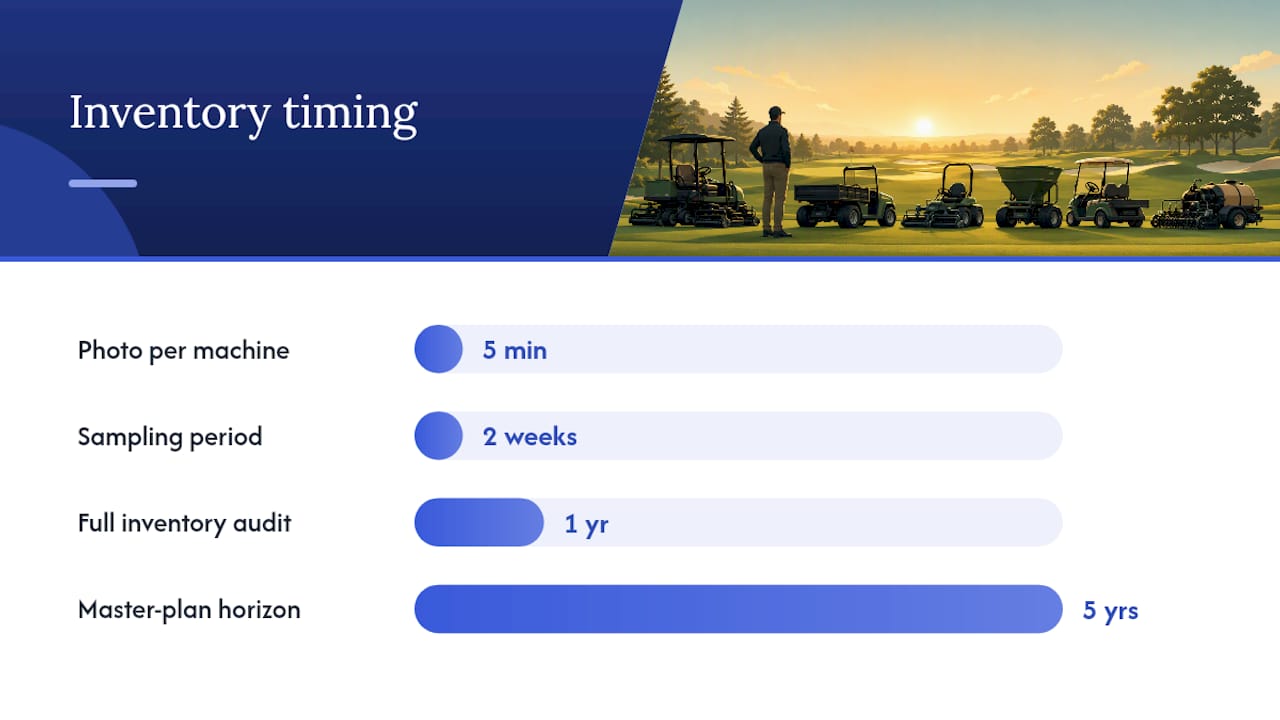
When hour meters are missing or unreliable, use operator logs or a two-week sampling period to estimate annual hours, then back-calculate accumulated hours from the purchase year. Equipment condition, usage patterns, and storage environment all materially affect useful life, so note whether each unit is stored indoors or exposed to moisture, sunlight, or corrosive irrigation water.
Pro Tip: Photograph the nameplate, serial number plate, and overall condition of every unit during the annual audit. Store the photos with the inventory record. This takes about five minutes per machine and pays off immediately during insurance claims or warranty disputes.
Run a full inventory audit once per year, ideally in the off-season or shoulder season. A five-year master equipment plan requires an up-to-date inventory to support accurate capital budgeting, and annual updates keep replacement timing realistic rather than reactive.
Step 2: How do you calculate equipment ROI, payback, and annualized TCO?
These three formulas do the heavy lifting. You can run all of them in a basic spreadsheet. A practical ROI formula and step-by-step calculation make it straightforward to compute ROI (%) and payback periods for any equipment investment.
Primary formulas:
- ROI (%) = (Net benefit ÷ Total investment) × 100
- Payback period = Initial investment ÷ Annual net cash benefit
- Annualized TCO = (Purchase price ÷ Useful life in years) + Annual maintenance + Annual fuel/energy + Annual downtime cost
Worked example: fairway mower
Step-by-step calculation checklist:
- Enter purchase price and financing charges (total cash out).
- Divide purchase price by estimated useful life in years to get annual depreciation.
- Pull 12 months of actual maintenance and repair costs from shop logs.
- Record fuel or electricity costs from invoices or meter readings.
- Count downtime incidents and multiply lost rounds by average green fee (or lost labor hours by hourly rate).
- Sum lines 2–5 to get annualized TCO.
- Identify the annual benefit: labor savings, outsourcing cost avoided, or revenue protected.
- Subtract annualized TCO from annual benefit to get net annual benefit.
- Divide net annual benefit by purchase price and multiply by 100 for ROI (%).
- Divide purchase price by net annual benefit for payback period in years.
Step 3: How do you interpret ROI results and run scenario checks?
Raw numbers only become decisions when you stress-test them. A short payback period combined with low annualized TCO is a clear signal to replace aging equipment. High maintenance costs paired with a payback that stretches beyond the remaining useful life points toward replacement or leasing rather than continued repair.
Run these three scenario tests on any unit scoring 1 or 2 in the triage rubric:
- Utilization shift (±10–30%): If you increase utilization by 20%, does the payback period drop below five years? If so, the machine may be underused rather than worn out.
- Parts cost increase (+20%): Rising parts prices, driven by supply chain pressure or an aging model, can flip a marginal ROI negative within one budget cycle. The global golf equipment market remains sizable and growing, which generally supports parts availability for current-generation equipment, but older or discontinued models face real supply risk.
- Life extension (+2 years): If a $3,000 preventive maintenance investment extends useful life by two years, does the annualized TCO drop enough to justify the spend? Usually yes, for well-maintained units.
Red flags that suggest immediate replacement:
- Maintenance cost per operating hour has doubled over the past two years.
- A single repair estimate exceeds 50% of current replacement value.
- The unit has caused a safety incident or failed a regulatory inspection.
- Downtime spikes are clustering in peak season, directly costing rounds.
Prioritized next actions based on scenario outcomes:
- Units with negative ROI and a payback beyond useful life: add to the 1–2 year replacement queue.
- Units with marginal ROI but high utilization potential: schedule an operator efficiency review.
- Units with strong ROI but rising maintenance cost: implement a preventive maintenance schedule immediately.
- Units with low utilization: evaluate right-sizing or redeployment before replacement.
Step 4: What are the most effective strategies to improve equipment ROI?
Buying new equipment is the most expensive way to improve ROI. Most courses have faster, cheaper levers available right now.
Operational fixes:
- Preventive maintenance is the single highest-return activity. Courses that extend equipment life through consistent PM schedules lower annualized cost per year, which strengthens every future capital request.
- Operator training reduces abuse-related wear. A technician who knows the correct ground speed for a reel mower on wet turf avoids the $800 bedknife replacement that follows a forced cut.
- Standardize parts across models where possible. Running two or three mower brands means stocking two or three parts inventories. Consolidating to one brand family cuts parts cost and reduces mechanic training time.
- Right-size the fleet. An idle machine is money parked in the garage. Audit utilization rates and identify units averaging below 40% of available hours before approving any new purchase.
Financial levers:
- Leasing works well for frequently used reel and rotary mowers, while longer-lasting assets like tractors and loaders are generally more cost-effective to purchase and depreciate as capital. Run the TCO comparison for both options before committing. For a deeper look at the numbers, the leasing vs. buying analysis for golf course vehicles walks through the key decision points.
- Extended warranties on high-hour machines can cap repair cost exposure and make annualized TCO more predictable for budget presentations.
- Bulk parts agreements with a single supplier often yield 10–15% cost reductions on consumables, directly improving maintenance cost per hour.
Technology:
Fleet telematics platforms track real utilization hours, idle time, and fuel consumption automatically. Combined with an annual master plan, telematics produces the most defensible capital requests because it ties actual parts and labor costs to replacement timing rather than relying on estimates.

Pro Tip: Swap operator schedules to reduce idle hours on shared equipment. If two operators share one utility vehicle and it sits unused for four hours each morning, a staggered schedule can increase utilization by 25–30% with zero capital spend.
Step 5: How do you present the equipment business case to owners or a board?
A one-page business case built around three or four KPIs is far more persuasive than a spreadsheet dump. Framing equipment purchases as a business strategy — presenting TCO and lifecycle scenarios rather than a lowest-price comparison — is what separates approved capital requests from deferred ones.
Must-have elements in your one-page case:
- Summary KPI block: ROI (%), payback period in months, annualized TCO for the unit in question.
- Current-state cost: What the course is spending today on repairs, downtime, and lost rounds for the aging unit.
- Recommended action and cost: Replace, lease, or repair, with a dollar figure and timeline.
- Revenue translation: Fewer downtime incidents means more playable rounds. If a new fairway mower eliminates eight lost rounds per season at an average green fee, that is a concrete revenue line, not an abstraction.
- Risk and mitigation: What happens if the decision is deferred another year? Rising repair costs, a potential safety incident, or a parts availability gap are all quantifiable risks.
- Timeline: When the replacement needs to be ordered to arrive before peak season.
For boards evaluating larger capital projects, valuation multiples such as SDE and EBITDA provide context for how equipment investments can influence overall business valuation metrics, which is a useful frame when requesting significant capital.
Quick visuals that work: a bar chart comparing annualized cost of the current unit vs. a replacement, a simple payback timeline, and the triage table from your inventory audit.
How do you build a 1–5 year master equipment plan?
A five-year plan converts your inventory audit and TCO calculations into a capital budget your finance team can actually use. Industry guidance recommends a five-year replacement program updated annually, with comprehensive inventory fields supporting budget projections each cycle.
How to build the plan:
- Rank every unit by three criteria: annualized cost impact (highest TCO first), safety risk (any unit with a safety flag moves to the top), and critical-path downtime exposure (fairway mowers and greens mowers before rough equipment).
- Assign each unit to one of three tiers: Critical (replace within 12 months), Important (replace in years 2–3), Discretionary (replace in years 4–5 or defer).
- For each planned replacement, record: unit ID, replacement cost estimate, preferred acquisition method (purchase or lease), planned year, and budget line.
- Fold leasing into the plan for high-cycle equipment to smooth capital spending. A lease payment spread over three to five years is easier to absorb than a $30,000 purchase in a single budget year.
Recommended update cadence: Review and update the plan every year during the off-season. Adjust replacement years based on actual hours accumulated, repair history from the prior season, and any changes in parts availability or technology. Golf industry trends, including record participation levels in 2024 and accelerating tech adoption, are changing equipment demand and lifecycle costs, so replacement timing assumptions made three years ago may no longer hold.
Your printable step-by-step ROI checklist
Immediate (0–30 days) — Priority A
- Pull or create a complete equipment inventory with all mandatory fields. Owner: Superintendent. Cost: Low (staff time).
- Run the ROI and payback calculation on your three highest-cost units. Owner: Superintendent / Finance. Cost: Low.
- Score every unit 0–3 using the triage rubric. Owner: Superintendent. Cost: Low.
- Flag any unit scoring 3 for immediate safety review. Owner: Mechanic / Superintendent. Cost: Low to medium.
Short-term (30–180 days) — Priority B
- Photograph and document serial numbers and condition for all units. Owner: Mechanic. Cost: Low.
- Pull 12 months of maintenance and repair cost data from shop logs. Owner: Mechanic / Finance. Cost: Low.
- Run scenario tests (utilization shift, parts cost increase, life extension) on all triage-1 and triage-2 units. Owner: Superintendent / Finance. Cost: Low.
- Evaluate leasing vs. buying for any unit flagged for replacement. Owner: Finance / GM. Cost: Low.
Medium-term (6–12 months) — Priority B/C
- Build or update the one-page business case for any approved replacement. Owner: Superintendent / GM. Cost: Low.
- Implement a preventive maintenance schedule for all units scoring 0–1. Owner: Mechanic. Cost: Medium (parts and labor).
- Evaluate fleet telematics for high-utilization equipment. Owner: Superintendent / GM. Cost: Medium.
Long-term (1–5 years) — Priority C
- Build the five-year master equipment plan with replacement years, acquisition method, and budget lines. Owner: Superintendent / Finance / GM. Cost: Low (planning time).
- Review and update the plan annually in the off-season. Owner: Superintendent. Cost: Low.
- Standardize parts across equipment brands where feasible during replacement cycles. Owner: Superintendent / Mechanic. Cost: Low to medium.
What benchmarks should you use to prioritize replacements?
Benchmarking your equipment ROI against industry standards helps you decide whether a unit’s performance is genuinely poor or just below your internal expectations. Rules-of-thumb like revenue multiples and price-per-hole are useful quick screens, but they must be adjusted for local market conditions, course quality, and operational performance before you apply them to specific equipment decisions.
A few practical reference points for U.S. golf course operations:
- Maintenance cost per operating hour: When repair costs per hour approach or exceed the hourly cost of a replacement unit’s depreciation, replacement is typically justified. Track this ratio annually.
- Resale value floor: Equipment retaining less than 15–20% of its original purchase price at end of useful life has limited residual value to offset replacement cost. Factor this into your annualized TCO.
- Utilization threshold: Units consistently running below 40% of available hours are candidates for right-sizing or redeployment before replacement.
- Payback benchmark: For most maintenance equipment, a payback period under five years is generally considered acceptable. Equipment with a payback beyond its remaining useful life is a replacement candidate regardless of current condition.
Apply these benchmarks as starting points, not hard rules. A course in a high-humidity coastal climate will see faster corrosion and shorter useful lives than a course in a dry inland market, so adjust your thresholds accordingly.
What risk factors can undermine your equipment ROI?
Even a well-built ROI model can be overtaken by external factors. Knowing the risks in advance lets you build mitigation into the plan.
Technology obsolescence: Electric and telemetry-equipped equipment is changing lifecycle cost assumptions. A gas-powered utility vehicle purchased five years ago may face rising fuel and parts costs as the market shifts toward electric alternatives. Trends such as increased participation and tech adoption are accelerating this shift, so factor technology trajectory into replacement timing, especially for high-cycle equipment.
Parts availability and market fluctuations: Discontinued models face parts scarcity that inflates repair costs and compresses useful life. The global golf equipment market supports parts availability for current-generation equipment, but older or niche models carry real supply risk that your annualized TCO should reflect.
Resale value erosion: Market conditions affect what you recover at disposal. Build a conservative resale assumption (10–15% of purchase price for older units) into your TCO rather than using optimistic trade-in estimates.
Mitigation strategies:
- Maintain a spare-unit policy for critical-path equipment. One backup greens mower eliminates the most costly downtime scenario.
- Review parts availability for every unit older than eight years during the annual audit.
- When evaluating new purchases, confirm that the manufacturer has a strong U.S. dealer and parts network before committing. A small business vehicle selection guide covers the key criteria for evaluating dealer support and parts networks for utility vehicles.
- Build a 10–15% contingency into every capital budget line to absorb unexpected repair cost spikes.
Running this checklist in-season takes discipline, not perfection
The annual audit is straightforward in the off-season. Running it during peak play is where most courses fall short, and where the real discipline lives.
The most common mistake is waiting until a machine breaks to ask whether it should have been replaced two seasons ago. The ROI checklist works best as a living document, not a once-a-year exercise. During peak season, a 15-minute weekly check of repair backlog and downtime incidents against your triage scores is enough to catch a unit crossing from “hold” to “replace” before it costs you rounds.
Getting buy-in from ownership often comes down to one number: the cost of doing nothing. When you can show that deferring a $22,000 replacement for another season will generate $6,000 in repair costs and $4,000 in lost-round revenue, the math makes the decision. That framing, grounded in actual shop logs and tee sheet data, is far more persuasive than a general argument about aging equipment.
One practical note on condition versus age: a well-maintained utility vehicle at 2,800 hours may outperform a neglected one at 1,400 hours. Hours-driven replacement thresholds are useful starting points, but condition-informed decisions, backed by your maintenance records and the annual photo documentation, will always be more accurate. The golf course vehicle maintenance checklist from Importjunkies is a solid companion resource for keeping those condition records current between annual audits.
Importjunkies has replacement golf carts and utility vehicles ready to order
When your ROI checklist flags a unit for replacement, sourcing the right vehicle at the right price is the next problem to solve. Importjunkies sells new electric golf carts and utility vehicles direct to the public at wholesale pricing, with no dealer markup and no minimum fleet size required. The 48V Electric Golf Cart 4 Seater Renegade Edition is a practical, cost-effective replacement for aging gas carts, with lower fuel and maintenance costs that improve annualized TCO from day one. For courses needing rough-terrain capability, the Lifted Renegade+ 2.0 Edition handles uneven terrain without the operating cost of a gas unit.
Contact Importjunkies directly for fleet or bulk pricing inquiries. Browse the full golf cart and utility vehicle catalog at Importjunkies and request a quote for your specific replacement needs.
Sources
- Taking the long view on golf course equipment purchases | GCM Online
- Fresh Iron: The ultimate equipment replacement guide - Golf Course Industry
- Golf Course Investment Rules & Benchmarks | DealStream
- Golf in play: what’s driving investment opportunities - R.W. Baird (insights)
- Golf Equipment Market Report - Fortune Business Insights
Recommended
- Optimize Golf Course Vehicles: Essential Maintenance Checklist – Saferwholesale || Import Junkies || Great Sports
- How to select the best vehicles for your golf course – Saferwholesale || Import Junkies || Great Sports
- Bulk buying for golf courses: Maximize savings and efficiency – Saferwholesale || Import Junkies || Great Sports
- Reducing Golf Cart Operating Costs: A Manager’s Guide – Saferwholesale || Import Junkies || Great Sports


