


 Location
 Login
Login
Most U.S. homeowners should budget $3,000 to $10,000 all-in for a home sauna, covering the unit, delivery, electrical work, and basic site prep, according to UseSauna’s full price guide. More complete residential projects, including custom indoor rooms and larger outdoor cabins, commonly land between $4,000 and $15,000 installed, with high-end custom builds pushing past $20,000, per Sauna Steam Center’s installation guide. The unit sticker price is only part of the story.
Here is where most buyers start on unit price alone, before installation:
- Sauna blankets and portable steam tents: under $500
- Plug-in infrared cabins (1–2 person): $1,500–$3,000
- Mid-range infrared cabins (3–4 person): $4,000–$8,500
- Prefab traditional or hybrid kits: $3,000–$9,000
- Outdoor barrel saunas: $3,500–$12,000
- Custom indoor sauna rooms: $8,000–$25,000+
The four biggest factors that move your number: sauna type, size, electrical requirements, and site preparation. Everything else is secondary.
Key Takeaways
Most U.S. homeowners should plan for $3,000 to $10,000 all-in for a home sauna, with the unit sticker price covering only part of that total once electrical, site prep, and delivery are added.
| Point | Details |
|---|---|
| Typical installed range | Budget $3,000–$10,000 for most projects; custom builds can exceed $20,000. |
| Unit price vs. project cost | A $5,000 sauna unit can become an $8,000–$10,000 installed project after electrical and site prep. |
| Infrared vs. traditional cost | Infrared cabins cost less upfront and often plug into 120V; traditional electric requires a 240V circuit adding $500–$1,500. |
| Outdoor adds cost | Foundation work alone runs $300–$2,500; outdoor builds consistently cost more than indoor installs at the same unit price. |
| Importjunkies pricing | Browse infrared cabins, traditional kits, and outdoor barrel saunas with direct-to-public pricing at Importjunkies. |
Table of Contents
- What do saunas cost by type?
- What does “installed cost” actually include?
- Infrared vs. traditional saunas: which costs less to own?
- Indoor vs. outdoor saunas: where do the extra costs come from?
- Three sample project budgets: entry, mid-range, and premium
- How to budget for ongoing costs and calculate your payback period
- Buying options: which path fits your budget and situation?
- How to get accurate quotes and what to ask before you buy
- An honest look at sauna pricing from someone who sells them
- Importjunkies has saunas ready to browse and quote
- Sources
What do saunas cost by type?
The table below shows unit-only and typical installed ranges for the most common sauna categories. Installed ranges assume standard U.S. residential conditions, no major panel upgrades, and reasonable site access.
Product price data from Verywell Fit confirms the practical floor for 1–2 person infrared cabins sits around $1,500–$3,000, with mid-range multi-person units clustering in the $4,000–$8,500 band.
A few things explain why ranges overlap across categories. A 4-person barrel sauna in western red cedar costs considerably more than a 2-person version in hemlock, even within the same “outdoor barrel” label. Heater type matters too: a wood-burning stove adds character but also requires a chimney or flue, which is a separate cost. Delivery and access fees vary widely by region and by how far the unit must travel from the truck to the installation site.
Plug-in infrared cabins often do not require electrician work, typically running on a standard household outlet, so installed cost is mostly unit price plus delivery and assembly. Traditional electric saunas, by contrast, almost always need a dedicated 240V circuit, and that wiring work adds real money before you even touch the heater.
What does “installed cost” actually include?
The sticker price on a sauna covers the cabinet and heater. The installed cost covers everything it takes to get that cabinet running in your home or backyard. HomeIndepth’s real-cost breakdown makes the gap concrete: a $5,000 sauna unit can become an $8,000–$10,000 installed project once you add delivery, electrical, permits, and foundation prep.
Here is what a complete project quote should break out:
Electrical work is the most common hidden cost. A dedicated 240V circuit installation from your panel to the sauna can cost several hundred to over a thousand dollars, with costs increasing if panel upgrades are needed. Permits vary by location and typically add up to a few hundred dollars.
Infrared vs. traditional saunas: which costs less to own?
The cost difference between infrared and traditional saunas shows up at every stage: purchase, installation, and monthly operation.
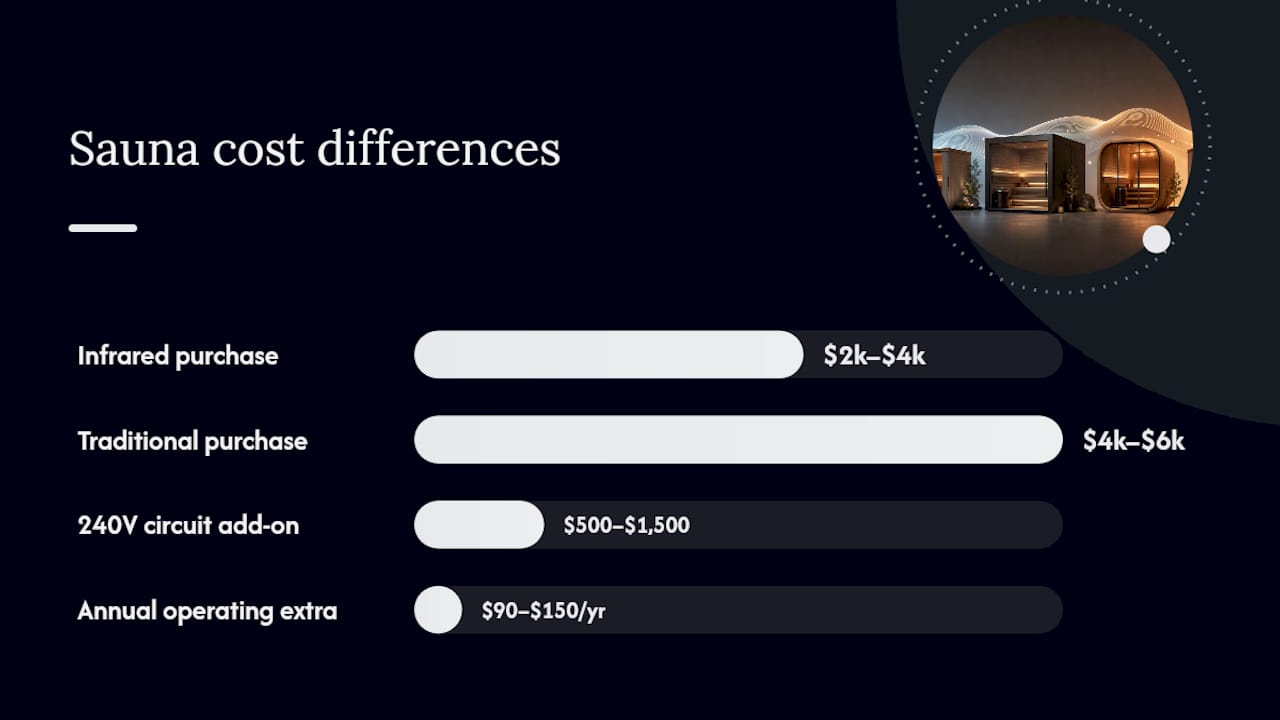
Upfront purchase: Infrared cabins generally cost less per square foot than traditional electric or wood-burning units at the same capacity. A 2-person infrared cabin might run $2,000–$4,000 installed, while a comparable traditional electric unit often starts at $4,000–$6,000 once the wiring is included.
Installation complexity:
- Infrared (120V plug-in): standard outlet, no electrician required for most 1–2 person units
- Infrared (240V larger units): dedicated circuit needed, adds $500–$1,500
- Traditional electric: dedicated 240V circuit almost always required, adds $500–$1,500+
- Wood-burning: no electrical circuit needed, but flue or chimney installation adds $300–$1,000+
Operating cost per session: A typical infrared sauna draws 1.5–3 kW and runs for 30–45 minutes per session. At the U.S. average residential electricity rate of roughly $0.16 per kWh, a 30-minute session in a 2 kW infrared unit costs about $0.16. A traditional electric sauna with a 6–9 kW heater running for 60 minutes (including preheat) costs closer to $0.60–$0.90 per session at the same rate. Over 200 sessions a year, that difference adds up to roughly $90–$150 annually.
Traditional saunas deliver higher temperatures and the authentic steam experience that infrared cannot replicate. If that matters to you, the extra installation cost and slightly higher operating cost are worth it. If you want a lower entry price, faster heat-up, and simpler installation, infrared is the practical choice for most first-time buyers.
Indoor vs. outdoor saunas: where do the extra costs come from?
Pro Tip: Indoor installs almost always cost less than outdoor builds at the same unit price, because you skip foundation work, weatherproofing, exterior finishing, and long electrical runs. If budget is your primary concern, an indoor location is the smarter starting point.
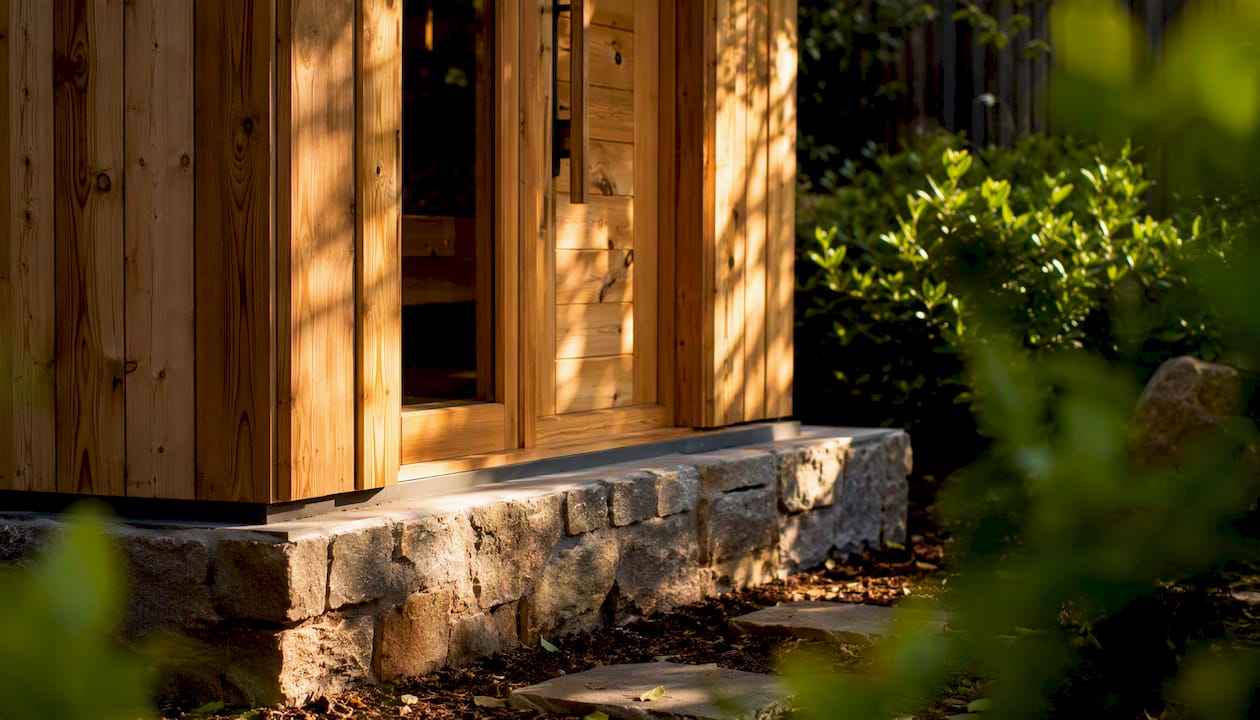
Indoor saunas benefit from existing flooring, walls, and electrical infrastructure. You are adding a cabinet to a finished space, not building a structure from scratch. Outdoor saunas, even when they ship as complete kits, require you to prepare the ground, protect the wood from weather, and often run power from a panel that may be 50 or more feet away.
CostToRenovate’s 2026 home sauna guide confirms that indoor installs skew lower than outdoor because outdoor builds require extra site prep, weatherproofing, and potentially trenching for power.
Foundation options for outdoor saunas and their typical costs:
- Gravel base: $300–$700, suitable for lighter barrel saunas with good drainage
- Poured concrete pad: $900–$1,800, the most durable option for heavier cabin-style units
- Deck platform: $1,300–$2,500, adds elevation and aesthetics but requires proper structural support
Outdoor barrel saunas and cabin-style kits typically fall into a broad installed price band influenced by size and finish level. The foundation alone can add $300–$2,500 to that total, and if your electrical panel is on the far side of the house, trenching for a buried conduit run can add another $500–$2,000.
One scenario where outdoor costs more than buyers expect: a large barrel sauna delivered to a backyard with limited truck access. Crane or manual carry fees are real and can run $300–$800 or more depending on the job. Ask about delivery access before you order.
Three sample project budgets: entry, mid-range, and premium
These sample budgets are planning tools, not guaranteed quotes. Use them to anchor your conversations with retailers and installers.
Entry ($2,350 total): A 1–2 person plug-in infrared cabin, installed indoors in an existing room with a nearby 120V outlet. No electrician, no foundation, minimal assembly. Best for someone testing sauna use before committing to a larger build.
Mid-range ($8,050 total): A 3–4 person infrared or traditional electric cabin, installed in a garage or basement with a new 240V dedicated circuit. Includes a gravel or concrete pad if placed outdoors, or basic indoor prep. Suits most families who plan to use the sauna several times a week.
Premium ($17,550 total): A large outdoor barrel or custom indoor room with high-grade wood, glazed door, upgraded heater, and full electrical and foundation work. Built for daily use and long-term durability.
Electrical surprises, panel upgrades, and delivery complications are common enough that HomeIndepth recommends building that buffer in from the start.
How to budget for ongoing costs and calculate your payback period
Once the sauna is installed, your recurring costs are electricity and occasional maintenance. The math is straightforward.
Per-session electricity cost formula: Heater kW × session hours × your local rate ($/kWh) = cost per session.
Example: A 6 kW traditional sauna running 1 hour (including 20-minute preheat) at $0.16/kWh costs $0.96 per session. At four sessions per week, that is about $3.84 per week, or roughly $200 per year. A 2 kW infrared unit at the same rate and three sessions per week runs about $50–$60 per year.
Maintenance costs are modest for well-built units. Budget $50–$150 per year for replacement sauna rocks (traditional), wood treatment or sealant (outdoor units), and occasional heater element checks. A quality heater typically lasts 10–20 years with normal use.
Pro Tip: Track your sauna sessions for the first 90 days. If you use it fewer than twice a week on average, recalculate your payback period before committing to a premium build. Frequency of use is the single biggest variable in whether a home sauna makes financial sense.
Payback period vs. studio memberships: Many retailers note that regular users can reach a break-even point against gym or studio sauna memberships in roughly 18 months. Here is how that math works:
- Find your local per-session sauna studio rate (commonly $25–$60 per session in U.S. cities).
- Multiply by your expected sessions per month.
- Divide your total installed project cost by that monthly spend.
- The result is your approximate payback period in months.
At $40 per studio session and four sessions per month, you spend $160/month. A $8,000 installed sauna pays for itself in 50 months, or just over four years. At eight sessions per month, that drops to about 25 months. The more you use it, the faster the math works in your favor.
Buying options: which path fits your budget and situation?
Sauna blankets and portable steam tents ($150–$500): The lowest-cost entry point. No installation, no dedicated space, and no electrical work. The experience is genuinely different from a cabin sauna, and resale value is minimal. Treat these as a way to test whether you enjoy regular sauna use before spending more.
Plug-in infrared cabins ($1,500–$4,500 installed): The most popular choice for first-time buyers. Standard outlet, quick assembly, and a real cabin experience. Check our portable infrared sauna review for a closer look at what to expect from this category.
Prefab traditional kits ($5,000–$13,000 installed): Pre-cut panels that assemble in a few hours. You still need a 240V circuit and often a permit, but the unit itself arrives ready to build. Good for buyers who want the authentic steam experience without a full custom build.
Outdoor barrel saunas ($4,500–$18,000 installed): Visually striking and well-suited to backyards with good access. Budget for foundation work and exterior finishing. Our 4–6 person outdoor barrel sauna in hemlock wood is a practical example of what a mid-to-upper-range barrel unit looks like.
Custom indoor sauna rooms ($12,000–$30,000+ installed): Built-in rooms with custom dimensions, tile or wood finishes, and integrated lighting. The highest upfront cost but also the highest resale value and the most durable long-term option.
Before choosing a path, answer these questions:
- Do you have a dedicated indoor space, or will this go outdoors?
- How often do you realistically plan to use it per week?
- Is your electrical panel within 30 feet of the install location?
- Do you want the sauna to add resale value to your home?
- Are you open to a DIY assembly, or do you need full installation service?
One warning worth repeating: a cheap unit that requires major electrical or structural work is not actually cheap. A $2,500 infrared cabin that needs a panel upgrade and a new circuit can end up costing more than a $4,000 unit that plugs into an existing 240V outlet.
How to get accurate quotes and what to ask before you buy
Getting a reliable quote starts with a location brief. Before you contact any retailer or installer, write down: the room or outdoor dimensions, distance from the electrical panel to the install site, your desired capacity (persons), preferred heater type, and your finish expectations (basic vs. premium wood, glazed door, etc.). The more specific you are, the more comparable your quotes will be.
Questions to ask every retailer or installer:
- What is the heater’s kW output, and does the unit require a 120V or 240V circuit?
- Is a dedicated circuit included in the quote, or is that a separate contractor cost?
- Who pulls the permits, and is that fee included?
- What are the delivery terms, and is there a fee for difficult access or second-floor delivery?
- What does the warranty cover, and for how long (heater vs. wood cabinet separately)?
- What is the assembly timeline, and who handles cleanup?
- Are site-prep costs (foundation, gravel, concrete) included or excluded from the quote?
Red flags to watch for:
- A quote with no line-item breakdown of electrical and site costs
- Vague language like “electrical as needed” with no dollar estimate
- Open-ended contingency fees with no cap
- No mention of permits when your municipality requires them
- Delivery terms that exclude anything beyond curbside drop-off
Before you sign any quote, ask the installer to confirm in writing: the circuit type required, who pulls the permit, and whether the quoted price covers delivery to the installation point or only to the curb. Those three items account for the majority of post-contract surprises on sauna projects.
Checking a retailer’s Trustpilot and BBB pages before committing is a practical step that takes five minutes and can save you from a difficult post-purchase experience. Look specifically for complaints about delivery damage, missing parts, and warranty response times.
Pro Tip: Get at least three quotes and ask each one to use the same unit model as the baseline. That way you are comparing installation and service costs directly, not comparing apples to oranges across different product lines.
An honest look at sauna pricing from someone who sells them
Sauna prices are one of the most misunderstood topics in home improvement retail, and the confusion is almost always the same: buyers compare sticker prices without accounting for the full project cost. A $3,000 unit and a $3,000 installed project are not the same thing, and the gap between them is where most budget surprises live.
The ranges in this guide are planning estimates drawn from catalog pricing, installer data, and published cost guides. They are not guaranteed quotes. Your actual number will depend on your electrical panel’s location, your local permit fees, your site conditions, and the specific model you choose. Treat every figure here as a starting point for a conversation with a qualified installer, not a final budget.
Importjunkies sells saunas and related equipment and publishes buying guides like this one to help you walk into that conversation prepared. For a deeper look at how to choose the right model before you start comparing prices, the home sauna buying guide covers capacity, heater types, and wood species in detail.
Importjunkies has saunas ready to browse and quote
Importjunkies offers direct-to-public pricing on infrared cabins, traditional indoor saunas, and outdoor barrel units, with detailed product pages that include specifications, heater output, and capacity so you can compare models before requesting a quote.
If you are ready to move from planning to purchasing, start by browsing the best home sauna options to shortlist models by capacity and price band. For buyers watching their budget, the discount sauna deals page collects current offers across the catalog. When you have a model in mind, contact the sales team for a written quote that includes delivery terms and any applicable installation guidance. Bring the quote checklist from this article to that conversation and ask for a line-item breakdown. That one step alone will save you from the most common post-purchase surprises.
Sources
The following sources informed the price ranges and installation guidance throughout this article. Each one is worth bookmarking if you are in active planning mode.
- In Home Sauna Cost: Prices, Installation and Planning Guide
- How Much Does a Sauna Cost - 2026 Full Price Guide | UseSauna
- How Much Does a Sauna Cost? Real 2025 Prices + Hidden Costs
- How Much Does It Cost to Add a Home Sauna in 2026?
- Best infrared saunas — product price examples and anchors
Recommended
- Home Sauna Buying Guide for Smart Shoppers – Saferwholesale || Import Junkies || Great Sports
- Steam Shower vs Sauna: Which Is Better? – Saferwholesale || Import Junkies || Great Sports
- 7 Best Home Sauna Options to Compare – Saferwholesale || Import Junkies || Great Sports
- Best Discount Sauna Deals Online – Saferwholesale || Import Junkies || Great Sports


