


 Location
 Login
Login
Most kei and mini trucks carry an official payload rating of roughly 350 kg, or about 770 lbs, according to sources like Wikipedia and kei truck enthusiasts. But the number only helps you if you apply the one rule that governs every load you’ll ever plan: usable payload equals your truck’s GVWR minus its actual current weight, including fuel, people, and any fixed equipment already bolted on. Skip that math and you’re guessing.
TL;DR:
- The practical payload of a kei or mini truck often differs from the rated 350 kg due to variations in actual curb weight and current load, sometimes by hundreds of pounds.
- Accurate payload calculation requires measuring the truck’s GVWR and curb weight separately at a public scale, including fuel and fixed equipment, then subtracting to find available capacity.
- Towing capacity is a separate measure that is typically much lower than payload and is not interchangeable with load-carrying limits; overloading can lead to safety and legal issues.
- Upgrading suspension or tires does not increase the official payload rating; only a formal re-rating approved by an engineer can do so, which is rarely needed outside commercial use.
- Regularly weighing the truck and following safe cargo placement practices can prevent overloads and improve vehicle safety, fuel economy, and component longevity.
Table of Contents
- What Does “350 Kg Payload” Actually Mean?
- How Do You Calculate Your Truck’s Actual Payload?
- Where Can You Get an Accurate Weight Reading?
- How Should You Pack and Secure a Heavy Load?
- Do Lift Kits or Bigger Tires Raise Your Payload Rating?
- Weighing Your Truck the Right Way: A Quick Worksheet
- Why Does Payload Capacity Affect Safety and Legal Compliance?
- Who Actually Relies on Mini Truck Payload in the Real World?
- Does a Heavier Load Hurt Fuel Economy and Wear Faster?
- How Do Payload Ratings Differ Across Mini Truck Models?
- Conservative Loading Beats Chasing Every Last Pound
- How Import Junkies Helps You Haul Safely
- Where to Verify These Numbers Yourself
- Sources
- FAQ
What Does “350 Kg Payload” Actually Mean?
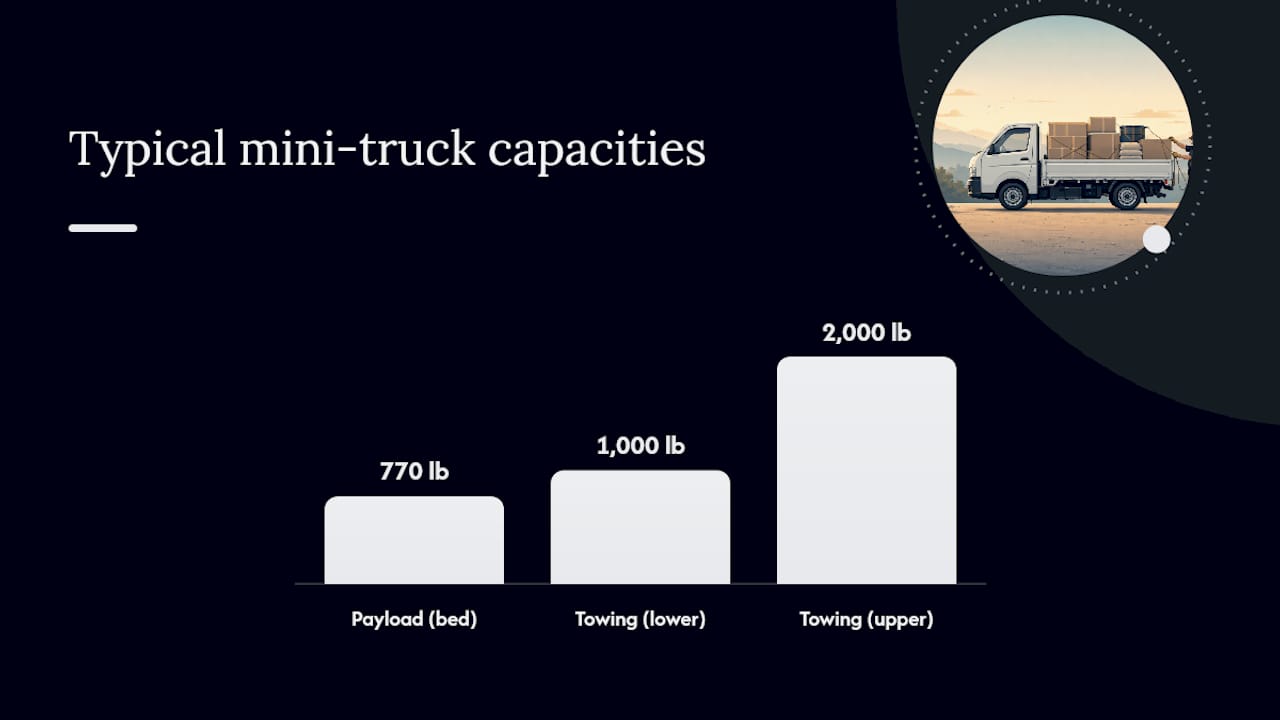
That 350 kg (770 lb) figure isn’t a marketing number. It traces back to Japan’s kei vehicle class, a statutory category with strict size and weight rules that shaped how these trucks were engineered from the factory floor up. Because so many mini trucks sold worldwide originated in that same regulatory box, the kei truck payload rating of around 350 kg shows up again and again, whether you’re looking at a Honda Acty, a Suzuki Carry, or a Daihatsu Hijet.
Here’s where it gets murkier for buyers comparing listings: export and modified variants don’t always carry the same numbers as their domestic Japanese counterparts. Export versions sometimes get larger engines, different gearing, or altered suspension setups, and any of those changes can shift the payload or towing figures printed on the spec sheet.
That’s also where people mix up two separate numbers:
- Payload is what the truck carries in the bed or cabin, weighed straight down through the suspension.
- Towing capacity is what it pulls behind it on a trailer hitch, and for most small mini trucks that range sits well below what a full-size pickup handles, often in the 1,000 to 2,000 lb range depending on hitch rating and drivetrain.
Confusing the two is how people end up overloading a truck that was never rated to pull what they hooked up to it.
How Do You Calculate Your Truck’s Actual Payload?
Forget the sticker for a second. Your real number comes from three figures, and you only need basic subtraction to get there.
- Find your GVWR (Gross Vehicle Weight Rating). This is the maximum total weight the manufacturer certifies the truck can weigh, fully loaded, printed on the door jamb or manufacturer’s label.
- Weigh your curb weight. This means the truck as it sits right now, with a full tank of fuel, any permanent equipment already installed (a bed liner, a toolbox, a lift gate), and no passengers or cargo.
- Subtract: GVWR minus curb weight equals your available payload.
Pro Tip: Don’t estimate curb weight from a spec sheet. Fuel alone can shift the number by 40 to 50 lbs depending on tank size, and choosing the right capacity for your project helps ensure accurate payload calculations, while aftermarket accessories add up fast.
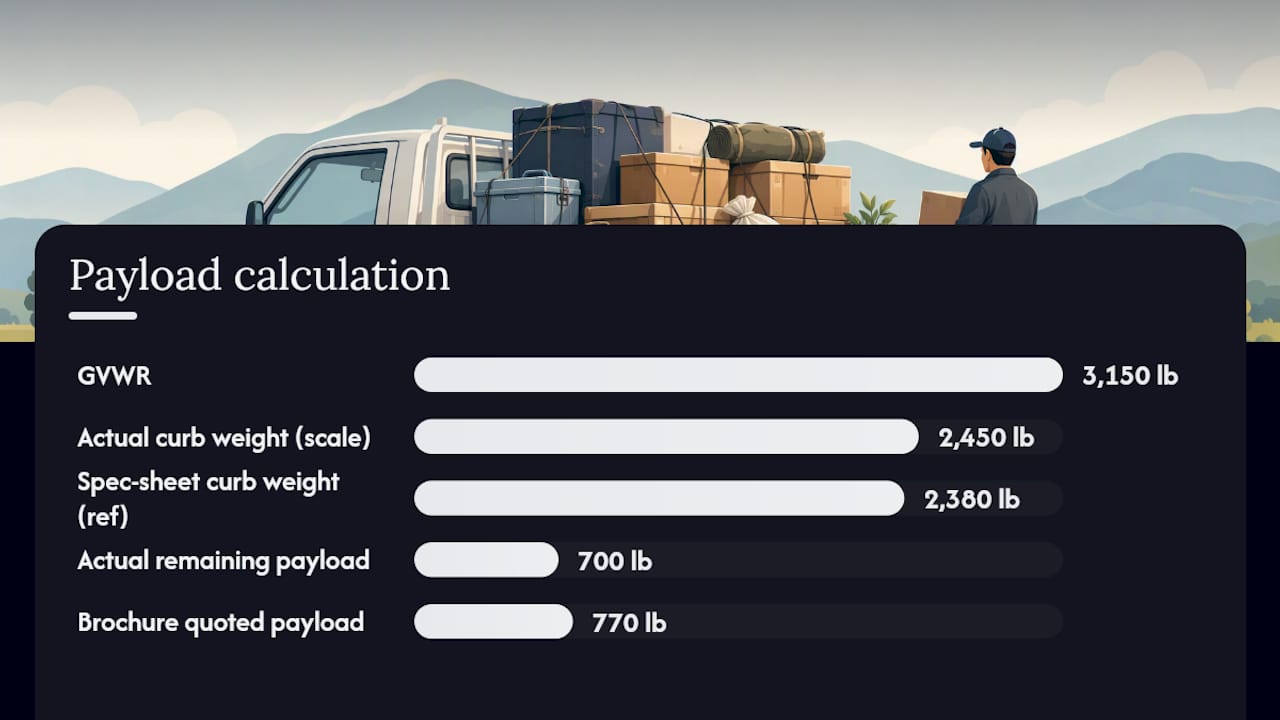
Say your truck carries a rated GVWR of 3,150 lbs (a typical figure once you convert a 350 kg payload rating against a roughly 2,380 lb curb weight). If your scale reading comes back at 2,450 lbs with a full tank and a toolbox installed, your real payload margin is 700 lbs, not the 770 lbs printed in the brochure. That’s the practical payload math every owner should run before hauling anything heavy, and it’s the single biggest reason two trucks with identical badges can safely carry different amounts.
Where Can You Get an Accurate Weight Reading?
Public truck scales at grain elevators, recycling centers, and some truck stops give you the most reliable numbers, and most charge a small fee for a quick weigh. Pull straight onto the scale, keep the truck level, and don’t ride the brakes while the reading settles.
Getting the total weight is only half the job. Front and rear axle weights matter just as much, because a truck can sit comfortably within its overall GVWR while still overloading one axle if cargo sits too far forward or back. Many public scales offer split readings for exactly this reason, weighing the front wheels and rear wheels separately.
Keep a simple record every time you weigh:
- Date and scale location
- Fuel level at time of weighing
- Front axle weight and rear axle weight
- Number of passengers aboard
- Any fixed equipment already installed
Pro Tip: Weigh empty first, then weigh loaded. The difference between those two numbers is your true, real-world payload for that specific load, no guesswork involved.
How Should You Pack and Secure a Heavy Load?
Cargo placement changes how a mini truck handles almost as much as the total weight does. Heavy items belong low in the bed, pushed forward toward the cab, and centered side to side. A load stacked high and hanging off the tailgate raises your center of gravity and puts leverage on the rear axle exactly where you don’t want it.
Tie-downs matter more on a mini truck bed than most people assume, mostly because the beds are shorter and cargo has less room to settle. Use the bed’s built-in anchor points rather than looping straps around the tailgate hinge or bed rail edges, which weren’t designed to take that kind of load.
Watch for these warning signs before you pull out of the driveway:
- Rear end sitting noticeably lower than the front
- Steering that feels vague or delayed at low speed
- Braking distance that feels longer than usual
- Any visible sag in the rear suspension
Run a quick walk-around before every loaded trip: check tire pressure, confirm tie-downs are snug, and glance at the rear ride height compared to how the truck sits empty. That thirty-second check catches most overload problems before they become a highway problem.
Do Lift Kits or Bigger Tires Raise Your Payload Rating?
No. Suspension upgrades, helper springs, and larger tires change how a load feels, not what the truck is certified to carry. A helper spring can reduce sag and make a heavy load ride more level, and bigger tires can improve traction, but neither one rewrites the GVWR stamped on the vehicle label by the manufacturer.
The only way to legitimately raise a rated capacity is a formal re-rating, and that typically requires an engineer’s sign-off along with documented structural changes, not just aftermarket parts. This matters most for commercial operators, since running a truck loaded beyond its certified rating creates real liability exposure if something goes wrong.
Watch for these signs your truck is carrying more than it should, regardless of what any upgrade promises: bottoming out over bumps, a rear end that won’t rebound after a dip, or a wandering feel in the steering that wasn’t there before you loaded up.
Weighing Your Truck the Right Way: A Quick Worksheet
- Confirm your GVWR from the vehicle’s door label or manual.
- List passengers and fixed equipment already aboard.
- Drive to a public scale with a full tank.
- Record front axle weight, rear axle weight, and total.
- Subtract measured weight from GVWR for your available margin.
Save fields for date, location, fuel level, and axle numbers so you can compare readings over time. If you’re modifying the truck structurally or running it commercially, loop in a qualified mechanic or engineer before you trust any new number.
Why Does Payload Capacity Affect Safety and Legal Compliance?
Overloading a mini truck isn’t just a mechanical risk, it’s a legal one. Most states enforce weight limits tied directly to a vehicle’s GVWR, and law enforcement can weigh a commercial or personal vehicle roadside if it looks visibly overloaded. The NHTSA’s GVWR framework exists precisely because a truck’s rated capacity connects to how its brakes, tires, and structure were engineered to perform, and exceeding it degrades all three at once.
Braking distance increases measurably on an overloaded truck, since the same brake system now has to stop more mass without any added capacity. Steering response softens, tire sidewalls flex more than they’re built for, and in a hard stop or sudden swerve, an overloaded rear end is far more likely to fishtail. Insurance is the other piece people forget: if a loaded truck causes an accident and investigators determine it exceeded its rated GVWR, that finding can affect liability and claims outcomes.
None of this means you need to treat every trip like a hazmat run. It means the rating on your door jamb isn’t a suggestion, it’s the baseline every other safety system on the truck was designed around.
Who Actually Relies on Mini Truck Payload in the Real World?
Golf courses run mini trucks daily for hauling turf equipment, bagged fertilizer, and maintenance gear across terrain a full-size pickup would tear up. Landscapers favor them for the same reason: tight job sites, narrow gates, and loads that rarely exceed a few hundred pounds of soil, mulch, or tools.
Small farms and orchards use mini trucks to move produce bins and feed sacks between buildings, especially where the ground stays too soft or narrow for larger equipment. Warehouses and distribution yards run them indoors and on loading docks, taking advantage of a tight turning radius that a standard pickup simply can’t match.
Small businesses have found a niche too: mobile repair techs, delivery services running short urban routes, and vendors hauling equipment to weekend markets all lean on mini trucks specifically because the payload, while modest, lines up with what they actually carry on a given day. The applications share a pattern: loads that are real but moderate, spaces that are tight, and a full-size truck that would be overkill.
Does a Heavier Load Hurt Fuel Economy and Wear Faster?
Yes, and the effect shows up faster than most owners expect on a small-displacement engine. A mini truck running near its rated payload asks its engine to work harder on every acceleration, which increases fuel consumption noticeably compared to running empty or lightly loaded.
Wear compounds in places you don’t see until it’s expensive. Tires carrying consistent heavy loads wear faster and unevenly, particularly on the rear axle. Brake pads and rotors take more heat and friction stopping additional mass, shortening their service life. Suspension bushings and shock absorbers degrade faster under repeated heavy cycles, especially if the truck sits loaded for long periods rather than just during transport.
None of this argues against using the payload you’re rated for. It argues for factoring wear into how often you inspect tires, brakes, and suspension components if hauling near-capacity loads is a regular part of how you use the truck, not an occasional trip.
How Do Payload Ratings Differ Across Mini Truck Models?
Payload numbers shift noticeably between models, even within the same general kei truck category, and the differences usually track back to engine displacement, drivetrain configuration, and whether you’re looking at a two-wheel-drive or four-wheel-drive version. A two-wheel-drive model built for pavement use often carries a slightly higher rated payload than its four-wheel-drive counterpart, since the added drivetrain hardware adds curb weight without necessarily changing GVWR.
Model year matters too. Older kei trucks imported secondhand may show different specs than current-production versions, since manufacturers periodically revise engine and chassis packages, and each revision can nudge curb weight up or down by a meaningful margin. Community-reported real-world load tests generally cluster in the 700 to 1,000 lb practical range across popular models, but that range reflects a mix of conditions, not a guarantee for any one truck.
The takeaway for anyone comparing mini truck capacity across models: don’t assume one badge’s payload transfers to another, even from the same manufacturer. Pull the specific GVWR and curb weight for the exact configuration you’re buying, then run the math yourself.
Conservative Loading Beats Chasing Every Last Pound
Building in a safety margin below your truck’s rated payload costs you almost nothing and buys you real protection when a load runs heavier than you estimated. Use the weighing checklist, choose accessories that manage loads rather than inflate expectations, and treat the rated number as a ceiling, not a target.
— Gary
How Import Junkies Helps You Haul Safely
There are alternatives to guessing your way through a heavy load: instead of hoping your truck can handle it, you can pair your rated payload with equipment built to move that weight safely and predictably.

A mini truck’s official payload rating never changes based on what you bolt onto it, but the right accessories make the margin you already have go a lot further. Powered lift gates take the strain out of loading and unloading heavy items by hand, which matters as much for your back as it does for keeping loads centered and controlled during transfer. Browse the full catalog at Import Junkies for securement hardware, load carriers, and utility vehicles built around real-world hauling needs, or check out a powered liftgate rated at 1,300 lbs if manual loading has become the bottleneck in your workday. None of these accessories change your truck’s certified GVWR, but they make working within that rating a lot less physically demanding.
Where to Verify These Numbers Yourself
Cross-check any payload figure against your truck’s own documentation first. For background on the kei class and its standard 350 kg payload rating, see Wikipedia’s kei truck overview. For the weighing methodology and worksheet fields used throughout this guide, KeiTruckHub’s payload math breakdown walks through the process in more detail. For context on how persistent this vehicle class remains in the market, Statista’s mini truck sales data tracks unit volume over time.
Sources
- Kei truck - Wikipedia
- Kei Truck Payload Math: Plan a Safe First Haul - KeiTruckHub
- Mini trucks: unit sales in Japan - Statista
FAQ
What Is the Payload Capacity of a Small Truck?
Most kei and mini trucks carry an official rating around 350 kg (about 770 lbs), though the exact figure depends on the model, drivetrain, and domestic or export version.
How Much Weight Can a Multicab Carry?
A multicab, essentially a kei truck variant, typically falls in the same 350 kg range, but you should always confirm the exact GVWR and curb weight for your specific unit rather than assuming a standard number applies.
Can a Kei Truck Pull a Trailer?
Yes, most kei trucks can tow, but towing capacity is separate from payload and usually falls in a lower range than what a full-size pickup handles, so check the hitch rating and manufacturer towing figure before hooking up a trailer.
Can a Minivan Tow 5,000 Lbs?
Most minivans have towing capacities that vary significantly depending on trim and towing package, which is a different vehicle class entirely from mini trucks and shouldn’t be confused with kei truck towing figures.
How Do I Find My Truck’s Exact Payload Rating?
Check the manufacturer’s label on the door jamb for GVWR, then weigh your truck’s actual curb weight at a public scale and subtract to get your real available payload since printed specs don’t account for aftermarket equipment or fuel load.


