


 Location
 Login
Login
For most commuters and riders who stop frequently, deal with hills or cargo, or manage limited mobility, a step-through e-bike is worth choosing. The low frame makes mounting, stopping, and low-speed control easier than a traditional diamond frame does. The trade-off is a bit more weight and, on cheaper models, some flex under heavy loads, which matters most to aggressive riders or anyone hauling serious cargo. For everyone else, the accessibility gains outweigh those compromises.
TL;DR:
- Step-through e-bikes simplify daily mounting, dismounting, and low-speed stability, making them ideal for frequent stops, cargo, and riders with mobility limitations.
- The lower standover height reduces joint strain, increasing comfort and accessibility, especially for those with hip issues or arthritis, when matching inseam and clearance.
- Proper fitting, including saddle height and handlebar reach, is essential to maximize comfort and handling, regardless of frame shape.
- While more flexible under cargo loads and in slow traffic, step-through frames may flex more at high speeds or with heavy cargo, requiring test rides to ensure stiffness.
- These bikes are best for urban commuting, errands, and multi-rider households but are less suited for aggressive riding, long-distance speed, or heavy cargo without reinforced engineering.
Table of Contents
- Step Through Ebike Benefits at a Glance
- Why Ease of Mounting Matters Every Single Day
- Comfort Comes From the Whole Riding Position, Not Just the Frame
- Where Step-Throughs Win on Safety, and Where They Don’t
- Cargo, Racks, and Family Hauling on a Step-Through
- What Motor Type and Battery Placement Mean for Handling
- Who Actually Benefits Most From a Step-Through Frame
- A Practical Checklist for Choosing and Fitting a Step-Through E-Bike
- Import Junkies’ Take on Buying the Right E-Bike
- Convenience Usually Wins for Everyday Riders
- How Import Junkies Makes Finding Your E-Bike Easier
- Sources
- FAQ
Step Through Ebike Benefits at a Glance
You don’t need to read the whole guide to get the gist. Here’s the shortlist of what a step-through frame actually delivers once you’re riding it every day instead of just looking at it in a showroom.
- Easier mounting and dismounting. No swinging a leg over a top tube means less strain getting on and off at every stoplight, which matters if you’re doing a school pickup with a kid seat strapped to the back.
- Upright comfort on long rides. The riding position keeps your back straighter and your neck less strained during a 20-minute grocery run or a 10-mile commute.
- Low-speed stability. Getting a foot down fast at a crosswalk or in stop-and-go traffic is simpler when the frame doesn’t block your leg swing.
- Cargo-friendly design. Rear racks, baskets, and panniers mount cleanly without a top tube getting in the way of loading groceries or work gear.
- Inclusive by design. Riders with limited hip or knee mobility, older adults, and shorter riders all get a bike that fits their body instead of fighting it.
- Practical with everyday clothes. Skirts, dresses, work slacks, or a heavy winter coat don’t turn getting on the bike into a production.
- Confidence for new riders. First-time e-bike buyers tend to feel steadier learning throttle and pedal-assist controls when they’re not also worrying about frame clearance.
- Better resale versatility. A step-through appeals to a wider range of future buyers, from teens to grandparents, which helps if you ever sell it.
Why Ease of Mounting Matters Every Single Day
The core structural difference between a step-through and a diamond frame is standover height, the clearance between the ground and the top tube you’d otherwise have to swing your leg over. Lower standover means less hip flexion and less knee lift every time you get on or off, and if you’re riding multiple times a day, that adds up fast.
Think about what a typical errand run actually looks like: you stop at the pharmacy, then the post office, then swing by to grab your kid from practice. That’s three or four dismounts and remounts in under an hour. On a diamond frame, each one requires a deliberate leg swing over a tube that can sit 30 inches or higher off the ground. On a step-through, you just step through. For someone with a hip replacement, arthritic knees, or simply tight hamstrings from sitting at a desk all day, that difference isn’t cosmetic. It’s the reason they ride at all.
Research on cycling adaptations for older adults backs this up: bike geometry that reduces joint strain directly supports people getting back into riding after they’d otherwise written it off as too physically demanding, based on biomechanical studies on cycling for older adults. Lower barriers to entry translate into more actual riding, not just more intention to ride.
Before you buy, run this quick fit check:
- Measure your inseam standing flat-footed, then compare it against the bike’s standover height listed in the spec sheet.
- Straddle the frame in the store with both feet flat on the ground. You should have at least an inch of clearance, more if you plan to ride in bulky footwear.
- Check saddle height range separately. Standover and saddle height solve different problems.
Pro Tip: Test standover wearing the shoes you’ll actually ride in. Winter boots or platform sneakers can eat up that clearance margin fast.
Comfort Comes From the Whole Riding Position, Not Just the Frame
An upright seating position does more than feel relaxed. It opens your sightlines in traffic, letting you see over parked cars and further down the block than you would hunch over a drop bar. It also takes pressure off your lower back and wrists, the two spots that tend to ache first on a long ride with an aggressive, forward-leaning geometry.
Frame shape is only half the comfort equation, though. The accessories you pair with a step-through determine whether that upright posture actually feels good for an hour, not just five minutes in the parking lot.
- A wider, gel-padded saddle spreads pressure better than a narrow performance seat built for speed, not comfort.
- A suspension seatpost absorbs curb cuts and rough pavement without you needing full suspension.
- Swept-back handlebars put your wrists in a more neutral angle, reducing the numbness that shows up on longer commutes.
- Adjustable stems let you fine-tune reach so you’re not stretching or hunching to grab the grips.
Fit is a multiplier here, not an afterthought. A step-through with the wrong saddle height or handlebar reach can still feel worse than a well-adjusted diamond frame. Spend the ten minutes at purchase getting saddle height, reach, and bar angle dialed in, and the comfort advantage of the frame design actually shows up on the road.
Where Step-Throughs Win on Safety, and Where They Don’t
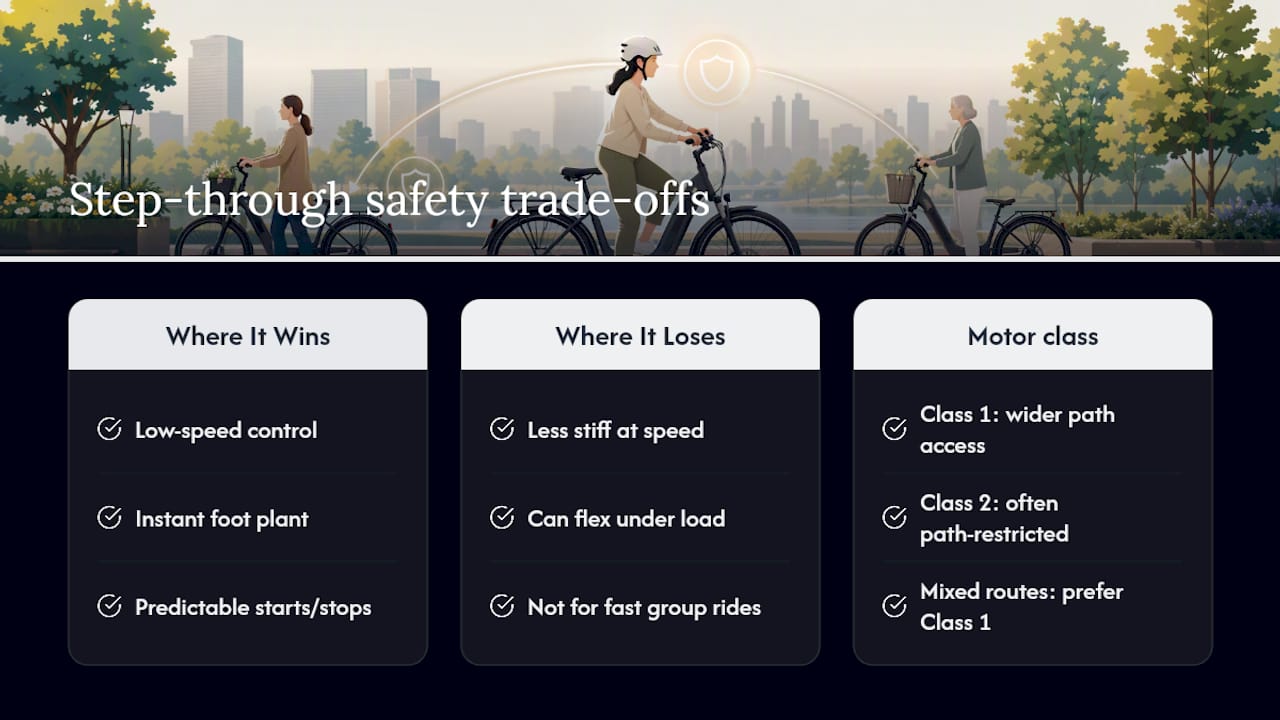
Low-speed control is where a step-through frame earns its keep. At a red light, a crowded bike path, or a driveway with pedestrians crossing, being able to plant a foot instantly, without maneuvering around a top tube, cuts down on the wobbly, off-balance moments that cause most low-speed tip-overs. Riders switching to e-bikes already report more predictable starts and stops in stop-and-go city riding, according to analysis on step-through e-bikes for everyday riding, and that predictability compounds when the frame itself isn’t fighting your footwork.
Step-through geometry and electric assistance together reduce the physical friction of frequent stops, a real factor for anyone riding through school zones, farmers markets, or crowded downtown blocks where you’re braking every block or two—in line with practical sustainability tips for everyday life that highlight replacing short car trips with more eco-friendly e-bike rides.
That said, step-throughs aren’t the better choice in every scenario. At higher speeds, frame stiffness matters more than standover clearance, and some step-through designs flex more than a diamond frame under hard cornering or heavy rider weight. If you’re doing fast group rides or carrying serious cargo regularly, that flex is worth test-riding for before you commit.
One safety factor that has nothing to do with the frame: motor class. Class 2 throttle-controlled e-bikes are frequently restricted from multi-use, non-motorized paths in many U.S. cities, while Class 1 pedal-assist models tend to get the broadest access across bike paths and trails. If your commute mixes streets and paths, Class 1 keeps more routes open to you.
Cargo, Racks, and Family Hauling on a Step-Through
Everyday utility is where step-throughs quietly outperform expectations. Without a top tube in the way, rear racks and child seats mount cleanly, and loading a rack while the bike is parked doesn’t require lifting cargo over a frame bar first.
That said, load capacity is a spec you have to check, not assume. Manufacturers rate racks differently, and battery placement changes how a loaded bike handles.
- Confirm the rear rack’s weight rating before mounting a child seat, and check that the mounting points are bolted to the frame, not just the fender.
- Downtube-mounted batteries keep weight low and centered, which helps handling when you add rack weight on top.
- Rear-rack-mounted batteries raise the bike’s center of gravity, and stacking a child seat or panniers on top of that setup changes the steering feel noticeably, according to buyer’s guide analysis on step-through frame trade-offs.
- Ask for the bike’s total payload limit, meaning rider plus cargo plus accessories combined, not just the rack rating alone.
What Motor Type and Battery Placement Mean for Handling
Hub motors and mid-drive motors change how a step-through feels well before you ever load it with cargo. Hub motors, usually mounted in the rear wheel, deliver a simpler, more consistent push and tend to keep the bike’s weight distribution predictable. Mid-drive motors, mounted near the pedals, put power through the existing gears, which gives better hill-climbing torque but can put more stress through the frame’s central junction, exactly the spot where step-through designs are already thinner than a diamond frame’s downtube-to-seat-tube triangle.
Weight is another trade-off to consider. Step-through e-bikes with a mid-drive motor and rear-rack battery often weigh significantly more than many commuter models, heavier than most step-over commuter e-bikes. That matters the moment you need to lift it onto a car rack, carry it up an apartment stairwell, or maneuver it out of a crowded bike storage room.
Reinforced junctions, thicker tubing, and integrated rear-rack batteries are how manufacturers compensate for step-through flex, meaning a well-engineered model doesn’t have to feel weaker just because it’s shaped differently, per comparative analysis of step-through and step-over frame strength.
Before buying, test these on the sales floor or during a demo ride:
- Start from a dead stop on a slight incline to feel how the motor handles low-speed torque.
- Load the rack with the weight you’d actually carry, then ride a figure-eight to feel for flex or wander.
- Lift the bike, even just a few inches, to gauge whether you can realistically get it up stairs or onto a rack alone.
Pro Tip: If you’re regularly hauling a child seat or full panniers, ask specifically about the frame’s reinforcement at the head tube and seat tube junction. That’s where flex shows up first under load.
Who Actually Benefits Most From a Step-Through Frame
Certain riders get outsized value from this frame style, while others are better served elsewhere.
- Older adults and riders with hip or knee limitations get the biggest functional win, since standover clearance directly reduces the joint strain that often keeps people off bikes entirely.
- Urban commuters and errand-runners benefit from faster, easier stops at lights, curbs, and crosswalks throughout a typical day.
- Multi-rider households appreciate that a step-through fits a wider range of heights and abilities, useful if the bike gets shared.
- Riders in skirts, dresses, or bulky work clothes avoid the awkward leg-swing entirely.
Exceptions exist. Aggressive riders chasing speed, anyone hauling consistently heavy cargo loads, and very tall riders who need a longer top tube for reach may find a reinforced step-over frame or a hybrid step-through with a raised, gusseted frame better suited to their needs.
A Practical Checklist for Choosing and Fitting a Step-Through E-Bike
Buying one of these isn’t complicated, but skipping a step here is how riders end up with a bike that looks right in photos and feels wrong on the road.
- Check your fit first. Measure inseam, confirm standover clearance with an inch or more of margin, and adjust saddle height and handlebar reach before judging comfort.
- Match motor class to your routes. Class 1 pedal-assist gives you the widest access to bike paths and trails; Class 2 throttle models face more restrictions on multi-use paths in many cities.
- Confirm payload and rack ratings. Get the total combined weight limit, not just the rack’s individual rating, especially if you’re adding a child seat.
- Note battery placement. Downtube batteries keep the center of gravity lower; rear-rack batteries raise it, which shows up most when the bike is loaded.
- Test-ride under real conditions. Start from a stop, load the rack with actual weight, and mount the bike wearing the kind of clothing you’ll typically wear.
- Watch for red flags. Vague or missing payload specs, no stated frame warranty, and unusually light rear racks are all signs to keep shopping.
Pro Tip: Bring your actual cargo, like a loaded backpack or a friend’s kid, to the test ride if you can. Showroom test loops rarely tell you how a bike handles once it’s carrying real weight.
Import Junkies’ Take on Buying the Right E-Bike
Some retailers specialize in helping everyday riders, from commuters to golf course operators, match the right vehicle to how they actually live, not how a spec sheet reads. That buyer-guide approach shapes every recommendation here: test the fit, check the payload rating, ride it loaded before you decide. If you’re weighing a step-through against other electric options, the best electric scooter for commuting and best electric moped for commuting guides cover adjacent vehicle classes worth comparing before you commit.
Convenience Usually Wins for Everyday Riders
Most people don’t need a race bike. They need something that gets them to work, the store, and back without a fight, and that’s exactly where a step-through earns its reputation. The accessibility argument isn’t hype: lower standover genuinely removes a daily physical barrier that keeps some riders off bikes altogether. Where I’d push back on the marketing is the idea that step-throughs are automatically “just as capable” as a diamond frame in every situation. They’re not, particularly once you add serious cargo weight or start riding aggressively. Test-ride loaded, test-ride at low speed, and let the bike prove itself under the conditions you’ll actually use it in, not just around the parking lot.
— Gary
How Import Junkies Makes Finding Your E-Bike Easier
A U.S.-based company offers a practical alternative to hunting through scattered listings and guessing at specs: one catalog, support, and pricing built for buyers who want a straight answer instead of a sales pitch. Whether you’re set on a step-through for the accessibility benefits covered here or still weighing your options against other electric vehicles, browsing a single wholesale catalog beats piecing together comparisons from five different sites.
Here’s how to move forward without overthinking it:
- Browse the full electric vehicle catalog to compare models side by side.
- Contact the team directly if you need help matching a spec sheet, like payload rating or motor class, to your actual riding routine.
- Ask about financing options if you’re weighing a step-through against other electric vehicles in the same budget range.
If cargo capacity or riding terrain has you leaning toward a different vehicle class entirely, the electric ATV benefits guide is worth a look before you decide. Start by browsing what’s in stock, and reach out with your specific use case. A quick conversation about your commute or cargo needs beats guessing from spec sheets alone.
Sources
- Clinical/biomechanical studies relevant to cycling for older adults (PMC9790588)
- Pedal-assist vs throttle: Which e-bike class suits a 10-mile commute? - Electric Bike Magazine
- Road
Always confirm local path and trail rules before committing to a motor class, since access restrictions vary by city and county.
FAQ
What are the downsides of step-through e-bikes?
The main downsides are added weight, since step-through frames with mid-drive motors and rear-rack batteries often run heavier than step-over models, and potential frame flex under heavy cargo or aggressive riding. Reinforced, well-engineered models largely close that gap, per frame strength comparisons.
What eBikes should I stay away from?
Avoid models with vague or missing payload and rack weight ratings, no stated frame warranty, and unusually light-duty rear racks if you plan to carry cargo or a child seat. Also be cautious of Class 2 throttle-only models if your routes rely on multi-use paths, since access is often restricted for that class in many cities.
Why would I want a step-through bike?
You’d want one for easier mounting and dismounting, better low-speed control at stops, and a more upright, comfortable riding position for daily errands or commuting. It’s especially valuable if you have limited hip or knee mobility, based on research supporting reduced joint strain from adapted bike geometry.
Should I get a step-over or step-through e-bike?
Choose a step-through if you value easy mounting, frequent stops, or riding in everyday clothing, since that covers most commuters and errand-runners. Choose a step-over if you ride aggressively, haul consistently heavy cargo, or need maximum frame stiffness at higher speeds.
Does Import Junkies sell step-through e-bikes?
Import Junkies carries electric bikes as part of its broader catalog of electric vehicles and recreational equipment. Current models and pricing are available on the Import Junkies website, where you can also reach the team for spec comparisons.


