


 Location
 Login
Login
Most electric scooters land between $335 and $2,107, but the sweet spot for a dependable daily commuter sits around $600 to $1,100. That range buys real range, a motor that handles hills without straining, and a battery that won’t quit in year two. Used gas scooters can undercut that further, while premium electric models push past $2,000 once you add tax, shipping, and a helmet.
TL;DR:
- Mid-range scooters priced between $500 and $1,200 offer the best value for daily commuting, with realistic ranges and strong motor performance.
- Battery capacity primarily influences price, with larger batteries providing more range but often delivering only about 70% of the advertised miles under real-world conditions.
- Buying from reputable brands offers better support and easier access to parts, though some lesser-known brands match specs at lower prices if long-term service is guaranteed.
- The first-year ownership costs generally include purchase, taxes, accessories, and basic maintenance, with charging expenses being minimal and battery replacement needed after three to five years.
- Prices vary regionally due to tax, shipping, and local regulations, with important considerations for used options including battery health and seller documentation.
Table of Contents
- Scooter Price Tiers: Budget to Premium
- What Actually Drives the Price of a Scooter
- What Does a Scooter Really Cost to Own in the First Year?
- Where to Find the Best Scooter Deals
- New vs. Used: Which Makes More Sense?
- Why Scooter Prices Differ by State and Region
- Does Brand Reputation Actually Change the Price?
- Financing and Payment Options for Buying a Scooter
- How Import Junkies Prices and Backs Scooter Buyers
- Ready to Compare Scooters at Import Junkies?
- Sources
Scooter Price Tiers: Budget to Premium
Scooter prices break into four practical bands, and knowing which one you’re shopping in saves you from comparing a $300 toy to a $2,000 commuter as if they solve the same problem.
Budget scooters ($200 to $500) are entry-level electric models or basic gas scooters built for short trips, light riders, and occasional use. Don’t expect much suspension or a big battery here. Mid-range scooters ($500 to $1,200) cover the bulk of serious commuters, with better motors, real suspension, and batteries that actually hold a charge through a workweek. Premium scooters ($1,200 to $2,500) bring dual motors, off-road tires, and app-connected dashboards. Hyperscooters (above $2,500) are built for speed and distance, often rivaling small mopeds in output.
RiderGuide’s 2026 market data puts the average electric scooter price at $1,113, with budget models averaging around $335, mid-range around $934, and premium units averaging $2,107. Car and Driver’s testing coverage backs this up, noting that entry-level models run a few hundred dollars while premium machines reach several thousand, and that most buyers get the strongest value from mid-range picks rather than either extreme.
| Tier | Typical Price Range | What You Get |
|---|---|---|
| Budget | $200–$500 | Basic motor, short range, minimal suspension |
| Mid-range | $500–$1,200 | Real commuting range, better brakes and tires |
| Premium | $1,200–$2,500 | Dual motors, app features, off-road capability |
| Hyperscooter | $2,500+ | High top speed, moped-level performance |
Retailers like Best Buy commonly price commuter models between $400 and $800, which lines up with what most riders actually spend once they skip the flashy extremes. If you want a broader look at which category fits your riding style, our scooter types guide breaks down the differences model by model.
What Actually Drives the Price of a Scooter
Two scooters that look almost identical in photos can differ by $500 once you dig into the specs sheet. Motor wattage is the first lever. A 250W motor handles flat commutes fine, but anything with real hills needs 500W or more to avoid grinding uphill at a walking pace. Gas scooters follow a similar logic with engine displacement: a 50cc engine suits short errands, while 100cc-plus models handle longer rides and steeper grades.
Battery capacity, measured in watt-hours (Wh), is where price climbs fastest. Bigger batteries mean more range, but manufacturer range claims rarely hold up on the road. Testing data suggests planning for roughly 70% of the claimed range once you factor in rider weight, hills, and wind. A scooter advertised at 40 miles will more realistically deliver 28 to 30 in daily use.
Beyond the motor and battery, several other factors move the price:
- Suspension: Dual spring or hydraulic suspension adds cost but pays off on rough pavement.
- Brakes: Disc brakes cost more than drum brakes but stop faster in wet weather.
- Frame material: Aluminum alloy frames weigh less and cost more than steel.
- Tires: Pneumatic tires ride smoother; solid tires need less maintenance.
- Warranty and dealer support: A one-year warranty through an established seller adds real value over a no-name import with no service backup.
Pro Tip: If your commute is under five miles and mostly flat, don’t overpay for a huge battery or a high-wattage motor. Put that budget into better brakes and suspension instead. They matter more for daily comfort and safety than raw power you’ll rarely use.
What Does a Scooter Really Cost to Own in the First Year?
The sticker price is just the starting point for evaluating vehicle rental startup costs alongside ownership expenses. A detailed U.S. ownership breakdown shows purchase price drives most of the total, but taxes and shipping typically add $20 to $300 on top, and a helmet plus basic accessories run another $50 to $150.
Here’s what a realistic first year looks like:
- Purchase price: $335 to $2,107 depending on tier
- Tax and shipping/setup: $20 to $300
- Helmet and accessories: $50 to $150
- Basic tune-up or service: $30 to $100
Charging costs barely register. Electricity for a daily commuter scooter usually runs under $15 a year, which is one advantage electric holds firmly over gas.
The real long-term risk is the battery. For frequent daily riders, expect a battery replacement within three to five years, often costing a few hundred dollars. Factor that into any long-term value comparison, especially against a cheap import with an unclear parts supply chain. Insurance and registration requirements vary heavily by state, since some treat higher-speed electric scooters more like mopeds. Our electric scooter vs. moped comparison walks through where those lines get drawn.
Where to Find the Best Scooter Deals
Shopping channel matters almost as much as the model you pick. Big-box retailers offer convenience and easy returns but often mark up common models. Buying direct from a specialty seller frequently gets you closer to wholesale pricing, though you need to watch for destination fees and assembly charges that show up at checkout.
Timing helps too. Follow these windows to catch real discounts:
- Spring restock season (March through May), when retailers clear winter inventory to make room for new stock.
- Black Friday and Cyber Monday, which reliably produce the deepest markdowns of the year on commuter models.
- Model-year clearances (late summer into fall), when last year’s version drops in price as the new one arrives.
Before buying anything priced well below market, run through this checklist:
- Ask whether the battery is original or a third-party replacement.
- Confirm what the warranty actually covers and for how long.
- Check if the price includes shipping or if that’s added later.
- Search the model name plus “recall” before committing.
- Walk away from sellers who won’t answer direct questions about battery cell brand or motor origin.
New vs. Used: Which Makes More Sense?
A new scooter gives you a full warranty, the latest battery chemistry, and no wear-and-tear guesswork. That certainty costs money: you’re paying full retail with nothing subtracted for depreciation.
KBB’s scooter values tool and JD Power’s used scooter pricing resource both offer reference points for what a given make and model should sell for secondhand, which helps you spot an overpriced listing before you waste a trip to see it in person.
The catch with used electric scooters is battery health, which doesn’t show up in a photo. A scooter that’s three years old and heavily ridden may need a battery replacement soon after purchase, erasing whatever you saved on the purchase price. Gas scooters age more predictably. A well-maintained engine can run for a decade with basic upkeep, so a used gas model often represents better long-term value than a used electric one with an unknown battery history.
If you’re buying used, ask for the original charger, request a demonstration under load (not just powering on), and confirm the seller has service records if any repairs were done. A used scooter with documentation is worth more than an identical one without it, even at the same asking price. For newer riders unsure which category fits their needs, our buying guide for better deals covers negotiation tactics specific to secondhand listings.
Why Scooter Prices Differ by State and Region
Scooter prices aren’t uniform across the country, and the gaps come from a few identifiable sources rather than random retailer whim.
Sales tax is the most direct driver. Shipping costs also vary by region: buyers on the West Coast or in the Northeast often pay less to ship from major distribution hubs than buyers in more remote areas, where freight surcharges apply.
Local regulation plays a role too. States that classify higher-speed electric scooters similarly to mopeds sometimes require additional safety equipment or registration, which pushes the effective cost of ownership higher even when the sticker price is identical. Urban markets with strong commuter demand, like parts of California and the Northeast corridor, also tend to see retailers price commuter models slightly higher simply because demand supports it.
Rural and suburban markets often see better deals on gas scooters specifically, since gas models remain popular for utility use on farms and larger properties, keeping local competition and used-market supply higher. If you’re comparing prices across sellers, always check whether the quoted number includes destination or setup fees. A scooter that looks $100 cheaper in another state can end up costing the same once shipping is factored in.
Does Brand Reputation Actually Change the Price?
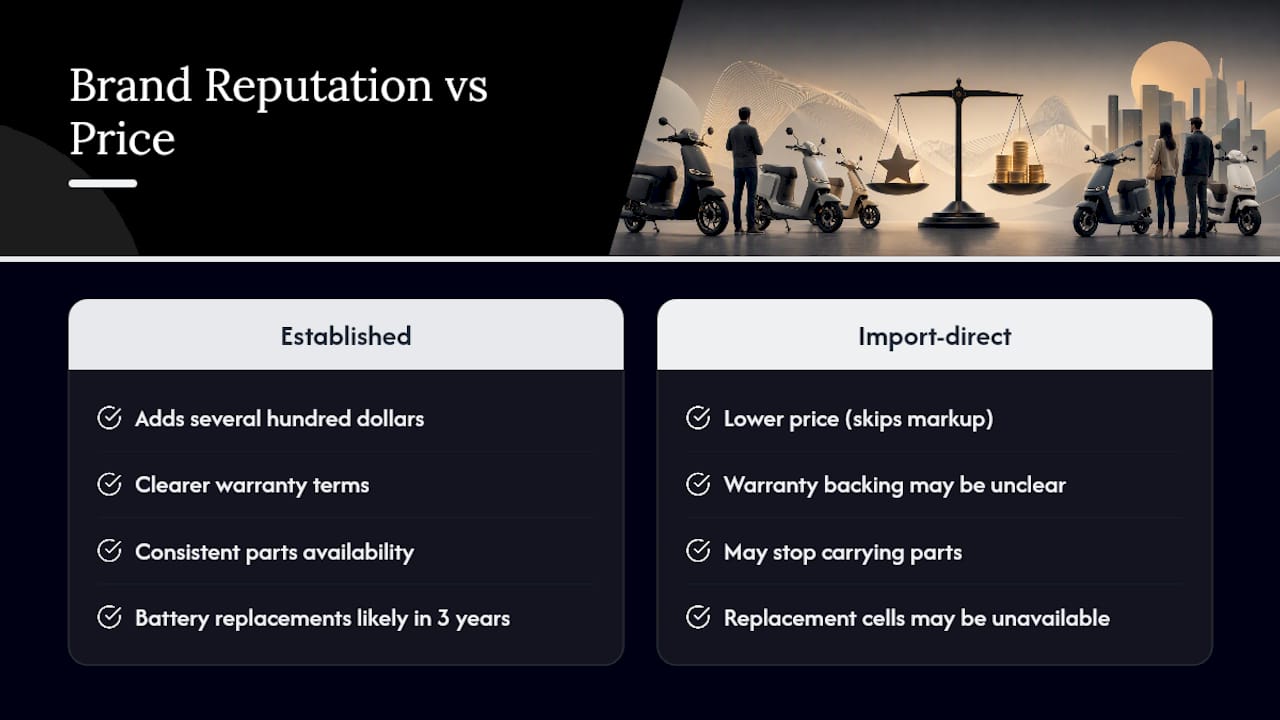
A recognizable brand name can add several hundred dollars to a scooter’s price tag, and sometimes that premium is worth it. Established brands typically back their products with clearer warranty terms, more consistent parts availability, and documented safety testing. That matters most for the battery, since brand reputation often reflects whether replacement cells will still be available in three years.
Lesser-known or import-direct brands aren’t automatically worse. Many offer nearly identical specs to established names at a lower price because they skip the marketing budget and retail markup that inflates the recognizable options. The risk isn’t the hardware itself; it’s support after the sale. If a no-name importer disappears or stops carrying parts, a broken controller board or a dead battery can turn a cheap scooter into an expensive paperweight.
The smartest approach is to weigh brand premium against actual service backing rather than name recognition alone. A seller who stocks parts, answers support questions, and stands behind the warranty is worth more than a famous logo with no local presence. Ask any seller, brand-name or not, how they handle a battery failure in month eight. The answer tells you more about long-term value than the price tag does.
Financing and Payment Options for Buying a Scooter
Most scooter buyers don’t need to pay the full price upfront. Many specialty retailers, including direct sellers, offer point-of-sale financing through third-party providers that split the purchase into monthly installments, often with promotional zero-interest periods for buyers with solid credit.
For premium models above $1,500, installment financing through a retailer checkout tends to offer better terms than a standard credit card, particularly if the promotional period runs six to twelve months.
Buy-now-pay-later services have also become common at checkout for scooters in the $500 to $1,500 range, letting buyers spread the cost across four to six payments with no interest if paid on schedule. Read the fine print carefully. Missing a payment on these plans often triggers a much higher retroactive interest rate than a standard credit card would.
Whatever financing route you choose, calculate the total cost including interest before committing, not just the monthly payment. A scooter that looks affordable at $45 a month can cost significantly more than its sticker price once a 12-month plan with deferred interest runs its course. If you’re financing, buying from a seller with clear, published pricing makes it easier to compare the cash price against the financed total before you sign anything.
How Import Junkies Prices and Backs Scooter Buyers
Selling scooters alongside golf carts, ATVs, and utility vehicles for years taught me one consistent lesson: buyers regret the purchase far less often when they understand the total cost before checkout, not after. Pricing a scooter honestly means showing the real number up front, including what shipping and setup actually add, instead of luring someone in with a number that grows once they reach the cart.
That’s the standard Import Junkies holds itself to. Every listing shows specs, images, and pricing clearly, so you can compare a $400 commuter against a $1,800 premium model without guessing what’s missing. If you want to go deeper before buying, our scooter types guide and buying guide for better deals cover the details this article didn’t have room for.
— Gary
Ready to Compare Scooters at Import Junkies?
Import Junkies is the direct-to-buyer alternative to marked-up retail listings: you get wholesale pricing on new and used scooters, e-bikes, and light-electric vehicles without the inflated margins that big-box stores build into their sticker prices.
The catalog runs from entry-level electric commuters to utility-grade rides built for heavier daily use. If you’re shopping the budget end, the 500 Watt Wizzer Electric Motor Scooter delivers pedal-assist commuting at a price that undercuts most retail floor models. For riders who need more utility than a standard scooter offers, the Electric Powered Cargo Truck shows how far the light-electric lineup extends beyond basic commuting.
Every listing shows full specs and images upfront, so you can compare models side by side before you buy. Browse the current scooter inventory, check specs against what this guide covered, and reach out to the sales team with any questions before you check out.
Sources
- Electric Scooter Statistics 2026: Price, Range & Safety Data
- Best electric scooters tested (Car and Driver)
- Scooter Values & Pricing (KBB)
- Motorized scooter price guide for U.S. buyers 2026


