


 Location
 Login
Login
A local haul under 100 miles typically runs $100 to $300. A regional move of 100 to 500 miles lands between $300 and $700. Cross-country shipments over 500 miles commonly fall between $700 and $1,500, depending on whether you choose open or enclosed transport. Open transport is fine for most standard carts. Enclosed makes sense when you’re moving something custom, lithium-powered, or genuinely valuable. Before you request quotes, gather these four things:
- Pickup and delivery ZIP codes
- Cart length, width, height, and weight
- Battery type (lead-acid or lithium)
- Clear photos of the cart from all four sides
Key Takeaways
Shipping a golf cart typically costs $100 to $1,500 depending on distance and transport type, and choosing open versus enclosed transport is the single biggest lever on that price.
| Point | Details |
|---|---|
| Know your price band | Budget $100–$300 local, $300–$700 regional, and $700–$1,500 cross-country. |
| Choose transport type wisely | Pick open for standard carts; pay the 30%–50% enclosed premium for high-value or lithium models. |
| Prep before pickup | Measure the cart, secure the battery, set fuel below a quarter tank, and photograph every side. |
| Vet the carrier | Confirm USDOT/MC registration on FMCSA SAFER and get proof of current cargo insurance. |
| Compare shipping against buying local | For lower-value carts, check Importjunkies’ inventory for pickup or local delivery before booking a long haul. |
Table of Contents
- Shipping A Golf Cart: What Actually Drives The Price
- Open Vs Enclosed: Which Transport Type Fits Your Cart?
- How Long Does It Take To Ship A Golf Cart?
- Preparing Your Golf Cart For A Smooth Pickup
- How To Vet A Golf Cart Shipping Carrier
- What Happens At Pickup And Delivery
- Golf Cart Shipping Cost Examples By Distance
- Is Shipping A Golf Cart Ever The Wrong Call?
- Skip The Freight Bill: Buy Local Instead
- Frequently Asked Questions
- Sources
Shipping A Golf Cart: What Actually Drives The Price
Carriers don’t pull numbers out of thin air. Distance sets the baseline, but three other factors swing your quote by hundreds of dollars.
- Distance band. Short hauls under 100 miles often cost less per mile than you’d expect because carriers rarely dispatch a truck for a single short run. Regional trips in the 100 to 500-mile range hit the sweet spot for cost efficiency. Cross-country jobs cost more in total but less per mile, since the carrier spreads fixed costs over more distance.
- Add-on fees. Residential pickup or delivery, liftgate service for loading without a ramp, remote or rural delivery, oversized cart dimensions, and expedited pickup can each add anywhere from $25 to $150 to your final bill.
- Cart specs. Lifted carts and models with oversized tires or roof racks commonly add $50 to $150 to the quote because they need carrier-specific trailer clearance. Lithium battery chemistry can also trigger a surcharge if the carrier needs special hazmat handling.
Weight matters more than most buyers realize. A stock two-seater weighs around 900 to 1,100 pounds, but a lifted four-seater with a lithium pack and aftermarket wheels can push past 1,600 pounds. That extra bulk changes how the cart gets loaded and strapped, and carriers price accordingly.
Open Vs Enclosed: Which Transport Type Fits Your Cart?
Open transport is the default for a reason: it’s cheaper, widely available, and perfectly fine for a standard gas or electric cart making a routine move. Your cart rides exposed to weather and road grime, similar to how a used car gets shipped on an open-air auto hauler. For a $6,000 golf cart headed to a second home, that’s an acceptable trade-off.
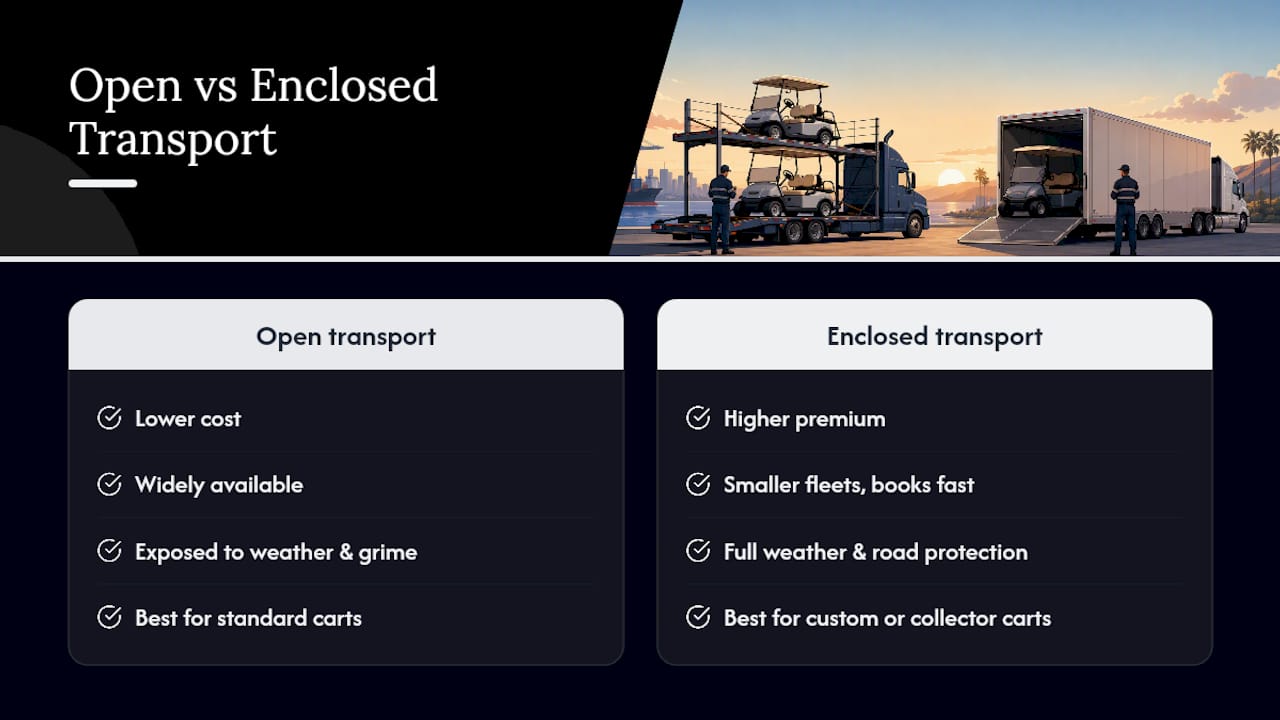
Enclosed transport runs a significant premium compared to open transport, and it earns that premium when the cargo justifies it — a customized golf cart with a fresh paint job, a high-end electric model, or a cart with sentimental or collector value. Freight/terminal shipping (where you drop off and pick up at a hub rather than your driveway) can shave cost further but adds legwork. DIY towing is legal in some states with the right hitch and trailer rating, but most standard vehicles aren’t rated to tow a loaded cart safely over long distances.
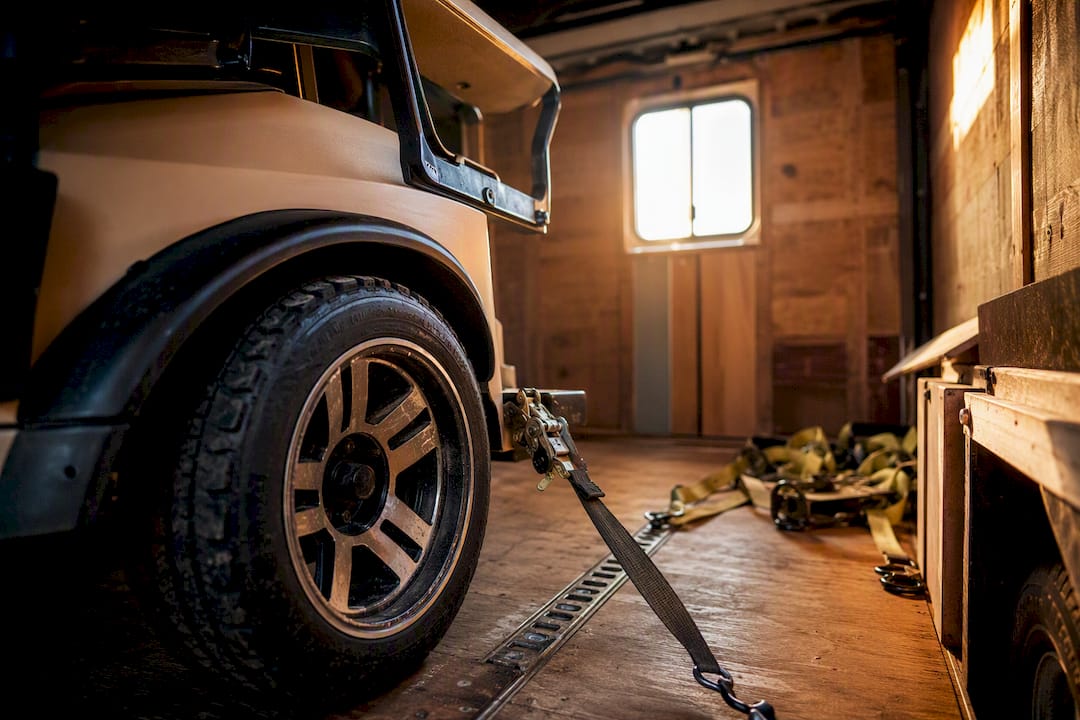
Pro Tip: Enclosed carriers run smaller fleets and book up faster, so if you know you want enclosed, reserve it two to three weeks ahead rather than a few days out.
How Long Does It Take To Ship A Golf Cart?
Drivers typically cover 400 to 500 miles per day, so a 300-mile regional move might take a single day on the road, while a cross-country trip of 2,000 miles can stretch to a full week or more. Standard transit windows run 1 to 10 days once the cart is loaded.
- Expect a pickup window of 1 to 5 business days after booking for open transport
- Enclosed carriers have longer pickup windows since fewer trucks run that route
- Bad weather, consolidated multi-stop loads, and remote rural addresses can all add a day or two
Book earlier than you think you need to, especially for enclosed service or delivery to a rural address.
Preparing Your Golf Cart For A Smooth Pickup
Carriers refuse more pickups over preventable prep mistakes than mechanical problems. Work through this list before the truck shows up:
- Measure everything. Log the cart’s length, width, height, lifted ground clearance, and total weight. A quote based on guesswork almost always gets revised at pickup, and that revision rarely favors you.
- Handle the battery correctly. Lead-acid batteries usually just need to be secured in place. Lithium packs are a different story: DOT hazmat rules can require disconnection, protective terminal covers, or confirmation that the carrier holds hazmat authority before the truck ever arrives.
- Set fuel below a quarter tank for gas carts. Full tanks add weight and, in rare cases, run afoul of carrier fuel policies.
- Remove or secure loose accessories like cup holders, umbrellas, and aftermarket lighting, then take timestamped photos from all four corners plus the odometer or hour meter.
- Immobilize the tires with wheel chocks or confirm the carrier will do this at pickup.
A cart that’s over 1,000 pounds with a lithium battery and lifted suspension is the profile most likely to get flagged for extra clearance checks, so disclose every modification when you request your quote, not after the truck arrives.
How To Vet A Golf Cart Shipping Carrier
Not every quote you receive comes from a carrier who can actually deliver on it. Run these checks before you book:
- Look up the company’s USDOT and MC numbers through the FMCSA SAFER system to confirm active registration
- Ask for current proof of cargo insurance, not just a claim that they “carry coverage”
- Confirm they have hazmat authority if your cart runs on lithium batteries
- Ask about trailer clearance if your cart is lifted or oversized
- Clarify whether delivery is door-to-door or terminal-to-terminal, since terminal pickup shifts more legwork onto you
- Get the claims process and contact person in writing before the cart ships, not after something goes wrong
A broker who confirms hazmat authority and clearance at the quote stage, rather than the day of pickup, is the one worth booking. That single step prevents most refused pickups.
Pro Tip: If a carrier can’t produce a USDOT number in under five minutes, treat that as a red flag and move to the next quote. For a broader checklist on evaluating any freight provider, this haulage vetting guide walks through similar red flags in a related industry.
What Happens At Pickup And Delivery
The driver photographs your cart’s condition at pickup and records it on the Bill of Lading (BOL), the legal document both parties sign. That paperwork is your entire case if a dispute comes up later.
- Compare the delivered cart against your own pickup photos before signing anything
- Note any new scratches, dents, or battery issues directly on the delivery paperwork
- Signing the BOL without noting damage can forfeit your ability to file a claim
- Most carriers give a short window, often 24 to 48 hours, to report issues after delivery
Golf Cart Shipping Cost Examples By Distance
| Distance | Open Transport | Enclosed Transport |
|---|---|---|
| Under 100 miles | $100–$300 | $150–$400 |
| 100–500 miles | $300–$700 | $300–$700 |
| Over 500 miles | $700–$1,500 | $1,000–$2,000 |
Lifted carts, lithium battery surcharges, and remote delivery fees can push any of these ranges higher, so treat them as a starting point rather than a guarantee.
Is Shipping A Golf Cart Ever The Wrong Call?
Sometimes it is. If the cart’s value is close to what shipping costs, buying locally usually wins on both money and hassle. Ship it when the cart is custom, high-value, or has real sentimental weight behind it.
Skip The Freight Bill: Buy Local Instead
If you’re staring down a $700 to $1,500 shipping quote for a cart you don’t have deep attachment to, there’s a simpler math problem to run: what does a comparable cart cost bought outright, ready to pick up, with no carrier paperwork involved? Importjunkies stocks new electric and gas carts you can browse, price, and arrange local delivery or pickup for, without waiting a week for a truck to cross three states.
The 48V Electric Golf Cart 4 Seater Renegade Edition is a solid example: a full four-seat electric utility cart at a wholesale price, with no long-distance freight bill stacked on top. If you need more ground clearance, the Lifted Renegade+ 2.0 Edition covers that without the surcharges a lifted cart triggers on a shipping quote. Contact Importjunkies about local pickup or delivery options in your area, and compare that total against your best shipping quote before you commit either way.
Frequently Asked Questions
How much does it cost to ship a golf cart across the country? Cross-country shipments over 500 miles typically run $700 to $1,500 on open transport, more for enclosed or lifted carts with lithium batteries.
What’s the best way to ship a golf cart with a lithium battery? Confirm the carrier’s hazmat authority at the quote stage. Some carriers require disconnection or separate shipment of large lithium packs under DOT rules.
Is open or enclosed transport better for a golf cart? Open transport works for most standard carts and costs less. Enclosed transport costs 30% to 50% more and is worth it for custom, high-value, or electric carts.
How long does golf cart freight shipping take? Drivers typically cover 400 to 500 miles per day, so transit ranges from a single day for regional moves to about a week or more for cross-country shipments.
What should I check before hiring a golf cart shipping company? Verify the carrier’s USDOT number through FMCSA SAFER, confirm current cargo insurance, and ask about hazmat authority if your cart runs on lithium batteries.
Sources
- Golf Cart Shipping in 2026: How It Works, Costs & Tips | SAKAEM Logistics
- How Much Does It Cost to Ship a Golf Cart? | A-1 Auto Transport
Recommended
- Golf Cart Buying Guide for Smart Buyers – Saferwholesale || Import Junkies || Great Sports
- Street Legal Golf Cart Requirements Explained – Saferwholesale || Import Junkies || Great Sports
- 6 Passenger Golf Cart Price: What to Expect – Saferwholesale || Import Junkies || Great Sports
- Golf cart features: a complete buyer’s guide for 2026 – Saferwholesale || Import Junkies || Great Sports


