


 Location
 Login
Login
Yes, ventilate a steam shower, but mainly after the session ends. Run a wet-location rated exhaust fan ducted to the exterior, sized to the enclosure’s square footage, and controlled by a timer or a humidity/dew-point sensor rather than a manual switch. The fan’s job is cleanup, not steam suppression while you’re inside.
TL;DR:
- Proper ventilation should only be activated after the steam session, using an exhaust fan that runs for 20 to 30 minutes to clear residual vapor.
- Use a wet-location rated fan with corrosion-resistant parts, sealed motors, and appropriate airflow capacity based on enclosure size, typically around 1 CFM per square foot.
- Place the fan outside the enclosure in the bathroom ceiling to avoid early failure from direct steam exposure and to simplify maintenance.
- Insulate ducting passing through unconditioned space and terminate it outdoors with a damper and insect screen to prevent condensation and pests.
- Employ controls with adjustable humidity and dew-point sensors to optimize venting, minimizing unnecessary operation during humid days or high outdoor dew points.
Table of Contents
- How and When to Run Steam Shower Ventilation
- Which Fan Types and Ratings Actually Hold Up
- How Much CFM Do You Need and Where Should the Fan Go?
- Ducting, Termination, and Insulation Done Right
- Controls and Sensors That Make Ventilation Reliable
- Installation and Safety Checklist Before You Sign Off
- Maintenance and Troubleshooting for Steam Shower Fans
- What I’ve Learned About the Real Trade-Off Here
- Where Import Junkies Fits Into Your Steam Shower Plans
- Sources
- FAQ
How and When to Run Steam Shower Ventilation
Running an exhaust fan while the generator is still firing works against you. Pull air out during the session and you’re diluting the steam envelope you paid for, cooling the room, and forcing the generator to work harder to hold temperature. MrSteam’s own best-practices guidance is direct on this point: keep the enclosure sealed and let the fan wait until you’re done.
Here’s the sequence that actually works:
- Seal the door and any glass panels for the full session so steam builds and holds.
- When you’re finished, crack the door slightly or open a transom louver to equalize pressure before fully opening it.
- Switch on the exhaust fan and let it run for 20 to 30 minutes, to clear residual vapor from the enclosure and surrounding bathroom air.
- A brief cold-water rinse of the walls afterward speeds condensation runoff and cuts drying time.
One caveat worth knowing: on days when outdoor dew point is high, that exhaust fan pulls in air that’s nearly as damp as what it’s removing. Green Building Advisor’s analysis of bath fan performance makes the case for checking conditions or using a control smart enough to skip the cycle when it won’t help.
Which Fan Types and Ratings Actually Hold Up
Standard bathroom fans aren’t built for the moisture load a steam shower produces, and putting one inside the enclosure is asking for early failure. CyShower’s rundown on fan compatibility is blunt about this: any fan exposed to direct steam needs a wet-location UL listing or an IP65/IP67 rating, sealed motor housing, and corrosion-resistant components, because standard fan windings and bearings corrode fast in saturated air.
Look for these features when you’re comparing units:
- UL wet-location listing or IP65/IP67 rating stamped on the housing
- Sealed motor assembly with corrosion-resistant blades and casing
- Low-sone rating (under 1.5 sones) so it doesn’t sound like a leaf blower
- Insulated ducting collar to reduce condensation drip-back into the housing
If you can place the fan just outside the steam enclosure, in the ceiling of the adjacent bathroom area, you sidestep most wet-rating headaches while still capturing the moisture that escapes when the door opens.
Pro Tip: If you’re retrofitting an older steam shower and the existing fan sits inside the enclosure, budget for a wet-rated replacement even if it still spins. Corrosion inside a sealed motor rarely shows symptoms until it fails outright, often taking a breaker or a GFCI with it.
How Much CFM Do You Need and Where Should the Fan Go?
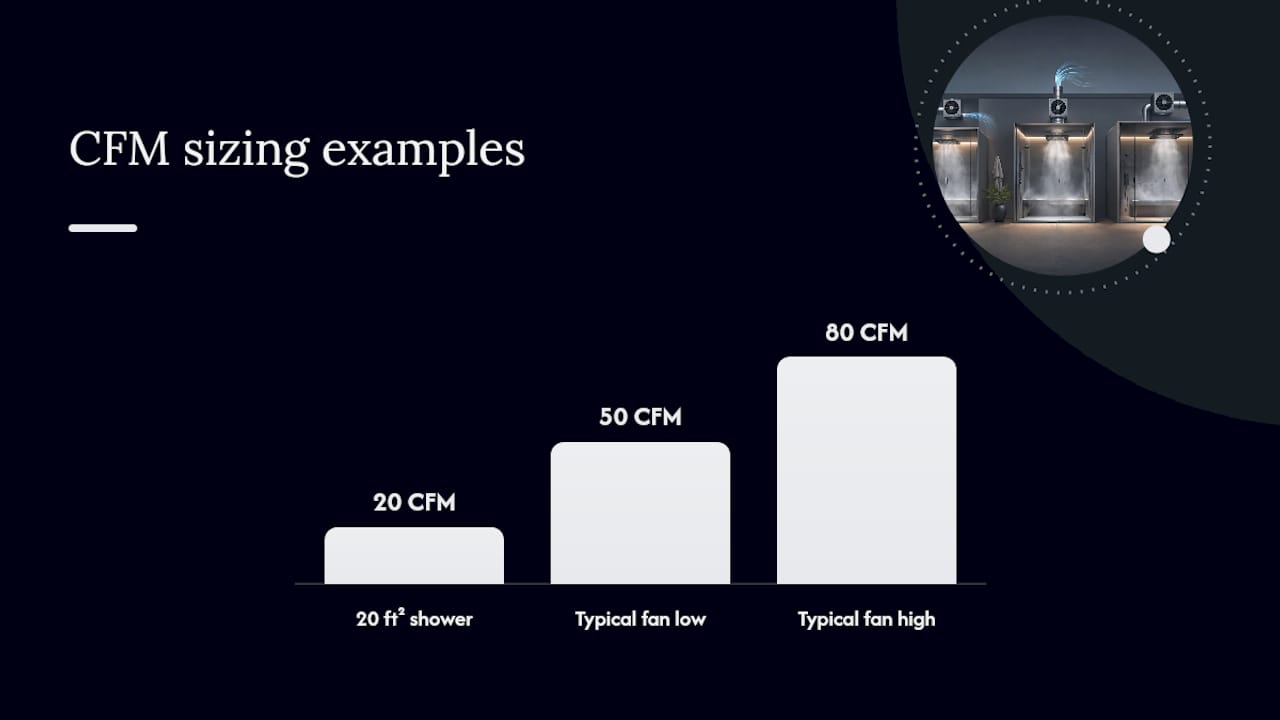
A workable starting rule is roughly 1 CFM per square foot of shower floor area, a benchmark echoed in sizing guidance for steam shower exhaust fans. A 4 by 5 foot enclosure (20 square feet) points you toward a 20 CFM minimum, though most installers round up to the nearest common fan size, typically 50 to 80 CFM, to account for real-world duct losses.
Adjust upward when:
- Ceiling height exceeds 8 feet, since taller enclosures hold more air volume per square foot.
- The generator is oversized for the space, producing more steam output than the enclosure’s dimensions would suggest.
- Duct runs are long or include several turns, which reduces effective airflow well below the fan’s rated CFM.
Placement matters as much as capacity. Mount the fan at the top of the adjacent room or wall, away from the generator’s steam head and never directly above it, where condensation can drip back onto electrical components. Keep it clear of direct spray zones, and respect manufacturer-specified mounting heights so wiring stays isolated from moisture intrusion.
Ducting, Termination, and Insulation Done Right
Rigid, smooth-walled duct outperforms flexible duct here, both for airflow and for resisting sag that traps condensation. Fewer bends and shorter runs preserve the CFM you actually paid for, since every 90-degree turn eats into real-world performance. Installer guidance on in-shower ventilation setups consistently points toward insulated runs wherever duct passes through unconditioned space like an attic.
Keep these non-negotiables in mind:
- Insulate any duct segment running through an attic or crawlspace to stop condensation from forming inside the pipe.
- Terminate to the exterior through a wall or roof cap, never into an attic or soffit cavity.
- Install a backdraft damper at the termination point to block outside air and pests from working their way back in.
- Add a bird screen and check local code for minimum clearance from windows, since exhaust vapor shouldn’t drift straight back into a living space.
Controls and Sensors That Make Ventilation Reliable
A basic humidistat switches the fan on past a fixed humidity percentage, which sounds simple but often runs the fan longer than needed or misses the point entirely on humid days. Dew-point-aware controls, like Panasonic’s WhisperControl Condensation Sensor, read both temperature and humidity to judge whether venting will genuinely lower indoor moisture, not just shuffle damp air around.
Features worth prioritizing on any control you buy:
- Adjustable sensitivity so the trigger point matches your bathroom’s typical humidity swing
- Automatic delay-off timing, commonly 20 to 30 minutes post-session, which lines up with ASHRAE 62.2-style minutes-per-hour ventilation targets
- Manual override for guests or unexpected humidity spikes unrelated to steam use
Leviton’s Decora in-wall humidity sensor and fan control is a solid example of a component that automates this cycle without requiring you to remember a manual switch every time.
Installation and Safety Checklist Before You Sign Off
A steam shower’s electrical environment is unforgiving of shortcuts, so treat this checklist as the minimum, not a suggestion.
- Confirm GFCI protection on every circuit serving the fan, lighting, and controls, per local electrical code.
- Hire a licensed electrician for wiring runs near the enclosure, especially where conduit passes through wet zones.
- Verify the fan carries a wet-location UL listing or equivalent IP rating and keep the installation manual for warranty claims.
- Mount the fan at the manufacturer’s specified height, routing wiring away from any path where water could pool or drip.
- Confirm the duct terminates outdoors through a damper, not into an attic, and have your contractor document this at final inspection.
Pro Tip: Ask your installer to photograph the duct run before drywall goes up. It’s a five-minute step that saves a demolition headache if you ever need to troubleshoot airflow years later. For a fuller rundown of what a quote should include, see Import Junkies’ installation checklist.
Maintenance and Troubleshooting for Steam Shower Fans
Clean the intake grille every month and inspect the backdraft damper and duct insulation twice a year, since lint and mineral buildup from steam residue accumulate faster here than in a standard bathroom fan.
Common problems and quick fixes:
- Weak airflow: usually a blocked duct or a failing motor. Check the termination cap first for debris before assuming motor failure.
- New rattling or grinding noise: worn bearings, typically not repairable. Replace with a wet-rated unit rather than patching an aging fan.
- Visible rust on the housing: a sign the fan was never rated for this environment. Swap it for a UL wet-location model.
- Persistent condensation or mold after runs: often an insulation gap in the duct run, not a fan problem at all.
In hard-water regions, mineral scale accelerates wear on motor bearings, so a slightly shorter inspection interval pays off. If a fan trips a GFCI repeatedly or shows any sign of electrical arcing, call an electrician rather than resetting the breaker and hoping. For deeper generator-side care, Import Junkies’ maintenance guide covers the other half of the system.
What I’ve Learned About the Real Trade-Off Here
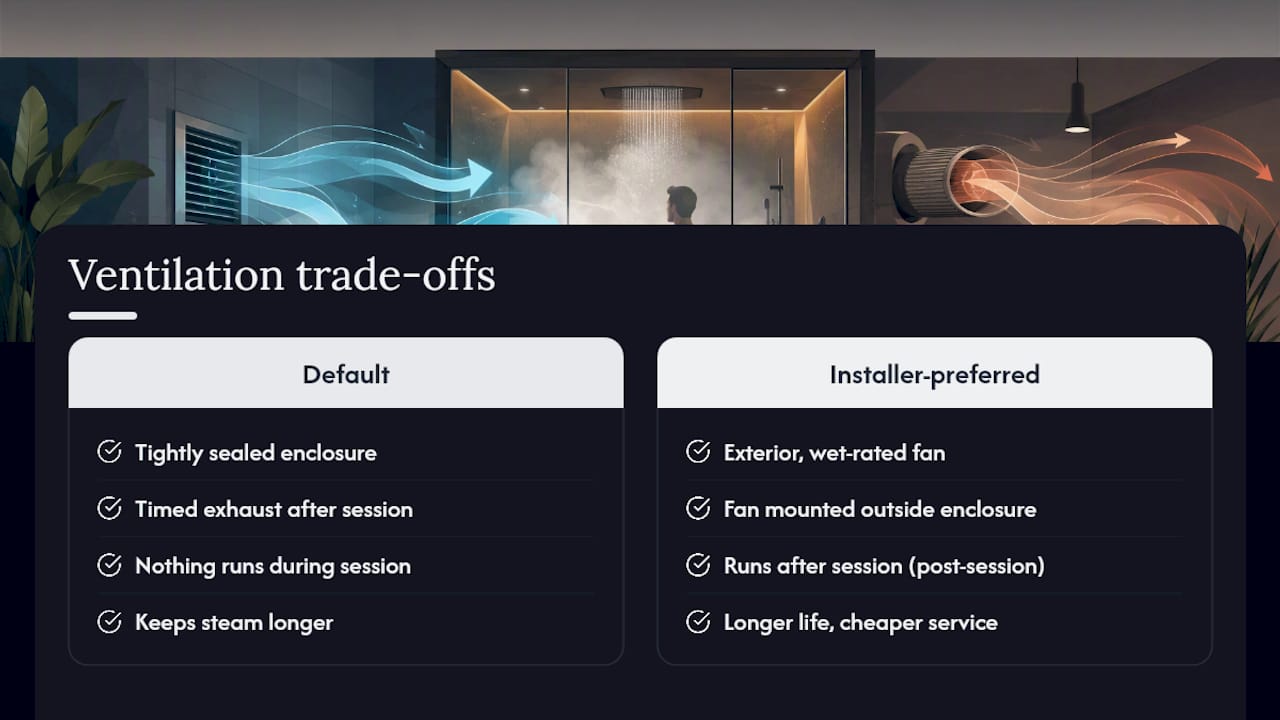
Every homeowner wrestling with steam shower ventilation is really negotiating between two competing goals: hold the steam in long enough to justify the investment, and clear it out fast enough that the bathroom doesn’t grow something you’ll regret. The default that works for most builds is a tightly sealed enclosure paired with post-session timed exhaust, nothing running during the session itself.
Where I’d push back on generic advice: don’t default to an in-enclosure fan just because it’s simpler to install. Installers favor exterior-mounted, wet-rated units for good reason, they last longer and cost less to service. If you’re still comparing enclosure options before ventilation even enters the picture, Import Junkies’ steam shower buyer guide is a useful starting point.
— Gary
Where Import Junkies Fits Into Your Steam Shower Plans
One can purchase steam showers and the accessories that go with them, listed with real specs, images, and pricing so you can check wet-location ratings and CFM figures before committing to a fan or an enclosure.

If you’re comparing enclosure sizes against the sizing guidance above, our product catalog lists specifications up front rather than burying them behind a quote request. Every listing keeps installation manuals accessible so you’re not chasing down a PDF after the sale. If you’ve got a sizing question specific to your bathroom’s square footage or ceiling height, our customer service team can walk through it with you before you buy. Browse current steam shower listings on the Import Junkies catalog and get the specs you need to spec out ventilation correctly the first time.
Sources
- 6 Tips for Keeping Steam In and Letting Steam Out — MrSteam
- Running bath fans to control humidity — Green Building Advisor
- Can you put a fan in a steam shower? — CyShower
FAQ
What Are the Downsides of a Steam Shower?
The main drawbacks are moisture-related: mold risk if ventilation is inadequate, higher installation cost from sealing and electrical requirements, and ongoing maintenance on both the generator and the exhaust fan.
Is Breathing In Shower Steam Good for You?
Steam can loosen congestion and open pores temporarily, but the moist heat also raises humidity fast in an enclosed space, which is exactly why post-session exhaust ventilation matters for the room, not just for comfort during the session.
How Long Should You Sit in a Steam Shower?
Most manufacturer guidance suggests 20 to 30 minutes per session, though this varies by generator output and personal heat tolerance.
Can You Take a Regular Shower In a Steam Shower?
Yes, most steam shower enclosures double as a standard shower stall, but confirm the fixtures and drainage are rated for both regular water flow and steam operation before relying on that dual use daily.
Does a Steam Shower Need a Dedicated Exhaust Fan?
Yes. A wet-location rated exhaust fan ducted to the exterior is standard practice, since the moisture load from a steam session exceeds what a typical bathroom fan or passive ventilation can handle.


