


 Location
 Login
Login
Liability-only UTV insurance typically runs from low to several hundred dollars a year, while full coverage can range from the mid-hundreds up to around or above a thousand dollars depending on your machine’s value and how you outfit it, according to Progressive’s coverage guide and analysis from Boundless Rider. Your exact number depends on where you live, what you ride, and how you’re covered. The only way to nail it down is to run quotes, which we’ll walk through below.
TL;DR:
- Costs are influenced mainly by vehicle value, intended usage, rider profile, location, and policy structure, with regional claim and theft rates affecting premiums.
- Additional equipment such as aftermarket wheels or winches can increase costs unless specifically covered by riders, and choosing higher deductibles reduces premiums but raises out-of-pocket expenses.
- State laws, loan requirements, and land access rules often mandate full coverage, regardless of the minimums set by insurance providers.
- Accurate quotes require detailed vehicle info, rider records, and clear questioning about coverage specifics like trailer or equipment riders, with independent agents recommended for complex situations.
Table of Contents
- Typical UTV Insurance Cost Ranges by Coverage Level
- What Affects Your UTV Insurance Cost?
- Coverage Types and Add-Ons: What Each One Actually Does
- When Is UTV Insurance Actually Required?
- How to Get an Accurate UTV Insurance Quote
- Author Proof: How Your Vehicle Choice Shapes Insurance
- Balancing Purchase Price and Insurance Cost
- Choose a UTV That Keeps Insurance Costs in Check
- Sources
Typical UTV Insurance Cost Ranges by Coverage Level
Think of UTV insurance pricing in three rough tiers, each tied to how much protection you’re buying.
- Liability-only: Typically ranges from about low to mid-hundreds of dollars per year. This covers damage or injury you cause to other people or their property, and it’s the bare minimum most states or lenders will accept.
- Standard full coverage: Usually falls somewhere above the liability-only range up to near around nine hundred dollars per year for a mid-value UTV, according to Cost Insider’s budget estimates. This adds collision and comprehensive, so your own machine is protected too.
- Advanced or high-value packages: Boundless Rider’s data puts average basic packages around $413 a year, with advanced packages averaging closer to $1,587. That jump usually comes from equipment riders, lower deductibles, and higher coverage limits on pricier machines.
Aftermarket wheels, winches, or a stereo system can add meaningful cost to that top tier, since insurers generally won’t cover custom parts without a specific rider attached. Your deductible choice matters just as much. Dropping from a $1,000 deductible to $250 raises your premium, sometimes by a noticeable margin, because the insurer is absorbing more of the risk on every claim.
What Affects Your UTV Insurance Cost?
Insurers price UTV policies using the same logic they apply to cars, just recalibrated for off-road risk. Five categories do most of the work:
- The vehicle itself: Value, engine displacement, make and model, model year, and any modifications all factor into risk assessment.
- How you use it: Recreational weekend riding costs less to insure than daily work use on rough terrain.
- Who’s riding: Your age, driving record, and prior claims history on ATVs or UTVs all shift your rate.
- Where you keep it: ZIP code risk, local theft rates, and whether you garage the machine or leave it exposed.
- How you structure the policy: Coverage limits, deductible level, and any optional riders you add.
Location carries more weight than most buyers expect. Riders in the Northeast often pay 5 to 15 percent more than the national average because regional claim costs and theft rates run higher there.
Pro Tip: A clean multi-year riding record works in your favor over time. Insurers treat riders with recent violations or prior UTV claims as higher risk, and premiums tend to ease once you build a claims-free stretch.
Coverage Types and Add-Ons: What Each One Actually Does
A UTV policy is built from distinct pieces, and knowing what each one triggers helps you avoid paying for coverage you don’t need, or skipping coverage you do.
- Liability: Pays for injury or property damage you cause to someone else. Nearly always the baseline requirement.
- Collision: Covers damage to your own UTV after an accident, regardless of fault.
- Comprehensive: Covers non-collision losses like theft, fire, or storm damage.
- Uninsured/underinsured motorist (UM/UIM): Steps in when the other party has no coverage or not enough.
- Medical payments: Covers medical bills for you and your passengers after an accident, no fault determination needed.
- Equipment/accessories riders: Covers aftermarket parts like winches, light bars, or roll cages, which standard policies typically exclude without this add-on, per GEICO’s coverage guidance.
If you tow your UTV on a trailer, ask specifically about trailer coverage since it’s often a separate line item. And if you financed the machine, the lender likely requires full coverage as a condition of the loan, independent of anything your state mandates.
When Is UTV Insurance Actually Required?
State law is only half the picture. Contracts and land-use rules often force the issue even where the DMV doesn’t.
- Financing or leasing: Lenders almost universally require full coverage for the life of the loan, no matter what your state minimum says.
- Public trail and land access: Many state and federal land managers require registration and liability coverage before you can legally ride public trails. Rules vary by state, so check your DMV and the specific land manager’s site before you head out.
- Your existing policies probably don’t help: Homeowners and standard auto policies typically exclude off-road vehicles entirely, which is why a dedicated powersports policy is the reliable route rather than an exception.
- Trail clubs and organized rides: Some clubs require proof of liability coverage before you can join organized events.
How to Get an Accurate UTV Insurance Quote
- Gather your vehicle details. VIN, year, make, model, estimated value, and a full list of accessories or modifications.
- Document your riders. Ages and driving records for everyone who’ll operate the UTV, plus where you’ll store it (garage, shed, or open lot) and your ZIP code.
- Ask carriers pointed questions. Confirm whether equipment riders, trailer coverage, and towing protection are included or need to be added separately.
- Compare apples to apples. Match limits, deductibles, and exclusions across every quote, not just the bottom-line premium.
- Call an independent agent if your situation is complex (multiple riders, heavy modifications, mixed work/recreation use). Agents can shop several carriers at once and flag exclusions you’d otherwise miss.
Author Proof: How Your Vehicle Choice Shapes Insurance
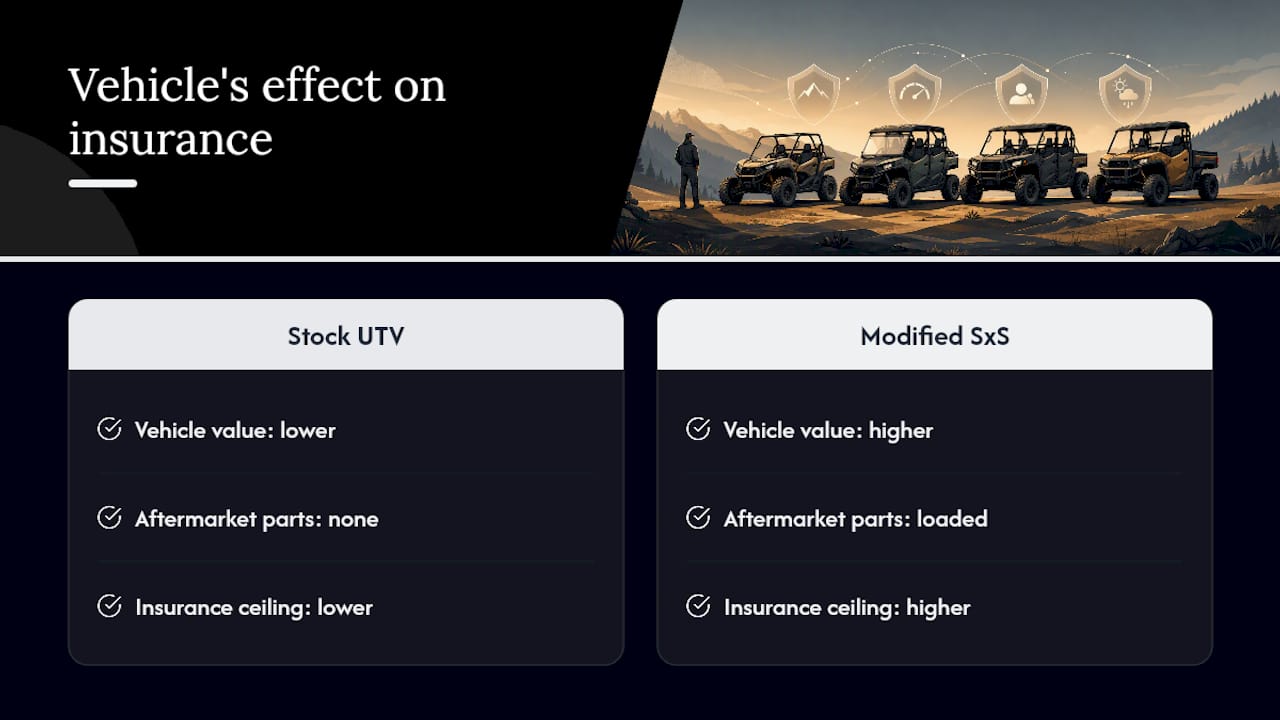
This guide comes from Gary, experienced in selling UTVs, ATVs, and utility vehicles directly to riders and small businesses. That vantage point makes one thing clear: the vehicle you buy sets your insurance ceiling before you ever request a quote. A factory-stock utility UTV with no aftermarket parts generally insures cheaper than a high-performance side-by-side loaded with mods, since insurers price both the machine’s value and its modification list. If you’re still shopping, our breakdown of UTV prices and true out-the-door costs and our rider safety guide both help you estimate what a given machine will cost to own, not just to buy.
Balancing Purchase Price and Insurance Cost
If you’re cross-shopping UTVs, weigh the sticker price against what you’ll pay every year after. A stripped-down base model with factory safety features and no aftermarket add-ons almost always insures cheaper than a heavily customized machine, even when the purchase prices are close. Budget for both numbers before you sign anything, not just the one on the invoice.
— Gary
Choose a UTV That Keeps Insurance Costs in Check
This source provides full specs and documented pricing on vehicles before purchase, helping you avoid guessing what an insurer will see. Since equipment riders and modification lists drive so much of your premium, starting with a factory-stock, well-documented machine puts you ahead before you request a single quote.
Browse utility-focused options like the 400cc 4x4 UTV with snow plow and dump bed or the lighter 200cc UTV with snow plow and dump bed, both built around utility use rather than heavy modification. Regular upkeep also keeps claims down over time, a point Premier Fleet Repair’s maintenance guidance backs up well beyond just UTVs. Contact the seller for a spec sheet on any listed model. Having exact specs in hand speeds up every quote you request afterward.
Sources
- How Much Is ATV & UTV Insurance? | Progressive
- How much does UTV insurance cost? | Boundless Rider
- ATV Insurance: Affordable UTV & Four-Wheeler Coverage | GEICO
- UTV Insurance Cost With State Farm: Price Insights and Budget Estimates 2026 – Cost Insider


