


 Location
 Login
Login
TL;DR:
- Utility cart attachments expand storage and functionality for various vehicles, but compatibility and safe load limits are essential considerations. Proper material selection, installation, and adherence to load calculations ensure durability and safety in specific environments. Always verify vehicle specs and attachment ratings before purchase to prevent structural failure or tipping.
A utility cart attachment is a modular add-on that mounts to a cart or utility vehicle to expand its storage, carrying capacity, or function. Three common examples: a service bin that clips to a cart rail for refuse or small parts, a tool holster bracket that keeps hand tools at the point of use, and a dump bed that bolts to a UTV cargo area for bulk material hauling. Before you buy, you’ll want to confirm compatibility with your vehicle’s mounting points, verify the combined weight stays within the rated payload, and check whether the material suits your cleaning requirements. Those three topics are covered in detail below.
- Service bins and trash scoops attach to rails or frames to collect refuse or sort small parts without a separate trip
- Tool holsters and brackets keep wrenches, cords, or chargers accessible on the vehicle rather than in a toolbox back at the shop
- Dump beds bolt onto UTV or utility vehicle cargo areas and tip hydraulically or manually to unload bulk material fast
Table of Contents
- What types of utility cart attachments are there?
- Does the attachment actually fit your vehicle?
- How do you calculate safe load limits?
- What materials hold up and clean easily?
- What should you check before buying an attachment?
- How do you install a utility cart attachment?
- How Importjunkies vehicles match common attachment needs
- What regulations apply to utility cart attachments in the U.S.?
- Key Takeaways
- A note from the Importjunkies team
- Ready to find the right vehicle for your attachment?
- Useful sources
What types of utility cart attachments are there?
Utility cart attachments are modular add-ons that expand a cart’s functionality and storage for industrial and commercial settings. The category is broader than most buyers expect.
Bins and service bins are the most common type. They snap or hook onto cart rails to hold refuse, dirty linen, or sorted parts. In foodservice and banquet service, a bin attached to the side of a bussing cart means staff complete a full room pass without doubling back to a trash station.
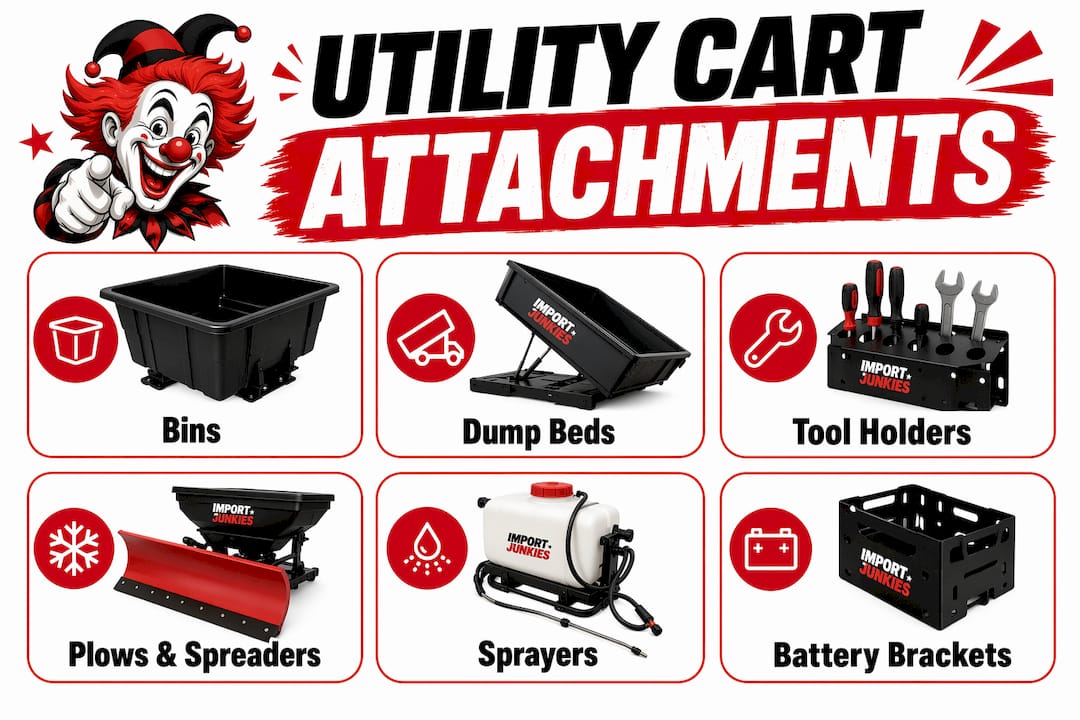
Dump beds serve groundskeeping, landscaping, and light construction. A dump bed replaces or augments the flat cargo area of a UTV or utility vehicle, letting one operator unload mulch, gravel, or clippings by tipping rather than shoveling.
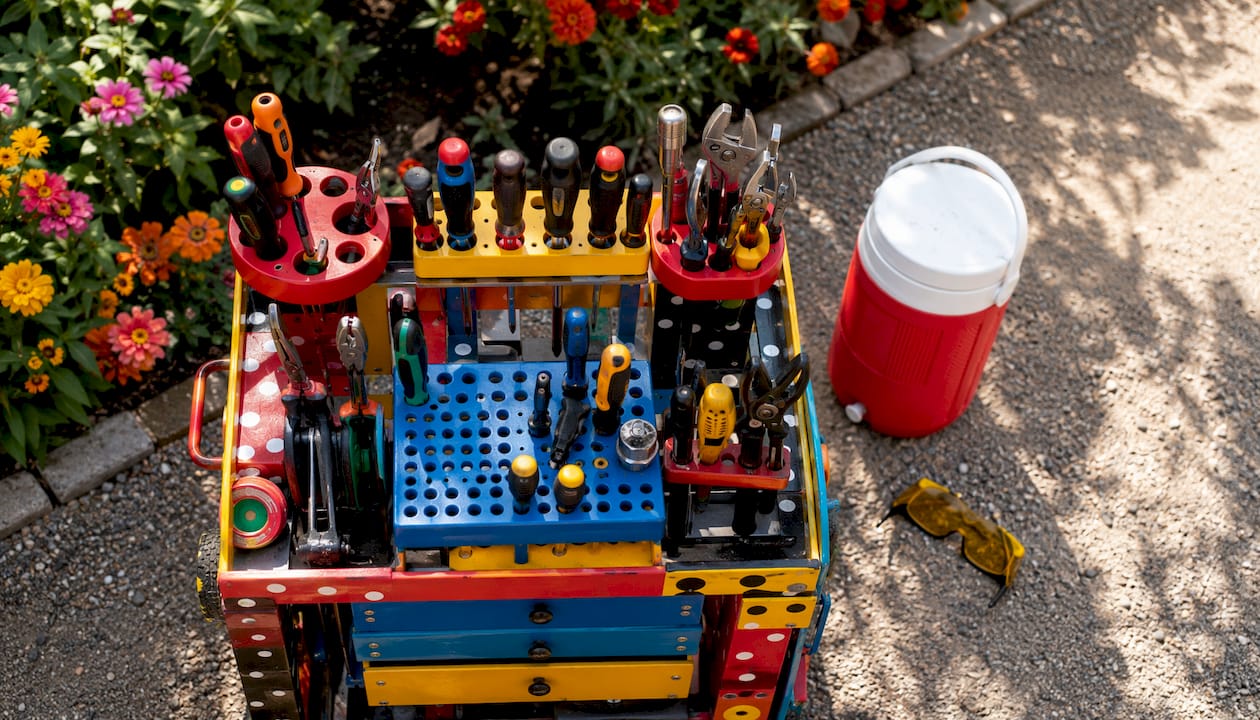
Tool holders, holsters, and racks keep hand tools, cords, and power equipment on the vehicle. A maintenance tech rolling through a facility has every tool within reach instead of returning to a central crib between jobs.
Plows and spreaders mount to the front or rear of ATVs and UTVs for snow removal or material spreading. These are among the heavier attachment categories and require the most careful payload math.
Sprayers and dispensers attach to cargo beds or rear frames for irrigation, pest control, or surface treatment. They typically include a tank bracket, pump mount, and hose reel holder.
Battery and charger brackets are a smaller but growing category. A charging bracket screws onto existing cart mounting holes and positions a charging station for laptops, scales, or card readers without reducing cargo space.
Does the attachment actually fit your vehicle?
Compatibility is where most buyers run into trouble. Record these specs before you shop:
| Spec to check | Why it matters |
|---|---|
| Vehicle model, year, and frame type | Mounting hole patterns vary by manufacturer and model year |
| Rated payload (lbs) | Sets the hard ceiling for attachment weight plus cargo |
| Bed or cargo area dimensions | Determines whether the attachment footprint physically fits |
| Existing mounting points or rail type | Tells you which mounting system is compatible |
| Electrical connectors (for powered attachments) | Prevents wiring mismatches on powered sprayers or chargers |
Mounting systems fall into three main categories. Bolt-on brackets are the most secure and suit permanent or semi-permanent installs. Clamp-on mounts require no drilling and work well for lighter accessories on standard tube frames. Rail-slot systems use two parallel vertical rails with sliding fasteners, letting you reposition accessories at any vertical point without removing hardware — a practical choice when your workflow changes seasonally.
Footprint is easy to overlook. Adding even a few inches of width or length can make some routes inaccessible in tight aisles or older facilities, so measure aisle and doorway clearances before you finalize a purchase. This matters especially on golf courses and in warehouses where turning radius is already tight.
Pro Tip: Before ordering, pull your vehicle’s owner’s manual and note the exact payload rating and any frame reinforcement warnings. Manufacturers sometimes list a lower “attachment-ready” payload than the gross vehicle weight rating — those are two different numbers.
How do you calculate safe load limits?
Underestimating total weight capacity is the most common buyer mistake and a leading cause of structural failure or tip-over incidents. The math is straightforward once you lay it out:
Combined load = attachment dead weight + cargo weight That total must stay below the vehicle’s rated payload.
- Record the rated payload from your vehicle’s spec sheet or owner’s manual.
- Add the attachment’s dead weight (listed in the product specs — never skip this step).
- Estimate your typical cargo weight under real operating conditions, not a best-case scenario.
- Confirm you have a margin. If the combined figure is within 10% of the rated payload, reconsider the attachment or reduce cargo.
As a real-world reference point, the Rubbermaid Commercial Heavy-Duty Adaptable Cart lists a 500 lb total capacity with 250 lbs per shelf, snap-in hooks rated at 10 lbs, and a flip-up shelf rated at 20 lbs. Those per-component ratings matter as much as the total.
Red flags to watch for when evaluating any attachment:
- No load rating listed anywhere in the product specs
- No mention of frame reinforcement for heavy or cantilevered designs
- High center-of-gravity designs (tall racks, top-heavy bins) with no anti-tip guidance
- Aftermarket welds with no certification or weld-quality documentation
Pro Tip: Always distribute load low and centered. A rear-heavy or side-heavy attachment shifts the vehicle’s center of gravity and increases tipping risk on inclines, even when you’re technically within the rated payload.
What materials hold up and clean easily?
Material choice determines how long an attachment lasts and how easy it is to keep clean, which matters most in foodservice, healthcare, and outdoor environments.
Stainless steel resists corrosion and survives repeated sanitizing cycles. It’s the standard for foodservice and healthcare carts where NSF compliance is required. The tradeoff is weight and cost. Powder-coated steel is lighter and less expensive, but the coating can chip in high-impact or chemical-exposure environments, leaving bare metal exposed to rust. Polyethylene and structural foam are lightweight, impact-resistant, and won’t corrode. Structural foam construction, for example, handles heavy loads without the weight penalty of solid plastic.
For regulated environments, prioritize removable modules and smooth surfaces that you can disinfect without damaging finishes. Sealed seams prevent liquid from pooling in crevices where bacteria grow. NSF-listed materials confirm the design meets food-safety standards.
A practical maintenance cadence for most attachments:
- Weekly: Inspect fasteners for looseness; wipe down surfaces with appropriate cleaner for the material
- Monthly: Check caster and hinge lubrication; look for cracks, corrosion, or weld fatigue
- Seasonally: Replace worn wear parts (rubber bumpers, caster wheels, locking pins) before they fail
For outdoor or corrosive environments, look for hot-dip galvanized or marine-grade powder coat finishes, and confirm that replacement wear parts are available before you buy. Checking a fleet vehicle maintenance checklist is a useful habit for operators running multiple vehicles with attachments.
What should you check before buying an attachment?
Run through this checklist at the product page or on a call with the seller:
- Confirmed vehicle compatibility (model, year, frame type)
- Attachment’s rated load capacity and dead weight listed in specs
- Mounting hardware included or sold separately (and at what cost)
- Return policy and warranty terms, especially for structural components
- Availability of replacement parts and mounting templates
- Seller’s stated installation time and whether professional install is recommended
Questions worth asking the seller directly: Does a mounting template come with the attachment? Does installation require drilling into the frame? Does adding this attachment void any part of the vehicle warranty? What load distribution does the manufacturer recommend?
Pricing rarely stops at the base price. Factor in required mounting kits, optional hardware upgrades, shipping weight (heavy attachments cost more to ship), and installation labor if you’re not doing it yourself. A $200 attachment with a $75 mounting kit and $100 in professional installation time is a $375 purchase.
How do you install a utility cart attachment?
Installation complexity ranges from a few minutes to a half-day shop job, depending on the mounting system.
Quick-attach and rail systems are the fastest. You slide the accessory into the rail slot, tighten the fastener, and you’re done. No drilling, no templates. These systems, described in Stanley Black & Decker’s modular rail patent, are designed for exactly this kind of flexible, tool-light installation.
Bolt-on brackets take longer. You’ll need the mounting template (usually included), a drill, the correct bit for your frame material, a torque wrench to hit the manufacturer’s spec, and threadlocker on fastener threads to prevent vibration loosening. Budget 1–3 hours for a straightforward bolt-on install.
Weld-on conversions are the most permanent and the most involved. These require a welder, proper safety equipment, and knowledge of your frame’s steel grade. Unless you have that experience, this is a professional install.
Hire a professional when the attachment involves structural reinforcement, electrical integration (wiring harnesses, powered sprayers, charging systems), or when the installation would void the vehicle warranty if done incorrectly.
How Importjunkies vehicles match common attachment needs
Two Importjunkies vehicles illustrate how to match a base vehicle to attachment requirements.
The 48V Electric Golf Cart 4 Seater Renegade Edition is a passenger-duty vehicle suited to lighter service attachments: bin brackets, tool holsters, charger mounts, and small racks. Before pairing any attachment, confirm the payload rating and bed dimensions on the product page, and verify that the mounting points match the attachment’s hardware template.
The Electric Powered Cargo Truck 1000 Watt is built for cargo-focused work. Its three-wheel platform and cargo bed make it a practical base for heavier attachments like dump beds, sprayer tanks, or tool racks. Check the product page for payload capacity and bed dimensions before specifying an attachment.
Importjunkies product pages include detailed specs — payload, dimensions, and images — so you can verify compatibility without guessing. For buyers comparing vehicle types before committing to an attachment strategy, the utility trucks vs. golf carts guide on the Importjunkies blog is a useful starting point.
What regulations apply to utility cart attachments in the U.S.?
Regulations on utility cart attachments vary by use environment rather than by a single federal standard. OSHA’s material handling guidelines (29 CFR 1910.176) govern how loads must be secured and stacked in general industry workplaces, which applies when attachments are used in warehouses, manufacturing floors, or commercial facilities. Exceeding a vehicle’s rated payload is an OSHA compliance issue in those settings, not just a mechanical risk.
For foodservice and healthcare, NSF International standards govern which materials and surface finishes are acceptable for equipment used near food or in clinical environments. An attachment used on a bussing cart in a commercial kitchen should carry NSF listing or be made from NSF-approved materials.
For on-road or street-legal use, state motor vehicle codes apply. Most utility carts and golf carts with attachments are not street-legal by default; adding a plow or cargo extension does not change that status. Check your state’s DMV rules before operating an attachment-equipped vehicle on public roads. Local zoning or facility rules may also restrict attachment types in specific venues like airports, hospitals, or sports facilities.
This article is general information, not legal or regulatory advice. Confirm current rules with OSHA, your state DMV, or a qualified professional for your specific situation.
Key Takeaways
Matching an attachment to your vehicle starts with payload math: add the attachment’s dead weight plus your expected cargo, and confirm that total stays below the vehicle’s rated capacity with margin to spare.
| Point | Details |
|---|---|
| Define compatibility first | Record your vehicle’s model, year, frame type, payload, and bed dimensions before shopping. |
| Run the payload math | Attachment dead weight plus cargo must stay below rated payload — always leave a safety margin. |
| Choose the right mount | Rail-slot systems offer flexibility; bolt-on brackets offer permanence; weld-on suits structural needs. |
| Match material to environment | Stainless steel or NSF-listed materials for foodservice and healthcare; powder-coat or polyethylene for outdoor use. |
| Use Importjunkies specs | Check payload and dimensions on Importjunkies product pages before pairing any attachment to a vehicle. |
A note from the Importjunkies team
At Importjunkies, we work with consumers and small business owners every day who are figuring out exactly this question: which vehicle, which attachment, and how to make sure they work together safely. If you’re not sure whether a specific attachment is compatible with a vehicle you’re considering, reach out to our product support team before you buy. We can point you to the right spec sheet, confirm mounting point details, or help you compare two vehicles side by side. The goal is a purchase you’re confident in, not one you’re second-guessing after delivery.
Ready to find the right vehicle for your attachment?
Importjunkies carries a range of utility vehicles built for real work, from passenger-duty golf carts to cargo-focused electric trucks, with product pages that list the payload ratings and dimensions you need to match attachments confidently.
If you need a capable base for heavier attachments like dump beds or plows, the 200cc UTV with Snow Plow and Dump Bed shows exactly how factory-fitted attachments and vehicle specs work together. For lighter service work, the 48V Electric Golf Cart 4 Seater Renegade Edition is a strong starting point. Browse the full catalog at Importjunkies, check the payload specs on the product page, and contact the team if you have questions about mounting compatibility before you order.
Useful sources
- Utility Cart Accessories & Parts | Global Industrial — broad overview of attachment types and hook/bin/bracket options
- Foodservice Utility Carts Buying Guide | ChefEquipment.com — workflow efficiency and bin attachment use cases
- Selecting the Right Utility Cart (White Paper) | Lakeside — cleanability, NSF materials, and modular design guidance
- Heavy-Duty Adaptable Cart | Rubbermaid Commercial — real-world capacity specs and per-component load ratings
- Modular Accessory Attachment System Patent | Justia — technical description of rail-slot mounting systems
- Utility Cart Buying Guide | Channel Manufacturing — commercial kitchen load capacity and caster standards
- KwikBoost EdgePower Bracket | Worthington Direct — example of a charger bracket attachment and installation method
- 6 Features Your Service Utility Cart Must Have | Vevor — weight capacity guidance and tipping risk
- Cart Footprint Considerations | ToolGuyd — maneuverability and clearance planning
Always consult the manufacturer’s load rating documentation and installation guide before purchasing or fitting any attachment to your vehicle.
Recommended
- Types of Commercial Utility Carts: A Business Buyer’s Guide – Saferwholesale || Import Junkies || Great Sports
- Utility trucks vs. golf carts: which delivers more value? – Saferwholesale || Import Junkies || Great Sports
- Utility Vehicles Explained: Uses, Types, and Right Fit – Saferwholesale || Import Junkies || Great Sports


