


 Location
 Login
Login
TL;DR:
- Homeowners and auto policies often exclude off-premises golf carts, creating coverage gaps for owners and operators. Proper insurance depends on specific use cases, with several product types needed for total protection. Many claims are denied due to policy language owners fail to review before incidents occur.
If you own a golf cart or operate a course fleet, you almost certainly need a standalone policy or a commercial endorsement. Standard homeowners and personal auto policies routinely exclude golf carts the moment they leave your driveway, and a course’s master property policy does not cover members’ personal carts at all. The three coverage gaps that most often force a separate policy are:
- Third-party liability — your homeowners policy typically won’t pay if your cart injures a guest on-course
- Physical damage off-premises — collision and theft coverage under a homeowners policy usually stops at your property line
- Operational exposures — mowers, sprayers, and utility vehicles on a course need inland marine scheduling, not just a commercial property listing
Before your next round or your next season: check your auto and homeowners policies for explicit golf cart exclusions, ask your agent whether your mobile equipment is scheduled on an inland marine form, and require any member who parks a personal cart at your facility to show proof of their own coverage.
Table of Contents
- What golf course vehicle insurance actually covers and the product types you need to know
- Why homeowners and auto policies often deny golf cart claims
- What a golf cart policy covers: liability, physical damage, medical, and more
- Golf carts vs. low-speed vehicles: how legal classification changes what you owe
- How much golf cart insurance costs and practical ways to lower your premium
- How claims work and the exclusions that catch owners off guard
- Operator exposures and the policy items most courses miss
- A step-by-step buying checklist and the questions to ask your agent
- Key Takeaways
- What most buyers get wrong about golf cart coverage
- Ready to buy a golf cart? Here’s where to start at Importjunkies
- Further reading and sources
What golf course vehicle insurance actually covers and the product types you need to know
Golf cart and golf-course vehicle insurance is not a single product. It’s a category of specialized coverages that vary depending on who owns the cart, how it’s used, and where it operates. Getting the right type starts with understanding the five main product forms.
| Coverage Type | What It Is | Best For |
|---|---|---|
| Personal golf cart policy | Standalone policy for individually owned carts | Private owners using carts on a course or community |
| Commercial golf-course policy | Package policy for course operators | Courses, clubs, and resorts with owned fleets and facilities |
| Commercial auto | Covers vehicles that operate on public roads | Course-owned carts or utility vehicles driven on streets |
| Inland marine / scheduled equipment | Covers mobile equipment in transit and on-property | Mowers, tractors, sprayers, and attachments |
| LSV endorsement or policy | Covers low-speed vehicles registered for road use | Carts modified or classified as street-legal LSVs |
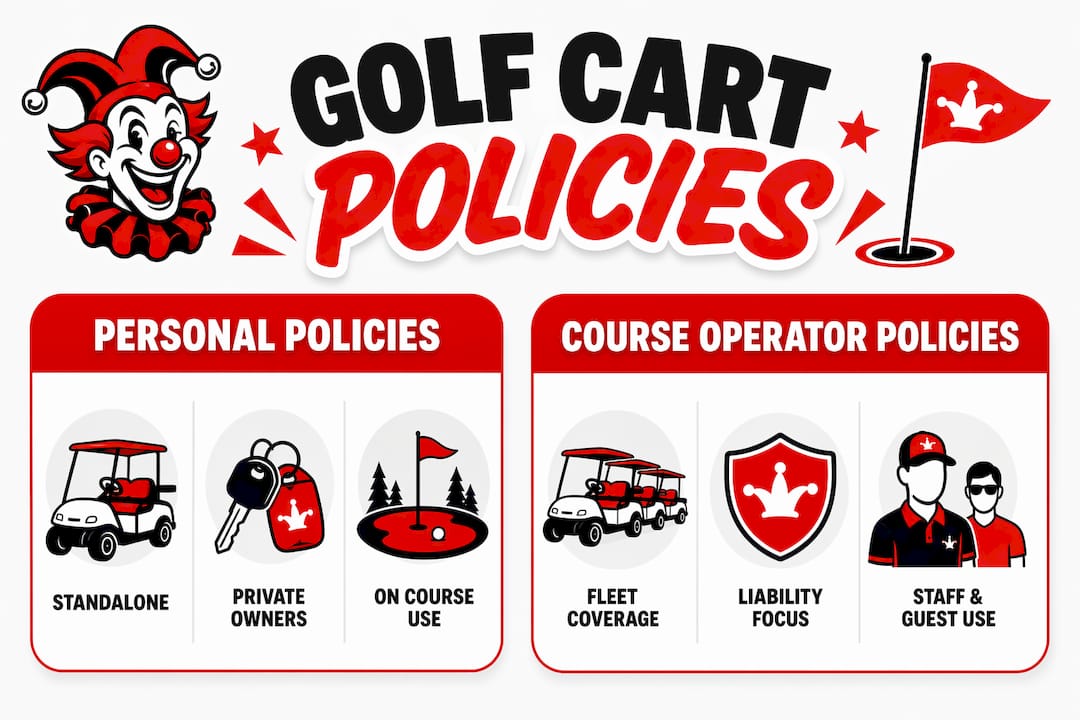
A personal golf cart policy works well for the private owner whose cart stays on a course or a gated community. The moment that cart moves onto a public road, commercial auto or an LSV endorsement becomes the relevant form. For course operators, the picture is more layered: course vehicles and equipment that move across the property create fluctuating liability at every public-access point, which is why inland marine scheduling matters so much. The personal-versus-commercial distinction also affects underwriting directly. A carrier pricing a personal cart policy assumes recreational use; a commercial underwriter prices in the frequency of operation, the number of drivers, and the proximity to the public.
Why homeowners and auto policies often deny golf cart claims
The coverage gap is the single most common surprise in golf cart ownership, and it’s almost always traceable to policy language that most buyers never read until after a claim.
Homeowners policies commonly restrict off-premises vehicle coverage, which means a cart that leaves your property to travel to a nearby course is operating in a gray zone at best and an excluded zone at worst. Personal auto policies add another layer of exclusion: most define “motor vehicle” in a way that either includes golf carts (triggering a separate auto policy requirement) or excludes them entirely (leaving no coverage at all). Neither outcome protects you.
Three claim scenarios that expose the gap most clearly:
- A member-owned cart collides with a third party on the 7th fairway. The member’s homeowners policy excludes the cart because the incident happened off the member’s residence premises. The course’s master policy excludes personal carts entirely.
- A maintenance cart crosses a public path and damages a parked car. The course’s commercial property policy doesn’t cover vehicles in transit; without an inland marine or commercial auto endorsement, the claim is denied.
- A cart is stolen from a course parking lot overnight. The owner’s homeowners policy covers theft only at the insured residence, not at a third-party location.
Typical denial language from a homeowners policy reads something like: “This policy does not apply to bodily injury or property damage arising out of the ownership, maintenance, use, loading, or unloading of a motor vehicle or motorized land conveyance not covered under this policy.” If your cart qualifies as a “motorized land conveyance” under your carrier’s definition, you’re uninsured the moment a claim is filed.
Pro Tip: If a claim is denied, request the specific policy exclusion language in writing, then bring it to a specialist agent who handles golf cart or recreational vehicle coverage. That denial letter is exactly what you need to shop for the right standalone policy.
What a golf cart policy covers: liability, physical damage, medical, and more
A well-structured golf cart or course-vehicle policy can include several distinct coverage components. Understanding what each one does helps you spot gaps when comparing quotes.

| Coverage | What It Pays For | Typical Limits / Notes |
|---|---|---|
| Bodily injury liability | Medical costs and legal fees if you injure someone | Often $25,000 per person |
| Property damage liability | Repairs to someone else’s property you damage | Often $25,000 per occurrence |
| Collision | Repairs to your cart after an at-fault accident | Subject to deductible; sublimits may apply |
| Comprehensive | Theft, fire, weather, vandalism | Subject to deductible |
| Medical payments | Occupant medical costs regardless of fault | Often $1,000 per person |
| Uninsured/underinsured motorist | Covers you when the at-fault party has no insurance | Mirrors liability limits in many states |
| Accessories and custom equipment | Aftermarket upgrades, lift kits, custom seats | Often sublimited to $500–$2,000 unless scheduled |
| Towing and roadside | Flatbed or roadside service for disabled carts | Usually a low-cost add-on |
Accessories coverage deserves special attention. Carriers frequently sublimit this at $500 to $2,000, which is far below the cost of a lift kit, custom wheels, or an upgraded sound system. If you’ve invested in modifications, ask your agent to schedule those items individually rather than relying on a blanket accessories sublimit.
A practical example: an errant cart rolls into the parking lot and puts a crack in a car’s windshield. Without property damage liability on your cart policy, you’re paying that repair out of pocket. With a $25,000 property damage limit, the claim is handled. Golf-course insurance is not a single product but a bundle of specialized coverages, and the same logic applies at the individual cart level.
Golf carts vs. low-speed vehicles: how legal classification changes what you owe
Whether your cart needs registration and mandatory insurance depends heavily on how your state classifies it, and that classification usually comes down to speed capability and equipment.
A standard golf cart is generally defined as a vehicle designed for use on a golf course, with a top speed of 20 mph or less and no requirement for registration or insurance in most states when used on private property. A low-speed vehicle (LSV) is a federally defined category: a four-wheeled vehicle with a top speed between 20 and 25 mph that meets Federal Motor Vehicle Safety Standards, including headlights, turn signals, mirrors, seat belts, and a windshield. Once a cart meets LSV criteria, most states require registration, a valid driver’s license, and liability insurance to operate it on public roads.
Common state-level triggers that push a cart into LSV or street-legal territory:
- Top speed exceeds 20 mph (often after aftermarket motor upgrades)
- Cart is operated on any public road, even briefly
- State law requires registration for any motorized vehicle above a set speed threshold
- Cart is modified with DOT-required safety equipment to comply with local ordinances
Check your state’s DMV website for the exact thresholds. Arizona’s DOT, for example, publishes vehicle insurance requirements that apply to registered LSVs just as they apply to standard automobiles. Most states follow a similar framework, but the speed cutoffs and equipment lists vary. For a detailed breakdown of what makes a cart street-legal in your state, the street legal golf cart requirements guide covers the specifics.
If you’ve modified your cart for road use, that modification likely reclassifies it. A cart that started life as a standard 20 mph vehicle but now tops 25 mph after a motor swap is an LSV in most jurisdictions, and operating it on public roads without registration and insurance exposes you to fines, liability, and uninsured-motorist risk.
How much golf cart insurance costs and practical ways to lower your premium
Golf cart insurance is generally affordable compared to standard auto coverage, but the price range is wide because carriers weigh several variables differently.
The main cost drivers:
- Vehicle value — a basic used cart costs less to insure than a new 4-seat utility model with custom upgrades
- Use type — private recreational use on a course is priced lower than commercial fleet use with multiple drivers
- Road use — any street-legal or LSV classification adds cost because it introduces traffic-related liability
- Driver history — moving violations and prior claims raise premiums
- Location — states with higher litigation rates or theft rates carry higher base premiums
- Fleet size — operators insuring multiple units often qualify for fleet discounts that reduce per-unit cost
Premium ranges vary by carrier and state, so treat any published figure as a starting point rather than a guarantee. What you can control is the underwriting profile you present. A well-maintained cart stored in a locked garage, driven by a single licensed adult with a clean record, and used only on private property will always price better than the same cart used commercially with multiple drivers.
Concrete tactics to reduce your premium:
- Store the cart in a locked structure and document it with photos
- Add a GPS tracker or anti-theft device
- Bundle the cart policy with your homeowners or commercial package
- Request a limited-use endorsement if the cart is seasonal
- Maintain a clean maintenance log (carriers reward documented upkeep)
- Ask about multi-unit discounts if you’re insuring a fleet
- Raise your deductible if you can absorb a moderate out-of-pocket loss
Following a vehicle maintenance checklist also reduces the likelihood of a mechanical-failure claim, which keeps your loss history clean and your renewal premium stable.
How claims work and the exclusions that catch owners off guard
Filing a golf cart claim follows the same basic flow as any property or liability claim, but a few steps are specific to this vehicle type.
- Secure the scene — move injured parties to safety and call emergency services if needed
- Document everything — photograph the cart, the damage, the location, and any third-party vehicles or property involved
- Gather witness information — names and contact details from anyone who saw the incident
- Notify your insurer promptly — most policies require notice within a defined window; late notice can complicate or void a claim
- Preserve the vehicle — don’t authorize repairs until the adjuster has inspected or waived inspection
- Keep all repair records — invoices, estimates, and parts receipts support your claim value
Common exclusions that surprise owners after a loss:
- Intentional damage — no policy covers deliberate acts
- Wear and tear — mechanical breakdown from age or lack of maintenance is almost universally excluded
- Unapproved modifications — a lift kit or motor swap not disclosed to the carrier can void coverage
- Off-premises exclusions — homeowners riders for golf carts often stop at the property line
- Unregistered road use — driving an unregistered cart on a public road can trigger a policy exclusion
To protect your coverage proactively: if you operate a course, use written usage agreements with members that specify cart rules and require proof of personal insurance. Schedule high-value equipment on an inland marine form rather than leaving it on a general property schedule. Mobile equipment that moves across the property often needs inland marine scheduling rather than standard property coverage to avoid gaps during transit.
Operator exposures and the policy items most courses miss
Course operators face a different risk profile than individual cart owners. The vehicles are moving assets, not static property, and their interaction with public-access areas changes the underwriting picture entirely.
A mower crossing a cart path, a sprayer operating near a public boundary, or a utility cart transporting equipment between holes all create liability exposure at points where guests, staff, and the public intersect. Treating these as static property on a commercial property schedule is one of the most common and costly mistakes operators make.
Policy items operators routinely overlook:
- Inland marine scheduling for mowers, aerators, sprayers, and attachments that move on and off the property
- Errant golf-ball liability — a separate endorsement or explicit inclusion in the general liability form; not automatic
- Pesticide and chemical application coverage — standard GL policies often exclude pollution-related claims, which can include pesticide drift
- Hired and non-owned auto — if staff or vendors drive personal or rented vehicles on course business, this gap can leave the course exposed
- Event liability and prize indemnity — hole-in-one promotions and tournaments create single-event exposures that can exceed standard GL limits
- Tee-to-green and equipment breakdown endorsements — standard commercial property policies commonly miss greens, tees, irrigation systems, and specialty landscaping
According to Travelers, slips, trips, and falls accounted for 44% of general liability bodily injury claims in one carrier’s golf-course portfolio. That figure alone justifies carrying higher general liability limits and a commercial umbrella, not just a base GL policy.
The owned auto vs. non-owned/hired auto distinction is also an underwriting audit trap. Clubs must explicitly endorse temporary or rented vehicles to avoid coverage gaps for staff or vendor-operated units. Underwriters at General Re recommend on-site risk inspections every 2–3 years and detailed maximum-loss scenarios to properly size business interruption and property limits. For operators managing a growing fleet, a fleet management guide can help you document vehicles accurately before an underwriting review.
A step-by-step buying checklist and the questions to ask your agent
Buying the right coverage is a process, not a single phone call. Work through this checklist before you contact a carrier or broker.
- Inventory every vehicle and attachment — list make, model, year, value, and any modifications
- Identify all use cases — private recreational, commercial fleet, road use, seasonal, or mixed
- Request scheduled inland marine values for any mobile equipment that moves on or off the property
- Gather loss runs — three to five years of claims history helps carriers price accurately and helps you spot patterns
- Set your limits and deductibles — decide the minimum liability limits you need and the deductible you can absorb
- Compare endorsements and exclusions side by side — a lower premium with broad exclusions is often worse value than a higher premium with narrow ones
- Require proof of insurance from members — personal carts and property stored at a course are almost always excluded from the facility’s master policy
Questions to ask your agent, word for word:
- “Does my homeowners or auto policy cover this cart on-course and off-premises?”
- “Do you offer inland marine scheduling for my mowers, tractors, and attachments?”
- “Is errant golf-ball liability included in the general liability form, or is it a separate endorsement?”
- “Does the commercial auto policy cover hired and non-owned vehicles operated by staff or vendors?”
- “What is the accessories sublimit, and can I schedule high-value modifications separately?”
- “Does the policy cover the cart if it’s modified for road use or classified as an LSV?”
Red flags during quoting:
- Carrier refuses to schedule mobile equipment on an inland marine form
- Broad off-premises exclusion language with no endorsement option
- No hired/non-owned auto coverage available
- Accessories sublimit under $1,000 with no option to increase
- Unusually low liability limits with no umbrella option
Pro Tip: Ask for a specimen policy before you bind coverage. Reading the actual exclusions section takes 20 minutes and can prevent a denied claim that costs far more.
Alfa Insurance and Inszone both offer golf cart and specialty vehicle programs worth comparing. Allstate and Travelers offer commercial golf-course packages that include the endorsements described above. Getting quotes from at least two carriers gives you a baseline for what the market will bear on limits and exclusions.
Key Takeaways
Golf cart and golf-course vehicle insurance fills the gaps that homeowners and auto policies consistently leave open, and the right coverage type depends on how and where the vehicle operates.
| Point | Details |
|---|---|
| Check your existing policies first | Homeowners and auto policies routinely exclude off-premises golf cart use; confirm exclusions in writing before assuming you’re covered. |
| Inland marine scheduling matters | Mobile equipment like mowers and sprayers needs inland marine or scheduled property coverage, not just a commercial property listing. |
| Slips/trips/falls drive 44% of claims | According to Travelers, this share of bodily injury claims at golf facilities justifies higher GL limits and a commercial umbrella. |
| LSV classification triggers legal requirements | A cart modified to exceed 20 mph may require registration, a driver’s license, and mandatory liability insurance in most states. |
| Importjunkies offers direct-to-public pricing | Buyers shopping for golf carts, utility vehicles, and course equipment can compare models and specs at wholesale pricing before securing the appropriate coverage. |
What most buyers get wrong about golf cart coverage
The conventional wisdom says golf cart insurance is simple and cheap, so most owners treat it as an afterthought. That’s the wrong frame entirely. The real risk isn’t the premium cost. It’s the assumption that an existing policy already handles it.
Most denied golf cart claims aren’t denied because the owner lacked coverage. They’re denied because the owner had the wrong type of coverage for the specific use case. A homeowners rider that covers a cart on your property is genuinely useful. It just stops working the moment you drive to a neighbor’s course, a community path, or a public road. That gap isn’t a technicality. It’s a deliberate underwriting boundary that carriers enforce consistently.
For course operators, the stakes are higher. A single slip-and-fall near a cart path, a mower that clips a guest’s vehicle, or a pesticide drift complaint can generate a claim that exceeds a basic GL policy’s limits. The operators who handle this well don’t just buy more coverage. They treat their vehicle fleet as an operational risk, schedule equipment properly, require member proof of insurance, and review their policies annually rather than at renewal when it’s too late to make changes.
The buying process is straightforward once you know what to ask for. The hard part is knowing what questions to ask before a claim forces the answer.
Ready to buy a golf cart? Here’s where to start at Importjunkies
If you’re at the point where you’re ready to buy and insure a cart, Importjunkies sells golf carts and utility vehicles at direct-to-public, wholesale pricing with no middleman markup. The 48V Electric Golf Cart 4 Seater Renegade Edition is a strong starting point for buyers who want a capable, multi-passenger utility cart at a competitive price. If you need more ground clearance or heavier-duty performance, the Lifted Renegade+ 2.0 Edition is worth a look.
Importjunkies sells vehicles, not insurance policies. Before you take delivery, secure the appropriate coverage using the buying checklist above, confirm whether your cart’s speed and equipment classify it as an LSV in your state, and ask your agent the specific questions listed in this guide. Getting the vehicle right and getting the coverage right are two separate steps, and both matter.
Further reading and sources
The claims and operator guidance in this article draws on the following sources. Use them to verify facts and follow up on state-specific rules or carrier program details.
- Travelers — Golf Courses and Country Club Insurance: Source for the 44% slips/trips/falls share of bodily injury claims and general commercial golf-course coverage guidance.
- The Oak Insurance Group — Golf Course Insurance: Types, Coverage, and What Most Owners Overlook: Source for tee-to-green endorsements, errant golf-ball liability, equipment breakdown coverage, and event/prize indemnity guidance.
- Kelly Insurance Group — Golf Course Inland Marine Insurance for Mobile Equipment: Source for inland marine scheduling of mowers, tractors, and attachments.
- T2Green Insurance — Commercial Auto Insurance for Golf Clubs: Source for owned vs. non-owned/hired auto distinctions and endorsement requirements for temporary vehicles.
- Daly & Alexander — Golf Cart Insurance Guide: Source for homeowners off-premises exclusions, member-owned cart exclusions from facility policies, and personal property storage rules.
- Gannon Associates — Fairway Protection: Understanding the Importance of Insurance for Golf Courses: Source for event liability, property damage protection, and customizable golf-course coverage guidance.
- General Re — Golf Clubs and Golf Courses: Underestimated Risks?: Source for underwriting inspection recommendations and maximum-loss scenario guidance.
- Arizona DOT — Vehicle Insurance Information: Primary state source for LSV registration and insurance requirements; check your own state DMV for jurisdiction-specific rules.
This article is general information, not legal or insurance advice. Confirm current coverage requirements and policy terms with a licensed insurance professional or your state’s regulatory authority for your specific situation.
Recommended
- How to select the best vehicles for your golf course – Saferwholesale || Import Junkies || Great Sports
- Essential safety standards for golf carts: operator’s guide – Saferwholesale || Import Junkies || Great Sports
- Optimize Golf Course Vehicles: Essential Maintenance Checklist – Saferwholesale || Import Junkies || Great Sports
- How electric vehicles transform golf facility operations – Saferwholesale || Import Junkies || Great Sports


