


 Location
 Login
Login
The fastest way to check a model before you buy is dividing its battery capacity in watt-hours by 25 to 30, which gives a conservative mile estimate you can actually trust. Add a buffer on top of that for your commute, and you’ll rarely get caught short.
TL;DR:
- Real-world scooter range is typically 53% to 90% of the advertised range, so plan accordingly and add a buffer for your specific riding conditions.
- Battery watt-hours divided by 25 to 30 provide a conservative estimate of actual miles, making Wh the most reliable spec for range planning.
- Factors like riding speed, rider weight, terrain, weather, tire pressure, and battery age significantly impact actual range and should be considered in your calculations.
- For daily commutes, aim for scooters with a Wh rating of at least 500 to 750 to reliably cover typical distances with some margin for variable conditions.
- Maintaining partial charges between 20% and 80% and riding in Eco mode can extend your scooter’s battery life and overall range over time.
Table of Contents
- How far can an electric scooter really go?
- Why watt-hours matter more than any other spec
- What actually eats into your scooter’s range
- Turning your commute into a scooter shopping target
- Simple habits that stretch every charge
- What our buying guides tell commuters about range
- The judgment call when range numbers don’t add up
- How Importjunkies makes range planning easier
- Sources
- FAQ
How far can an electric scooter really go?
Marketing numbers come from lab conditions: flat ground, ideal temperature, a rider who weighs less than most adults, and the lowest power setting available. Real roads rarely match that. Independent testing from RiderGuide found tested range averaged about 71% of the claimed figure across a set of popular scooters, with individual models landing anywhere from 53% to 90% of their advertised distance.
That spread matters more than the average. A scooter claiming 40 miles could deliver anywhere from 21 to 36 miles depending on how it was tested and how you actually ride it. For most riders shopping today, the practical range bands look like this:
- Budget commuter models: typically range around 10 to 15 miles per charge
- Mid-range daily riders: usually cover about 15 to 25 miles per charge
- Long-distance and touring scooters: often go 25 to over 40 miles, according to ElectricBikeExplorer
A quick reality check: If a listing advertises 30 miles of range, plan your trips around 21 miles. That’s the RiderGuide average applied directly, and it’s a far safer number to build a commute around than the marketing figure.
There’s a tradeoff hiding behind bigger battery packs, too. A scooter that covers more ground per charge might leave you waiting longer before it’s ready to ride again.
Why watt-hours matter more than any other spec
Top speed and motor wattage get all the attention on product pages, but neither one tells you how far you’ll actually get. Watt-hours (Wh), calculated as voltage multiplied by amp-hours, is the number that actually predicts range, because it represents the total energy stored in the battery.
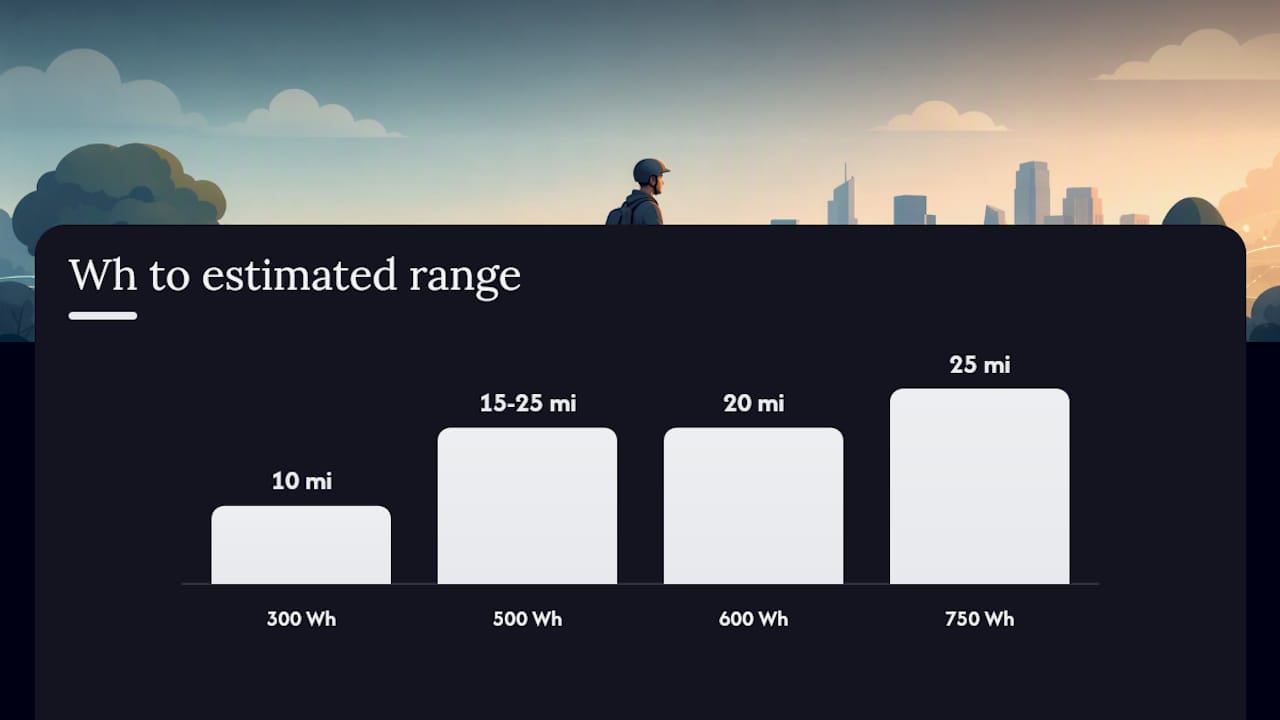
The estimation method is simple. Take the battery’s Wh rating and divide it by 25 to 30 Wh per mile, a range that accounts for real-world inefficiencies rather than lab conditions. VoltCalcs uses this exact rule of thumb for conservative range planning, and it holds up well across most adult commuter scooters.
Here’s how that math plays out for common battery sizes, using the Wh ÷ 30 baseline that ElectricBikeExplorer applies for quick reference:
| Battery Capacity | Estimated Real-World Range |
|---|---|
| 300 Wh | About 10 miles |
| — | About 12 miles |
| 500 Wh | About 15 to 25 miles |
| 600 Wh | About 20 miles |
| 750 Wh | About 25 miles |
| — | 25 to over 40 miles |
- Look for the Wh spec first, not just voltage or amp-hours alone.
- If a listing only shows voltage and amp-hours, multiply them yourself to get Wh.
- Use the low end of the Wh÷25 to Wh÷30 range when planning anything longer than a short errand.
What actually eats into your scooter’s range
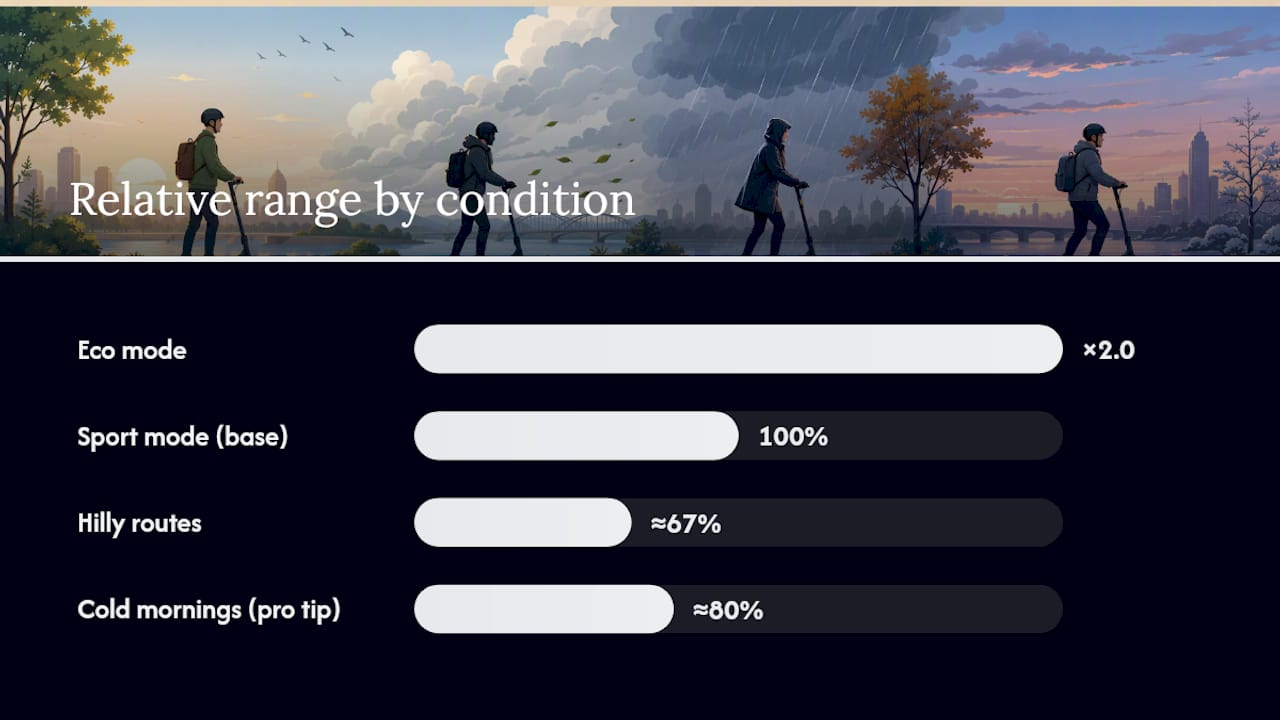
Speed is the biggest factor, and the relationship isn’t a straight line. Running in Eco mode instead of Sport mode can roughly double your range in many cases, according to range modeling from EVRatio, because pushing a scooter toward its top speed demands disproportionately more energy than cruising at a moderate pace.
Several other variables stack on top of that:
- Rider weight — a heavier rider draws more current per mile, especially on inclines.
- Hills and terrain — climbing repeatedly can cut range by a third or more compared to flat routes.
- Cold weather — battery chemistry slows down below freezing, reducing usable capacity for the same charge level.
- Tire pressure — underinflated tires increase rolling resistance and quietly drain range every ride.
- Battery age — older packs lose capacity and experience more voltage sag under load.
That last point deserves attention most riders miss. A scooter can lose top speed and acceleration well before the battery percentage indicator drops noticeably, a phenomenon called voltage sag. Riding performance, not just the percentage on the display, is the better signal that you’re running low.
Pro Tip: If your commute includes a steep hill or consistently cold mornings, mentally subtract 20% from your Wh-based estimate before deciding if a scooter fits your route.
Turning your commute into a scooter shopping target
Start by measuring your actual round trip, not the one-way distance. If you live 5 miles from work, your daily need is 10 miles, and that’s before accounting for any errands or detours along the way.
Next, apply the planning math: use the 70% real-world adjustment on the claimed range, then add a buffer for battery aging and unplanned stops.
Here’s how that translates for common commute lengths:
- 2-mile one-way commute (4 miles round trip): look for a claimed range of at least 8 to 10 miles
- 5-mile one-way commute (10 miles round trip): target a claimed range of 18 to 20 miles
- 10-mile one-way commute (20 miles round trip): target a claimed range of 35 to 40 miles
- 15 to 20-mile one-way commute: you’re likely better served by a long-range model in the 40 to 60 mile claimed category, or by charging at your destination if that’s an option
Destination charging changes this math entirely. If you can plug in at work, you only need enough range for one leg plus a safety margin, not the full round trip.
Simple habits that stretch every charge
Small adjustments in how you ride and charge add up over months of use, and most cost nothing.
- Ride in Eco mode when you don’t need the extra speed. Smooth, gradual throttle input uses less energy than repeated hard acceleration.
- Keep tires properly inflated. Low pressure is one of the easiest range losses to fix, and it takes two minutes with a gauge.
- Charge to 80% to 90% for daily use rather than always topping off to 100%. Partial charging habits extend usable battery cycles significantly compared to repeated full cycles, according to eRiders Guide.
- Use the charger that came with your scooter. Third-party chargers can cause uneven charging or long-term battery damage.
- Check your battery indicator before any long ride, and top up during the day if you have access to an outlet.
Pro Tip: Keeping your charge window between roughly 20% and 80% most days, rather than draining to zero and charging to full every time, is one of the simplest ways to protect long-term battery health.
What our buying guides tell commuters about range
We built our Electric Scooter Buying Guide around this same Wh-first approach, because spec sheets full of top speeds and motor wattage don’t tell you what you actually need to know: will it get you home.
Take a rider commuting 8 miles round trip. Using the Wh ÷ 30 method, a scooter with a 500 Wh battery clears that distance with room to spare, even after accounting for a hill or a cold morning. Someone covering closer to 20 miles round trip should be looking at 750 Wh or higher.
- Check the Wh rating on any listing before comparing top speed or price
- Cross-reference claimed range against the 70% real-world adjustment
- Read our Best Electric Scooter for Commuting guide for models built around daily riding rather than weekend fun
The judgment call when range numbers don’t add up
Marketing claims and real-world performance rarely match, and no spec sheet accounts for your hills, your weight, or your winter mornings. The honest approach is doing the Wh math yourself, then testing a scooter on your actual route before you commit to it for daily use.
— Gary
How Importjunkies makes range planning easier
This catalog aims to simplify range planning by listing battery capacity, voltage, and amp-hours clearly on every scooter page, enabling buyers to run the Wh math before purchase rather than relying solely on advertised range.

Every listing includes the specs you need to apply the conservative range method covered above, whether you’re comparing a budget commuter or a higher-voltage long-range model. If you’re weighing a lower-Wh option against your daily distance, our guide to affordable electric scooters for adults breaks down realistic expectations for entry-level battery packs. Information about financing options and warranty details may be available on product pages to help inform buyers about total costs and support before checkout. Browse the full scooter and electric vehicle lineup to compare Wh ratings side by side and find a model that actually covers your commute.
Sources
For deeper reading on tested range, Wh calculations, and battery longevity, see RiderGuide’s claimed-vs-tested comparison and VoltCalcs’ range calculator.
- Electric scooter range: claimed vs tested — RiderGuide
- Electric scooter battery range calculator — VoltCalcs
- How far can an electric scooter go? — ElectricBikeExplorer
- Electric scooter range calculator — EVRatio
- Electric scooter batteries explained — eRiders Guide
FAQ
What is the maximum range of an electric scooter?
Most riders should treat any claimed maximum as a best-case number reached only under ideal conditions.
How long is 7 miles on an electric scooter?
At a typical commuter speed of 15 to 18 mph, 7 miles takes roughly 25 to 30 minutes of riding time. Battery-wise, it’s a manageable distance for most scooters with at least a 300 Wh pack, based on the Wh÷30 estimation method.
How far can my electric scooter go?
Divide your battery’s watt-hour rating by 25 to 30 to get a conservative mile estimate, then adjust downward for hills, cold weather, or a heavier rider. This method, outlined by VoltCalcs, gives a far more reliable number than the manufacturer’s claimed maximum.
What kind of electric scooter has a 20-mile range?
A scooter with roughly a 600 Wh battery typically delivers around 20 miles of real-world range using the Wh÷30 baseline referenced by ElectricBikeExplorer. Riding in Eco mode on flat terrain can push that figure higher, while hills, cold weather, or a heavier rider will bring it down.


