


 Location
 Login
Login
New ATVs run roughly $1,999 to $16,000 or more depending on category, and used models typically land between $1,000 and $5,000 or higher for late-model machines in good shape. Whatever number you see on a sticker or listing, plan to add another $500 to $2,000 in dealer and state fees before you sign anything.
TL;DR:
- Used ATVs can be purchased for 30% to 60% less than new models, with final value mainly depending on hours, maintenance records, and modifications.
- Dealer fees typically add between $500 and $2,000 to the sticker price, with taxes and registration costs further increasing out-the-door costs depending on the state.
- Buying late in the model year or during manufacturer promotions generally offers better discounts than waiting for market prices to drop.
- High-end and performance ATVs can reach $16,000 or more, while utility models typically range from $6,000 to $12,000 across brands.
- Focus on durability, resale value, and total ownership costs—such as maintenance and insurance—rather than just the sticker price when choosing an ATV.
Table of Contents
- What Do ATV Prices Look Like by Category?
- Should You Buy New or Used — and How Much Do You Save?
- What Fees Get Added to the MSRP?
- How Much Will Financing Actually Cost You Monthly?
- What Will It Cost You to Own an ATV Each Year?
- How Do You Pick an ATV That Fits Your Budget?
- Why Trust This Guide?
- Do Prices Vary by Region and Dealer?
- Are ATV Prices Rising, and What’s Driving Demand?
- How Do Prices Compare Across Major ATV Brands?
- What’s the One Number That Actually Matters When You Buy an ATV?
- Ready to See Current ATV Prices?
- Sources
What Do ATV Prices Look Like by Category?
The category you need drives the price more than almost anything else, so it’s worth knowing where each one sits before you start shopping listings.
Youth ATVs with small engines (50cc to 125cc) are built for supervised riding and typically price between $1,999 and $3,500. Entry-level adult models (125cc to 400cc) step up to $3,500–$6,500, and they’re where most first-time buyers land. Mid-range utility ATVs (400cc to 700cc) are the workhorses of the category, and this is where farm, property, and hunting buyers spend most of their money.
- Youth ATVs (50cc–125cc): $1,999–$3,500
- Entry-level adult ATVs (125cc–400cc): $3,500–$6,500
- Mid-range utility ATVs (400cc–700cc): $6,000–$12,000
- High-end/performance ATVs (700cc+): $10,000–$16,000+
These price bands shift within each tier based on options. Four-wheel drive typically adds several hundred dollars over a comparable two-wheel-drive model. Upgraded suspension, power steering, and limited-run special editions can push a mid-range machine toward the top of its bracket or even into the next one, so it’s important to choose monotube or twin tube shocks based on your intended use to balance price and ride quality effectively.
Should You Buy New or Used — and How Much Do You Save?
Buying used typically cuts your upfront cost by 30% to 60% compared to the same or a similar model new. A mid-range utility ATV that retails new for $8,000 to $9,000 often sells used for $3,500 to $5,500, with the final number driven by engine hours, maintenance history, and how many seasons it’s been ridden hard.
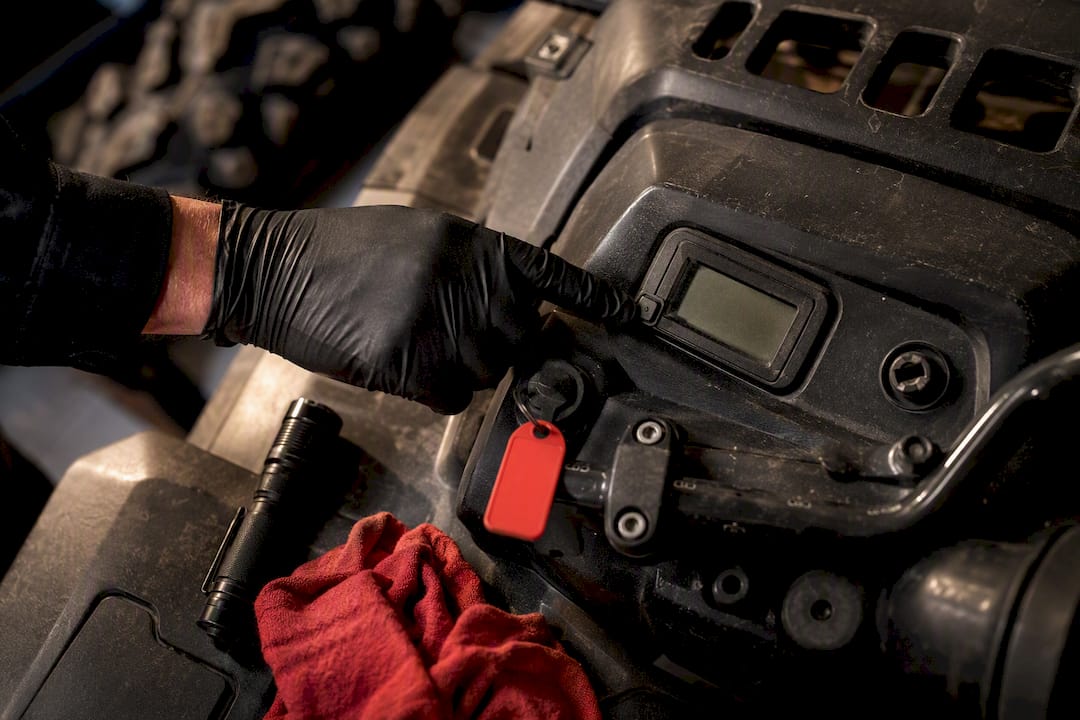
Three things matter more than the asking price when you’re evaluating a used machine: hours on the odometer, whether service records exist, and what’s been modified. A low-hour ATV with documented oil changes is worth more than a flashy one with an aftermarket exhaust and no paper trail.
Before handing over cash, work through this:
- Ask for maintenance records or a service history, even informal receipts.
- Check the VIN against a title to confirm it matches and isn’t reported stolen.
- Start the engine cold and listen for knocking, excessive smoke, or rough idle.
- Inspect tires, CV boots, and the frame underneath for rust or bent components.
- Test all four wheels engage in 4WD mode if the model has it.
Pro Tip: Bring a small flashlight and get underneath the ATV before you buy. Frame damage and leaking seals hide in shadows that a quick walk-around will never catch.
What Fees Get Added to the MSRP?
The number on the price tag is rarely the number you pay. Dealers routinely add $500 to $2,000 on top of MSRP once you count every line item on the invoice.
- Destination/freight fee: $300–$600
- Dealer setup/prep fee: $150–$400
- Documentation fee: $50–$300
- Sales tax: varies by state, often 4%–9% of the purchase price
- Registration/title fees: typically $50–$150
Here’s how that plays out on a $9,000 mid-range utility ATV: add a $450 destination fee, $250 dealer setup, $150 documentation, roughly $540 in sales tax at a 6% rate, and $100 for registration. That pushes your out-the-door total to around $10,490, nearly $1,500 above the sticker price. Because sales tax varies so much by state, a buyer in a no-sales-tax state could pay hundreds less than someone in a higher-tax jurisdiction for the identical machine.
How Much Will Financing Actually Cost You Monthly?
Financing terms change your monthly number dramatically, and dealers love to lead with the payment instead of the total price. Promotional rates as low as 1.99% APR show up on new inventory during manufacturer sales events, while typical dealer or lender financing runs higher for buyers without top-tier credit.
Longer terms lower your payment but stretch out interest, sometimes costing more overall than a shorter loan at a higher payment. A larger down payment shrinks the loan balance and cuts total interest paid either way. Always compare the dealer’s offer against a credit union or bank quote before signing, especially if your credit sits below prime tier.
What Will It Cost You to Own an ATV Each Year?
The purchase price is just the entry fee. Budgeting for ownership is where most first-time buyers underestimate their real cost.
- Routine maintenance: oil changes, filters, and tune-ups typically run $200–$500 per year
- Tires: a full set replacement every 2–3 seasons costs $300–$800
- Insurance: $75–$300 annually depending on state and usage
- Registration renewal: $20–$100 per year in most states
Add it up over five years and total ownership costs, including insurance, maintenance, tires, and registration, commonly add $3,500 to $7,500 on top of the purchase price for a mid-range utility ATV. That’s real money, and it’s the number most buyers never budget for before they sign.
How Do You Pick an ATV That Fits Your Budget?
Start with your use case, not the shiniest model on the lot. A weekend trail rider doesn’t need the same machine as someone plowing snow or hauling feed daily, and matching category to purpose keeps you out of the high-end bracket you don’t actually need.
- Total your realistic budget as purchase price plus first-year fees and gear, not just the sticker.
- Ask the seller for the title, VIN, and any lien information before discussing price.
- Request maintenance records and ask directly about accident or flood history.
- Compare the asking price against J.D. Power’s used ATV values or Kelley Blue Book’s ATV pricing to confirm it’s in a reasonable range.
- Walk away from any deal where the seller won’t let you inspect or start the machine.
If a used ATV is priced 40% or more below comparable local listings, treat that as a warning sign rather than a bargain. Stolen machines, flood damage, and salvage titles get dumped fast and cheap.
Pro Tip: Cross-reference the VIN through your state’s DMV or a vehicle history service before wiring any money for a private-party sale. It takes five minutes and can save you thousands.
Why Trust This Guide?
This guide comes from Gary, who has written prior buyer breakdowns including a first-time ATV guide and an ATV buying checklist for new owners navigating their first purchase.
An e-commerce platform sells new and used ATVs directly to the public, lists transparent pricing on product pages, and supports buyers through the purchase process online. You can browse current inventory, compare specs and prices side by side, and request more details on any listed unit without leaving the site.
Do Prices Vary by Region and Dealer?
They do, and the swing is bigger than most first-time buyers expect. Sales tax alone can shift your final cost by hundreds of dollars between states, since some charge close to zero and others sit near 9% on vehicle purchases. Registration and title fees follow the same pattern. A Montana buyer and a California buyer looking at the identical ATV can end up with out-the-door totals separated by $500 or more purely on state-level costs.
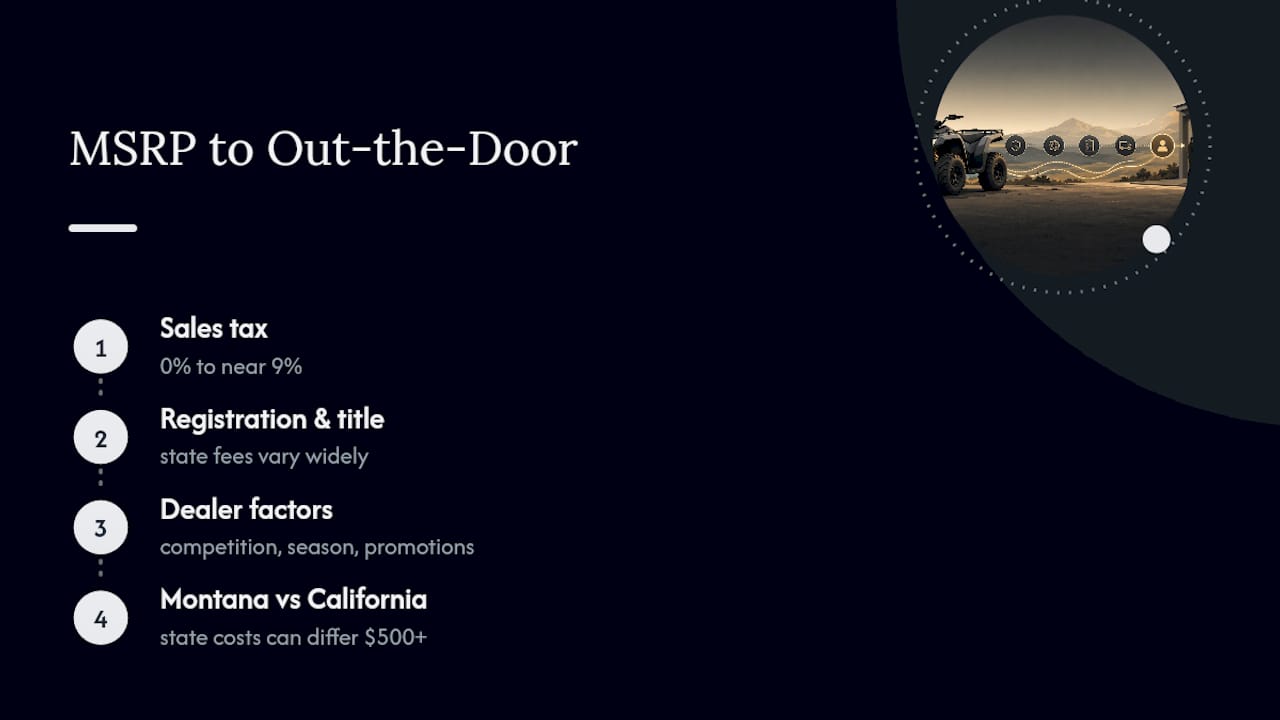
Dealer competition matters just as much. Markets with several dealerships within driving distance tend to see more aggressive discounting on leftover inventory, especially near model-year changeovers in late summer and fall. Rural areas with one or two dealers in range often see less flexibility on price, simply because there’s less competitive pressure.
Seasonal timing plays into this too. Snow country dealers frequently discount ATVs and utility machines in late winter to clear space for spring inventory, while regions with year-round trail riding see steadier demand and less seasonal price movement. Manufacturer promotional events, usually tied to model-year releases, create windows where financing incentives or rebates temporarily lower the effective price regardless of region.
If you’re comparing a purchase across state lines or considering picking up a machine while traveling, factor in that the fees and taxes attach to where you register the vehicle, not necessarily where you buy it. That detail alone can make a longer drive to buy worth the trip.
Are ATV Prices Rising, and What’s Driving Demand?
ATV prices have trended upward over the past several years, following a pattern common across the powersports market. Material costs, updated safety and emissions equipment, and steady consumer demand for outdoor recreation vehicles have all pushed MSRPs higher across nearly every category.
Demand for utility and recreational ATVs surged during the pandemic years as more people took up outdoor hobbies close to home, and that elevated demand kept upward pressure on both new and used pricing even as broader supply chains normalized. Used values in particular stayed firmer than usual because buyers who couldn’t get a new unit quickly turned to the secondhand market instead, tightening used inventory and keeping prices higher than historical norms.
That demand hasn’t fully receded. Utility buyers, including hobby farmers, hunters, and rural property owners, continue to represent a steady base of purchases regardless of broader economic conditions, since an ATV often functions as working equipment rather than a discretionary toy. Performance and sport-category ATVs are more sensitive to discretionary spending swings, which is part of why high-end models sometimes see more aggressive promotional financing than utility models during softer sales periods.
For a shopper today, the practical takeaway is that waiting for prices to drop significantly isn’t a reliable strategy. Watching for manufacturer incentives, model-year clearance events, and off-season dealer discounts is a far more dependable way to save money than betting on a broad market correction.
How Do Prices Compare Across Major ATV Brands?
Brand reputation and price don’t always move together the way people assume. Some of the most recognized names in utility and sport ATVs price their entry-level models competitively to attract first-time buyers, while reserving premium pricing for their high-displacement and performance-tuned lineups.
Utility-focused lines built for farm and property work tend to cluster in the $6,000 to $12,000 mid-range band regardless of brand, since the core engineering, cargo capacity, and towing specs are similar across manufacturers competing for the same buyer. Where brands really separate on price is in the high-end and performance categories, where advanced suspension, larger displacement engines, and racing-derived components can push machines well past $13,000.
Value-oriented and import brands, the category Importjunkies focuses on, often deliver comparable displacement and utility features at a lower price point than legacy domestic and Japanese manufacturers, which is part of why they’ve built a following among budget-conscious buyers and small property owners who need working equipment rather than a status purchase. The trade-off buyers should understand is usually in resale value and dealer network density, not necessarily in day-to-day capability.
Special editions and limited runs, regardless of brand, almost always carry a premium over the standard trim, sometimes $500 to $1,500 more for cosmetic packages, upgraded wheels, or factory-installed accessories that a buyer could often add separately for less.
What’s the One Number That Actually Matters When You Buy an ATV?
Sticker price is the number everyone fixates on, and it’s the least useful one. The MSRP tells you almost nothing about what you’ll actually spend over the years you own the machine, once fees, financing costs, tires, and maintenance are factored in.
What separates a good purchase from a regretted one is durability and resale value, not the lowest number on a listing. A well-maintained mid-range utility ATV holds its value far better than a bargain-bin model that needs $1,500 in repairs by year two. If you’re timing your purchase, late summer and early fall model-year changeovers, along with post-holiday inventory clearance, are consistently the best windows for real discounts.
— Gary
Ready to See Current ATV Prices?
The platform provides transparent, listed pricing on every ATV and UTV in inventory, with no back-and-forth needed just to find out what a machine actually costs. Compare a budget-friendly workhorse against a feature-loaded model side by side, without setting foot on a lot or waiting on a callback.
If snow removal or property work is the goal, the 200cc ATV with a snow plow attachment is a practical entry point that shows exactly what a working utility machine costs before fees. For readers still weighing an ATV against a side-by-side, the best UTV for property maintenance breakdown is worth a look before you commit. Browse the full current inventory at Importjunkies and request pricing details on any listing you’re considering.


