


 Location
 Login
Login
For trailers under 1,000 pounds, a large utility ATV or small UTV handles the job. Loads between 1,000 and 2,500 pounds call for a full-size UTV like a Polaris Ranger XP 1000 or Can-Am Defender. Anything heavier than 2,500 pounds needs a heavy-duty side-by-side, a 6x6 platform, or a truck. Before you commit to any of them, confirm the rated towing and payload numbers in the owner’s manual.
TL;DR:
- Loading racks, passengers, and gear reduce towing capacity by consuming part of your vehicle’s payload limit before factor in trailer weight.
- Heavy-duty UTVs with ratings over 2,500 pounds often require a trailer with its own braking system to remain within legal and safe limits.
- Always verify your vehicle’s owner’s manual for exact towing and payload ratings, as recommended capacities vary by model, trim, and accessories.
- Upgrading parts like hitch receivers or brakes does not increase your vehicle’s factory-rated capacity but can improve safety and towing effectiveness.
- Laws in many areas require trailers exceeding certain weights to have independent brakes, proper lighting, and registration, especially on public roads.
Table of Contents
- How Much Can an ATV Tow? Capacity Bands Explained
- What’s the Difference Between Towing Capacity, Payload, and Tongue Weight?
- Why Real-World Towing Capacity Is Lower Than the Spec Sheet
- How Do You Choose the Right ATV or UTV for Towing?
- Safe Towing Practices Every Operator Should Follow
- Our Take: What We Hear From Buyers Choosing a Tow-Capable Machine
- Do Aftermarket Towing Accessories Change Your Vehicle’s Rated Capacity?
- How Do Towing Capacities Compare Across Popular ATV and UTV Models?
- What Are the Legal Requirements for Towing With an ATV or UTV?
- The Overlooked Truth About Buying for Towing Capacity
- Find a Towing-Capable ATV or UTV Built for Farm and Utility Work
- Sources
How Much Can an ATV Tow? Capacity Bands Explained
Rated towing capacity swings widely depending on frame size, drivetrain, and whether you are looking at an ATV or a full-size UTV. Breaking it into bands makes shopping a lot less confusing.
- Under 1,000 lb: Entry-level ATVs and small utility quads. Fine for a garden trailer loaded with tools, mulch, or a couple of fence posts.
- 1,000 to 2,000 lb: Mid-size utility ATVs and compact UTVs. This covers small hay loads, a lawn mower on a ramp trailer, or firewood by the cord.
- 2,000 to 2,500 lb: Full-size UTVs. Think equipment wagons, a couple of livestock, or a loaded utility trailer with a small tiller.
- 2,500 to 3,500+ lb: Heavy-duty UTVs and 6x6 platforms. This is where you tow gooseneck-style equipment trailers or a stock trailer with two or three animals.
Representative figure: heavy-duty UTV models can reach 2,500 to 3,500 pounds of rated towing capacity, while standard ATVs typically top out well below that range. These numbers vary by trim, drivetrain, and even tire size, so treat any published figure as a starting point, not a guarantee for the exact unit you’re buying.
What’s the Difference Between Towing Capacity, Payload, and Tongue Weight?
Towing capacity is the maximum weight your vehicle can pull behind it, measured at the hitch. Payload is everything the vehicle carries on board itself: the rider, passengers, cargo bed load, and rack accessories. Tongue weight is the downward force the trailer’s coupler puts on your hitch, usually 10 to 15% of the loaded trailer’s total weight.
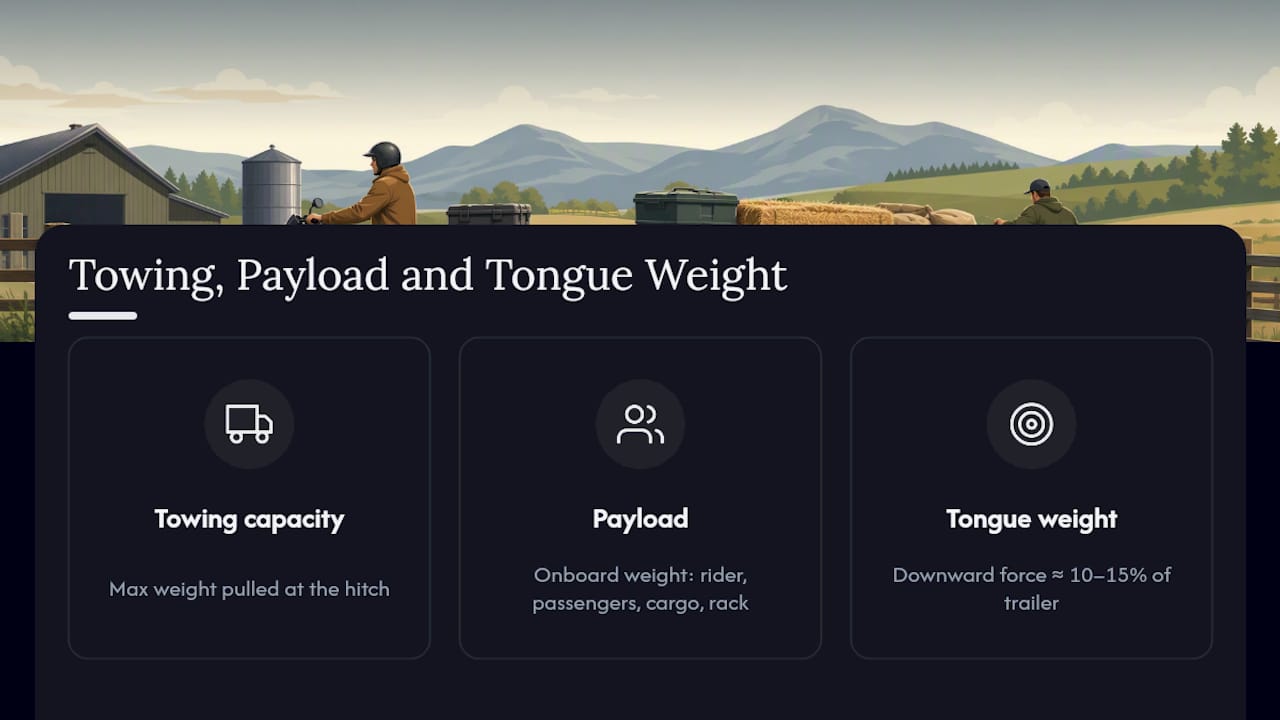
Here’s the math that keeps you legal and safe: rider weight, plus cargo, plus tongue weight, plus any rack load, has to stay at or under your vehicle’s rated payload and towing limits combined. If your UTV is rated for 1,500 pounds of towing and 500 pounds of payload, loading 300 pounds of gear on the rack eats directly into what’s left for the trailer.
Every manufacturer publishes these numbers separately in the owner’s manual, and they’re not interchangeable. A vehicle with impressive towing capacity can still be badly overloaded if the payload budget gets ignored, so check both figures before you hook up anything heavier than a garden cart.
Why Real-World Towing Capacity Is Lower Than the Spec Sheet
Manufacturer ratings describe a best-case scenario: one rider, no accessories, flat ground. The moment you add a passenger, a full cargo rack, or a set of mud tires, you’re spending down the same weight budget the spec sheet allocated to your trailer. ATV Streets frames it well: treat towing capacity and payload as one combined allowance, not two separate numbers you can max out independently.
A front rack loaded with 150 pounds of fencing supplies, a passenger in the second seat, and a full tank of fuel can quietly consume 400 to 500 pounds of your rated payload before the trailer hitch even enters the equation. Terrain compounds the problem. A grade that feels manageable unloaded becomes a sway risk with a loaded trailer pushing from behind, and loose gravel or mud cuts your stopping distance dramatically.
- Rack and cargo loads subtract directly from your towing allowance, not just your payload.
- Passengers count against the same weight budget as your trailer tongue weight.
- Slopes and loose surfaces reduce braking traction more than most operators expect.
- A trailer with poor weight distribution can induce sway even well under the rated capacity.
Pro Tip: Keep tongue weight around 10 to 15% of your loaded trailer’s total weight by centering heavier cargo directly over the trailer’s axle. Too little tongue weight causes sway; too much overloads your hitch and lightens your steering.
How Do You Choose the Right ATV or UTV for Towing?
Picking the right machine comes down to running the numbers before you fall in love with a model. Follow this order and you’ll avoid the most common buying mistake: choosing a vehicle based on looks or brand loyalty instead of the actual job.
- Weigh your loaded trailer. Include the equipment, feed, or livestock you’ll realistically haul, not just the empty trailer weight.
- Add your rider and gear weight. Factor in a passenger if you regularly tow with one, plus anything you keep in the cargo bed or rack.
- Pick a category with margin. Don’t buy to the exact limit. A 15 to 20% buffer above your typical load gives you room for terrain and future needs.
- Confirm hitch and tongue ratings. The receiver and ball rating need to match or exceed your trailer’s tongue weight.
- Check brakes and low-range gearing. Heavier loads demand a vehicle with strong engine braking and, ideally, a trailer with its own brakes.
| Typical Towing Capacity | Payload / Rack Allowance | Best For | |
|---|---|---|---|
| Entry-level ATV | suitable for lighter towing loads | typical rack allowance varies | Light yard work, garden trailers, small tool loads |
| Mid-size utility ATV | 1,000–1,500 lb | 400 lb | Firewood, small hay loads, single-passenger farm chores |
| Full-size UTV | 1,500–2,500 lb | 400–1,500 lb | Equipment wagons, multi-passenger utility work, small livestock trailers |
| Heavy-duty UTV / 6x6 | 2,500–3,500+ lb | 1,000–2,000 lb | Gooseneck equipment trailers, larger livestock loads, commercial farm hauling |
When you’re talking to a seller, ask directly what the rated towing figure assumes: one rider, no cargo, flat ground? Ask whether the hitch receiver is factory-installed or aftermarket, and get the payload capacity in writing, not just the towing number. Our buyer’s guide on matching UTV size to your hauling jobs walks through this in more detail if you’re still narrowing down a category.
Safe Towing Practices Every Operator Should Follow
Before you ever pull out of the driveway with a loaded trailer, run through a quick pre-departure check. Inspect the hitch pin, safety chains, trailer lights, and tie-downs. Confirm your ball size actually matches the coupler, since a mismatch is one of the most common causes of trailers separating mid-haul. Set your rear suspension preload to compensate for tongue weight; sagging rear suspension shifts weight off your front tires and hurts steering response.
Once you’re moving, drive like the load is fighting you, because it is. Use low range on grades, keep your speed well under what feels comfortable unloaded, and give yourself two to three times your normal stopping distance. ATV Trail Rider’s towing guidance makes a point worth repeating: towing safety comes down to your ability to stop, not how much torque you have to pull. Avoid diagonal descents on slopes entirely; a sliding trailer on an angled grade is how rollovers happen. Keep tire pressures at the manufacturer’s towing spec, since underinflated tires flex more and generate heat faster under load.
- Rigid hitch or tow bar rated for your trailer’s tongue weight
- Properly sized safety chains, crossed under the coupler
- A hitch ball matching your coupler exactly, commonly 1 7/8 inch or 2 inch for ATV trailers
- Trailer brakes on anything approaching your vehicle’s upper towing limit
- Quality tie-downs rated for the cargo weight, not just the trailer’s own weight
Most ATV trailers are unbraked, which means your tow vehicle’s brakes are doing all the work of stopping both machines. That single fact should shape every decision about how much you actually load onto a trailer, even one technically rated for more.
Our Take: What We Hear From Buyers Choosing a Tow-Capable Machine
Most customers who come to us asking about towing capacity aren’t chasing a spec sheet number. They’re trying to figure out if a machine can handle a specific job: hauling feed twice a week, moving a mower between properties, or pulling a stock trailer during calving season.
Every model we carry lists its published towing and payload figures on the product page, but we always tell buyers to cross-check those numbers against the owner’s manual for their exact trim and year, since configuration changes can shift the rating.
Do Aftermarket Towing Accessories Change Your Vehicle’s Rated Capacity?
Adding a hitch, tow bar, or brake controller doesn’t increase your vehicle’s factory-rated towing capacity. The number in your owner’s manual reflects the frame, drivetrain, and braking system’s engineering limits, and no bolt-on accessory raises that ceiling. What aftermarket gear does change is how safely and effectively you use the capacity you already have.
A properly rated hitch receiver, matched to your trailer’s tongue weight, prevents the kind of hardware failure that turns a manageable load into a runaway trailer. Upgraded brake components on the tow vehicle can meaningfully improve stopping distance when you’re regularly hauling near your rated limit, since factory brakes are often sized for unloaded operation rather than sustained towing duty. If braking performance is a concern on your setup, it’s worth looking at upgraded brake components built specifically for towing loads.
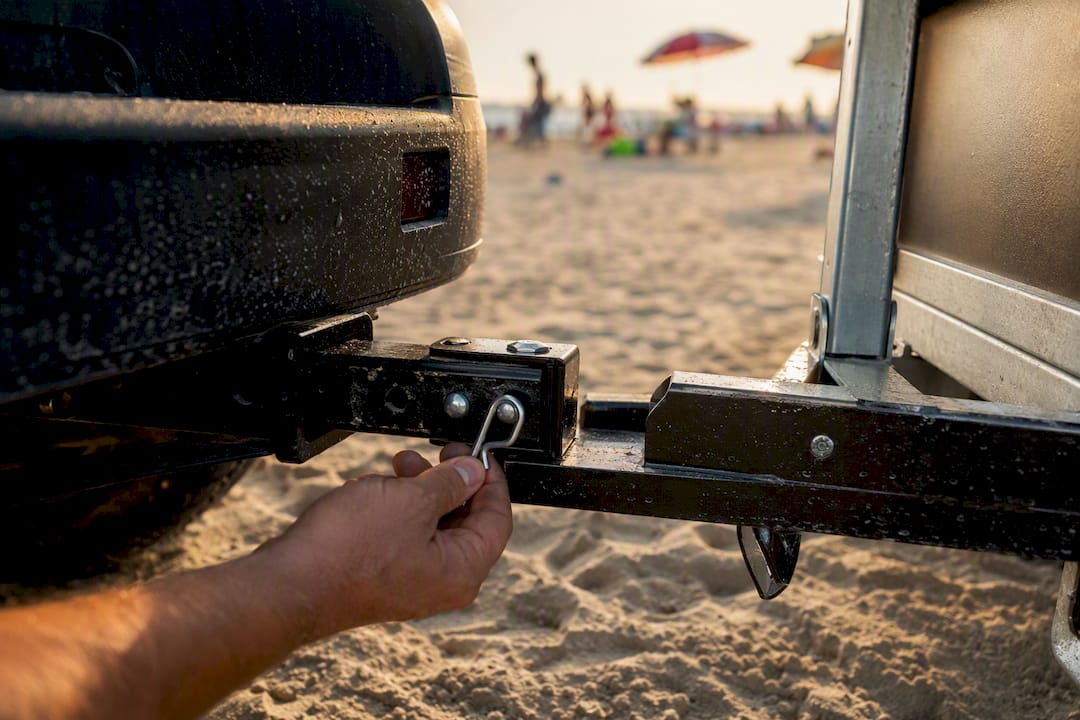
Aftermarket suspension upgrades, particularly heavier-rate rear springs or adjustable preload shocks, help manage tongue weight sag without technically changing your rated payload. The danger comes when owners assume a beefed-up hitch or lift kit means they can safely exceed the factory towing number. It doesn’t. Adding a bigger receiver to a frame rated for 1,500 pounds still leaves you with a frame rated for 1,500 pounds; you’ve just made it easier to attach more weight than the vehicle can safely handle.
How Do Towing Capacities Compare Across Popular ATV and UTV Models?
Towing capability varies enormously even within a single manufacturer’s lineup, which is exactly why matching the category to your job matters more than chasing a brand name. Full-size utility ATVs like the Honda Pioneer 500 and Polaris Ranger 500 sit on the lower end of the UTV spectrum, well suited to smaller farm chores but limited for heavier equipment trailers. Mid-tier models including the Honda Pioneer 700, Kawasaki Mule, Kubota RTV500, and Yamaha Viking EPS step up considerably, handling equipment wagons and moderate livestock loads with room to spare.
For heavier-duty work, the Polaris Ranger XP 1000, Can-Am Defender, CFMOTO UFORCE 1000, and Kubota RTV-X1120 represent the workhorse tier that most farm and ranch operations end up needing. These models trade a bit of nimbleness for meaningfully higher towing and payload numbers. At the top end, the Can-Am Defender 6X6 DPS and Can-Am Defender Pro DPS push into heavy-duty territory. They are useful when you’re regularly pulling gooseneck trailers or hauling multiple large animals.
Machines like the Arctic Cat Prowler Pro,},{ Polaris General 1000 Sport, and Gravely Atlas JSV 3000 occupy a middle ground that balances recreational capability with real utility work. The trade-off across this entire range is consistent: higher towing capacity generally means a larger frame, higher price, and reduced maneuverability on tight trails. A Polaris RZR 570 or Kymco UTXV 450i Platform won’t out-tow a heavy-duty 6x6, but they’ll navigate a wooded property far more easily.
What Are the Legal Requirements for Towing With an ATV or UTV?
Licensing and equipment rules for towing with ATVs and UTVs vary significantly depending on where you operate the vehicle and whether you’re on public roads, private property, or designated trails. Most states don’t require a special towing endorsement for off-highway trailers used exclusively on private land or closed trail systems, but crossing onto public roads changes the picture substantially.
Many jurisdictions require trailers over a certain weight threshold to have their own functioning brake system and independent lighting, particularly for anything towed on a public road at night. Weight limits on trailers pulled by off-highway vehicles are often set by state transportation codes rather than the vehicle manufacturer, meaning your ATV might be rated to tow 2,000 pounds while local law caps trailer weight lower for road use. Registration requirements for the trailer itself, separate from the towing vehicle, also apply in most states once you exceed a modest weight threshold.
Farm and utility use on private agricultural land generally carries fewer restrictions than recreational or road use, but that exemption typically requires the vehicle and trailer to stay off public roads entirely. Given how much this varies by state and even by county, check your state’s ATV and UTV statute or contact your local motor vehicle department before towing anything on a public roadway. Our guide on ATV safety standards covers additional operational rules worth reviewing alongside your local trailer laws.
The Overlooked Truth About Buying for Towing Capacity
Most buying advice treats towing capacity like a single number you shop against, and that’s where people get into trouble. The real question isn’t “what’s the maximum this machine can tow?” It’s “what does my actual trailer weigh, fully loaded, on the worst day I’ll use it?” Farmers chronically underestimate this because they picture the empty trailer, not the one loaded with wet hay or three head of cattle.
The conventional wisdom of “buy a little more than you need” is right, but most buyers apply the buffer to the wrong number. They pad the towing capacity and ignore the payload side entirely, then wonder why a fully accessorized UTV feels sluggish and unstable towing a load well under its rated limit. Payload gets consumed by racks, toolboxes, and passengers long before towing capacity becomes the binding constraint.
That process, not the biggest number on a spec sheet, is what keeps a farm or ranch operation running without a mid-season vehicle replacement.
— Gary
Find a Towing-Capable ATV or UTV Built for Farm and Utility Work
Once you know your trailer-weight band, the next step is finding a machine that fits it without paying for capacity you’ll never use. Importjunkies stocks utility-focused vehicles at direct-to-public, wholesale pricing, which means you’re not paying dealership markup for the same towing and payload specs.
Our lineup includes utility UTVs built for farm chores, plus the 200cc ATV with snow plow configuration for smaller trailers and seasonal plow duties. We also carry the 400cc 4x4 UTV with snow plow and dump bed for heavier utility work that needs both hauling and dumping capability. If you need a towing accessory to round out your setup, our heavy-duty tow dolly rated at 4,900 pounds capacity pairs well with a heavier-duty UTV purchase.
Every listing shows detailed specs and pricing up front, so you can compare payload and towing numbers before checkout instead of guessing at a dealership. Browse the current utility vehicle catalog and check specific towing figures against your trailer weight before you buy.
Sources
- ATV Towing & Hauling Guide: Load Ratings, Racks, Trailers, and Payload Safety - ATV Streets
- ATVs with the Highest Towing Capacities & Payloads - ATV Trader
- Towing with an ATV - ATV Trail Rider Magazine


