


 Location
 Login
Login
Leasing is the right move when you need operational flexibility, lower upfront cost, and predictable monthly expenses without tying up capital. For golf course operators and small business owners, the core advantages of leasing golf course vehicles come down to three things: you preserve working capital by avoiding large one-time purchases, you can scale your fleet seasonally without owning underused assets in the off-season, and bundled maintenance packages shift repair risk away from your staff. Before acting on any of this, consult a tax advisor — lease payments and depreciation are treated very differently on your books, and the right structure depends on your specific business situation.
Table of Contents
- Pros and cons of leasing golf course vehicles at a glance
- How a typical golf cart lease works
- How leasing affects your cash flow and taxes
- Operational advantages for golf courses and seasonal operators
- Lease restrictions and red flags to watch for
- Should you lease? A practical decision checklist
- How to compare lease offers and negotiate smart terms
- When buying is clearly the better choice
- Environmental and sustainability considerations
- Key Takeaways
- The case for knowing your numbers before you sign
- If you decide to buy, Importjunkies has you covered
- Useful sources and further reading
Pros and cons of leasing golf course vehicles at a glance
| Pros | Cons |
|---|---|
| Lower upfront cash requirement | No equity built over time |
| Predictable monthly payments | Usage caps and wear-and-tear fees |
| Seasonal fleet scaling | Early termination penalties |
| Maintenance often bundled | Customization restrictions |
| Easy technology refresh cycle | Higher total cost over many years |
| Keeps capital free for turf and operations | Transferability limits if business changes |
Seasonal courses benefit most from the scaling advantage. Resorts and year-round properties often care more about maintenance inclusion and fleet consistency. Individual buyers typically prioritize the lower upfront number.
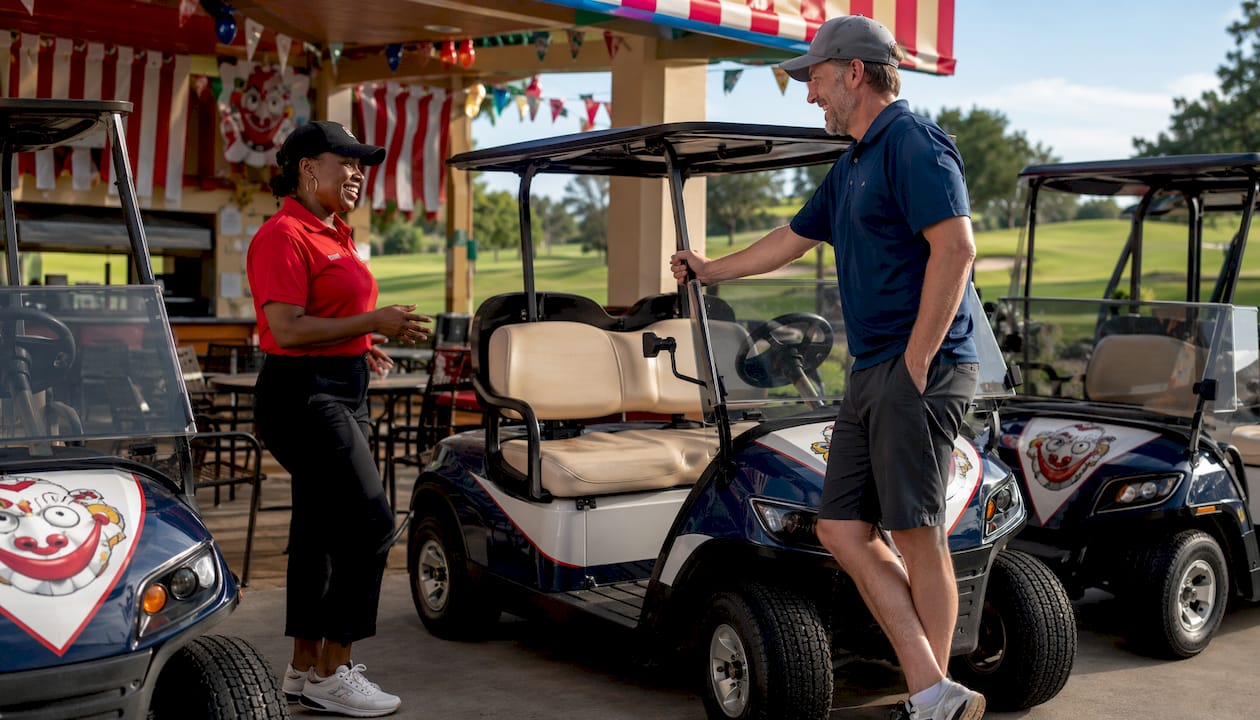
Pro Tip: A hybrid approach — own a small core fleet for daily heavy use and lease extra units for peak season or special events — is a strategy experienced operators recommend to balance equity, control, and flexibility.
How a typical golf cart lease works
Understanding the basic mechanics helps you read quotes and contracts without surprises. Here are the key terms you’ll encounter:
- FMV (Fair Market Value) lease: You pay to use the vehicle; at the end of the term, you return it, renew, or buy at its current market value. FMV leases frequently include maintenance packages that reduce your on-site repair burden.
- Closed-end lease: The residual value is fixed upfront, so you know exactly what a buyout costs from day one.
- Open-end lease: Residual value is determined at lease-end; you absorb more risk if the vehicle depreciates faster than projected.
- Residual value: The vehicle’s estimated worth at lease-end, used to calculate your monthly payment.
- Term length: Most golf cart leases run 24–60 months, aligning with typical battery and drivetrain performance cycles.
- Usage caps: Hour or mileage limits per period; exceeding them triggers per-unit fees.
- Buyout option: Your right to purchase the vehicle at lease-end, either at FMV or a pre-agreed price.
Monthly payments are calculated from the vehicle’s capitalized cost (purchase price minus any down payment), the residual value, the term length, and a money factor (the lease equivalent of an interest rate). The gap between cap cost and residual, divided by the term, forms the base payment before the money factor is added. Some lessors also offer seasonal payment schedules — six months on, six months off — which is worth asking about if your revenue is concentrated in peak months.
How leasing affects your cash flow and taxes
Leasing reduces upfront capital expenditure and preserves working capital for priorities like turf maintenance, clubhouse upgrades, or marketing. Most leases require little to no down payment, spreading cost across predictable monthly figures that are easier to budget than a single large outlay.
The accounting difference matters more than most buyers realize. If your business operates on a tight operating budget, expensing lease payments can be cleaner than managing depreciation schedules. That said, long-term ownership usually reduces total cost if you keep vehicles for many years, because lease payments include the lessor’s financing margin on top of the vehicle’s cost.
Operational advantages for golf courses and seasonal operators
The day-to-day benefits of leasing go well beyond the payment structure. Three areas stand out for course operators:
- Seasonal scaling: Leasing lets you add units during peak season and return them when demand drops, avoiding the cost of assets sitting idle for months. A course that runs 60 carts in summer but needs only 20 in winter doesn’t have to carry that full capital burden year-round.
- Maintenance and uptime: Operators without in-house mechanics gain the most from service-inclusive leases. When the lessor handles repairs, fleet uptime stays predictable and you avoid the cost of hiring specialized technicians. Confirm the service-level agreement covers response time, not just parts.
- Technology refresh: Lease cycles of 24–60 months align well with modern EV battery performance windows, letting you rotate into newer electric utility vehicles, updated telematics, or more efficient drivetrains without a large capital write-off. Electric utility vehicles also produce zero tailpipe emissions, which matters for courses near sensitive turf or water sources. You can read more about how EVs transform operations on the Importjunkies blog.
Lease restrictions and red flags to watch for
Leasing has real trade-offs, and some contract terms can make it significantly more expensive than it first appears.
Beyond usage limits, early termination penalties can be steep if your business needs change mid-term. Some contracts also restrict assignment or transfer, which creates problems if you sell the business or restructure operations. Customization is another constraint: most lessors prohibit permanent modifications, so if your brand identity depends on custom wraps, logos, or accessory builds, confirm what’s allowed in writing before signing. Reviewing common fleet mistakes before you commit to any agreement can help you avoid the most frequent contract pitfalls.
Should you lease? A practical decision checklist
Work through these questions before requesting quotes:
- What is your expected annual usage? High-hour, year-round operations often favor ownership over time.
- Is your business seasonal? If revenue concentrates in 4–6 months, seasonal payment structures and fleet scaling make leasing attractive.
- Do you need customization? If bespoke branding or permanent modifications are required, leasing may not fit.
- How much working capital can you commit upfront? Limited capital strongly favors leasing’s low-entry structure.
- Do you have in-house maintenance staff? Without dedicated mechanics, a service-inclusive lease reduces downtime risk.
- What is your tax structure? Discuss with your accountant whether expensing lease payments or depreciating owned assets is more advantageous for your entity type.
- Ask lessors directly: Does the service package cover parts and labor? What are the exact wear-and-tear definitions? Is a seasonal payment schedule available? What does early termination cost?
How to compare lease offers and negotiate smart terms
Getting apples-to-apples quotes requires a little preparation on your end. Gather your vehicle specs, expected usage hours or miles per year, preferred term length, and fleet size before contacting lessors. That information lets them price accurately rather than giving you a ballpark that shifts later.
Once you have itemized quotes, verify the residual and buyout math yourself. Confirm whether maintenance inclusions cover parts, labor, and loaner units during repairs. Ask about insurance responsibility — some leases require you to carry specific coverage levels that add to your monthly cost. Check assignment and transfer rights in the contract, especially if business ownership might change during the lease term. Seasonal payment flexibility is negotiable; if a lessor won’t discuss it, another one likely will.
When buying is clearly the better choice
Leasing is not always the right answer. Buying makes more financial sense in several specific situations:
- Very high annual usage: Long-term ownership reduces total cost when you keep vehicles for many years, because you stop paying the lessor’s financing margin after purchase.
- Full customization requirements: Courses that need permanent branding, custom builds, or specialized accessories should own their fleet. Leases typically prohibit modifications that can’t be reversed at return.
- Building asset equity: Ownership gives you a depreciable asset with resale value. If lifecycle timing and resale control matter to your business model, buying is the cleaner path.
Pro Tip: Before committing to a lease, run a real cost breakdown comparing total lease payments over the full term against the purchase price plus estimated maintenance. The numbers often surprise buyers who assumed leasing was always cheaper.
Environmental and sustainability considerations
Leasing makes it easier to keep your fleet current with electric vehicle technology, which carries direct environmental benefits for golf courses. Electric utility vehicles produce zero tailpipe emissions, eliminating fuel spills and oil leaks that can damage turf and soil near sensitive water sources. Quiet electric drivetrains also allow early-morning maintenance without disturbing players or neighboring properties.
Because lease cycles align with EV battery performance windows, you can rotate into newer lithium battery technology as it improves, rather than holding aging gas-powered units past their efficient lifespan. Courses that prioritize sustainability credentials — increasingly expected by members and guests — find that a leased electric fleet supports those goals without requiring large capital commitments upfront. Advances in faster charging and longer battery life mean the operational gap between electric and gas-powered vehicles continues to narrow, making an electric golf cart lease a practical sustainability choice, not just a marketing one.
Key Takeaways
Leasing golf course vehicles is the right tactical choice when operational flexibility, predictable cash flow, and low upfront cost matter more than building long-term asset equity.
| Point | Details |
|---|---|
| Seasonal scaling | Lease extra units for peak months and return them off-season to avoid idle capital. |
| Cash flow advantage | Leases require little to no down payment, spreading cost into predictable monthly expenses. |
| Tax treatment | Lease payments are often deductible as business expenses; confirm the right approach with a tax advisor. |
| Watch the contract | Usage caps, wear-and-tear definitions, and early termination fees are the most common cost surprises. |
| Importjunkies buying option | If you decide to buy, Importjunkies offers direct-to-public pricing on new and used golf carts and utility vehicles with no middleman markup. |
The case for knowing your numbers before you sign
Most operators who regret a lease decision didn’t do the math wrong — they skipped it entirely. A lessor’s monthly payment looks attractive until you multiply it by 48 months and add the end-of-lease fees you didn’t read carefully. Leasing is genuinely useful as a tool for flexibility and cash flow management, but it works best when you treat it as a financial decision, not a convenience. Run the total cost comparison. Ask for itemized quotes. Confirm the tax treatment with your accountant. The operators who get the most value from leasing are the ones who negotiated specific terms — seasonal payments, defined service-level agreements, swap rights for damaged units — rather than accepting the standard contract as-is. Leasing buys you predictability and flexibility; purchasing builds equity and control. Neither is universally better. The right answer depends on your usage pattern, your capital position, and how long you plan to keep the fleet.
If you decide to buy, Importjunkies has you covered
Leasing fits a lot of situations, but ownership wins when you need full customization, high annual usage, or long-term cost control. Importjunkies sells new and used golf carts, utility vehicles, and UTVs directly to the public at wholesale pricing, with no dealer markup and a straightforward online checkout. The 48V Electric Golf Cart 4 Seater Renegade Edition is a strong starting point for courses and small businesses that want a capable electric fleet without the lease restrictions. You can also browse the full lineup of electric carts and utility vehicles to find the spec that fits your property.
Browse the Importjunkies catalog, compare specs, and check out directly online. If you have questions about which vehicle fits your operation, the customer service team is available to help you make the right call before you buy.
Useful sources and further reading
- Leasing vs. buying golf cart fleets: What should courses consider? — Tara Golf Cart, operational and financial comparison for course operators
- Golf Cart Leasing for Resorts and Complexes: The Complete Guide for Property Managers — Crestmont Capital, FMV lease mechanics and tax treatment
- Should you buy or lease your golf car fleet? — Club + Resort Business, seasonal payment structures and negotiation guidance
- How leasing vs. buying commercial golf carts impacts your bottom line — Commercial Golf Cars, total cost of ownership analysis
- Golf cart leasing vs financing — Golf Carts Cypress, contract red flags and trade-off summary
This article is general educational information, not professional tax or legal advice. Confirm the current rules and accounting treatment for your specific business with a qualified tax advisor or accountant.
Recommended
- Best golf carts for business: Boost efficiency and utility – Saferwholesale || Import Junkies || Great Sports
- How to select the best vehicles for your golf course – Saferwholesale || Import Junkies || Great Sports
- Why Choose Low-Speed Vehicles for Your Business – Saferwholesale || Import Junkies || Great Sports
- Small Business Vehicle Selection Guide for 2026 – Saferwholesale || Import Junkies || Great Sports


