


 Location
 Login
Login
TL;DR:
- A scissor lift is a mobile platform that raises personnel and materials vertically using a folding X-shaped mechanism called a pantograph. It is primarily used in construction and maintenance settings, with safety, power source, and type influencing its selection and operation. Proper maintenance, operator training, and adherence to OSHA standards are essential for safe and effective use.
A scissor lift is a mobile elevated work platform that raises personnel and materials vertically using a folding X-patterned mechanism called a pantograph. The industry standard term is Mobile Elevating Work Platform, or MEWP, though “scissor lift” remains the dominant term on job sites and in procurement catalogs. Classified by OSHA as mobile supported scaffold work platforms, scissor lifts are restricted to vertical movement directly above the base. Construction crews, facility managers, warehouse operators, and retail maintenance teams rely on them daily for overhead tasks that ladders and fixed scaffolding cannot safely handle.
What is a scissor lift and how is it defined?
A scissor lift is defined as a self-propelled or towed aerial work platform that achieves vertical elevation through a series of linked, folding supports arranged in a crisscross pattern. The name comes from the visual resemblance to a pair of scissors opening and closing. When the mechanism extends, the platform rises. When it retracts, the platform descends. The motion is purely vertical, which separates scissor lifts from boom lifts and other aerial platforms that can reach horizontally.
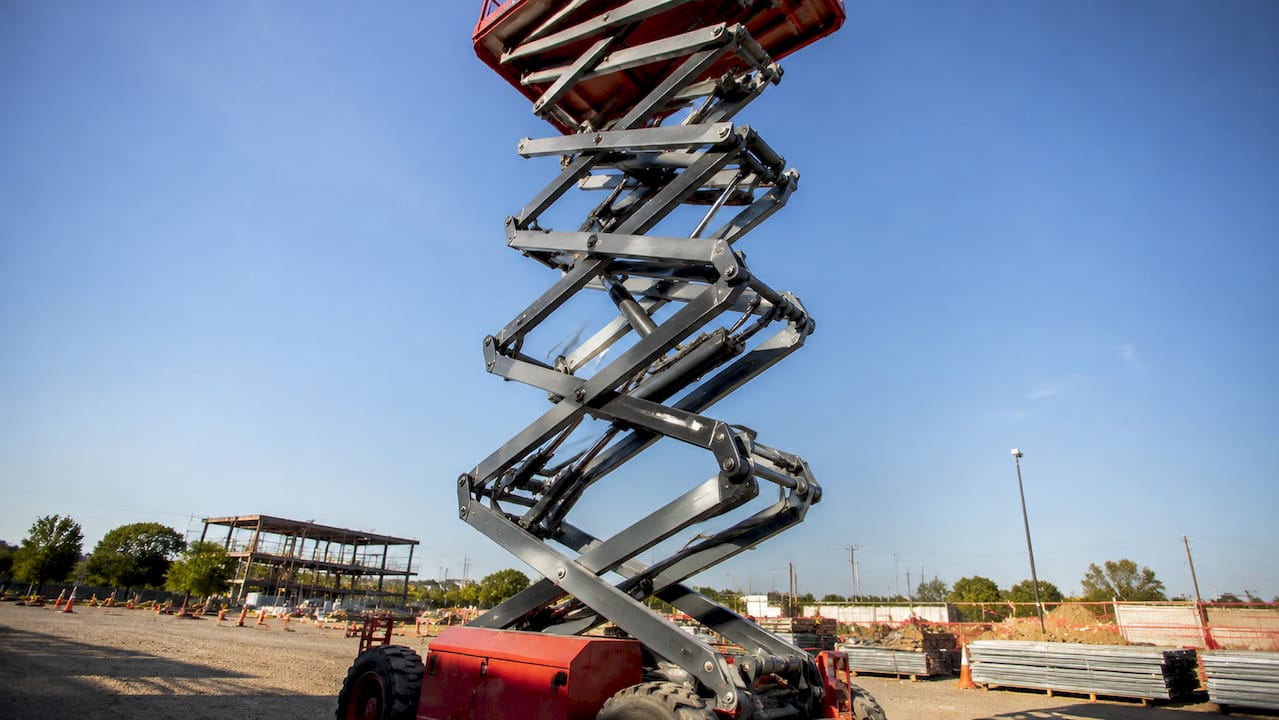
The pantograph mechanism is the defining feature of every scissor lift. The pantograph converts horizontal hydraulic or pneumatic force into vertical platform movement but prevents any horizontal outreach around obstacles. This is not a design flaw. It is a deliberate trade-off that delivers a larger, more stable platform in exchange for limited lateral reach. For construction professionals installing ceiling systems or facility managers servicing overhead HVAC units, that stability is exactly what the job demands.
How does a scissor lift work: mechanism and power systems
The mechanical operation of a scissor lift follows a straightforward sequence, but the physics underneath it are worth understanding before you put workers on the platform.
- Initiation: The operator activates the power system, which pressurizes a hydraulic cylinder or engages an electric actuator connected to the scissor arms.
- Force conversion: The horizontal force applied at the base of the scissor arms pushes the linked X-frames outward and upward simultaneously, translating lateral energy into vertical lift.
- Platform rise: As the arms extend, the platform climbs. The rate of rise depends on the power output and the current angle of the scissor legs.
- Full extension: At maximum height, the platform locks into position. Most modern units include automatic safety locks that engage if hydraulic pressure drops.
- Descent: Releasing pressure allows the platform to lower in a controlled manner, guided by the same scissor mechanism in reverse.
One detail that facility managers frequently miss: the lifting force required is non-linear, demanding significantly higher power at the start of the ascent when the scissor legs are tightly nested. A unit rated for 1,000 kg may require multiple times that force to initiate movement from the fully stowed position. This means loading the platform to its rated capacity and then expecting smooth initial lift is a miscalculation that strains hydraulic cylinders and accelerates wear.
Power systems: electric, hydraulic, and pneumatic
Electric, hydraulic, and pneumatic systems are the three primary power methods driving scissor lifts, and each has a distinct operational profile. Electric models run on rechargeable battery packs, produce zero emissions, and operate quietly. They are the standard choice for indoor environments like warehouses, hospitals, and retail facilities. Hydraulic models use fluid pressure generated by an engine or motor and deliver higher lift forces, making them common on outdoor construction sites. Pneumatic models, powered by compressed air, are less common but appear in environments where sparks from electric motors or engine exhaust from hydraulic units create hazards.
Pro Tip: On electric scissor lifts, check battery charge at the start of every shift. A partially discharged battery reduces the available force at initial extension, which is already the most demanding point in the lift cycle. Running low power at that stage is how you get jerky, uneven ascents that stress the scissor arms.
Scissor lift types and their uses in construction and facility management
Understanding scissor lift types by power source and design helps you match the right unit to the right job. The wrong choice costs time, creates safety exposure, and can damage equipment.
Electric scissor lifts:
- Best for indoor use in warehouses, retail stores, and commercial facilities
- Quiet operation protects workers in noise-sensitive environments
- Zero exhaust emissions meet indoor air quality requirements
- Typical working heights range from 19 feet to 32 feet for standard models, with extended units reaching higher
- The Electric Scissor Lift XL with 21.5-foot working height is a practical example of this category for maintenance applications
Hydraulic/rough terrain scissor lifts:
- Designed for outdoor construction sites with uneven ground
- Larger tires and higher ground clearance handle gravel, mud, and slopes
- Diesel or gasoline engines provide the power needed for outdoor conditions
- Platform capacities typically exceed those of comparable electric models
Pneumatic scissor lifts:
- Used in hazardous environments where electric sparks or engine exhaust are prohibited
- Less common but critical in specific industrial settings
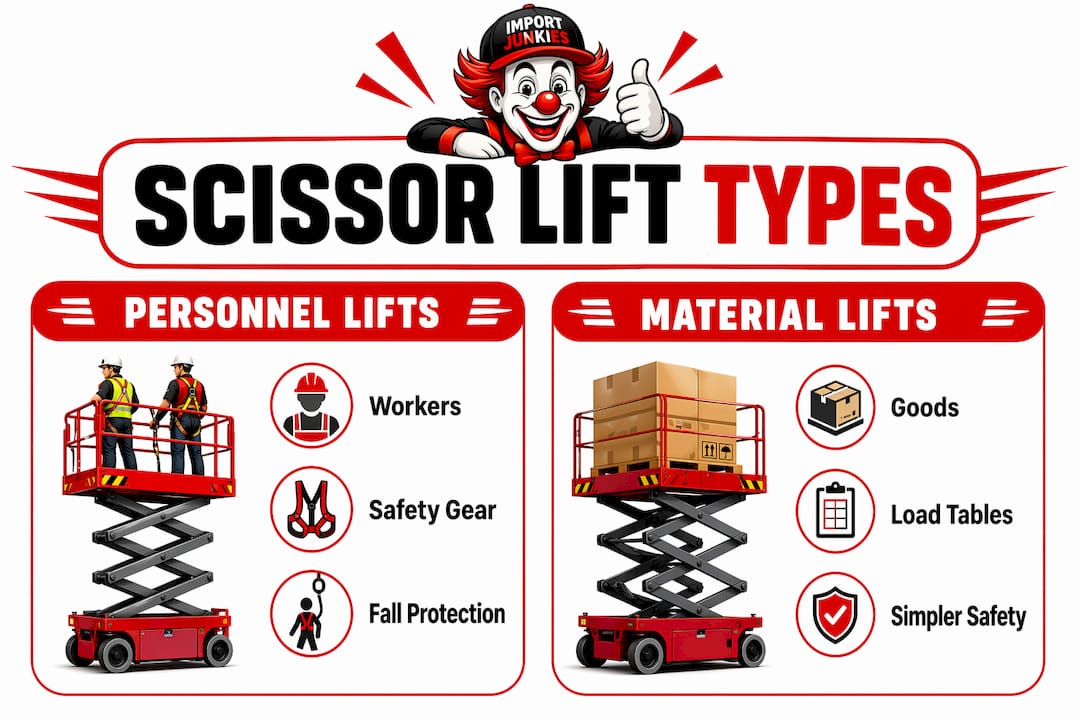
Beyond power source, you also need to distinguish between personnel aerial lifts and material lift tables. Both use the scissor mechanism, but they serve completely different purposes.
| Feature | Personnel Scissor Lift | Material Lift Table |
|---|---|---|
| Primary use | Elevating workers | Raising goods and materials |
| Safety standards | MEWP/OSHA personnel lift standards | General material handling standards |
| Fall protection | Required guardrails and toe boards | Not designed for personnel |
| Mobility | Self-propelled or towed | Typically stationary or limited mobility |
| Typical capacity | 500–1,500 lbs platform load | 500–4,000 lbs depending on model |
Personnel lifts must meet stricter safety standards than material lift tables, including fall protection requirements. Putting workers on a material lift table is a serious safety violation, not a workaround.
Scissor lift vs. boom lift: which one do you need?
The most common equipment selection mistake on job sites is choosing a boom lift when a scissor lift would do the job better, or vice versa. The difference comes down to one question: does the work require horizontal reach, or just vertical height?
Scissor lifts provide a larger, more stable platform than boom lifts, making them the right choice when workers need room for tools, materials, and movement at elevation. Their straight vertical movement delivers steadiness but limits access to locations that are not directly above the base. Boom lifts extend both vertically and horizontally, allowing operators to reach over obstacles, around corners, and into spaces that a scissor lift cannot access. That flexibility comes at the cost of platform size and stability.
| Comparison Point | Scissor Lift | Boom Lift |
|---|---|---|
| Movement direction | Vertical only | Vertical and horizontal |
| Platform size | Large, suitable for multiple workers | Smaller basket, typically 1–2 workers |
| Stability | High, due to wide base and vertical motion | Lower, due to extended arm leverage |
| Best application | Overhead work directly above base | Hard-to-reach or offset locations |
| Indoor suitability | High (especially electric models) | Moderate (articulating models) |
| Typical height range | Up to 50+ feet | Up to 185+ feet |
For ceiling tile replacement, light fixture installation, or overhead pipe work in a straight line, a scissor lift is the faster and safer choice. For work on building facades, tree trimming near structures, or accessing equipment above an obstacle, a boom lift earns its place.
Safety considerations every operator and manager must know
Scissor lift safety starts with understanding how OSHA classifies the equipment. OSHA classifies scissor lifts as mobile supported scaffold work platforms, which means general scaffolding safety rules apply, not just aerial lift regulations. This distinction affects training requirements, inspection protocols, and the documentation your site needs to maintain compliance.
Key safety practices for scissor lift operations:
- Conduct pre-shift inspections. Check hydraulic fluid levels, battery charge, guardrail integrity, and tire condition before every use.
- Verify ground conditions. Soft soil, slopes, or uneven surfaces affect stability. Most scissor lifts require firm, level ground.
- Respect load limits. The platform capacity rating includes workers, tools, and materials combined. Exceeding it stresses the scissor mechanism at the worst possible moment.
- Never use material lift tables for personnel. Misapplication of material lift tables for personnel leads to safety violations and increased accident risk. The guardrail systems and structural ratings are simply not there.
- Train operators before deployment. OSHA requires documented operator training specific to the equipment type.
Pro Tip: Pay close attention to the rollers and sliding carriage at the base of the scissor arms. Jammed or improperly lubricated rollers affect smooth scissor leg movement and can cause mechanical failures or hazards. A quick visual check and scheduled lubrication prevent the kind of jerky, uneven lifts that put stress on the entire structure.
The non-linear mechanical advantage during initial lift extension creates high pressure on hydraulic cylinders. This is where mechanical failures most often appear in units that have not been properly maintained. Budget for regular hydraulic system inspections, not just visual checks.
Key takeaways
A scissor lift is the right tool for stable, vertical elevated work, but only when operators understand its mechanical limits, power requirements, and safety classifications.
| Point | Details |
|---|---|
| Core definition | A scissor lift raises personnel or materials vertically using a folding X-frame pantograph mechanism. |
| OSHA classification | OSHA classifies scissor lifts as mobile supported scaffolds, requiring compliance with scaffolding safety standards. |
| Power system selection | Choose electric for indoor use, hydraulic for outdoor rough terrain, and pneumatic for hazardous environments. |
| Personnel vs. material lifts | Material lift tables must never be used to elevate workers; only MEWP-rated personnel lifts meet the required safety standards. |
| Maintenance priority | Lubricate base rollers regularly and inspect hydraulic cylinders, since initial lift extension creates the highest mechanical stress. |
What i’ve learned from watching scissor lifts get misused
I’ve spent enough time around construction sites and facility operations to know that the most common scissor lift problems are not mechanical. They are decisions made before the machine even powers on.
The first one is positioning. Because the pantograph mechanism cannot reach horizontally, operators who do not plan their lift placement end up repositioning the unit two or three times to complete a single task. That costs time and, on busy job sites, creates collision risk with other equipment and foot traffic. Spend five minutes mapping your overhead work path before you move the lift into position. You will save thirty minutes of repositioning.
The second problem is the personnel-versus-material lift confusion. I have seen facility managers use scissor lift tables to raise workers because the table was available and the personnel lift was across the site. That is a shortcut that OSHA does not forgive. The structural ratings, guardrails, and safety interlocks on a material lift table are not designed for human occupancy. Keep those two categories of equipment clearly labeled and stored separately if you manage a mixed fleet.
The third issue is underestimating initial lift force demands. Facility managers often load a scissor lift to its rated capacity and then wonder why the ascent feels rough or why the hydraulic system is showing wear ahead of schedule. The rated capacity applies at working height, not at initial extension. Load conservatively when starting from the fully stowed position, especially on older units.
Scissor lifts are reliable, practical machines when you respect what they are designed to do. The problems come when operators treat them as interchangeable with boom lifts or as a substitute for equipment that is simply not on site.
— Gary
Lifting equipment options worth exploring at Importjunkies
If you are sourcing lifting equipment for automotive, facility, or construction applications, Importjunkies carries a range of electric scissor lifts and lift tables built for real work demands.

The Car Electric Scissor Lift with 8,000 lbs capacity is a strong option for automotive shops and maintenance facilities that need reliable mid-rise elevation with pneumatic release. For personnel lift applications, the Double Scissor Lift Table offers 59 inches of lifting height and 1,760 lbs of capacity, suited for material handling in warehouse and facility settings. Browse the full catalog at Importjunkies to compare specifications, pricing, and availability on lifting equipment that fits your operation.
FAQ
What is the scissor lift definition in simple terms?
A scissor lift is a mobile elevated work platform that uses a folding X-frame mechanism to raise workers or materials straight up. It is classified by OSHA as a mobile supported scaffold work platform.
How does a scissor lift work mechanically?
The scissor lift converts horizontal hydraulic or pneumatic force into vertical motion through linked, crisscrossing arms called a pantograph. As the arms extend outward at the base, the platform rises directly above.
What are the main types of scissor lifts?
The three main types are electric, hydraulic, and pneumatic scissor lifts. Electric models are preferred indoors for quiet, emission-free operation, while hydraulic models handle outdoor rough terrain, and pneumatic models serve hazardous environments.
Can a scissor lift move horizontally like a boom lift?
No. A scissor lift moves vertically only, directly above its base. Boom lifts provide both vertical and horizontal reach, making them the right choice when the work location is offset from where the machine can be positioned.
What safety standards apply to scissor lift operations?
OSHA classifies scissor lifts as mobile supported scaffolds, so general scaffolding safety standards apply. Personnel lifts must also comply with MEWP standards, and material lift tables must never be used to elevate workers.
Recommended
- Types of Auto Lifts: Mechanic’s Guide for 2026 – Saferwholesale || Import Junkies || Great Sports
- Single Scissor Lift Table - 2200 lbs - 39.4" lifting height - A-2014 – Saferwholesale || Import Junkies || Great Sports
- Double Scissors Stainless Steel Lift Table - 770 lbs - 51.2" lifting h – Saferwholesale || Import Junkies || Great Sports
- Double Scissors Lift Table - 770 lbs - 51.2" lifting height - SPS350 – Saferwholesale || Import Junkies || Great Sports


