


 Location
 Login
Login
Why low-speed vehicles make sense for business operations
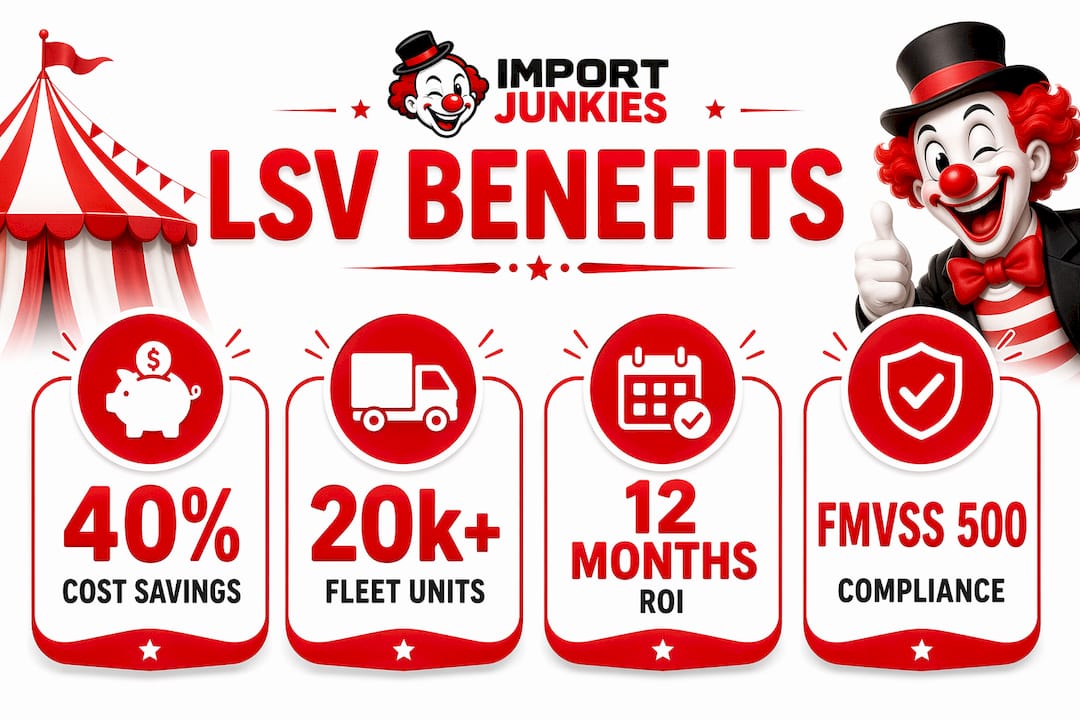
Low-speed vehicles, commonly called LSVs or Neighborhood Electric Vehicles (NEVs), are the right call for businesses that need reliable, affordable short-distance transport without the overhead of a full commercial truck fleet. These are federally defined, street-legal vehicles capped at 20–25 mph, restricted to roads with posted speed limits of 35 mph or less under FMVSS 500. That definition matters because it separates LSVs from golf carts and puts them in a class with real legal standing on public roads.
Here is the short version of why they work for business:
- Lower acquisition cost: LSVs typically run $8,000–$12,000, far below most commercial trucks
- Reduced energy use: Electric models use significantly less energy than conventional diesel trucks, enhancing efficiency.
- Zero tailpipe emissions: Electric LSVs produce no exhaust pollution, cutting your carbon footprint and noise levels simultaneously
- Operational agility: Compact size means faster parking, easier maneuvering in tight commercial spaces, and less traffic disruption
- Ideal task fit: Last-mile delivery, campus shuttling, facility maintenance, and groundskeeping are all well within their range
How LSVs cut costs and improve day-to-day operations
The financial case for adding LSVs to your fleet is straightforward. Purchase prices in the $8,000–$12,000 range are a fraction of what you pay for a standard commercial truck, and the savings compound quickly once the vehicle is in service. Electric drivetrains have fewer moving parts than gas engines, which means fewer scheduled maintenance visits and lower repair bills over time.

Right-sizing your fleet with LSVs for short, repetitive routes cuts fuel and labor costs while improving how efficiently your team moves through the day. Drivers spend less time hunting for parking and maneuvering oversized vehicles through tight loading areas. That time adds up across a week of operations.
Insurance is another line item where LSVs tend to come in below conventional vehicles. Licensing requirements are also simpler, since LSVs do not require a commercial driver’s license in most states. For a small business managing a handful of vehicles, that simplicity reduces administrative burden.
Market context: The global LSV market is experiencing steady growth, driven by corporate sustainability mandates and the push toward fleet electrification. Businesses adopting LSVs now are positioning ahead of that curve.
What legally defines a low-speed vehicle in the US?
The federal definition comes from FMVSS 500, which classifies LSVs as four-wheeled motor vehicles with a maximum speed of 20–25 mph, weighing no more than 3,000 lbs, and limited to roads with posted speed limits of 35 mph or less. That standard is set by the National Highway Traffic Safety Administration (NHTSA) and applies nationwide, though individual states and municipalities layer additional rules on top of it.
To be street-legal, an LSV must be equipped with:
- Seat belts for all occupants
- A parking brake
- Headlights and brake lights
- Turn signals and reflectors
- Exterior mirrors
- A windshield with wipers
- A speedometer
Beyond the federal equipment list, you will need to register the vehicle with your state’s motor vehicle authority and carry insurance. A valid driver’s license is required to operate an LSV on public roads. Check your local street-use rules before purchasing, because some municipalities restrict LSV access to specific corridors even when state law permits broader use.
Pro Tip: Before buying, call your city or county transportation office and ask specifically which roads in your operating area allow LSVs. Some suburban grids have gaps in their low-speed networks that could limit your routes more than you expect.
How LSVs and golf carts actually differ for business use
This is where a lot of buyers make an expensive mistake. Golf carts and LSVs look similar, but they are not interchangeable for commercial use. The table below lays out the differences that matter most when you are making a fleet decision.

| Feature | Low-Speed Vehicle (LSV) | Golf Cart |
|---|---|---|
| Federal standard | Meets FMVSS 500; street-legal | No federal standard; not street-legal |
| Speed range | 20–25 mph | Typically under 20 mph |
| Required safety gear | Seat belts, lights, wipers, mirrors, speedometer | None mandated federally |
| Braking and steering | Heavy-duty, road-rated systems | Basic, designed for course use |
| Road access | Public roads up to 35 mph limit | Designated paths and private property only |
| Registration | Required; receives license plate | Not required in most states |
| Insurance | Required | Optional or not available |
| Payload and body options | Cargo beds, enclosed cabs, vans | Limited; open-air standard |
For business purposes, the registration and insurance requirements are not just bureaucratic boxes. They protect your company from liability when a vehicle is operating on public roads. A golf cart doing the same job without proper documentation exposes you to fines and gaps in coverage. LSVs also carry heavier payloads and come in more versatile configurations, including enclosed cabs that protect cargo and operators in poor weather. You can read more about how these two categories compare in practical fleet settings in this utility trucks vs. golf carts breakdown.
Where businesses are actually using LSVs right now
LSVs show up across a wider range of commercial settings than most buyers initially expect. Their compact footprint and quiet electric operation make them practical in environments where a full-size truck would be disruptive or simply too large.
- Last-mile delivery: LSVs can move packages through dense neighborhoods and commercial districts faster than delivery vans, with less curb conflict and lower emissions per stop
- Campus and multi-property operations: Universities, corporate campuses, and apartment portfolios use LSVs to move staff and supplies between buildings without pulling full-size vehicles for short trips
- Hospitality and healthcare: Zero tailpipe emissions and near-silent operation make electric LSVs a natural fit for resorts, hospitals, and senior living facilities where noise and air quality matter to guests and patients
- Facility maintenance: Grounds crews, maintenance teams, and inspection staff benefit from cargo beds, tool racks, and enclosed storage options that LSVs can be configured with
- Municipal and parks operations: Local governments use utility LSVs for parks maintenance, enforcement patrols, and event support, where their small footprint reduces impact on pedestrian areas
The electric vehicle advantages extend beyond cost savings in these settings. Brands operating in guest-facing environments often find that quiet, emission-free vehicles reinforce a positive image in ways that a diesel truck simply cannot.
How to choose the right LSV for your business
Picking the wrong vehicle for your operation is a common and avoidable mistake. Start with your daily tasks, not the vehicle specs.
- Match vehicle type to task: Cargo-heavy maintenance work calls for a truck-bed configuration; moving small crews calls for a passenger van or multi-seat model; mixed use may warrant a modular platform
- Assess your operating environment: Map the roads your team will use and confirm their posted speed limits. If your routes include any roads above 35 mph, an LSV cannot legally travel them
- Evaluate total cost of ownership: Factor in purchase price, expected maintenance intervals, insurance, charging infrastructure (for electric models), and local service availability, not just the sticker price
- Look for fleet management compatibility: LSVs with built-in telemetry and tracking let you monitor usage, optimize routes, and catch maintenance issues before they cause downtime
- Check the buying guide: The low-speed electric vehicle buying guide at Importjunkies walks through the key specs and configurations worth comparing
Pro Tip: Prioritize vendors with strong local service networks. Proprietary parts and limited dealer coverage are the two fastest ways to turn a cost-saving vehicle into a costly one sitting idle. Local maintenance support is not optional for a working fleet.
What fleet experts and market data say about LSVs in 2026
Fleet management professionals have settled on a consistent recommendation: right-size your fleet by using LSVs for short, repetitive routes instead of deploying full-size trucks for every task. The efficiency gains are measurable, and the cost reductions show up in both fuel and labor budgets.
The global LSV market growing at nearly 9% annually through 2032 reflects real demand, not hype. Electrification mandates at the state and federal level are pushing fleet managers to find alternatives to gas-powered light trucks, and LSVs fill that gap for short-distance applications without requiring the infrastructure investment of full electric commercial vehicles.
LSVs occupy a practical middle ground in business fleets. They deliver enough utility for the tasks that actually make up most of a maintenance or delivery team’s day, at a fraction of the upfront and ongoing cost of a full commercial vehicle. For organizations that have been defaulting to pickup trucks for every job, the switch to purpose-built LSVs for short routes tends to produce faster results than any other single fleet change.
Connected LSVs are where the technology is heading. AI-enhanced battery management and predictive maintenance platforms already allow fleet managers to track charge state, flag mechanical issues before failures happen, and optimize charging schedules to avoid peak energy rates. For multi-site operations, that kind of visibility across a fleet pays for itself quickly. Window tinting for fleet vehicles is another practical consideration; a fleet window tint guide covers how to handle UV protection and visibility requirements across a mixed vehicle lineup.
Importjunkies has the electric utility vehicles your fleet needs
If you have been running full-size trucks for short-distance tasks and watching the fuel and maintenance costs pile up, switching to electric LSVs is one of the most direct ways to cut that overhead. Importjunkies sells electric utility vehicles built for exactly this kind of commercial work, at wholesale prices with no middleman markup.

The 48V Electric Golf Cart 4 Seater Renegade Edition is a practical starting point for businesses that need a capable, maneuverable electric utility vehicle for campus operations, maintenance fleets, or last-mile support. It seats four, handles cargo, and runs on a 48V electric system that keeps operating costs low. Importjunkies stocks multiple configurations so you can match the vehicle to your actual job requirements rather than settling for a one-size-fits-all option. Browse the full lineup at importjunkies.com and contact the team directly to discuss which model fits your fleet.
Key Takeaways
Low-speed vehicles deliver the strongest return when matched to short-distance commercial tasks where their cost, compliance, and operational advantages outperform conventional trucks.
| Point | Details |
|---|---|
| Federal definition matters | FMVSS 500 sets LSVs at 20–25 mph max, restricted to roads with 35 mph or lower speed limits. |
| Purchase cost advantage | LSVs typically cost $8,000–$12,000, well below standard commercial trucks. |
| Energy and maintenance savings | Electric LSVs use significantly less energy than conventional diesel trucks and require less routine maintenance. |
| Market growth signals adoption | The global LSV market is growing at nearly 9% annually through 2032, driven by electrification mandates. |
| Importjunkies for fleet buyers | Importjunkies offers 48V electric utility vehicles at wholesale prices, suited for business fleet applications. |
Recommended
- What Is a Low Speed Vehicle? Street-Use Basics – Saferwholesale || Import Junkies || Great Sports
- Low Speed Electric Vehicle Buying Guide – Saferwholesale || Import Junkies || Great Sports
- Small Business Vehicle Selection Guide for 2026 – Saferwholesale || Import Junkies || Great Sports
- Best golf carts for business: Boost efficiency and utility – Saferwholesale || Import Junkies || Great Sports


