


 Location
 Login
Login
TL;DR:
- ATV safety standards include federal and state rules that regulate age limits, training, and protective gear. Ignoring these standards increases injury risk, voids insurance, and may lead to legal consequences. Proper gear, age-appropriate vehicles, and certified training significantly improve rider safety and accident prevention.
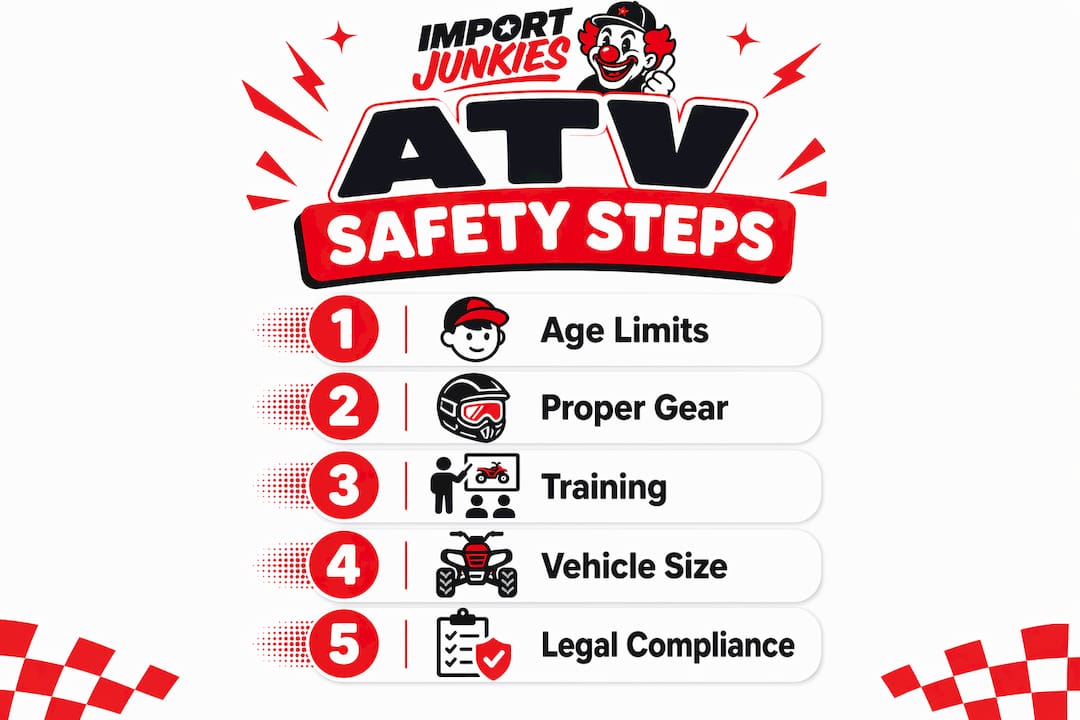
ATV safety standards are defined as the set of federal regulations, state laws, and equipment requirements that govern who can ride, what they can ride, and what protective gear they must wear. Explaining ATV safety standards means understanding three core pillars: age-based engine size restrictions, mandatory operator training certifications, and protective equipment mandates. The Consumer Product Safety Commission (CPSC) and the ANSI/SVIA 1-2017 standard both shape how ATVs are classified and how safety accessories must fit them. Riders who ignore these standards face real consequences, from voided insurance to doubled injury risk. This guide gives you a complete, practical breakdown of every layer of ATV safety regulation so you can ride legally and safely.
What are the federal and state regulatory frameworks for ATV safety?
Federal ATV safety regulations set the floor. State laws build on top of them, and the gap between states can be significant.
The federal framework starts with age-based engine displacement categories. Federal guidelines categorize youth ATV operation into four brackets:
- Under 6: Prohibited from operating any ATV
- Ages 6–11: Limited to ATVs with engines under 70cc
- Ages 12–15: Limited to ATVs with engines between 70cc and 90cc
- Ages 16 and older: Permitted to operate adult-sized ATVs over 90cc
These categories are not suggestions. They originate from a legally binding 1988 federal consent decree that established minimum safety benchmarks across the industry.
State laws add another layer. Most states require operators under 18 to complete an approved ATV safety certification course before riding on public land. These courses typically run 4–5 hours and cost between $25 and $150. That is a small investment compared to the cost of an emergency room visit.
Helmet laws vary sharply by state. Most states require minors to wear DOT-approved helmets on public land, but 9 states have no helmet mandate at all as of 2026. No helmet law does not mean no helmet risk. It means the legal minimum in those states is dangerously low.
Public versus private land rules also differ. Many states only enforce certification and helmet requirements on public trails and roads. Private land often falls outside those mandates, but the physics of a rollover do not change based on property lines.
Pro Tip: Before you ride in a new state, check that state’s OHV regulations directly. Rules on helmets, age limits, and trail access can differ significantly from your home state.
| Requirement | Public Land | Private Land |
|---|---|---|
| Age-based engine limits | Federally mandated | Often unenforced |
| Helmet law (most states) | Required for minors | Typically not required |
| Safety certification | Required in most states | Rarely required |
| Passenger restrictions | Enforced on trails | Varies by state |
What safety gear and equipment standards apply to ATV riders?
The right gear does not just reduce injury severity. It determines whether you walk away from a crash at all.

The baseline helmet standard for ATV riders is DOT FMVSS No. 218. Any helmet sold legally in the United States must meet this standard. However, the Snell and ECE 22.06 certifications offer significantly better impact protection than DOT alone, especially for the varied terrain and speed conditions of off-road riding. Choosing a Snell or ECE-certified helmet is the single most effective upgrade you can make to your safety setup.
Beyond the helmet, a complete ATV safety gear checklist includes:
- Eye protection: Goggles rated for off-road debris, not standard sunglasses
- Gloves: Full-finger gloves that protect knuckles and improve grip
- Boots: Over-the-ankle boots with ankle support and toe protection
- Protective clothing: Long sleeves, long pants, and ideally armored riding pants or a jacket
- Chest and back protector: Recommended for aggressive terrain or high-speed riding
The ANSI/SVIA 1-2017 standard defines ATVs by specific physical characteristics including handlebar steering, a straddle seat, and low-pressure tires. That definition matters because aftermarket safety gear and accessories are designed to fit within those parameters. Using gear built for a different vehicle type can compromise both fit and protection.
Pro Tip: Even in states with no helmet law, wear one anyway. The 9 states without a mandate still see ATV-related head injuries. The law sets a minimum; your gear should exceed it.
| Helmet Standard | Protection Level | Common Use Case |
|---|---|---|
| DOT FMVSS No. 218 | Baseline legal minimum | Street and light off-road |
| Snell M2020 | Higher impact threshold | Aggressive off-road riding |
| ECE 22.06 | European standard, high protection | All-terrain and competition |
How do age and vehicle size restrictions affect safe ATV operation?
Putting a child on the wrong ATV is one of the most preventable causes of serious injury in off-road riding. The numbers are clear. Children account for approximately 30% of all ATV-related emergency room visits. Children riding adult-sized ATVs face twice the injury risk compared to those on age-appropriate machines.
The mismatch is both physical and cognitive. A child’s hands may not reach the controls properly. Their body weight cannot counterbalance the machine on slopes. Their reaction time and judgment are not developed enough to manage a 400cc or 500cc engine.
The four federal age-displacement categories exist precisely to address this. Selecting the right ATV size for your rider is not just a safety decision. It is a legal one.
Ignoring federal age-based engine displacement limits does not just put a young rider at risk. It voids your insurance coverage and exposes you to direct legal liability if an injury occurs. The 1988 federal consent decree established these limits as legally binding benchmarks, not optional guidelines.
The legal and financial consequences of non-compliance are significant. If a minor is injured on an adult-sized ATV, your insurance carrier can deny the claim entirely. You may face personal liability for medical costs and damages. The age-displacement limits from the 1988 consent decree carry real legal weight, and courts have upheld them in injury cases.
Checking the ATV title and registration documentation also helps confirm the engine displacement class before you put a young rider on any machine.
What operator behaviors and training contribute to ATV safety?
Gear and regulations only go so far. Operator behavior is where most accidents actually originate.
Formal training is the foundation. Certified ATV safety courses teach skills that are difficult to self-teach, including weight-shifting technique, throttle control, and hazard recognition. Weight-shifting is the primary method to prevent rollovers. Riders must continuously shift their body weight to maintain balance on slopes, turns, and uneven terrain. Without this skill, even experienced-looking riders can lose control on a modest incline.
The “3 E’s” framework from ATV safety research covers the full picture: engineering (proper equipment), education (training), and enforcement (compliance). All three must be present. A well-equipped rider with no training is still a high-risk rider.
Here are the core operator behaviors that directly reduce accident risk:
- Complete a certified safety course. Most states require this for public land use. Take it even if your state does not.
- Never carry a passenger on a single-rider ATV. The machine is not designed for the extra weight or the shifted center of gravity.
- Ride sober. Alcohol and ATVs are a documented fatal combination. Impairment affects balance and reaction time, both of which ATVs demand constantly.
- Match your speed to the terrain. Excessive speed and inattentiveness are the two leading operator-controlled risk factors on both ATVs and UTVs.
- Run a pre-ride safety check. Inspect tires, brakes, throttle, and lights before every ride. A mechanical failure at speed is far more dangerous than catching it in the driveway.
Pro Tip: Practice weight-shifting on flat ground before taking any ATV onto a slope. Lean into turns, shift your weight uphill on inclines, and practice braking before you need it in a real situation.
Riders who want a deeper look at how UTVs compare on built-in safety features can review this UTV safety guide for a side-by-side breakdown of roll protection and restraint systems. For riders who need to understand ATV battery sizing relative to engine displacement categories, that detail matters when selecting replacement components for youth ATVs.
Key Takeaways
ATV safety standards require matching the rider’s age to the correct engine size, completing certified training, and wearing gear that meets or exceeds DOT FMVSS No. 218.
| Point | Details |
|---|---|
| Age-based engine limits are federal law | Children under 6 cannot ride; ages 6–15 face strict engine displacement caps. |
| Certification courses are mandatory in most states | Approved courses run 4–5 hours and cost $25–$150 for public land access. |
| Helmet standards vary in protection level | Snell and ECE 22.06 helmets outperform DOT-only helmets for off-road conditions. |
| Ignoring age limits voids insurance | Non-compliance with the 1988 consent decree creates direct legal and financial liability. |
| Weight-shifting prevents rollovers | Active body movement is the primary skill taught in certified ATV safety courses. |
Why most ATV injuries are completely preventable
I have seen the same pattern repeat itself across years of working with off-road vehicle buyers. Someone buys an ATV, skips the safety course because it feels like extra paperwork, puts their 10-year-old on a 250cc machine because “they’re a natural,” and then wonders how things went wrong. The answer is always the same: the standards exist because someone already paid the price for not following them.
The most important mindset shift I can offer is this: treat an ATV like an industrial tool, not a toy. A utility vehicle that weighs 600 pounds and reaches 60 mph on rough terrain demands the same respect as a piece of heavy equipment on a job site. That framing changes how you approach training, gear selection, and who you put on the machine.
Compliance with ATV safety regulations is not about fear. It is about riding longer, riding smarter, and not handing an insurance company a reason to deny your claim. The riders I see stay on the trails for decades are the ones who took the certification course, bought the right helmet, and matched the machine to the rider from day one.
— Gary
ATVs and UTVs worth riding safely from Importjunkies
Importjunkies carries a range of ATVs and UTVs built for riders who take both performance and safety seriously. Whether you are looking for a capable recreational ATV or a utility vehicle with built-in protective features, the catalog covers both ends of the spectrum.

The 200cc ATV with snow plow is a practical option for adult riders who want a machine sized for real work and real terrain. For riders who prefer the added protection of a roll structure and seat belt, the utility UTV lineup at Importjunkies includes models with those features built in. Browse the full selection at importjunkies.com and find a machine that fits your rider, your terrain, and your safety standards.
FAQ
What are ATV safety standards?
ATV safety standards are federal and state regulations that define age-based engine size limits, mandatory training certifications, and protective gear requirements for safe operation. The CPSC and the ANSI/SVIA 1-2017 standard both contribute to how these rules are structured.
What helmet standard do I need for ATV riding?
The legal minimum is DOT FMVSS No. 218, but Snell M2020 and ECE 22.06 certified helmets offer significantly better impact protection for off-road conditions. Most safety experts recommend exceeding the DOT baseline for any serious trail riding.
At what age can a child legally ride an ATV?
Federal guidelines prohibit children under 6 from operating any ATV. Children ages 6–11 are limited to engines under 70cc, and ages 12–15 are limited to 70cc–90cc machines. Riders 16 and older may operate adult-sized ATVs over 90cc.
Do I need a safety certification to ride an ATV?
Most states require operators under 18 to complete an approved ATV safety certification course for public land use. These courses typically take 4–5 hours and cost between $25 and $150, covering essential skills like weight-shifting and hazard recognition.
What happens if a child rides an adult-sized ATV?
Children riding adult ATVs face twice the injury risk compared to age-appropriate machines, and the incident may void your insurance coverage. Non-compliance with federal age-displacement limits also creates direct legal liability under the 1988 federal consent decree.
Recommended
- Why UTV Safety Matters: Your 2026 Rider’s Guide – Saferwholesale || Import Junkies || Great Sports
- All-Terrain Vehicle Features List: 2026 Buyer’s Guide – Saferwholesale || Import Junkies || Great Sports
- Electric ATV Benefits Outdoors: 2026 Rider’s Guide – Saferwholesale || Import Junkies || Great Sports
- ATV Title and Registration: What Every Owner Must Know – Saferwholesale || Import Junkies || Great Sports


