


 Location
 Login
Login
TL;DR:
- Vehicle lift certification proves that a lift meets safety standards at manufacture, but ongoing inspections ensure continued safety.
- Annual documented inspections are mandatory for lifts regardless of age or brand, checking critical components for damage or wear.
Vehicle lift certification is the formal verification that an automotive lift meets established safety standards at the point of manufacture and remains safe through documented annual inspections. For automotive professionals and business owners, explaining vehicle lift certifications means understanding two distinct frameworks: the ANSI/ALI ALCTV standard, which governs lift construction and testing, and the ANSI/ALI ALOIM standard, which mandates ongoing operational safety. The Automotive Lift Institute (ALI) administers both. OSHA enforces compliance through the General Duty Clause, making documented inspections a legal obligation, not just a best practice. If you operate a shop with lifts, this guide covers everything you need to stay compliant and protected.
What are the key safety standards for vehicle lifts?
The two standards every shop owner must know are ANSI/ALI ALCTV and ANSI/ALI ALOIM. ALCTV governs how lifts are designed, built, and tested before they reach your shop floor. ALOIM governs how those lifts are maintained and inspected throughout their working life.
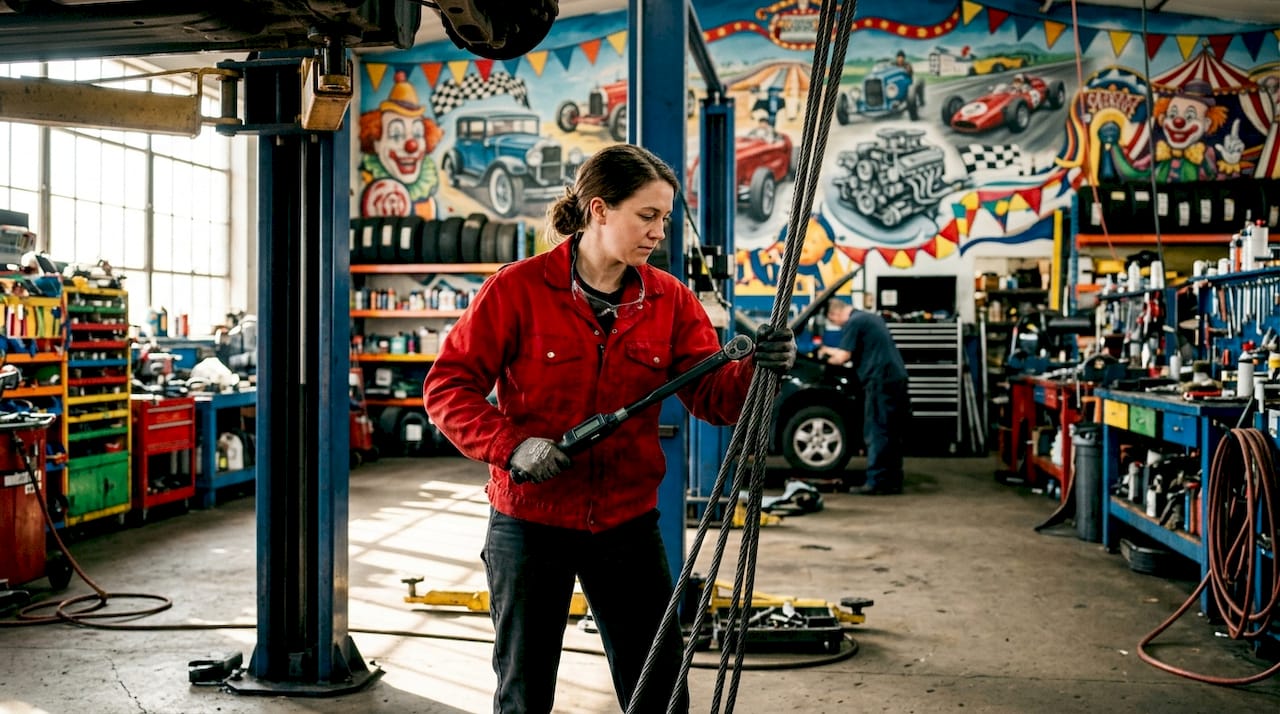
The ALI Gold Label is the clearest proof that a lift passed independent testing against ALCTV requirements. Lifts without the Gold Label lack verified compliance with safety standards and carry real liability risk in professional environments. That label is your first line of defense when purchasing equipment.
Certification at manufacture does not replace annual inspection. These are two separate obligations with different purposes. A lift can carry the Gold Label and still fail an inspection years later due to wear, corrosion, or improper use.
From an insurance and liability standpoint, the difference matters significantly. Insurers increasingly require documented proof of both certified equipment and current inspection records. A shop running uncertified lifts, or certified lifts with lapsed inspections, faces exposure on both fronts.
- ANSI/ALI ALCTV: Sets construction, performance, and testing requirements for lift manufacturers
- ANSI/ALI ALOIM: Requires documented annual inspections by qualified inspectors throughout the lift’s operational life
- ALI Gold Label: Confirms independent third-party testing at manufacture; look for it on every lift you buy
- OSHA General Duty Clause: Used to enforce ANSI/ALI ALOIM in the absence of a lift-specific OSHA standard
Pro Tip: When purchasing a used lift, request the original ALI Gold Label documentation and all prior inspection records before completing the transaction. Missing paperwork is a red flag.
What is involved in the required annual vehicle lift inspection?
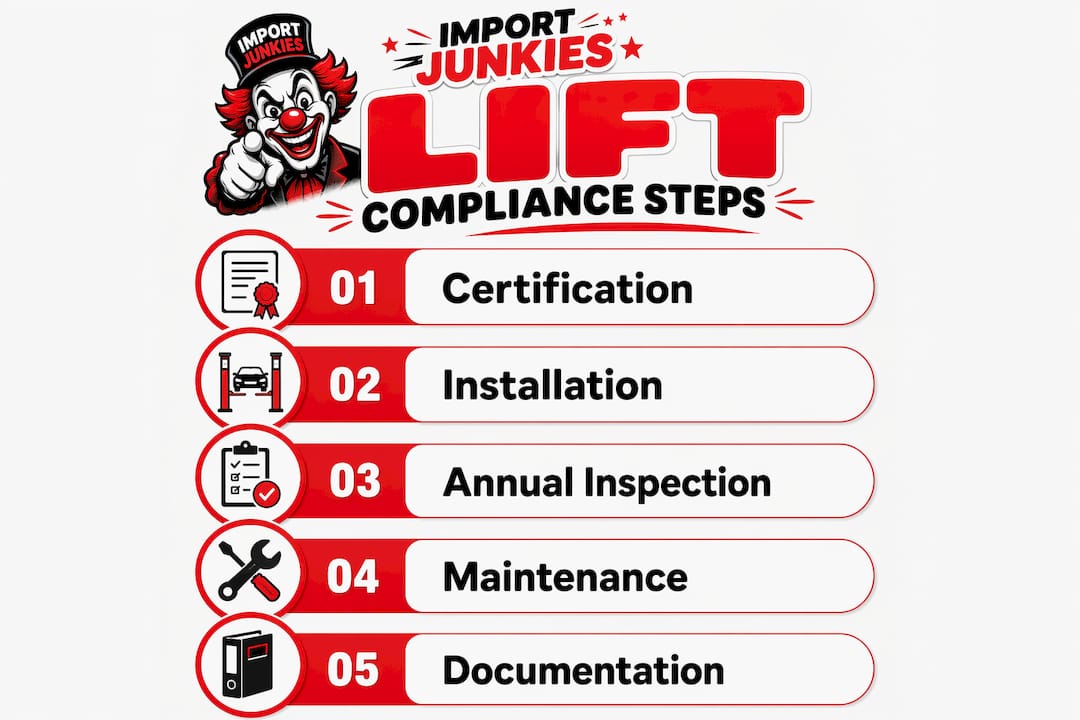
Annual inspections are required for every automotive lift, regardless of age, type, brand, or shop size. ANSI/ALI ALOIM:2020 mandates a documented safety inspection every 12 months. High-use lifts may need checks more frequently.
The inspection covers a specific set of components and systems. Here is what a qualified ALI-certified inspector examines:
- Structural integrity: The inspector checks all load-bearing components for cracks, deformation, and corrosion that could compromise strength.
- Anchoring and mounting: Anchor bolts and floor connections are verified for proper installation and secure attachment.
- Cables and chains: These are examined for wear, fraying, and correct tension. Cable wear is one of the most common causes of lift failure.
- Hydraulic systems: Hoses, cylinders, and fittings are checked for leaks, pressure loss, and fluid condition.
- Safety locks and mechanical stops: These must engage and release correctly. A safety lock that fails to hold is a critical defect.
- Electrical controls and wiring: Switches, controls, and wiring are tested for proper function and signs of damage.
- Travel limits: Upper and lower limit switches are verified to stop the lift at the correct positions.
- Load labels and safety decals: All required labels must be present, legible, and accurate.
Beyond the physical examination, the inspector conducts operational testing with and without a vehicle on the lift. This reveals abnormal motion, unusual noises, and locking failures that static checks might miss. Uneven rise, hesitation, or grinding sounds during operation are all documented findings.
Inspection results fall into three categories: pass, conditional pass, or fail. A conditional pass means the lift can remain in service temporarily, but specific repairs must be completed within a defined timeframe. Ignoring a conditional pass can invalidate your insurance coverage and increase your liability exposure significantly.
All findings must be formally documented. That report is your compliance record. Keep it on file and make it available during any OSHA audit or insurance review.
Pro Tip: Schedule your annual inspection at the same time as your preventive maintenance service. Combining both visits reduces downtime and gives your inspector a cleaner, better-maintained lift to evaluate.
How do certification and inspection differ, and why does it matter?
Business owners regularly confuse lift certification with lift inspection. The confusion is understandable, but the consequences of mixing them up are real.
Certification is a manufacturer’s proof that a lift met safety standards when it was produced. Inspection is the ongoing annual validation that the lift remains safe to operate. One happens once, at the factory. The other happens every year, in your shop.
Here is where the misunderstanding causes problems:
- Assuming a certified lift is always safe: A Gold Label confirms the lift was safe when built. It says nothing about its current condition after years of use.
- Skipping inspections on newer lifts: New lifts still require annual inspections under ANSI/ALI ALOIM. Age is not an exemption.
- Treating inspection as optional: OSHA enforces ANSI/ALI ALOIM through the General Duty Clause. Absence of documented inspections is a primary liability trigger in workplace incidents.
- Losing documentation: Inspection records serve as your evidence of compliance. Without them, you have no defense in an audit or legal proceeding.
The practical takeaway is straightforward. Certification gets you a safe lift. Inspection keeps it safe. Both are required, and neither substitutes for the other.
What practical steps keep your shop lift-compliant?
Maintaining compliance is less about paperwork and more about building consistent habits into your shop operations. The compliance responsibility is twofold: buying certified equipment and sustaining safety through annual inspections and operator training.
Start with your purchasing decisions. Every lift you buy should carry the ALI Gold Label. Verify certification documentation at the point of purchase, not after the lift is installed. When parts need replacement, use OEM components. Non-OEM parts can jeopardize certification status and operational safety.
For ongoing compliance, follow this framework:
| Action | Frequency | Purpose |
|---|---|---|
| ALI-certified inspection | Annually (minimum) | Meets ANSI/ALI ALOIM:2020 requirements |
| Operator pre-use check | Daily | Catches visible defects before each shift |
| Maintenance service | Per manufacturer schedule | Prevents hydraulic, cable, and mechanical failures |
| Documentation review | After each inspection | Confirms records are complete and current |
| Technician safety training | At hire and annually | Reduces operator error and improper use |
Technician training deserves specific attention. Operators who understand load ratings, proper vehicle positioning, and safety lock engagement prevent the kind of misuse that causes conditional failures during inspections. Training is also a documented record that supports your compliance posture during audits.
Documented annual inspections are the primary evidence OSHA uses when evaluating compliance under the General Duty Clause. Without that paper trail, a workplace incident involving a lift becomes significantly harder to defend. For a deeper look at the full compliance picture, the 2026 compliance guide from Importjunkies covers the current regulatory landscape in detail.
Pro Tip: Create a lift log for each piece of equipment in your shop. Record every inspection date, inspector name, findings, and completed repairs. A single binder per lift keeps everything organized and audit-ready.
Key Takeaways
Vehicle lift compliance requires both an ALI Gold Label at purchase and documented annual inspections under ANSI/ALI ALOIM:2020 throughout the lift’s operational life.
| Point | Details |
|---|---|
| Certification vs. inspection | Certification happens at manufacture; annual inspection validates ongoing safety in your shop. |
| ALI Gold Label requirement | Purchase only lifts carrying the Gold Label as proof of independent safety testing. |
| Annual inspection mandate | ANSI/ALI ALOIM:2020 requires documented inspections every 12 months for every lift. |
| Conditional pass obligations | Repairs flagged in a conditional pass must be completed promptly or insurance coverage may lapse. |
| Documentation is your defense | Inspection records are the primary evidence OSHA reviews during audits and incident investigations. |
Why I think most shops are one inspection away from a serious problem
Gary here. After years of watching automotive businesses operate, the pattern I see most often is not outright negligence. It is passive assumption. Shop owners buy a certified lift, see the Gold Label, and mentally check the compliance box forever. The annual inspection never gets scheduled because nothing has gone wrong yet.
That logic works right up until it does not. I have seen shops face insurance denials after incidents because their last documented inspection was three years old. The lift was certified. The Gold Label was still on the post. None of that mattered without current inspection records.
The shops that handle this well treat their annual lift inspection the same way they treat an oil change. It goes on the calendar, it happens on schedule, and the paperwork gets filed. That discipline is what separates a shop with a compliance culture from one that is hoping nothing goes wrong.
Regulatory scrutiny on lift safety is increasing, and insurance carriers are paying closer attention to inspection documentation than they were five years ago. The shops that build these habits now will not be scrambling when standards tighten further.
— Gary
Importjunkies and quality equipment for serious shops
Importjunkies carries a range of utility and specialty vehicles built for professionals who need reliable equipment without overpaying. If your shop services off-road vehicles, golf carts, or utility vehicles, having the right lift and the right support equipment matters.
For shops that also sell or service electric utility vehicles, the Lifted Renegade+ 2.0 Edition is a strong example of the kind of specialty vehicle Importjunkies stocks for commercial and recreational buyers. Browse the full inventory at Importjunkies to find equipment that fits your operation, backed by competitive pricing and direct-to-buyer purchasing.
FAQ
What does vehicle lift certification mean?
Vehicle lift certification is the manufacturer’s documented proof that a lift meets ANSI/ALI ALCTV safety standards at the point of production. The ALI Gold Label is the physical indicator of that certification.
How often do vehicle lifts need to be inspected?
ANSI/ALI ALOIM:2020 requires a documented inspection by a qualified lift inspector at least once every 12 months. High-use lifts may require more frequent checks.
Does OSHA have a specific vehicle lift standard?
OSHA does not have a dedicated automotive lift standard. It enforces ANSI/ALI ALOIM through the General Duty Clause, making documented annual inspections the primary compliance evidence.
What happens if a lift gets a conditional pass?
A conditional pass means the lift can stay in service temporarily, but identified defects must be repaired within a set timeframe. Ignoring those repairs can void insurance coverage and increase liability.
Is a certified lift still safe without annual inspections?
No. Certification confirms the lift was safe when manufactured. Annual inspections verify it remains safe after years of use, wear, and potential damage. Both are required under ANSI/ALI ALOIM:2020.
Recommended
- Auto Lift Safety Standards: A 2026 Compliance Guide – Saferwholesale || Import Junkies || Great Sports
- Auto Lift Buying Guide 2026: Choose Right, Work Safe – Saferwholesale || Import Junkies || Great Sports
- How to Inspect an Auto Lift: Safety Guide for Mechanics – Saferwholesale || Import Junkies || Great Sports
- Car Lift Weight Capacity Guide for Mechanics and Shops – Saferwholesale || Import Junkies || Great Sports


