


 Location
 Login
Login
TL;DR:
- Off-road vehicles are purpose-built to handle rough, unpaved terrain, offering better ground clearance, drivetrain capability, and chassis strength. They allow access to remote locations, improve safety in adverse conditions, and support gear and towing needs for outdoor adventures. However, they come with higher fuel, tire, and insurance costs, so choosing the right vehicle depends on actual usage and skill level.
Off-road transportation is the use of purpose-built vehicles designed to safely travel on rough, unpaved terrain that standard vehicles cannot navigate. If you are planning a family camping trip, a backcountry hunting excursion, or a utility run across a rural property, knowing why opt for off-road transportation matters before you spend a dollar. The right vehicle gets you where you need to go. The wrong one leaves you stuck, stranded, or overpaying for capability you never use. This guide covers the key features, real benefits, honest trade-offs, and vehicle options so you can make a confident, informed decision.
Why opt for off-road transportation over standard vehicles?
Off-road transportation gives you access to terrain that a standard sedan, minivan, or crossover simply cannot handle. Paved roads cover only a fraction of the land you might want to reach. Trails, forest roads, creek crossings, and remote campsites all require a vehicle built for the job.
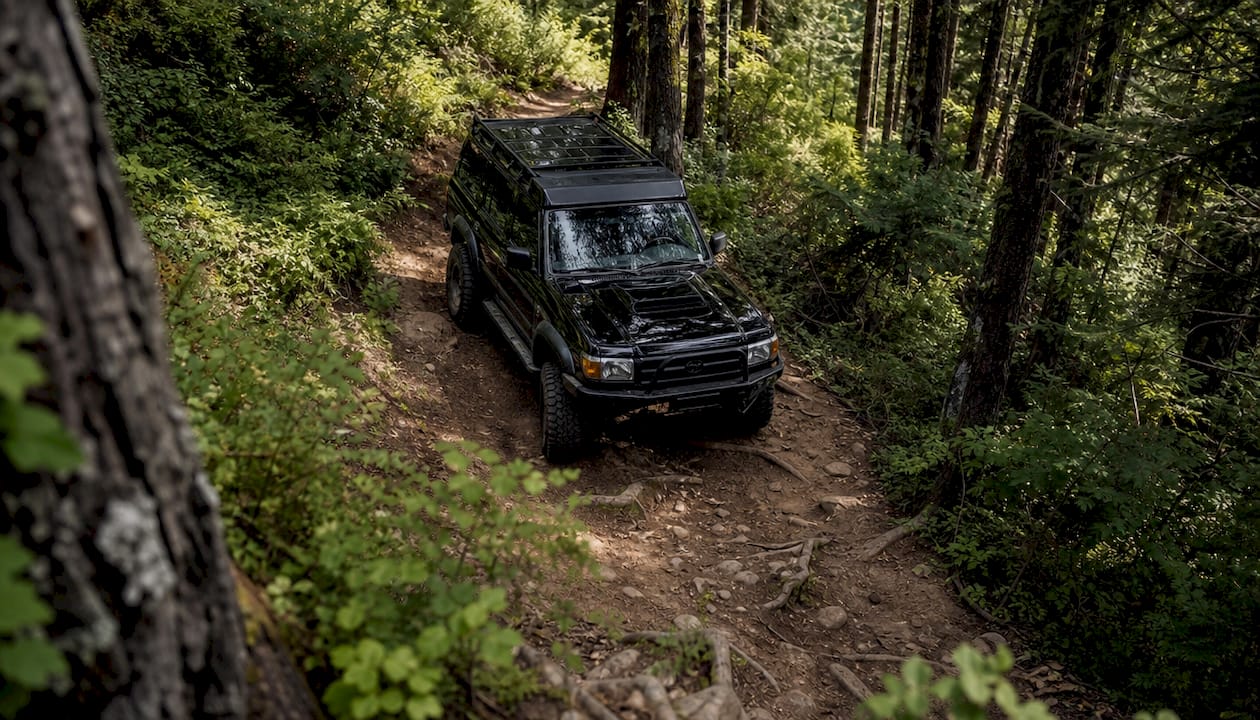
The core advantage comes from three design priorities: ground clearance, drivetrain capability, and chassis strength. Standard passenger cars typically sit 5–6 inches off the ground. Off-road vehicles carry 8–11 inches of ground clearance, which means rocks, ruts, and root systems pass under the vehicle instead of destroying it. That difference alone separates a capable trail vehicle from a liability.
Four-wheel drive (4WD) systems distribute power to all four wheels simultaneously, giving you traction on loose dirt, wet grass, mud, and snow. Paired with a low-range transfer case, 4WD also multiplies torque at low speeds, which is what lets a vehicle crawl up a steep incline without spinning out or overheating the engine. These are not luxury features. They are the mechanical foundation of safe off-road travel.
Body-on-frame construction is the third pillar. Unibody frames flex and fatigue on uneven terrain. A ladder-frame chassis absorbs the twisting forces of rough ground without structural damage. This is why purpose-built off-road vehicles outlast standard vehicles in demanding conditions.
What specific vehicle features enable effective off-road transportation?
The features that separate a capable off-road vehicle from a capable-looking one are specific and measurable. Knowing what to look for protects you from buying a vehicle that performs well on gravel but fails on a real trail.
- Ground clearance of 8–11 inches. This is the minimum for serious trail use. Anything less and you risk high-centering on rocks or ruts.
- 4WD with locking differentials. A locking differential forces both wheels on an axle to spin at the same speed, which prevents one wheel from spinning uselessly while the other sits still in mud or sand.
- Low-range transfer case. This gearing system reduces breakdown risk on steep terrain by providing engine braking on descents and maximum torque on climbs.
- Body-on-frame construction. Ladder frames handle torsional stress far better than unibody designs.
- Specialized tires. Good expedition tires improve traction and reliability more than most mechanical modifications. All-terrain or mud-terrain tires balance grip, puncture resistance, and load capacity in ways that standard highway tires cannot.
Pro Tip: Before buying any off-road vehicle, check the tire specification first. A well-equipped vehicle on the wrong rubber will underperform a simpler vehicle on proper all-terrain tires every time.
Suspension travel also matters. Long-travel suspension keeps all four tires in contact with the ground on uneven surfaces, which maintains steering control and traction. Short-travel suspension lifts a wheel off the ground the moment the terrain gets irregular, and that is when you lose control.
What are the benefits of off-road transportation for families and adventurers?
The practical advantages of off-road travel go well beyond getting to a trailhead. For families and outdoor enthusiasts, the benefits of off-road transport touch every part of the experience.
- Access to remote locations. Off-road capable vehicles reach campsites, fishing spots, and hunting grounds that are completely inaccessible by standard vehicle. You are not limited to developed campgrounds with paved access roads.
- Safety in adverse conditions. 4WD and high ground clearance give you real capability in snow, mud, and flooded roads. Families traveling in winter or wet climates benefit directly from this.
- Gear and towing capacity. Off-road vehicles typically carry higher payload ratings and tow ratings than standard passenger cars. You can bring the kayaks, the trailer, and the full camp setup without leaving anything behind.
- Skill and confidence development. Learning to read terrain, manage traction, and plan a route builds practical skills. Overlanding develops navigation and mechanical competence that transfer to real-world preparedness.
- Family bonding through shared challenge. Disconnecting from screens and navigating a trail together creates experiences that stick. Off-road travel forces cooperation, communication, and problem-solving in a way that a resort vacation does not.
“Off-road transportation fosters self-reliance and strengthens community bonds through shared challenges and disconnection from everyday distractions. The skills you build and the places you reach together are the point of the experience.”
Planning and self-reliance are not optional in off-road travel. You need to manage fuel, water, basic repair supplies, and medical preparedness because you are often far from any service infrastructure. That preparation is part of what makes the experience rewarding.
What are the trade-offs when choosing an off-road vehicle?
Off-road transportation advantages come with real costs. Understanding them upfront prevents regret after the purchase.
- Fuel consumption. Off-road capable vehicles typically return 15–20 MPG in mixed driving. That is meaningfully lower than a standard sedan or crossover, and the cost adds up on long trips.
- Tire expenses. Specialized all-terrain or mud-terrain tires cost $200–$400 each. A full set of four is a significant maintenance expense, and off-road use wears tires faster than highway driving.
- Insurance premiums. Off-road vehicles carry insurance costs that run 20–40% higher than standard vehicles. That gap reflects the higher repair costs and specialized parts involved.
- Urban usability. Full-size off-road SUVs and trucks are wide, tall, and long. Parking in city garages, navigating tight urban streets, and managing fuel costs on daily commutes all become friction points if you use the vehicle every day.
- Driver skill requirements. A heavily modified vehicle unknown to the driver is riskier than a moderately capable vehicle that is well understood. Buying the most capable rig on the market does not help if you have not learned to use it.
The biggest financial mistake buyers make is paying for capability they never use. If you take one camping trip per year on a graded forest road, you do not need a vehicle built for rock crawling. Match the vehicle to your actual use case, not your aspirational one.
What off-road transportation options are available for different needs?
The off-road vehicle category covers a wide range of platforms. Each one suits a different combination of terrain, mission, and user skill level.
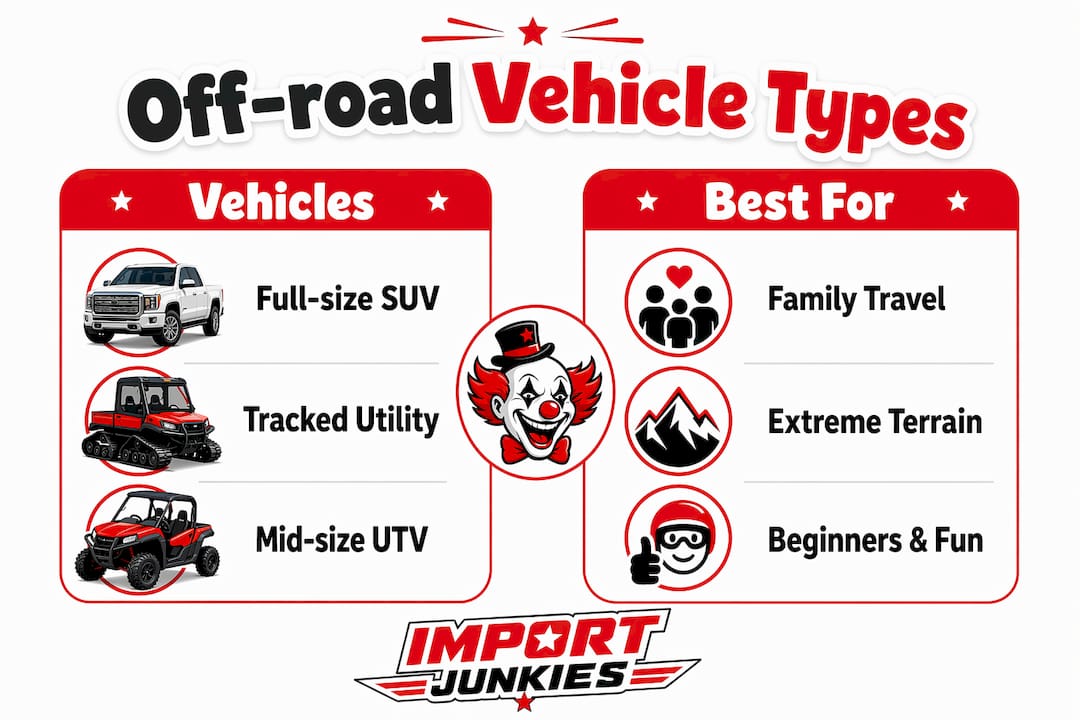
| Vehicle type | Best for | Key limitation |
|---|---|---|
| Full-size off-road SUV | Long-distance family travel, towing, mixed terrain | High fuel cost, difficult urban parking |
| Utility terrain vehicle (UTV) | Property work, short trail runs, family recreation | Limited highway capability |
| ATV / quad | Single-rider trail riding, hunting access | No passenger capacity, limited cargo |
| Tracked utility vehicle | Extreme snow, swamp, and mountain terrain | Slow speed, high cost |
| Electric utility golf cart | Campground, resort, and light trail use | Limited range and rough terrain capability |
Tracked utility vehicles deliver low ground pressure across snow, mud, swamps, and mountain terrain where wheeled vehicles fail completely. They are the right tool for extreme environments, but they are expensive and slow. Most families do not need them.
For beginners, the best starting point is a mid-size UTV or a capable ATV. Both are easier to learn on than a full-size SUV, cost less to maintain, and cover most recreational terrain. You can always move up in capability once you understand your actual needs.
Pro Tip: Prioritize terrain capability over comfort when choosing your first off-road vehicle. A vehicle that gets you out of trouble costs less in the long run than a comfortable one that gets you into it.
Reliability and simplicity matter more than feature count in remote terrain. A vehicle with fewer electronic systems has fewer failure points. That is not a knock on modern technology. It is a practical reality when you are 40 miles from the nearest mechanic. The electric ATV category has matured significantly and now offers a genuine option for families who want lower maintenance and quieter operation on trails.
For those researching battery systems for UTVs, AGM battery replacement guides are a useful reference when evaluating electric utility vehicle upkeep costs.
Key Takeaways
Off-road transportation delivers genuine access, safety, and utility in terrain where standard vehicles fail, but the right choice depends entirely on matching vehicle capability to your actual use case.
| Point | Details |
|---|---|
| Ground clearance is foundational | Off-road vehicles need 8–11 inches of clearance to handle rocks, ruts, and uneven terrain safely. |
| 4WD and low-range gearing matter | These systems provide traction and torque control that prevent breakdowns on steep or slippery terrain. |
| Operating costs are higher | Fuel at 15–20 MPG, tires at $200–$400 each, and elevated insurance premiums add up quickly. |
| Match capability to actual use | Buying more vehicle than you need wastes money; buying less leaves you stranded. |
| Familiarity beats complexity | A well-understood moderate vehicle outperforms an unfamiliar advanced rig in real off-road conditions. |
What I’ve learned from watching buyers get this wrong
Most people shopping for an off-road vehicle focus on the wrong things. They look at lift kits, aggressive tire tread, and roof rack capacity. What they should be asking is: where am I actually going, and how often?
I have seen buyers spend serious money on a fully built rock crawler and then use it twice a year on a graded dirt road. That is money parked in the garage. The vehicle depreciates, the tires dry-rot, and the owner never develops the skill to use what they paid for. The vehicle familiarity principle is real. A driver who knows every quirk of a mid-range UTV will outperform a novice in a top-spec rig every single time.
Start with something manageable. Learn the terrain near you. Build your skill set before you build your rig. The families I have seen get the most out of off-road travel are not the ones with the most expensive vehicles. They are the ones who planned well, maintained their equipment, and understood their limits.
The joy of off-road travel is real. Getting your family to a campsite that nobody else can reach, watching your kids navigate a trail for the first time, or hauling gear across your property without a second thought. These experiences are worth pursuing. Just pursue them with a vehicle that fits your life, not the life you imagine having.
— Gary
Off-road vehicles for recreation and utility at Importjunkies
Importjunkies carries a range of electric and gas-powered utility vehicles built for families and outdoor enthusiasts who want real capability without overcomplicating the purchase.

The 48V Electric Golf Cart Renegade Edition UTV seats four and handles light trail and campground terrain with zero emissions and low maintenance. For buyers who need snow and rough terrain capability, the 200cc ATV with Snow Plow adds a working plow and reverse for year-round utility. Importjunkies sells direct to the public at wholesale pricing, with detailed specs and purchase options available on each product page.
FAQ
What is off-road transportation?
Off-road transportation is travel using purpose-built vehicles designed for unpaved, rough, or unimproved terrain. These vehicles use features like 4WD, high ground clearance, and specialized tires to navigate conditions that standard vehicles cannot handle.
What ground clearance do I need for off-road driving?
Off-road vehicles typically require 8–11 inches of ground clearance for effective trail use. Anything below that range risks damage from rocks, ruts, and uneven surfaces on moderate to difficult terrain.
Is off-road transportation worth the extra cost?
Off-road transportation is worth the cost if you regularly access remote or unpaved locations. The higher fuel consumption, tire expenses, and insurance premiums are justified by the access and safety capability you gain. If your use is occasional, a lighter utility vehicle may offer better value.
What is the best off-road vehicle for beginners?
A mid-size UTV or a capable ATV is the best starting point for beginners. Both are easier to learn on, cost less to maintain, and cover most recreational terrain without the complexity of a full-size off-road SUV.
How do I choose between an ATV and a UTV for family use?
A UTV is the better family choice because it carries passengers and cargo. An ATV is a single-rider platform suited for individual trail riding or hunting access. If you are traveling with children or hauling gear, a UTV provides the capacity and safety features a family needs.
Recommended
- Your guide to every type of off-road vehicle – Saferwholesale || Import Junkies || Great Sports
- Benefits of Off-Road Vehicles for Adventure and Work – Saferwholesale || Import Junkies || Great Sports
- What is an off-road utility truck? A guide for buyers – Saferwholesale || Import Junkies || Great Sports
- Electric ATV Benefits Outdoors: 2026 Rider’s Guide – Saferwholesale || Import Junkies || Great Sports


