


 Location
 Login
Login
TL;DR:
- Choosing the right auto lift depends on your garage space, vehicle weight, and safety standards.
- Ensure your ceiling height, slab strength, and power supply meet the lift’s requirements for safe, long-term use.
An auto lift is a mechanical device that raises vehicles off the ground for repairs, maintenance, and storage, and choosing the right one for your home garage or small shop depends on matching capacity, bay dimensions, lift type, and safety certifications to your specific setup. This auto lift buying guide 2026 covers every factor that separates a smart purchase from an expensive mistake. The industry term for these units is “vehicle hoists,” though “auto lifts” is the widely accepted term in the U.S. consumer market. Key decision factors include ceiling height, concrete slab quality, power supply, ALI certification, and the type of work you plan to do. Get these right, and you have a lift that serves you safely for 10 to 15 years.
How to assess your garage or shop space for an auto lift
Your bay dimensions are the first filter in any auto lift features comparison. Buying a lift that does not fit your space wastes money and creates real safety risks.
Ceiling height requirements
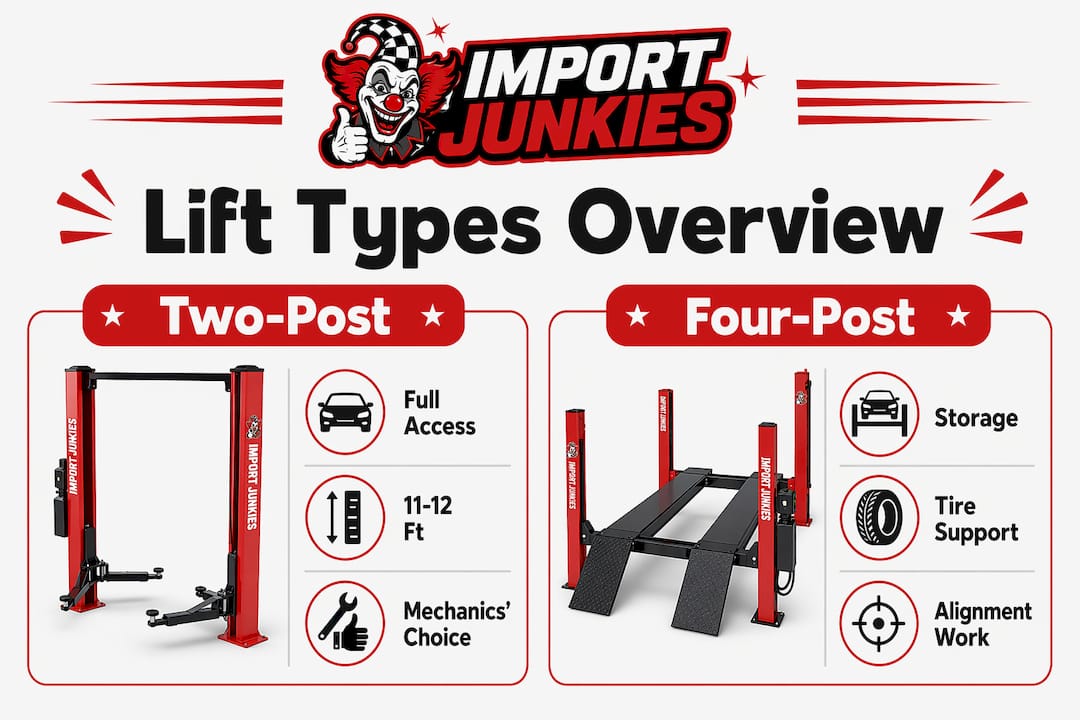
Standard overhead two-post lifts require 11–12 feet of ceiling clearance. That measurement catches a lot of home garage owners off guard, since most residential garages top out at 9–10 feet. If your ceiling falls below 11 feet, a floorplate or baseplate model is the right call. Baseplate designs reduce the required overhead clearance by routing the hydraulic and mechanical components through the floor plate rather than overhead, giving you full lift function in a shorter bay.
Concrete slab requirements
The slab under your lift is just as important as the lift itself. A minimum of 4 inches thick at 3,000 PSI with reinforcement is the baseline for safely anchoring a two-post lift. Slabs that are too thin, too old, or unreinforced can crack under load, which turns a routine oil change into a serious accident. Have a concrete professional assess your slab before you order anything.
Power, floor space, and pre-purchase checks
Most two-post and four-post lifts run on 220V single-phase power. If your garage only has 110V outlets, budget for an electrician before installation. Floor space requirements vary by lift type, but plan for at least 10–12 feet of width between posts for a standard two-post unit. Failure to assess ceiling clearance and slab condition before purchase is the leading cause of installation failures and ceiling damage.
Key pre-purchase measurements to take:
- Ceiling height from floor to lowest obstruction (beams, doors, lights)
- Slab thickness and age (check building permits or hire an inspector)
- Bay width and depth with vehicles parked inside
- Distance to nearest 220V panel and available amperage
Pro Tip: Measure your ceiling at the lowest point, not the peak. Garage ceilings are rarely uniform, and a beam or opener rail can cost you 6 inches of clearance you did not account for.
Two-post, four-post, scissor, and portable lifts compared
Understanding lift types by intended use is the fastest way to narrow your options. Each design serves a different purpose, and buying the wrong type means you will work around its limitations every time you use it.
| Lift Type | Capacity Range | Ceiling Needed | Best Use | Key Limitation |
|---|---|---|---|---|
| Two-Post (Overhead) | 7,000–12,000 lbs | 11–12 ft | Service, wheel removal | Needs tall ceiling |
| Two-Post (Baseplate) | 7,000–10,000 lbs | Under 11 ft | Low-ceiling garages | Less floor clearance |
| Four-Post | 8,000–14,000 lbs | 10–11 ft | Storage, alignment | Wheels stay on ground |
| Scissor Lift | 6,000–8,000 lbs | 9–10 ft | Quick service, low bays | Limited lift height |
| Portable/Drive-On | 3,000–6,000 lbs | 8 ft+ | Light maintenance | Lower capacity |
Two-post lifts
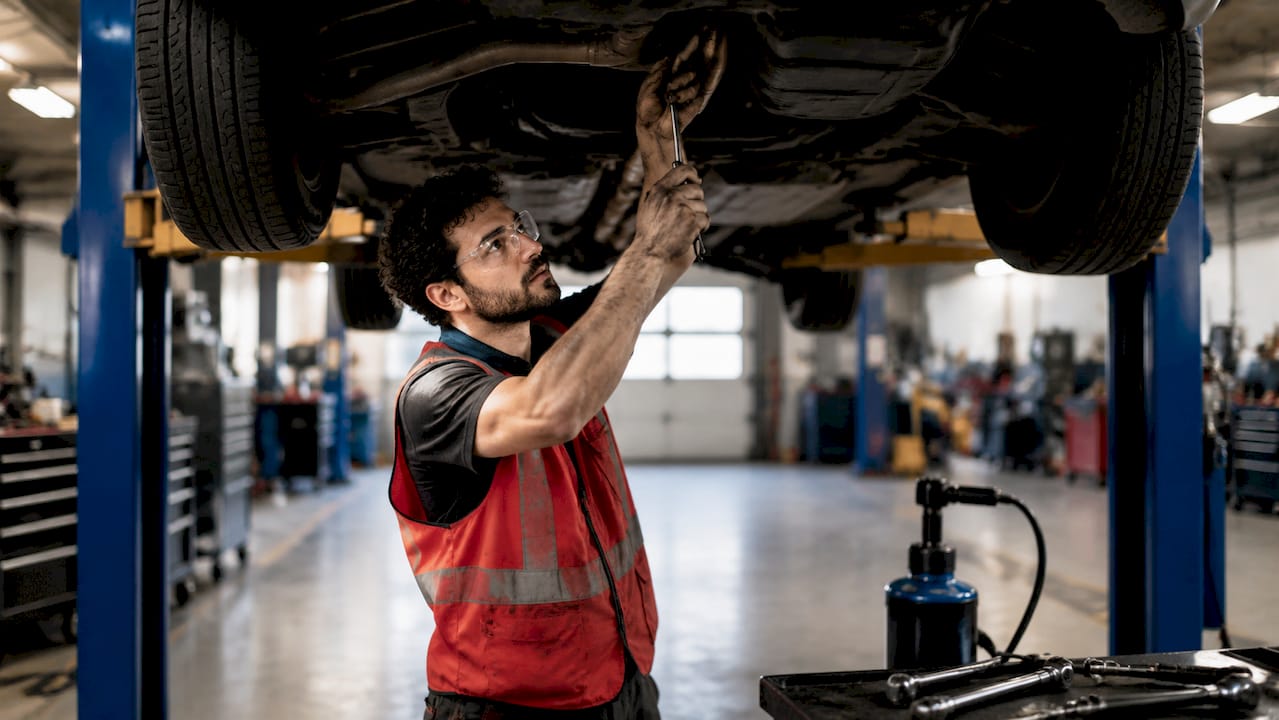
Two-post lifts are the most common choice for mechanics who need full access to the undercarriage and wheels. The vehicle contacts the lift at its frame or pinch welds, leaving all four wheels hanging free. That makes brake jobs, suspension work, and tire rotations fast and clean. The overhead design gives you the most floor clearance, but it requires 11–12 feet of ceiling height.
Four-post and scissor lifts
Four-post lifts favor storage and alignment work because the vehicle drives onto the runways and sits on its tires. You lose wheel-free access, but you gain stability and a lower ceiling requirement. Scissor lifts sit even lower and work well in tight bays, though their lift height is limited compared to post-style units. For a home garage where you want to stack a second car above the first, a four-post is the right tool.
Portable lifts
Portable lifts are worth considering if you rent your space or move between locations. Check out portable car lift options if your setup does not allow permanent installation. They carry lower capacity ratings and are not suited for heavy trucks or SUVs, but they handle light maintenance on sedans and compact vehicles without any concrete anchoring.
How to match lift capacity and arm geometry to your vehicles
Capacity is not just about your current vehicle. It is about every vehicle you might own in the next decade. Select a lift rated at least 25% above your heaviest vehicle’s curb weight. That buffer accounts for added accessories, fluids, and the growing weight of electric vehicles entering the market.
A full-size truck like a Ford F-250 can weigh over 7,000 lbs. An electric pickup like the Rivian R1T comes in near 7,100 lbs. If you buy a 7,000 lb rated lift today and add an EV in two years, you are already over capacity. A 10,000 lb rated lift gives you real room to grow.
Arm geometry matters just as much as raw capacity:
- Symmetric arms extend equally front and rear. They work well for trucks and SUVs but can interfere with door opening on sedans.
- Asymmetric arms position the front arms shorter and rear arms longer, rotating the vehicle back on the posts. This keeps doors clear and is the preferred setup for most passenger cars.
- Swing arms vs. fixed arms affect how precisely you can position the lift pads under OEM-specified lifting points. Always verify your vehicle’s lift points against the arm reach before buying.
Pro Tip: Download your vehicle’s OEM service manual and check the factory-specified lift points before you finalize arm selection. Lifting from the wrong point can damage the rocker panels or floor pan, especially on unibody vehicles.
Brands like Daytona offer certified lift models with detailed arm geometry specs published online. Cross-reference those specs with your vehicle list before you order.
What safety certifications actually mean in 2026
ALI Gold Label certification is the single most important credential to verify when buying a car lift. The Automotive Lift Institute tests lifts against ANSI/ALI ALCTV standards, which cover structural integrity, hydraulic performance, and safety lock reliability. A lift without ALI certification has not been independently verified to meet those standards.
Why this matters beyond safety: Many commercial insurance policies for small shops require ALI-certified equipment. If a non-certified lift fails and causes injury or property damage, your insurer may deny the claim entirely.
Safety features to verify before purchase
- Automatic safety locks: These engage at every rise increment and hold the lift if hydraulic pressure drops. They are non-negotiable.
- Single-point release: Allows both safety locks to disengage simultaneously, preventing uneven lowering that can tip a vehicle.
- Hydraulic flow control: Limits descent speed to a controlled rate even if a hose fails.
- Anchor bolt specs: Confirm the manufacturer specifies the correct anchor bolt diameter, depth, and spacing for your slab type.
Automatic locks and single-point release are the two features most commonly missing from cheap imports. Skipping them is not a cost savings. It is a liability. Regular inspection of safety locks and hydraulic systems is also critical for long-term safe operation, and most manufacturers recommend a full inspection every six months.
For a broader look at lift types and their safety profiles, the auto lift types guide from Importjunkies breaks down each category in detail.
Budgeting for affordable car lifts without cutting corners
The affordable car lifts 2026 market has improved significantly. Budget lifts under $3,000 can carry ALI certification and perform reliably for home garage use. BendPak and Triumph both offer certified models in this price range with solid build quality and reasonable warranty coverage.
| Price Range | What You Get | What You Give Up |
|---|---|---|
| Under $2,000 | Basic function, limited warranty | ALI cert often absent, fewer safety features |
| $2,000–$3,000 | ALI-certified options, decent build | Shorter warranty, fewer finish refinements |
| $3,000–$5,000 | Full certification, better arms, longer warranty | Higher upfront cost |
| Over $5,000 | Commercial-grade, premium features | Overkill for most home garages |
The risk with very cheap imports is not just quality. It is the absence of third-party testing. A lift that costs $1,200 and lacks ALI certification may work fine for a year, then develop hydraulic leaks or lock failures with no recourse from the manufacturer. The biggest mistake buyers make is choosing price over fit, ignoring slab thickness, ceiling height, and vehicle requirements in the process.
Installation costs are a real line item. Professional installation for a two-post lift typically runs $300–$600 depending on your region and whether electrical work is needed. Factor that into your total budget from the start.
Pro Tip: Ask the seller for the ALI Gold Label certificate number and verify it directly on the ALI website at autolift.org. Counterfeit labels exist on imported units, and a 30-second check protects you from a costly mistake.
Key takeaways
The right auto lift for your home garage or small shop is determined first by your bay dimensions and vehicle weight, then by lift type, ALI certification, and total installed cost.
| Point | Details |
|---|---|
| Measure your bay first | Ceiling height and slab quality determine which lift types are even possible for your space. |
| Match capacity with a buffer | Choose a lift rated at least 25% above your heaviest vehicle to accommodate future EVs. |
| Prioritize ALI certification | Only ALI-certified lifts meet independent safety standards and satisfy most shop insurance requirements. |
| Pick lift type by task | Two-post lifts serve maintenance best; four-post lifts work better for storage and alignment work. |
| Budget for installation | Add $300–$600 for professional installation to your total cost before comparing models. |
What i have learned after years of watching buyers get this wrong
The single most common mistake I see is buyers who fall in love with a price and then try to make the lift fit their garage. They measure the ceiling after the lift arrives. They discover the slab is 3 inches thick instead of 4. They find out the 220V panel is on the opposite wall and the electrician quote doubles their budget. Every one of those problems was visible before the purchase if they had done the space assessment first.
My honest advice: treat the space assessment as a hard gate. If your ceiling is under 11 feet, you are buying a baseplate or scissor lift, full stop. If your slab does not meet spec, you are pouring a new section before anything goes in. Those are not negotiable points.
The EV angle is also something most buyers in 2026 are still underweighting. If you own a gas vehicle today and plan to buy an EV in the next three to five years, buy the 10,000 lb lift now. The price difference between a 7,000 lb and a 10,000 lb rated unit is often $400–$600. Replacing a lift because it is undersized for your new truck will cost you ten times that.
Finally, do not skip the ALI certification check. I have seen uncertified lifts that looked identical to certified ones, same paint, same decals, different internal components. The 30 seconds it takes to verify a certificate number on the ALI website is the cheapest insurance you will ever buy.
— Gary
Find reliable garage equipment at Importjunkies
Importjunkies carries a range of vehicles and utility equipment built for enthusiasts who take their garage setup seriously. Whether you are outfitting a home bay or a small shop, having the right support equipment makes every job faster and safer.
If you are also looking at utility vehicles that need proper garage storage and maintenance access, the Lifted Renegade+ 2.0 Edition is one example of the kind of vehicle that benefits directly from a quality four-post lift setup. Importjunkies offers competitive pricing and direct customer support to help you match equipment to your specific needs. Visit importjunkies.com to browse current inventory or reach out to the team for purchase guidance.
FAQ
What ceiling height do i need for a two-post auto lift?
Standard overhead two-post lifts require 11–12 feet of ceiling clearance. Baseplate models are designed for ceilings under 11 feet and reduce the required overhead space without sacrificing lift capacity.
What does ALI certification mean for a car lift?
ALI certification means the lift has been independently tested by the Automotive Lift Institute against ANSI/ALI ALCTV safety standards. Certified lifts meet verified structural and hydraulic performance requirements, and many shop insurance policies require them.
How much capacity do i need for my auto lift?
Choose a lift rated at least 25% above your heaviest vehicle’s curb weight. That buffer covers accessories, fluids, and the added weight of electric vehicles you may own in the future.
Is a four-post lift better than a two-post lift for home garages?
It depends on your primary use. Two-post lifts give you full wheel-free access for brake and suspension work. Four-post lifts are better for vehicle storage and alignment tasks, and they work in garages with lower ceilings.
Can i install an auto lift on a standard residential concrete slab?
Only if the slab meets minimum specs: at least 4 inches thick, 3,000 PSI compression strength, and properly reinforced. Slabs that fall short need professional assessment and possible repair before any lift installation proceeds.
Recommended
- Types of Auto Lifts: Mechanic’s Guide for 2026 – Saferwholesale || Import Junkies || Great Sports
- What Is a Portable Car Lift? a DIY Buyer’s Guide – Saferwholesale || Import Junkies || Great Sports
- GSI - 8000 lb 4 Post Auto Lift Heavy Duty Automotive Portable Storage – Saferwholesale || Import Junkies || Great Sports
- Single Scissor Lift Table - 2200 lbs - 39.4" lifting height - A-2014 – Saferwholesale || Import Junkies || Great Sports


