


 Location
 Login
Login
TL;DR:
- Choosing the right commercial-grade golf cart improves productivity, reliability, and long-term cost savings.
- Key criteria include power, drive system, ground clearance, uptime, maintenance, and total ownership costs.
- Proper maintenance and considering total ownership costs are essential for maximizing fleet lifespan and efficiency.
Choosing the wrong golf cart for your business is a more costly mistake than most operators realize. Whether you run a golf course, a landscaping company, a resort, or a large warehouse campus, the cart you select directly affects how fast your crew works, how often you deal with downtime, and what you spend on maintenance over the next several years. The difference between a cart built for recreational rounds and one engineered for commercial work is not a minor upgrade. It is a fundamental shift in specs, reliability, and return on investment. This guide walks you through everything you need to make a confident, well-informed decision.
Table of Contents
- Key criteria for selecting golf carts for business
- Top commercial golf cart models for business use
- Commercial utility vs recreational golf carts: A detailed comparison
- Maintaining golf carts for long-term business success
- The overlooked factors in choosing golf carts for business
- Find the perfect golf cart for your business needs
- Frequently asked questions
Key Takeaways
| Point | Details |
|---|---|
| Utility carts outperform recreational | Commercial carts offer more power, capacity, and uptime critical for business use. |
| Maintenance is routine | Daily to annual checks are vital for reliability and long-term savings. |
| Electric carts suit most operations | Where charging is available, electric models provide efficient, low-maintenance performance. |
| Comparison is essential | Side-by-side model data helps ensure you pick the right cart for your needs. |
| Choose for total ROI | Operational efficiency and uptime make higher-spec carts worth the investment. |
Key criteria for selecting golf carts for business
Before you look at any specific model, you need a clear framework for evaluating your options. Too many buyers start with price and work backward. That approach leads to underpowered carts, unexpected repair costs, and frustrating operational gaps. Start instead with your actual requirements, and then match a cart to them.
Here are the six criteria that matter most for business buyers:
- Power and load capacity: Commercial utility carts outperform recreational golf carts significantly, delivering 13 to 15 HP versus the 4 to 5 HP found in recreational models, with load limits of 1,200 lbs compared to 500 lbs on standard carts. If your team is hauling tools, equipment, or supplies, that gap is critical.
- Drive system: 4WD (four-wheel drive) is essential for uneven terrain, wet ground, or any surface that is not a paved path. 2WD works for flat, dry, predictable environments. Don’t assume 2WD is fine until you have mapped every route your cart will travel.
- Ground clearance: Commercial carts offer 7 to 12 inches of clearance, while recreational models sit at just 4 to 5 inches. Curbs, ruts, and uneven turf can stop a low-clearance cart cold.
- Operational uptime: A commercial utility cart can run for one to three days between charges or fueling. A recreational cart often needs more frequent recharging, which kills productivity on busy days.
- Maintenance requirements: Battery type, tire ratings, brake systems, and component quality all affect how much time and money you spend keeping the fleet running. Knowing your battery maintenance practices before purchasing is smart planning.
- Budget and total cost of ownership: The sticker price is only part of the picture. Factor in battery replacement cycles, fuel costs, parts availability, and expected lifespan.
Pro Tip: If you are on the fence between electric vs gas carts, map out your charging infrastructure first. The answer often becomes obvious once you know whether consistent charging access is realistic for your operation.
When evaluating models, also consider whether you need custom golf cart features like dump beds, enclosed cabs, or cargo racks. These additions can transform a base model into a purpose-built work vehicle, but they need to be planned before purchase, not bolted on as afterthoughts.
With selection criteria clear, let’s look at top golf cart options suited for different business needs.
Top commercial golf cart models for business use
Not all commercial carts are created equal. There is a meaningful range of options across power levels, drive systems, fuel types, and intended use cases. Understanding where each type fits helps you avoid paying for features you do not need or missing ones that are essential.
High-HP heavy-duty utility UTVs sit at the top of the performance range. These units run at 13 to 15 HP and often come with 4WD, locking differentials, and load ratings that support serious hauling. They are the right choice for landscaping companies, golf course maintenance crews, and construction sites where terrain is unpredictable and loads are heavy. You can browse detailed commercial cart specs to get a concrete sense of what these machines look like in practice.
Versatile electric utility carts are growing in popularity across resorts, campuses, airports, and golf facilities. They run quietly, produce zero emissions, and cost significantly less per mile to operate than gas models. The electric cart benefits go beyond fuel savings: lower noise levels improve the guest experience, and fewer moving parts mean reduced mechanical failures over time. These are ideal for high-throughput environments where carts are running continuously throughout the day.
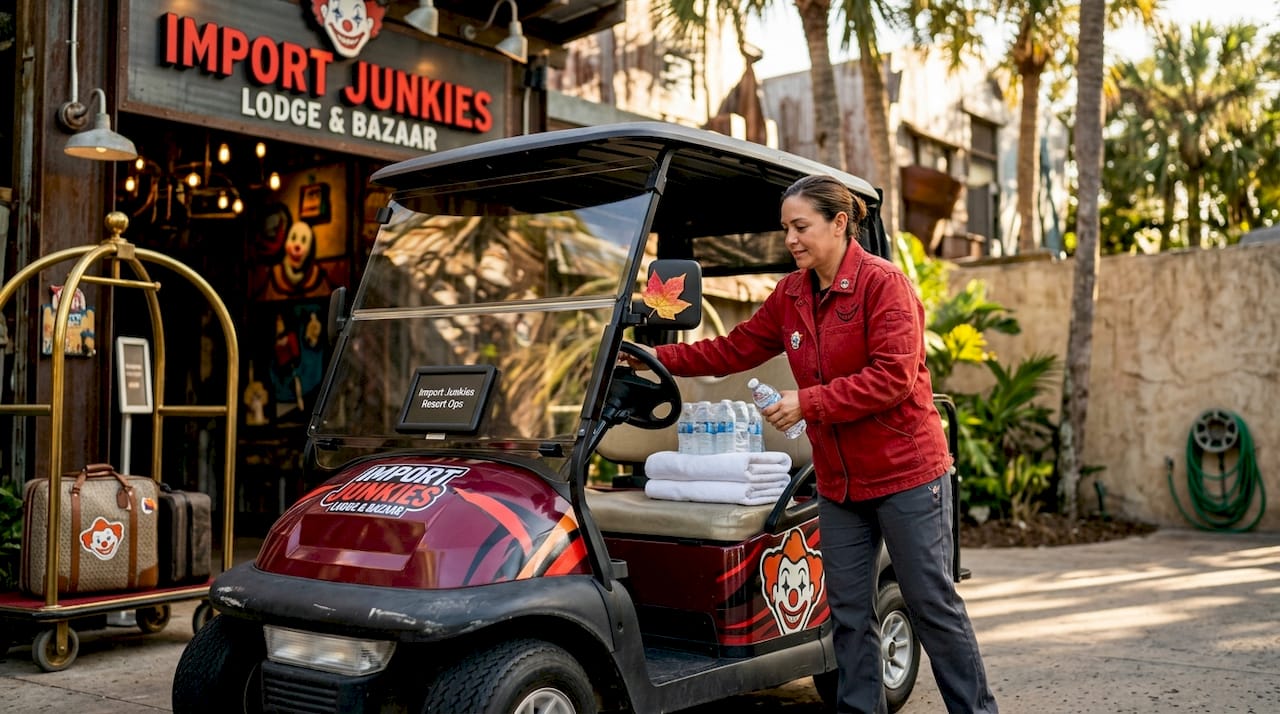
Gas-powered carts remain practical in one specific scenario: locations where reliable charging infrastructure does not exist. Remote worksites, rural properties, or temporary job locations may not have the electrical access needed to keep a fleet of electric carts running. In those cases, a well-maintained gas cart provides the range and refueling simplicity that keeps operations moving.
Mid-tier multi-use carts balance power, features, and cost for businesses that do not need top-tier specs but want something more capable than a basic recreational model. These typically sit in the 8 to 10 HP range with 2WD and moderate load capacity. They are well-suited for small resort properties, bed and breakfasts with large grounds, or light-duty facility maintenance.
Here are key features to prioritize across any model category:
- Towing capacity rated for your heaviest expected load
- Seat configuration that fits your crew size
- Weather protection if you operate in rain or cold
- Availability of replacement parts and service support in your region
- Warranty terms, particularly on the motor and battery system
Pro Tip: Do not overlook the value of a cart with a factory dump bed. For maintenance crews, a dump bed cuts unloading time dramatically and keeps workers off ladders and tailgates, which also reduces injury risk.
Having seen the top models, it is useful to compare these options side by side.
Commercial utility vs recreational golf carts: A detailed comparison
The numbers tell a clear story. When you line up commercial utility carts against recreational models, the performance gap is not subtle. It is the difference between a tool built for work and one built for leisure.
| Feature | Commercial utility cart | Recreational golf cart |
|---|---|---|
| Engine output | 13 to 15 HP | 4 to 5 HP |
| Load capacity | Up to 1,200 lbs | Up to 500 lbs |
| Drive system | 4WD available | 2WD standard |
| Ground clearance | 7 to 12 inches | 4 to 5 inches |
| Operational uptime | 1 to 3 days per charge | Frequent recharging needed |
| Terrain handling | Rough, uneven, wet surfaces | Flat, groomed surfaces |
| Maintenance complexity | Moderate to high | Low |
| Average price range | $8,000 to $20,000+ | $3,000 to $8,000 |
The table above reflects why a one-size-fits-all approach fails most business owners. A recreational cart dropped into a commercial setting will be underpowered within weeks. But a heavy-duty utility cart used only to shuttle guests around a flat resort is an expensive overkill that will sit underutilized.
“Recreational carts suffice for light-duty tasks but fall short in industrial settings where power and uptime are non-negotiable. Gas remains a viable option only where charging infrastructure is unavailable.” Source
That distinction matters for your budget. If your primary use case is guest transport across a paved or compacted surface, a quality mid-tier electric cart may be all you need. But if your team is maintaining 200 acres of turf, hauling fertilizer, or navigating gravel maintenance roads, you need the clearance, traction, and power that only a commercial-grade unit provides.
Understanding how electric vehicles transform golf facility operations can help you see the broader operational picture beyond the spec sheet. And before you finalize any purchase, reviewing golf cart safety standards for operators ensures your fleet meets legal and liability requirements, especially if you are transporting employees or guests.
Maintenance is where comparison results really start to diverge, so let’s examine what a solid long-term maintenance routine looks like.
Maintaining golf carts for long-term business success
A commercial golf cart that is well-maintained will outperform and outlast a poorly maintained one, regardless of which model you buy. Skipping basic maintenance is the fastest way to turn an asset into a liability. Building a consistent routine prevents costly breakdowns and extends the life of every cart in your fleet.
Here is a structured maintenance schedule that works for business fleets:
- Daily: Check battery charge level and tire pressure (target 18 to 22 PSI for most commercial cart tires). Look for fluid leaks, unusual sounds, or warning indicators before the first shift.
- Weekly: Clean the cart thoroughly, paying attention to wheel wells, undercarriage, and battery terminals where corrosion starts. Remove debris from moving parts.
- Monthly: Inspect brakes for wear and check steering components for looseness or unusual resistance. Test headlights, reverse indicators, and any onboard safety systems.
- Quarterly: Rotate tires to even out wear patterns, lubricate suspension and steering pivot points, and check battery water levels on lead-acid systems.
- Annually: Conduct a full operational test including load testing, brake performance evaluation, motor output check, and complete battery capacity assessment.
The maintenance schedule above reflects best practices for keeping both lead-acid and lithium battery systems in peak condition. Lithium batteries require the least hands-on upkeep since they do not need water top-offs and are less sensitive to partial charging. Lead-acid batteries cost less upfront but demand more consistent attention.
| Maintenance task | Frequency | Lead-acid | Lithium |
|---|---|---|---|
| Battery water check | Monthly | Required | Not applicable |
| Terminal cleaning | Monthly | Required | Recommended |
| Full charge cycle | Daily | Required | Recommended |
| Capacity test | Annually | Required | Required |
| Tire pressure check | Daily | Required | Required |
| Brake inspection | Monthly | Required | Required |
For businesses running multiple carts, consider assigning a specific crew member to fleet maintenance. A dedicated person who knows what normal looks and sounds like catches problems early, before they become costly repairs. You can build on the battery maintenance strategies that match your specific battery chemistry and usage pattern.
Before adding used carts to your fleet, a thorough used cart inspection process can save you from inheriting someone else’s deferred maintenance.
Proper maintenance forms the backbone of cart longevity, setting the stage for our unique perspective on the decision-making process.
The overlooked factors in choosing golf carts for business
Here is what most buying guides will not tell you: the sticker price of a golf cart is often the least important number in the decision. What actually determines your true cost is the total cost of ownership over three to five years, and that number can look very different from what you expect.
Consider downtime first. When a cart in your fleet breaks down mid-shift, the cost is not just the repair bill. It is the lost labor productivity of the crew member who now has no vehicle, the delayed task that was supposed to be completed, and the cascading effect on the rest of the day’s schedule. A fleet of five recreational carts running constant service calls will likely cost more in downtime losses than a fleet of three well-spec’d commercial units that rarely break down.
Seasonality is another factor that rarely gets enough attention. If your operation slows significantly in winter, your fleet strategy should reflect that. Keeping five carts on standby through the off-season means you are paying for battery degradation, tire flat-spotting, and general wear without return. A smaller, more capable fleet that you rotate properly will often outperform a larger fleet that sits idle.
The business case for investing in higher specs is genuinely strong in most commercial scenarios. Comparing the electric vs gas decision strictly on purchase price almost always favors gas. But when you factor in fuel costs, emissions compliance, noise regulations, and the quieter operating environment that many resorts and golf facilities require, electric pulls ahead over a three-year horizon.
Our perspective is this: buyers who focus exclusively on the lowest purchase price nearly always end up spending more over the ownership period. Investing in the right specs from the start, even at a higher upfront cost, is typically the smarter financial move for any business running carts as working equipment rather than recreational perks.
Find the perfect golf cart for your business needs
If this guide has helped you clarify what your operation actually needs, the next step is finding a cart that fits those requirements at a price that makes sense.

At Import Junkies, we carry a curated range of utility and electric golf carts built for real business use. Whether you need an electric 4-seater utility cart for campus transport, or a heavy-duty 4x4 gas UTV capable of handling rough terrain and serious loads, we stock options across the full commercial spec range. Browse our complete selection of business golf cart options and compare models side by side to find the right match for your operation, your terrain, and your budget.
Frequently asked questions
What are the main differences between commercial utility carts and recreational golf carts?
Commercial utility carts deliver significantly higher horsepower (13 to 15 HP vs 4 to 5 HP), far greater load capacity (1,200 lbs vs 500 lbs), better ground clearance, and longer operational uptime than recreational models. They are purpose-built for demanding workloads that recreational carts simply cannot sustain.
How often should business-use golf carts be serviced?
Business carts should follow a tiered maintenance schedule with daily battery and tire checks, weekly cleaning, monthly brake and steering inspections, quarterly lubrication and tire rotations, and a full annual operational test. Lithium battery systems require less frequent hands-on maintenance than lead-acid alternatives.
Is it better to choose electric or gas golf carts for business?
Electric carts are the stronger choice for most established business locations where reliable charging is available, offering lower operating costs and quieter performance. Gas models remain viable specifically for remote sites or temporary locations where electrical charging infrastructure is not accessible.
What is the typical load capacity of a commercial utility golf cart?
A commercial utility cart typically supports up to 1,200 lbs of load capacity, which is more than double the 500 lbs maximum found on recreational golf carts. That difference is critical for crews hauling tools, landscaping materials, or facility supplies across large properties.
Recommended
- Why choose electric golf carts? Benefits for golfers and courses – Saferwholesale || Import Junkies || Great Sports
- Utility trucks vs. golf carts: which delivers more value? – Saferwholesale || Import Junkies || Great Sports
- How electric vehicles transform golf facility operations – Saferwholesale || Import Junkies || Great Sports
- Lifted golf carts: benefits, types, and how to choose – Saferwholesale || Import Junkies || Great Sports


