


 Location
 Login
Login
What are the best alternatives to Coco Coupe electric golf carts?
The strongest cococoupe.com alternatives available in the U.S. right now are the Renegade V3, Gem, and models from highrollerusa.com, bvctrikes.com, and ajcycle.net. Each one targets a different buyer: the Renegade V3 suits buyers who want utility and dealer support, Gem suits those who prioritize build quality and warranty, and the others fill niche roles around styling, three-wheel configurations, and small business use. The Coco Coupe starts at $8,500 for a four-seater, which makes it one of the most affordable entry points in the low-speed vehicle (LSV) category. Alternatives range from roughly $12,000 to over $25,000 depending on features and configuration.
All six vehicles covered here are low-speed vehicles, the federally defined category for four-wheeled electric cars with top speeds between 20–25 mph and a gross vehicle weight rating under 3,000 pounds. That federal definition matters because it determines which safety features you need and which roads you can legally use.
| Vehicle | Top Speed | Passengers | Battery | Utility Features | Starting Price | Best For |
|---|---|---|---|---|---|---|
| Coco Coupe | 20–25 mph | 4 | 60V | Basic LSV | ~$8,500 | Budget-conscious urban riders |
| Renegade V3 | 20–25 mph | 4 | 48V | Utility bed, cargo | Mid-range | Versatility and dealer access |
| Gem | 20–25 mph | 2–6 | Higher voltage | Advanced safety | From $12,000 | Durability and warranty coverage |
| bvctrikes.com | Varies | 1–2 | Varies | Compact trike | — | Three-wheel niche buyers |
| ajcycle.net | 20–25 mph | Varies | Varies | Multi-use utility | — | Small business operators |
| highrollerusa.com | 20–25 mph | 4 | Varies | Style-focused | — | Recreational and golf use |
Coco Coupe pros and cons at a glance:
- Pros: Lowest entry price, retro styling, four-seat capacity, street-legal out of the box
- Cons: 60V system offers less range than higher-voltage competitors, limited dealer network, basic utility features
Renegade V3 pros and cons:
- Pros: Utility bed adds real cargo capacity, dealer support available, balanced price-to-feature ratio
- Cons: 48V system means you should verify range against your typical route before buying
Gem pros and cons:
- Pros: U.S.-made, strongest warranty in the category, 2–6 passenger configurations, advanced safety tech
- Cons: Starting price of $12,500 for the base e2 without doors; full enclosed models cost considerably more
bvctrikes.com pros and cons:
- Pros: Compact footprint, three-wheel configuration suits tight spaces
- Cons: Niche product with limited dealer presence and fewer configuration options
ajcycle.net pros and cons:
- Pros: Utility-focused build, competitive pricing for business buyers
- Cons: Less public information on warranty terms and service network
highrollerusa.com pros and cons:
- Pros: Styled for recreation, standard safety compliance features included
- Cons: Primarily recreational focus limits utility for work applications
How do these vehicles compare on specs, safety, and ownership costs?
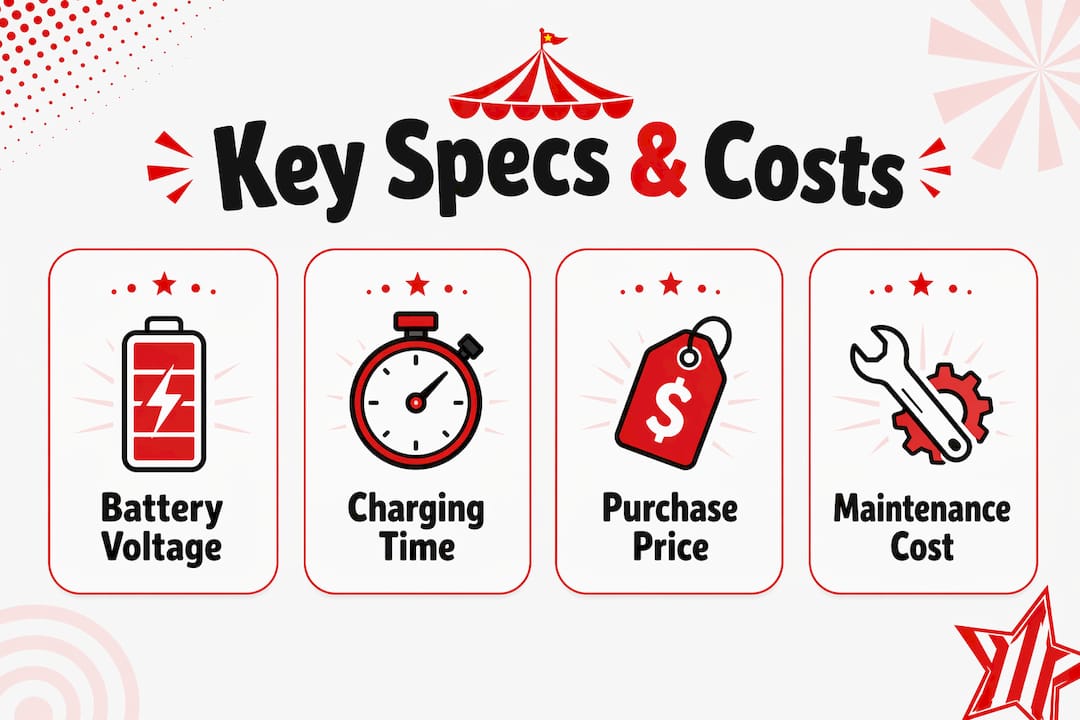
Price at purchase is only part of what you actually spend. Maintenance, insurance, and the cost of finding a local service center all add up, and imported LSVs often require more maintenance than domestically produced models. That gap shows up most clearly when comparing the Coco Coupe and Renegade V3 against the Gem.

Battery life and charging time
Battery voltage directly affects range and recharge speed. The Coco Coupe runs a 60V system, while the Renegade V3 uses a 48V setup. Gem and several other competitors use higher voltage battery systems than the Coco Coupe’s 60V, which generally translates to longer range and faster recovery between charges. If your daily route covers more than a few miles each way, voltage and amp-hour capacity deserve serious attention before you buy, especially as explained in track and off-road calibration risks.
Safety features and street legality
Every street-legal LSV must carry a specific set of safety equipment. Federal requirements include seat belts, headlights, taillights, brake lights, turn signals, mirrors, a parking brake, a windshield with wipers, and a backup camera in most states. The Gem stands out here because its U.S. manufacturing process builds those features in from the start, with quality control that import models sometimes lack. The Renegade V3 also ships with standard LSV safety equipment. For bvctrikes.com and ajcycle.net models, verify the specific unit’s compliance documentation before purchase, since three-wheel vehicles and utility configurations sometimes fall into different regulatory categories.
Warranty and customer service
Gem carries the strongest warranty position in this group, backed by its domestic production and established dealer network. The Renegade V3 offers dealer support through Importjunkies, which means you have a U.S.-based contact for questions and parts. The Coco Coupe, bvctrikes.com, and ajcycle.net models are primarily import-channel products. Imported vehicles sometimes carry limited coverage on critical components, so read the warranty document carefully before signing anything.
Dealer network and availability
Domestic brands typically provide better post-sale service than import-only distributors. Gem has the widest physical dealer footprint across the U.S. Importjunkies supports the Renegade V3 with direct online sales and customer service from a U.S.-based team. highrollerusa.com focuses on recreational buyers and maintains its own sales channel. For bvctrikes.com and ajcycle.net, service logistics depend heavily on your location, so factor in shipping costs for parts when calculating total ownership cost.
Total cost of ownership
Buyers frequently prioritize purchase price but overlook maintenance costs and compliance expenses, which heavily influence long-term satisfaction. Insurance for LSVs is generally inexpensive compared to full passenger cars, but it varies by state and by the vehicle’s declared value. An $8,500 Coco Coupe with limited local service options can end up costing more over three years than a $12,000 Gem with a dealer two towns over.
What are the street legality rules for low-speed vehicles in the U.S.?
LSVs are street-legal in most U.S. states, but the rules are more specific than most buyers realize. Understanding them before you purchase protects you from citations and keeps you safe.
Federal LSV definition: A low-speed vehicle is a four-wheeled electric vehicle with a top speed between 20–25 mph and a gross vehicle weight rating under 3,000 pounds. That definition comes from federal motor vehicle safety standards and determines which vehicles qualify for LSV registration.
Road restrictions: State laws typically limit LSV operation to roads with speed limits of 35 mph or less, and drivers must hold a valid driver’s license. A California Highway Patrol officer pulled over a Coco Coupe driver on a 40-mph road near Redding, resulting in a citation. That incident illustrates exactly what happens when buyers assume street-legal means unrestricted road access.
Required safety equipment for street-legal LSVs:
- Seat belts for all passengers
- Headlights and taillights
- Brake lights and turn signals
- Rearview and side mirrors
- Parking brake
- Windshield with wipers
- Backup camera (required in many states)
State and local variation: Consumers often confuse federal street-legal status with unrestricted road use, and that confusion leads to citations and safety risks. State laws set the baseline, but city and county ordinances can further restrict where LSVs operate, sometimes more strictly than state rules. Check your local ordinances before you buy, not after.
Common misconceptions:
- “Street-legal” does not mean you can drive on any public road
- Higher top speed does not automatically make a vehicle safer or more compliant
- A vehicle sold as an LSV by an online retailer may still require local registration and inspection
Pro Tip: Call your local DMV or city transportation office before purchasing any LSV. Ask specifically whether the vehicle’s top speed and configuration qualify for registration in your jurisdiction. This five-minute call can save you hundreds in fines and registration headaches.
How to choose the best motorized golf buggy for your needs
Picking the right LSV comes down to matching the vehicle’s actual capabilities to how you plan to use it every day. Here are the factors that matter most, in order of practical importance.
Legal compliance first. Before you compare prices or styling, confirm the vehicle qualifies as a street-legal LSV in your state and city. A vehicle that cannot be legally registered is money parked in the garage. Check the street-use basics for LSVs before you commit to any model.
Battery range versus your actual route. Measure the round-trip distance you plan to cover daily, then add a buffer for hills and passenger load. Higher voltage systems generally deliver more range, but amp-hour capacity matters just as much. Ask the seller for real-world range figures, not just voltage specs.
Passenger capacity and intended use:
- Four-seat models like the Coco Coupe and Renegade V3 suit families and recreational groups
- Two-seat models like the Gem e2 work well for couples or solo commuters who want a smaller footprint
- Utility configurations from ajcycle.net suit small business owners who need cargo capacity alongside passenger seating
Price versus total ownership cost. The LSV market splits between premium domestic vehicles and competitively priced imports, and the gap in maintenance costs can close the price advantage of a cheaper import within two or three years. Factor in parts availability, local service options, and insurance before deciding.
Dealer support and warranty terms. A vehicle with a one-year limited warranty and no local dealer is a risk. Prioritize models where you can reach a real service contact in the U.S. Read the warranty document for exclusions on battery packs and drivetrain components, since those are the most expensive repairs.
Evaluating warranty options:
- Ask whether the battery pack is covered separately from the vehicle warranty
- Confirm whether warranty service requires shipping the vehicle to a specific location
- For imports, ask who handles warranty claims if the original importer closes or changes distributors
You can also review the low-speed electric vehicle buying guide for a broader look at what separates a solid purchase from a frustrating one.
Pro Tip: Test the charging setup before you finalize a purchase. Some LSVs use proprietary chargers that are expensive to replace or hard to source. A standard 110V plug-in charger is far more practical for home use than a specialized unit that requires an electrician.
Importjunkies carries the Renegade V3 and more street-legal electric carts
If you’ve been comparing websites like cococoupe.com and want a direct purchase option with U.S.-based support, Importjunkies offers a practical alternative. The platform sells directly to the public at wholesale pricing, with no middleman markup, and the team is reachable for pre-sale questions and post-sale support.

The Renegade V3 four-seater is one of the most requested models, offering utility features and four-passenger capacity at a mid-range price point. For buyers who want a lifted configuration with more ground clearance, the Renegade+ 2.0 Edition adds that capability without jumping to a premium price tier. Importjunkies also carries the Coco Coupe itself, so you can compare both models side by side on the same platform before deciding.
Top Importjunkies options for buyers researching Coco Coupe alternatives:
- Renegade V3 48V four-seater with utility bed
- Renegade X Edition in silver for a style-forward option
- Renegade+ 2.0 lifted edition for mixed-terrain use
- Coco Coupe four-seater for buyers who want the original at the lowest entry price
Key Takeaways
The strongest Coco Coupe alternatives balance legal compliance, battery range, and total ownership cost rather than purchase price alone.
| Point | Details |
|---|---|
| Coco Coupe entry price | The Coco Coupe starts at a notably low price for a four-seater in the LSV category. |
| Alternatives cost more upfront | Competing models generally cost more upfront, starting at approximately $12,000 depending on features and configuration. |
| Road restrictions apply everywhere | LSVs are legally limited to roads with speed limits of 35 mph or less in most U.S. states, regardless of where you bought the vehicle. |
| Domestic brands offer better service | Domestically produced LSVs like Gem typically provide stronger post-sale support and parts availability than import-only models. |
| Importjunkies option | Importjunkies sells the Renegade V3 and Coco Coupe directly, with U.S.-based support and competitive wholesale pricing. |
Recommended
- Coco Coupe Blood Splatter Edition 60v Electric 4 Seater Golf Cart LSV – Saferwholesale || Import Junkies || Great Sports
- Coco Coupe Blood Splatter Edition 60v Electric 4 Seater Golf Cart LSV – Saferwholesale || Import Junkies || Great Sports
- Four Passenger Electric Golf Car Street Legal LSV Low Speed Vehicle Go – Saferwholesale || Import Junkies || Great Sports
- Coco Coupe 60v Scratch & Dent LE Edition Electric 4 Seater Golf Cart L – Saferwholesale || Import Junkies || Great Sports


