


 Location
 Login
Login
TL;DR:
- Electric scooters are eco-friendly, inexpensive, and practical alternatives to gas-powered transportation.
- Different types of electric scooters suit various needs, from commuting to high-performance rides.
- Riders should understand local laws, safety tips, and choose models aligned with their daily routines.
Electric scooters are no longer just for kids cruising around the driveway. Adults are using them to cut commute times, skip parking hassles, and reduce fuel costs in a real, measurable way. Whether you’re looking for a practical way to cover the last mile to work, a fun option for weekend recreation, or a cleaner alternative to driving, today’s electric scooters offer more capability than most people expect. This guide breaks down how they work, what types are available, how they compare to gas scooters, and what you need to know before your first ride.
Table of Contents
- What exactly is an electric scooter?
- Types of electric scooters: Commuter to high-performance
- Electric scooters vs gas scooters: How do they compare?
- Safety, regulations, and practical tips for new riders
- Why electric scooters are more than just a commuter’s gadget
- Explore advanced electric vehicles and upgrade your ride
- Frequently asked questions
Key Takeaways
| Point | Details |
|---|---|
| Versatility for all uses | Electric scooters offer options for both daily commuting and recreation, making them practical for many lifestyles. |
| Eco-friendly transportation | Compared to gas vehicles, electric scooters produce lower emissions and have lower operating costs. |
| Safety and rules matter | Following local laws and safety practices is essential for enjoyable, accident-free rides. |
| Choose by features | Pay attention to speed, range, weight capacity, and style to find the right model for your needs. |
What exactly is an electric scooter?
An electric scooter is a personal vehicle powered by an electric motor and a rechargeable battery pack instead of a gas engine. The rider stands on a flat deck, steers with handlebars, and controls speed and braking using handlebar-mounted throttle and brake levers. The design is straightforward, but the components underneath are more sophisticated than they look.
Here are the main parts you’ll find on virtually every electric scooter:
- Electric motor: Powers the rear or front wheel directly. Most commuter models use hub motors, which are built into the wheel itself.
- Battery pack: Typically a lithium-ion battery that stores energy and determines how far you can ride. Higher capacity batteries add weight but extend range.
- Deck: The flat platform where you stand. Size matters for comfort, especially on longer rides.
- Wheels and tires: Pneumatic (air-filled) tires absorb bumps better, while solid tires require zero maintenance but offer a firmer ride.
- Display and controls: A small screen on the handlebars shows speed, battery level, and ride mode. Some models connect to a smartphone app.
- Folding mechanism: Most commuter scooters fold down for easy storage or carrying on public transit.
Riding one is simple. You push off with one foot, then engage the throttle to let the motor take over. Braking is handled by a combination of electronic (regenerative) braking and a physical brake. Regenerative braking converts some of your stopping energy back into battery charge, which helps extend range slightly on stop-and-go routes.
Charging works by plugging the scooter into a standard wall outlet using the included charger. Most models fully charge in 4 to 8 hours, though fast-charging models can cut that down to 2 to 3 hours.
When it comes to real-world performance, commuter models reach 15-30 mph top speed, 15-40 miles real-world range, and carry riders weighing 220-330 lbs, with motors ranging from 250W to 1000W and weights from 20 to 50 lbs. It’s worth noting that hills and frequent stops can reduce range by 10 to 25% compared to the manufacturer’s claimed figures.
If you’re already thinking about which models fit your daily routine, our guide to best e-scooters for commuting covers the top picks across different price points and use cases.
Types of electric scooters: Commuter to high-performance
With the basics in mind, let’s look at the main types of electric scooters on the market. The right type depends heavily on how and where you plan to ride, so understanding the differences can save you from buying more or less scooter than you actually need.
The four main categories
Commuter scooters are built for efficiency. They’re lightweight, foldable, and optimized for flat urban streets. You’ll find them in the 250W to 500W motor range, with ranges between 15 and 30 miles per charge. They’re the easiest to carry onto a subway or bus and the most affordable entry point.

Recreational scooters sit in the middle ground. They have a bit more power and sometimes more deck space for comfort, but they aren’t built for extreme performance. These are great for riders who want something fun for weekend use but don’t need off-road capability.
Off-road scooters come with larger pneumatic tires, higher suspension clearance, and dual motors in many cases. They handle dirt paths, gravel, and uneven terrain that would quickly damage a commuter model. Expect heavier builds (often 60+ lbs) and stronger motors starting at 1000W.
High-performance scooters are in a category of their own. According to 2026 performance benchmarks, high-performance models hit 40-50+ mph, deliver 50-100+ miles of range, and run on dual motors rated at 2000W or more, with build weights of 70+ lbs. These are serious machines that require more rider experience and carry a higher price tag.
Side-by-side comparison
| Type | Top speed | Range | Motor power | Weight | Best for |
|---|---|---|---|---|---|
| Commuter | 15-25 mph | 15-30 mi | 250-500W | 20-35 lbs | Daily urban rides |
| Recreational | 20-30 mph | 20-35 mi | 500-800W | 30-50 lbs | Weekend fun |
| Off-road | 25-40 mph | 25-60 mi | 1000-2000W | 55-75 lbs | Trails, gravel paths |
| High-performance | 40-50+ mph | 50-100+ mi | 2000W+ | 70+ lbs | Speed, long range |
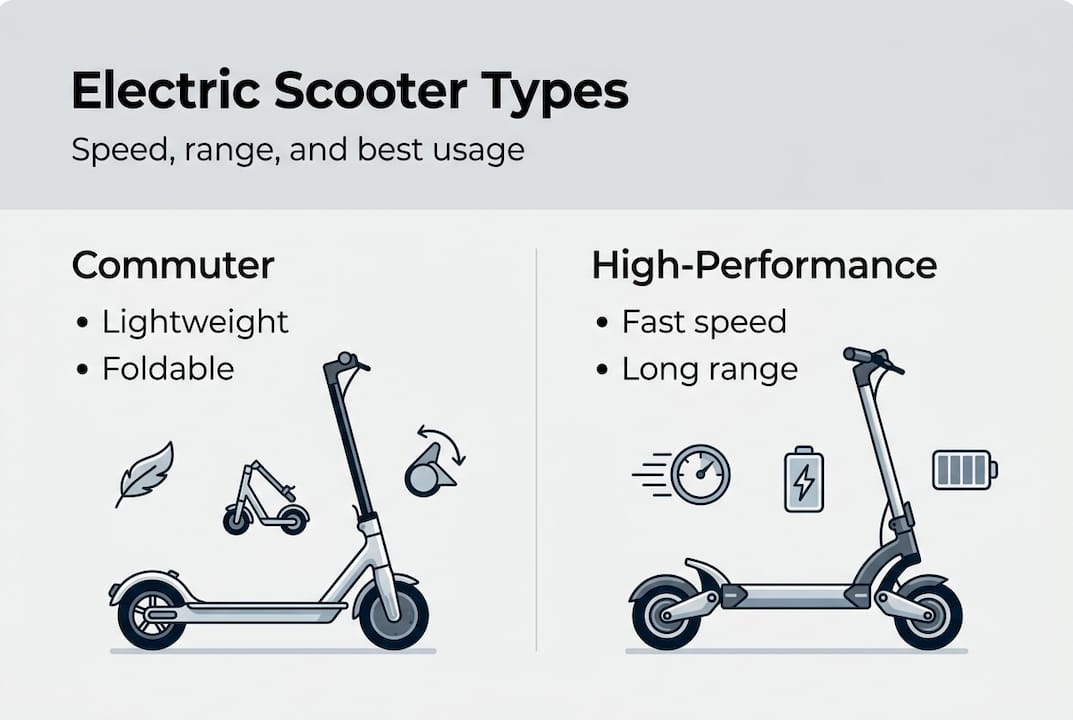
Matching the right type to your actual use case matters more than buying the most powerful option. If you’re primarily covering 5 to 10 miles each way on city streets, a commuter model handles the job without the extra cost and weight. For those who want options across both categories, comparing commuter scooter choices alongside high-performance e-scooters gives you a clearer picture of what’s available at different investment levels.
Price also follows capability closely. Entry-level commuter scooters start around $300 to $600, mid-range recreational models sit between $700 and $1,500, and high-performance scooters can reach $2,000 to $5,000+. Knowing your budget and primary use before shopping helps narrow things down quickly.
Electric scooters vs gas scooters: How do they compare?
Now it’s helpful to see how electric scooters stack up against their gas-powered counterparts. Each has genuine advantages depending on your priorities, and the decision isn’t always obvious.
Cost and environmental impact
The operating cost difference is significant. Electricity costs a fraction of gasoline per mile, and because electric motors have fewer moving parts, maintenance bills stay low. There’s no oil to change, no air filter to replace, and no carburetor to clean.
Gas scooters produce exhaust emissions, while electric models produce zero direct emissions. For urban riders concerned about air quality or their environmental footprint, electric is the cleaner option. Locally, they also run nearly silent, which is a real quality-of-life benefit in dense neighborhoods.
Practical comparison
| Factor | Electric scooter | Gas scooter |
|---|---|---|
| Fuel cost per mile | ~$0.01-0.03 | ~$0.10-0.15 |
| Emissions | Zero direct | CO2, NOx |
| Maintenance | Low (hub motor) | Moderate to high |
| Refuel/recharge time | 4-8 hours | 5-10 minutes |
| Range per fill/charge | 15-100 miles | 80-150 miles |
| Noise level | Near silent | Audible engine |
The main area where gas scooters retain an advantage is range and refueling speed. You can fill a gas tank in minutes and cover 80 to 150 miles on a single tank, while even the best electric commuter models require several hours to recharge. For long-distance riding or rural routes without easy charging access, gas models remain more practical.
Research on scooter safety and efficiency notes that electric scooters have lower operating costs and emissions compared to gas models, but shorter range and longer refuel times remain real trade-offs. Understanding this helps you set realistic expectations before you commit.
When it comes to motor type, most electric scooters use hub motors, which are built directly into the wheel. Hub motors are simple, require almost no maintenance, and are reliable for flat to moderately hilly terrain. Mid-drive motors, which power the drivetrain through a chain, offer better performance on steep hills and better weight distribution, but they introduce chain wear as an ongoing maintenance item.
Pro Tip: If your daily commute includes steep hills regularly, look specifically for dual-motor models or mid-drive configurations rather than assuming any electric scooter will perform equally on inclines.
Here’s a quick breakdown of what to consider when comparing the two power sources:
- Estimate your average daily mileage and decide whether a 15-40 mile electric range covers it.
- Factor in where you’ll charge. Home charging overnight is simple; no dedicated spot makes it harder.
- Calculate your monthly fuel or electricity savings to understand real cost differences over time.
- Consider how much maintenance you’re willing to handle. Electric wins here for most riders.
For a broader look at how electric and gas power compare across vehicle types, the electric vs. gas vehicle comparison guide covers the same decision-making framework in the context of golf carts, which applies well here too.
Safety, regulations, and practical tips for new riders
Understanding safety and legal requirements is essential before your first ride. Electric scooters are genuinely fun and practical, but they operate in shared traffic and pedestrian environments, which means following the rules matters for everyone’s protection.
What the law typically requires
Regulations vary by city and state, but you’ll commonly encounter these restrictions:
- Helmet requirements: Many states require helmets for riders under 18, and some require them for all riders. Even where it’s optional, wearing one is a smart choice.
- Sidewalk bans: Most urban areas prohibit riding electric scooters on sidewalks. You’re expected to use bike lanes or the road.
- Speed limits: Many cities cap electric scooters at 15 to 20 mph in designated areas. Shared streets or shared paths often have lower caps.
- Single rider only: Carrying a passenger on most scooters is prohibited and can be physically dangerous on a vehicle not designed for it.
- Age restrictions: Many cities require riders to be at least 16 or 18 years old.
“Regulations including geofencing, single-rider enforcement, and sidewalk bans have demonstrably reduced scooter-related injuries in urban areas.” Source: Injury Patterns and Safety Regulations in E-Scooters
Geofencing technology is now built into many shared scooter platforms and even some personal scooters. It automatically limits speed or shuts off the motor in restricted zones, which has proven effective in reducing accidents near schools, parks, and pedestrian plazas.
Before you ride, check the rules specific to your city. A quick search for your local ordinances takes 5 minutes and can save you a citation or worse. You can also review street legal scooter guidelines for a solid starting point on what’s typically required.
Practical safety tips for new riders
- Start on a quiet street or parking lot before riding in traffic.
- Wear a helmet, wrist guards, and knee pads on early rides.
- Check tire pressure and brake function before every ride.
- Use lights front and rear if you ride in low-light conditions.
- Give yourself extra stopping distance on wet pavement.
- Stay visible. Bright or reflective clothing helps other drivers see you.
Pro Tip: New riders often underestimate how quickly electric scooters accelerate. Practice throttle control from a standstill before merging into traffic, because a sudden burst of speed in the wrong moment is the most common cause of first-ride falls.
If you’re still in the research phase, our step-by-step guide on buying an electric scooter walks through exactly what to look for, what questions to ask, and how to avoid common buying mistakes.
Why electric scooters are more than just a commuter’s gadget
Most people approach electric scooters as a practical tool, and they are. But limiting the conversation to commuting specs and maintenance costs misses something important about what these vehicles actually do for people day to day.
Electric scooters change how riders relate to their immediate environment. A trip to the grocery store, a quick errand across town, or a weekend ride through a park becomes something you actually look forward to rather than a chore involving traffic and parking. That’s not hype. It’s a real shift in behavior that riders consistently report after making the switch.
There’s also a community dimension that doesn’t get enough attention. Riders who use electric scooters regularly tend to connect with other riders, discover routes they’d never take in a car, and become more aware of their neighborhood’s infrastructure. Commuting with electric scooters builds habits that contribute to reduced urban congestion in ways that individual car trips simply can’t.
The sustainable transportation conversation often focuses on large-scale solutions like electric buses or rail systems. Electric scooters fill the gap those systems leave open, specifically the short-distance, flexible, individual trips that account for a surprising share of daily urban travel. When you own a reliable scooter, you stop defaulting to the car for every 2-mile trip. That shift in habit, multiplied across thousands of riders in a city, adds up to real change.
Explore advanced electric vehicles and upgrade your ride
Ready to experience the benefits firsthand? At Import Junkies, we carry a wide selection of electric vehicles built for real riders, from practical commuter scooters to high-capacity options designed for longer rides and heavier demands.

Whether you’re drawn to the efficiency of long-range electric scooters with dual seating and serious motor output, or you want to explore a broader lineup that includes electric golf carts and utility vehicles, we offer direct-to-public pricing that cuts out the dealership markup. Browse our current inventory, compare models side by side, and reach out to our team with any questions before you buy.
Frequently asked questions
How far can modern electric scooters go on a single charge?
Most commuter models cover 15-40 miles per charge, while high-performance models can reach 50-100 miles depending on terrain, rider weight, and riding speed.
Are electric scooters safe to ride in urban environments?
Yes, with the right precautions. Regulations including geofencing and sidewalk bans have reduced injuries significantly, and wearing proper protective gear further lowers your personal risk.
What’s the main difference between hub and mid-drive motors on e-scooters?
Hub motors are simpler and need very little maintenance, while mid-drive motors handle steep hills better but introduce chain wear as an ongoing upkeep item.
Is it expensive to maintain an electric scooter?
Generally, no. Hub motor designs require minimal upkeep, and without oil changes, fuel filters, or engine tune-ups, the ongoing costs are much lower than gas-powered alternatives.
Can electric scooters carry heavier riders?
Most commuter models support 220-330 lbs of capacity, and high-performance models are often built to handle even more weight, so there are solid options across a wide range of rider sizes.
Recommended
- Street legal scooters explained: Requirements, types, and tips – Saferwholesale || Import Junkies || Great Sports
- How to buy electric scooters: 5 steps to avoid mistakes – Saferwholesale || Import Junkies || Great Sports
- Best Electric Scooter for Commuting – Saferwholesale || Import Junkies || Great Sports
- Low Speed Electric Vehicle Buying Guide – Saferwholesale || Import Junkies || Great Sports


