


 Location
 Login
Login
TL;DR:
- Actual scooter range is typically 60 to 70% of manufacturer claims, affected by terrain and rider weight.
- Choosing the correct category and wheel configuration is crucial for safety, stability, and usability.
- Prioritize real-world performance specs like continuous wattage, range, and safety features over marketing figures.
Most shoppers assume the scooter they see on a product page will perform exactly as advertised. The reality is different. Actual scooter range is often 60 to 70% of the claimed manufacturer numbers, and that gap can mean the difference between a vehicle that fits your life and one that disappoints on day one. The scooter market in 2026 spans mobility aids, electric commuters, and cargo haulers, each built around a completely different purpose. This guide walks you through the categories, wheel configurations, performance specs, and safety features you need to understand before you buy.
Table of Contents
- Scooter categories explained: Mobility, electric, and utility
- Wheel configurations and stability: 3-wheel vs 4-wheel
- Performance factors: Motor power, range, and braking
- Choosing features for safety and comfort
- What most buyers overlook when choosing a scooter
- Explore scooter and utility vehicle options with Import Junkies
- Frequently asked questions
Key Takeaways
| Point | Details |
|---|---|
| Know your scooter type | Understanding the main categories ensures your scooter matches your specific needs. |
| Prioritize stability and safety | Choosing the right wheel configuration and safety features helps prevent accidents and keeps you comfortable. |
| Focus on real-world performance | Continuous motor power and tested range are what matter, not just manufacturer specs. |
| Protect yourself every ride | Always wear a helmet and gear to minimize risk no matter your scooter’s speed. |
Scooter categories explained: Mobility, electric, and utility
With misconceptions cleared, let’s start by outlining the categories of scooters and their primary functions. Broadly speaking, scooters fall into three distinct groups, and buying the wrong type is one of the most common and costly mistakes shoppers make.
Mobility scooters are designed for seniors and disabled users, featuring seated, 3 to 4 wheel designs with varying speed and range capabilities. They prioritize comfort, ease of use, and terrain adaptability over speed. Most top out between 4 and 8 mph, making them ideal for indoor use, sidewalks, and light outdoor paths.
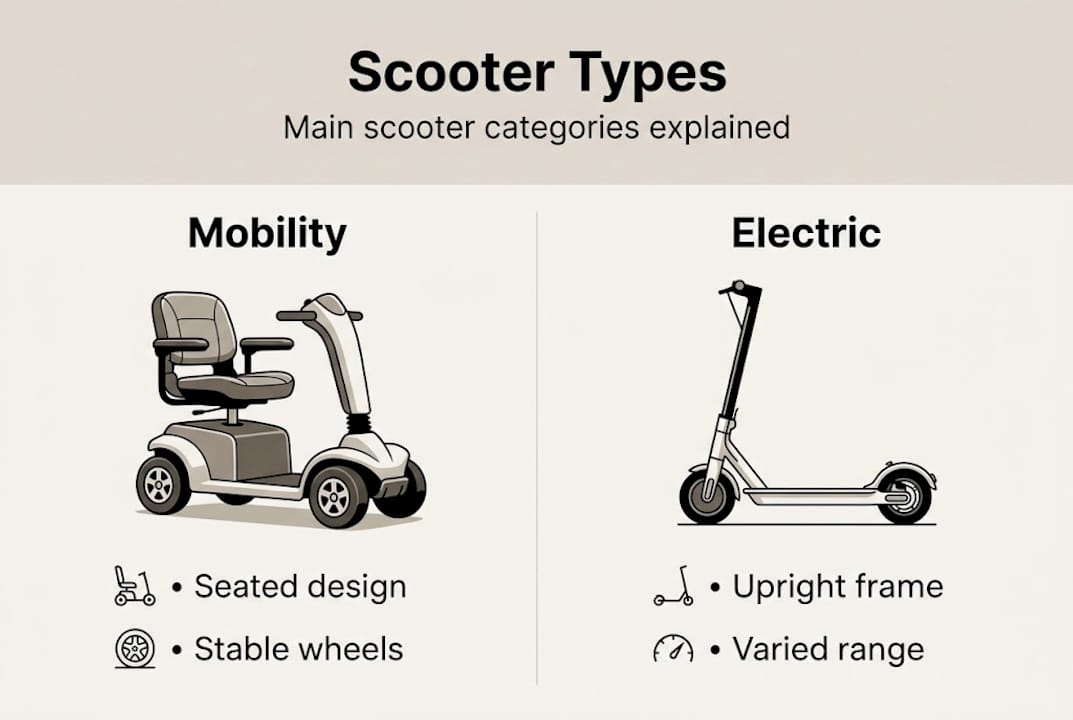
Electric scooters cover a much wider range. Entry-level models work well for short commutes and recreational riding. High-performance models push into territory that requires more serious attention to motor output, braking, and safety gear. If you’re thinking about street legal scooters, there are specific requirements around lighting, mirrors, and registration that vary by state.
Utility scooters are built tougher. They’re designed to move cargo, handle rough surfaces, and work as functional tools rather than personal transport. The frame, suspension, and load capacity are all heavier duty than what you’d find on a recreational model.
| Category | Primary use | Typical speed | Key feature |
|---|---|---|---|
| Mobility scooter | Seniors, disabled users | 4 to 8 mph | Comfort seating, terrain modes |
| Electric scooter | Commuting, recreation | 15 to 50+ mph | Motor power, range |
| Utility scooter | Cargo, work tasks | 10 to 25 mph | Load capacity, durability |
Here’s a quick breakdown of who each category is built for:
- Mobility scooters: People needing daily assistance with movement, short to medium distances
- Electric scooters: Commuters, recreational riders, performance enthusiasts
- Utility scooters: Small business owners, outdoor workers, cargo haulers
Matching your category correctly from the start saves you money, frustration, and potentially a safety issue down the road.
Wheel configurations and stability: 3-wheel vs 4-wheel
Understanding the categories leads to a crucial consideration: how wheel design affects safety and usability. This is where a lot of buyers make avoidable errors.
Three-wheel mobility scooters are less stable on uneven terrain and on downhill slopes than 4-wheel models. That’s not an opinion, it’s a documented safety difference. The tighter turning radius of a 3-wheel model is appealing, but that maneuverability comes at the cost of lateral stability, especially when the ground shifts beneath you.

Four-wheel scooters distribute weight more evenly across all corners. They brake more predictably and handle side slopes and curb transitions better. If you’re using a scooter daily or on unpredictable surfaces, the stability advantage is worth the slightly wider footprint.
For context, here’s how the two configurations compare across key performance areas:
| Factor | 3-wheel | 4-wheel |
|---|---|---|
| Turning radius | Tighter | Wider |
| Stability on slopes | Lower | Higher |
| Braking confidence | Moderate | Stronger |
| Indoor maneuverability | Better | Good |
| Rough terrain handling | Limited | Reliable |
When to choose a 3-wheel scooter:
- You’ll be using it primarily indoors or in tight spaces
- Your terrain is flat and predictable
- Maneuverability around furniture or narrow aisles is a priority
- You have good upper body balance and control
When to choose a 4-wheel scooter:
- You regularly navigate slopes, ramps, or outdoor paths
- You need consistent braking on varied surfaces
- You’re carrying cargo or passengers
- Long-distance use where fatigue could affect balance
If you’re considering other multi-wheel configurations, a 3 wheel trike guide covers broader options for riders who want the benefits of three wheels in a more performance-oriented package.
Pro Tip: If you’re unsure between configurations, default to 4 wheels. You can always adapt to the wider turning radius, but you can’t compensate for instability on a slope.
Performance factors: Motor power, range, and braking
Now that you know how stability varies, it’s time to demystify performance specs that truly affect usability. Motor power is where most spec-sheet confusion starts.
Manufacturers frequently advertise peak wattage. That number represents the maximum output the motor can briefly produce under ideal conditions. Continuous wattage is the figure that actually matters for sustained riding. High-power electric scooters may have peak wattage up to 8000W, but continuous output and thermal management are the real indicators of sustained performance, especially on hills or in warm weather.
Thermal management is a term worth understanding. When a motor runs hard for extended periods, heat builds up. Scooters without adequate cooling will throttle back their power automatically to protect the motor. This means that impressive hill-climbing figure you saw in the specs may not hold once the motor warms up after 10 minutes of riding.
Key performance factors to evaluate before buying:
- Continuous wattage: Look for this number, not peak wattage
- Thermal throttling: Does the manufacturer address heat management?
- Braking system: Disc or hydraulic brakes are essential for speeds above 20 mph
- Battery capacity: Measured in watt-hours (Wh), this determines how far you can go
- Tire type: Pneumatic (air-filled) tires absorb road vibration; solid tires require less maintenance
On range, real range is typically only 60 to 70% of manufacturer stated numbers. Rider weight, terrain, wind, and temperature all cut into that figure. If a scooter is listed at 40 miles, plan for 24 to 28 miles in real-world conditions.
For commuters, the electric scooter commuting section of our resource library covers how to evaluate range for daily routes specifically.
Pro Tip: Always calculate your real-world range need first, then add 30% to find the minimum manufacturer spec you should accept. This buffer protects you from being stranded mid-route.
Choosing features for safety and comfort
Beyond specs, your day-to-day safety and comfort depend on carefully selecting the right features. A scooter that looks great on paper can still be uncomfortable or unsafe if the feature set doesn’t match your actual use case.
Suspension is one of the most overlooked features. Front suspension absorbs road impact and keeps the handlebars from vibrating excessively on rough pavement. Full suspension (front and rear) significantly improves comfort and control on mixed terrain. If you’re riding on smooth sidewalks only, this matters less. If you’re hitting gravel, grass, or uneven pavement, good suspension can prevent fatigue and loss of control.
Lighting is non-negotiable for any scooter used near traffic or in low-light conditions. Look for integrated headlights, taillights, and ideally side visibility. Reflectors alone are not sufficient at speed.
Feature checklist to work through before buying:
- Suspension type: Front only, rear only, or full
- Braking system: Mechanical drum, disc, or hydraulic
- Lighting: Headlight, taillight, brake light functionality
- Seat ergonomics: Adjustable height, lumbar support for longer rides
- Tire size: Larger tires handle terrain better; smaller tires favor efficiency
- Weight capacity: Always verify your weight plus any gear or cargo
- Speed limiter: Useful for newer riders or regulated environments
“Always wear a helmet and protective gear due to speed risks, regardless of scooter type. Even low-speed scooters carry injury risk in falls or collisions.” Consumer Reports
For street legal scooter requirements, most states require mirrors, a horn, proper lighting, and registration for scooters above a certain speed or wattage threshold. Check your state’s specific laws before assuming your scooter qualifies for road use.
What most buyers overlook when choosing a scooter
Spec sheets pull attention to the numbers that are easiest to market: peak wattage, claimed range, top speed. These figures are real, but they’re rarely the ones that determine whether you’ll be happy with a scooter six months after buying it.
What actually matters is the match between your environment and the scooter’s real-world behavior. A model with impressive specs but poor thermal management will underperform on your hilly commute. A lightweight 3-wheel unit with a tight turning radius will feel unstable the first time you navigate a wet parking lot.
We’ve seen buyers overlook riding frequency entirely. A scooter used three times a week needs to handle charging cycles, motor wear, and component fatigue differently than one used occasionally on weekends. Higher-quality components pay for themselves in durability when the scooter gets regular use.
The most reliable approach is reading real-world reviews from riders who match your use case, not just tech reviewers doing single-session tests. If possible, test a model on terrain similar to what you’ll actually ride. Insights from resources like a 3 wheel trike buyer insights guide can help you see the real-world tradeoffs that spec sheets won’t show you.
Buy for how you’ll actually use it, not for the best-case scenario the numbers describe.
Explore scooter and utility vehicle options with Import Junkies
Ready to put this knowledge into action? Here’s where you can explore a range of scooter types tailored for every use case. At Import Junkies, we carry vehicles built for real-world use, from commuting and recreation to cargo and utility work.

Browse options like the 500W electric motor scooter for an efficient and practical everyday ride, the ATV utility style vehicle for serious off-road and cargo capability, or the electric golf cart UTV if you need passenger capacity with electric efficiency. Each product listing includes full specs so you can apply what you’ve learned here directly to your buying decision.
Frequently asked questions
What’s the real range for most electric scooters?
Actual range is usually 60 to 70% of what manufacturers claim, because real-world variables like terrain, rider weight, temperature, and load all reduce battery output significantly.
Are 3-wheel scooters safe for hilly terrain?
Three-wheel scooters are less stable downhill and on uneven surfaces, so four-wheel models are the more reliable and safer choice for hilly or unpredictable terrain.
How much motor power do I really need?
Continuous wattage matters more than peak wattage for real-world use, since sustained output and heat management determine how the scooter actually performs on hills and longer rides.
Do I need a license for riding a scooter?
Licensing requirements vary by state and scooter type, so check your local laws around registration, minimum age, and helmet requirements before riding on public roads.
What safety gear should I use with a scooter?
Always wear a helmet and consider protective pads for knees and elbows, since even low-speed scooters carry real injury risk during falls or unexpected stops.
Recommended
- Street legal scooters explained: Requirements, types, and tips – Saferwholesale || Import Junkies || Great Sports
- How to buy electric scooters: 5 steps to avoid mistakes – Saferwholesale || Import Junkies || Great Sports
- Best Electric Scooter for Commuting – Saferwholesale || Import Junkies || Great Sports
- Low Speed Electric Vehicle Buying Guide – Saferwholesale || Import Junkies || Great Sports


