


 Location
 Login
Login
TL;DR:
- Electric vehicle sales are projected to reach 23 million units in 2026, accounting for nearly 30 percent of all new car sales globally. Growth is uneven across regions, with China and Europe leading adoption while the US experiences a sales decline due to policy changes. Technological advances in range, charging speed, and vehicle software redefine EV capabilities and long-term ownership expectations.
The future of electric vehicles in 2026 is defined by record global sales, longer driving ranges, and a market that is splitting sharply along regional lines. Global EV sales are projected to surpass 23 million units this year, representing nearly 30% of all new car sales worldwide. That number tells a clear story: electric mobility is no longer a niche segment. Whether you are buying your first EV, managing a fleet, or tracking where the automotive industry is heading, understanding the forces shaping 2026 will help you make smarter decisions.
What are the projected global EV sales trends in 2026?
The headline figure for electric vehicle trends in 2026 is 23 million units sold globally. That represents an 11% increase over 2025, and it places EVs at roughly 30% of all new passenger car sales worldwide. The scale of that shift is hard to overstate. One in three new cars sold globally this year runs on electricity.
The global energy crisis is a primary driver behind this acceleration. IEA Executive Director Fatih Birol has pointed directly to volatile fuel prices as a force pushing consumers toward EVs. When gasoline costs become unpredictable, a fixed electricity rate starts looking very attractive.
Regional growth, however, is uneven. China and Europe are leading adoption, while the United States has hit a significant speed bump. Here is how the major markets compare:
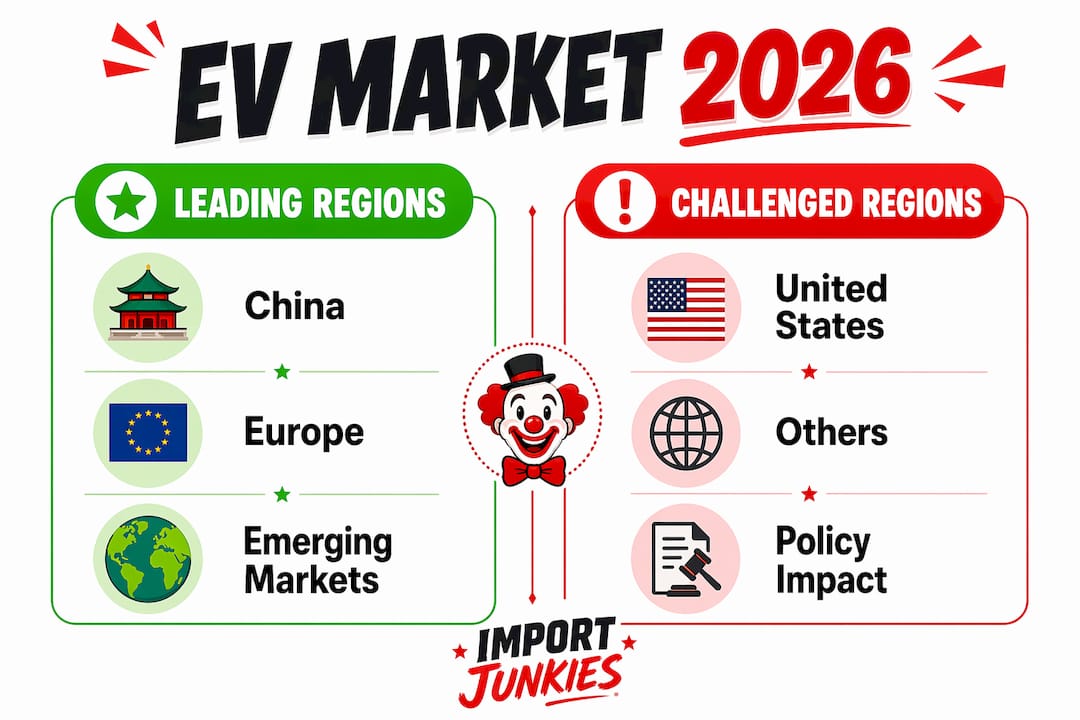
| Region | 2026 EV Market Status | Key Driver |
|---|---|---|
| China | Dominant growth, lowest prices | Mature battery supply chain |
| Europe | Strong adoption, policy support | Emissions regulations |
| United States | Sales contraction in Q1 2026 | Tax credit expiration |
| Emerging Markets | Rapid adoption gains | Fuel cost hedging, new models |
The US situation deserves a closer look. US EV sales dropped nearly 34% year over year in march 2026, with new registrations falling below 6% of total car sales. That drop was largely a pull-forward effect. Buyers rushed to purchase before federal tax credits expired, creating an artificial sales spike in late 2025 followed by a sharp correction. The underlying consumer interest in EVs has not disappeared.
Emerging markets are quietly outperforming expectations. Singapore, Vietnam, and Uruguay are posting EV sales shares that rival or exceed many established Western markets. Latin America is also showing strong momentum. These markets benefit from younger vehicle fleets, fewer legacy dealership structures, and strong government incentives.
What key technology advances define electric vehicle advancements in 2026?
Battery range and charging speed are the two metrics that matter most to everyday drivers. Both have improved significantly this year. The average real-world range of new EVs increased from 293 miles in 2025 to 325 miles in 2026. That is a meaningful jump for drivers who worry about long trips.

Ultra-fast charging has moved from a premium feature to a mainstream expectation. Some 2026 models can add 100 miles of range in under 10 minutes on compatible fast chargers. That closes the gap with gasoline refueling in a practical, real-world sense.
Beyond batteries, three technology trends are reshaping what an EV actually is:
- Vehicle-to-grid (V2G) integration: Your car can now send power back to your home or the grid during peak demand. This turns an EV into a mobile energy asset, not just transportation.
- Software-defined vehicles: AI and advanced software architectures are replacing fixed hardware functions. Updates delivered over the air can improve performance, add features, and extend vehicle life without a dealership visit.
- AI-assisted driving systems: Integrated AI now handles lane keeping, adaptive cruise control, and parking assistance as standard features on mid-range models. The role of AI in vehicle alerts and safety systems continues to expand rapidly.
Pro Tip: When comparing EV models, check the charging network compatibility, not just the range. A 325-mile range means little if fast chargers in your area do not support the vehicle’s charging standard.
Battery longevity is also better than most buyers expect. The average EV retains 97% of its initial range after three years and 95% after five years. Battery replacement anxiety is largely a myth at this point, and that data should factor into your total cost calculation.
How do regional policy shifts affect the EV market in 2026?
Policy decisions are the single biggest variable in EV market performance right now. The US example is the clearest proof. The expiration of federal tax credits did not kill consumer interest in EVs. It did, however, remove a $7,500 purchase incentive that made EVs price-competitive with comparable gasoline vehicles. Without that subsidy, sticker price comparisons shifted back in favor of gas-powered cars for many buyers.
China’s position is structurally different. China maintains cost advantages in battery manufacturing through mature supply chains, intense domestic competition, and lower labor costs. Chinese EV prices are significantly lower than comparable vehicles sold in North America or Europe. That cost gap is not closing quickly. Battery supply chain localization is accelerating in the US and Europe, but matching China’s cost efficiency remains a multi-year challenge.
Europe is holding its ground through regulatory pressure. Emissions standards continue to push automakers toward electrification, and consumer charging infrastructure has expanded faster than in the US. The result is steadier adoption without the sharp policy-driven swings seen in the American market.
For industry professionals, the takeaway is straightforward. Markets with stable, long-term EV policy frameworks produce predictable growth. Markets where incentives expire or regulations shift abruptly create volatile sales patterns that complicate inventory planning and investment decisions.
What should consumers and industry professionals know before buying an EV in 2026?
Buying an EV in 2026 requires a different evaluation framework than buying a gasoline car. The purchase price is only one part of the equation. Fuel savings, charging costs, maintenance expenses, and battery longevity all factor into the real cost of ownership over five years.
One counterintuitive data point: EV efficiency has actually declined since 2018. The reason is consumer preference. Buyers are choosing larger SUVs and trucks over compact sedans, and larger vehicles consume more energy per mile. Range has gone up, but energy efficiency per mile has gone down. If you want the most economical EV, a smaller model will cost less to run than a full-size electric truck, even if both have similar range ratings.
Charging infrastructure is the practical bottleneck for most buyers. Home charging solves the daily commute problem for most drivers. A Level 2 home charger adds roughly 25 miles of range per hour, which covers the average American’s daily driving needs overnight. The setup process for home and business charging is more straightforward than many buyers assume, but it does require a dedicated 240-volt circuit.
For buyers considering low-speed electric vehicles, golf carts, or utility EVs for property or commercial use, the calculus is even simpler. These vehicles operate on shorter routes, charge from standard outlets in many cases, and carry lower upfront costs than full highway EVs. The low-speed EV buying guide covers the key specs and use cases in detail.
Pro Tip: Calculate your total five-year cost of ownership before comparing sticker prices. Factor in your local electricity rate, estimated annual mileage, and any available state-level incentives that may still apply even after federal credits expired.
Here is a quick comparison of EV categories relevant to consumers shopping in 2026:
| Vehicle Type | Typical Range | Best Use Case | Charging Type |
|---|---|---|---|
| Full-size EV sedan | 300–400 miles | Daily commuting, road trips | Level 2 / DC Fast Charge |
| Electric SUV/truck | 250–350 miles | Family use, towing | Level 2 / DC Fast Charge |
| Low-speed EV / golf cart | 25–50 miles | Property, golf, short routes | Standard 110V or 240V |
| Electric utility vehicle | 30–60 miles | Commercial, campus, farm use | Standard 110V or 240V |
Key Takeaways
The future of electric vehicles in 2026 is shaped by record global sales, longer ranges, faster charging, and policy-driven regional volatility that creates both risks and opportunities for buyers and industry professionals.
| Point | Details |
|---|---|
| Record global sales | EV sales are projected to hit 23 million units, nearly 30% of all new car sales worldwide. |
| Range and charging gains | Average EV range reached 325 miles, with some models adding 100 miles in under 10 minutes. |
| US market contraction | A 34% sales drop in Q1 2026 reflects tax credit expiration, not a collapse in consumer interest. |
| Battery longevity is strong | EVs retain 97% of range after three years, making battery anxiety largely unfounded. |
| Efficiency vs. size tradeoff | Larger EVs offer more range but consume more energy per mile than compact models. |
My read on where the EV market actually stands in 2026
The data on 2026 EV sales looks impressive at the global level. But I think the more interesting story is what is happening underneath that headline number. The US market drop is being misread by a lot of commentators as a sign that EV demand is weakening. It is not. It is a textbook pull-forward correction. Buyers who were going to buy an EV in 2026 bought in late 2025 instead, before the tax credits expired. That is rational consumer behavior, not a rejection of electric vehicles.
What concerns me more is the efficiency trend. We are building EVs with longer ranges and bigger batteries, but the average energy consumption per mile is going up because consumers keep choosing larger vehicles. That is not a technology problem. It is a preference problem. And it has real implications for grid load, charging infrastructure capacity, and long-term operating costs that most buyers are not factoring in.
The technology trajectory, on the other hand, is genuinely exciting. Software-defined vehicles and V2G integration are not marketing buzzwords. They represent a fundamental shift in what a vehicle is. An EV that can power your home during a grid outage or receive a performance update overnight is a different product category than a gasoline car. The industry is still figuring out how to price and market that value, but it is real.
For anyone managing a fleet or running a business that uses utility vehicles, 2026 is a good year to act. The technology is mature, the range anxiety argument is largely settled by the data, and electric vehicles are already transforming golf facility operations and similar commercial applications in measurable ways.
— Gary
Importjunkies electric vehicles for 2026 buyers
Importjunkies carries a range of 48V electric golf carts and utility vehicles that align directly with where the EV market is heading in 2026. These vehicles are built for practical use on properties, golf courses, campuses, and commercial sites, where short-range electric power is the most cost-effective solution available.

The 48V Renegade Edition 4-seater golf cart is one of the most popular utility EVs in the Importjunkies catalog, offering four-passenger capacity and a 48-volt system suited for daily operational use. For buyers who want a lifted configuration, the Renegade+ 2.0 Edition adds ground clearance for rougher terrain. Importjunkies sells direct to the public at wholesale pricing, with full product details and checkout available online.
FAQ
What is the projected global EV market size in 2026?
Global passenger EV sales are projected to surpass 23 million units in 2026, representing nearly 30% of all new car sales worldwide. That figure marks an 11% increase over 2025 sales volumes.
Why did US EV sales drop in early 2026?
US EV sales fell nearly 34% year over year in march 2026 due to the expiration of federal tax credits and regulatory rollbacks. The drop reflects a pull-forward effect from buyers who purchased early to capture expiring incentives, not a long-term decline in consumer demand.
How long do EV batteries actually last?
The average EV retains 97% of its initial battery range after three years and 95% after five years. Battery degradation is significantly less severe than most buyers expect, and replacement costs are rarely a practical concern within a standard ownership period.
What new EV technologies matter most in 2026?
Vehicle-to-grid integration, software-defined vehicle architectures, and ultra-fast charging are the three most significant technology developments in 2026. Some models now add 100 miles of range in under 10 minutes on compatible fast chargers.
Are low-speed electric vehicles worth buying in 2026?
Low-speed EVs, including electric golf carts and utility vehicles, are a practical and cost-effective choice for property, commercial, and recreational use. They charge from standard outlets, carry lower upfront costs than highway EVs, and require minimal maintenance compared to gasoline-powered equivalents.
Recommended
- Must-Have Recreational Vehicles 2026: Top Picks Guide – Saferwholesale || Import Junkies || Great Sports
- How electric vehicles transform golf facility operations – Saferwholesale || Import Junkies || Great Sports
- Why Purchase Wholesale Vehicles: Save More in 2026 – Saferwholesale || Import Junkies || Great Sports
- Low Speed Electric Vehicle Buying Guide – Saferwholesale || Import Junkies || Great Sports


