


 Location
 Login
Login
TL;DR:
- Registering a scooter involves verifying its classification, gathering necessary documents, and paying state-specific fees. Proper registration ensures legal riding, insurance, and scooter recovery if stolen. Missing paperwork or misclassification can lead to delays, fines, or invalid registration.
Scooter registration is the legal process of recording your vehicle with a government agency, such as your state’s Department of Motor Vehicles, to authorize its operation on public roads. Knowing how to register a scooter correctly protects you from fines, keeps your scooter insurable, and gives law enforcement a way to return it if it’s stolen. The process involves gathering documents, verifying your scooter’s legal classification, paying scooter registration fees, and obtaining a registration number or plate. This guide walks you through every step, with real fee examples from U.S. states and practical advice on handling missing paperwork.
How to register a scooter: does yours actually need it?
Not every scooter requires registration, and getting the classification wrong wastes time and money. The legal definitions of scooter, moped, and motorcycle vary by state and even by county. Scooter laws vary widely enough that a vehicle street-legal without plates in one area may require full registration just across the county line.

The most common thresholds that trigger registration requirements are engine displacement and motor wattage. Gas-powered scooters with engines above 50cc are typically classified as motorcycles in most states, requiring full registration, a motorcycle endorsement, and insurance. Electric scooters above 1,000 watts often fall into the same category. Below those thresholds, many states treat the vehicle as a moped, which may require only a simple permit rather than full registration.
The presence of a VIN (Vehicle Identification Number) is the clearest signal. A VIN on a scooter usually triggers full motor vehicle registration requirements, including insurance and license plates. If your scooter has a VIN stamped on the frame, assume registration is required until your local DMV tells you otherwise.
State examples make the variation concrete. California classifies any two-wheeled motorized vehicle under 50cc as a moped requiring a special permit, while Tennessee requires full registration for scooters above 50cc with a separate title transfer process. Check the street legal requirements for your specific state before you do anything else.
- Gas scooters above 50cc: typically require full registration
- Electric scooters above 1,000 watts: often classified as motor vehicles
- Scooters with a VIN: almost always require registration
- Scooters below thresholds: may need only a moped permit or nothing at all
Pro Tip: Call your local DMV before you buy or ride. A five-minute phone call confirms your scooter’s classification and saves you from registering under the wrong category.
What documents and fees do you need for scooter registration?
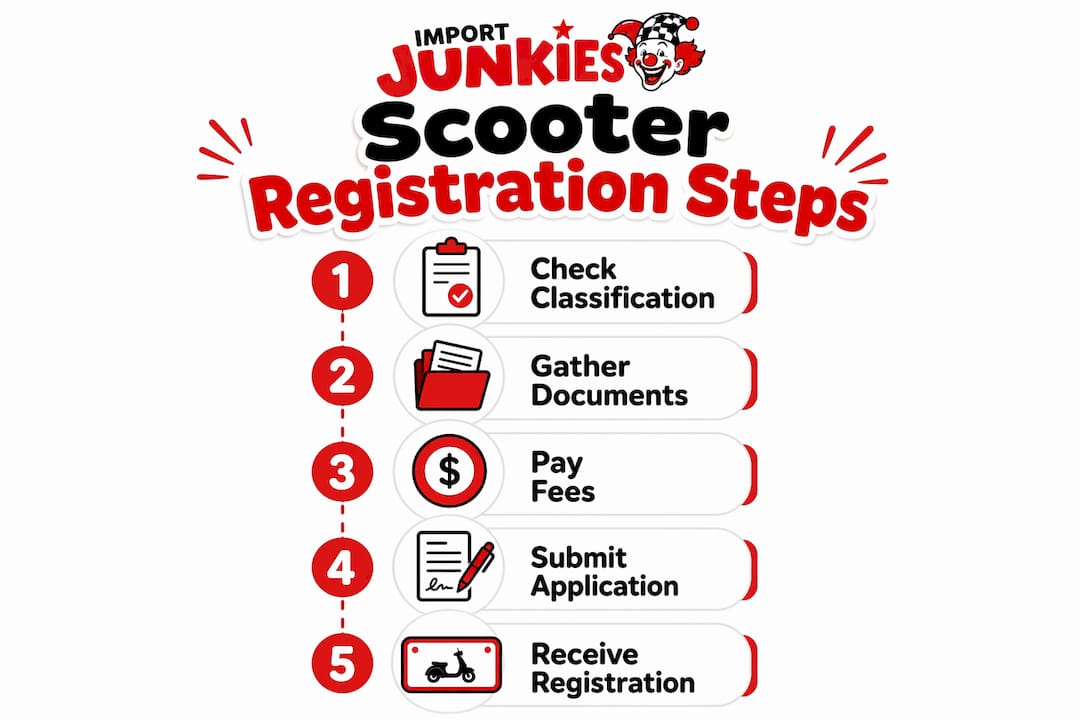
Gathering the right paperwork before you visit the DMV is the single biggest time-saver in the scooter registration process. Missing one document means a second trip. The documents for scooter registration follow a consistent pattern across most U.S. states, though specific forms differ.
Standard documents checklist
- Certificate of title or manufacturer’s certificate of origin (MCO): Proof that you legally own the vehicle
- Bill of sale: Required in states like Tennessee and Wisconsin; should include full legal names, sale date, VIN, and signatures
- Proof of identity: Government-issued ID such as a driver’s license or passport
- Proof of residence: Utility bill or bank statement showing your current address
- VIN verification form: Some states require a physical inspection or notarized VIN check
- Proof of insurance: Required before plates are issued in most states
Registration fee examples by state
Scooter registration fees vary significantly by state. Tennessee charges a 7% state sales tax plus applicable local taxes, an $11 title transfer fee, and a $26.50 annual registration fee. That combination adds up quickly on a $2,000 scooter purchase. Wisconsin sets its title transfer fee at $164.50, with a 5% state sales tax plus a 0.5% county tax and an $85 annual registration fee. Wisconsin’s higher title fee reflects its more complex titling process.
| State | Title Transfer Fee | Sales Tax | Annual Registration |
|---|---|---|---|
| Tennessee | $11 | 7% state + local | $26.50 |
| Wisconsin | $164.50 | 5% + 0.5% county | $85 |
After registration, you will receive a registration number and, in most states, a physical plate or label. Keep copies of your bill of sale, title, and registration documents for at least five years. These records protect your ownership claim and help authorities verify the vehicle’s history.
Insurance is mandatory for scooters classified as motor vehicles. Your insurer will need your registration number to finalize the policy, so registration and insurance are linked steps, not separate ones.
Step-by-step process to register your scooter
The scooter registration process follows a logical sequence. Skipping steps or doing them out of order is the most common reason registrations get rejected.
-
Gather all required documents. Collect your title or MCO, bill of sale, proof of identity, proof of residence, and any VIN verification forms your state requires. Make copies of everything before you submit originals.
-
Verify your scooter’s legal classification. Confirm whether your scooter is classified as a moped, motorcycle, or motor scooter in your state. The classification determines which forms you need and what fees apply. The scooters vs. mopeds distinction matters more than most buyers realize.
-
Choose your registration method. Most states offer three options: online through the DMV portal, in person at a DMV office, or through an authorized third-party agency. Online registration works well if your title is clean and your documents are complete. In-person visits are better when you have questions or need a VIN inspection.
-
Submit your application and pay fees. Complete the registration application form, attach your documents, and pay the required fees. This includes the title transfer fee, sales tax, and annual registration fee. Keep your payment receipt.
-
Obtain your registration number and plate. Once approved, you receive a registration number and a physical plate or label. Attach the plate to your scooter as required by your state. Some states mail the plate; others issue it on the spot.
-
Purchase liability insurance. Contact your insurer with your new registration number to finalize your policy. Most states require at least basic civil liability coverage before you ride on public roads.
-
Verify your registration is active. Check your state’s DMV website to confirm your registration appears in the system. This step takes a few days after submission but confirms everything processed correctly.
Pro Tip: If you are registering a scooter online, scan all documents at 300 DPI or higher before uploading. Low-resolution scans are a leading cause of online application rejections.
The full process typically takes one to two weeks from document submission to receiving your plate. In-person visits can speed this up to same-day if your paperwork is complete.
How to handle a missing title or incomplete documentation
A missing title is the most common obstacle in the scooter registration process. Without a title, the DMV cannot confirm legal ownership, and registration will be denied. The good news is that there are established paths to resolve this.
- Request a duplicate title: If the original title exists but is lost, contact the DMV where the vehicle was last titled. Most states issue duplicate titles for a small fee within two to four weeks.
- Use a bill of sale as a starting point: A properly completed bill of sale with VIN, seller information, and signatures gives you a foundation to apply for a title in your name.
- Apply for a bonded title: When prior ownership is unclear or documentation is incomplete, a bonded title is the standard solution. Bonded titles require purchasing a surety bond worth 1.5 to 2 times the vehicle’s appraised value. The bond protects any prior owner who may have a legitimate claim.
- Expect a 2–6 week timeline: The bonded title process takes 2–6 weeks from application to issuance. Start immediately after purchase if documentation is missing.
Do not delay resolving title issues. Riding an unregistered scooter while waiting on paperwork exposes you to fines and impoundment. Secure a temporary permit from your DMV if your state offers one while your title application is pending.
Keeping your documents organized after registration prevents these problems from recurring. Store your title, bill of sale, VIN verification, and insurance policy together in a single folder. Digital backups on a cloud service add another layer of protection.
Common registration mistakes and how to avoid them
Most registration problems are preventable. The mistakes that slow people down tend to fall into a short list of recurring errors.
- Misclassifying the scooter type: Submitting a motorcycle registration form for a moped, or vice versa, results in automatic rejection. Confirm your classification with the DMV before filling out any forms.
- Incomplete paperwork: A missing signature, wrong address, or absent VIN on the bill of sale sends your application back. Review every field before submitting.
- Ignoring local fee variations: County and municipal taxes add to state fees. Tennessee’s 7% state tax is just the starting point; local taxes stack on top. Budget for the total, not just the state rate.
- Skipping insurance: Some buyers try to register first and buy insurance later. Most states require proof of insurance at the time of registration. Arrive with your insurance binder or declaration page.
- Not verifying registration after submission: Assume nothing until you check the DMV system. Processing errors happen, and catching them early prevents riding on an invalid registration.
Pro Tip: Take photos of your scooter’s VIN plate, odometer, and all submitted documents before your DMV visit. If anything gets lost in processing, you have a complete record to reference.
When in doubt, call the DMV directly. Most offices have a dedicated line for registration questions, and a five-minute call resolves more confusion than an hour of online searching. You can also review the off-road vehicle registration guide for additional context on how registration works across different vehicle types.
Key Takeaways
Registering a scooter requires verifying its legal classification, gathering complete documentation, paying state-specific fees, and securing insurance before riding on public roads.
| Point | Details |
|---|---|
| Classification determines requirements | Check engine size, wattage, and VIN presence to confirm if full registration applies. |
| Documents must be complete | Gather title, bill of sale, proof of identity, residence, and insurance before visiting the DMV. |
| Fees vary significantly by state | Tennessee charges $11 title transfer plus 7% tax; Wisconsin charges $164.50 title transfer plus 5% tax. |
| Missing titles have solutions | A bonded title resolves unclear ownership but takes 2–6 weeks and requires a surety bond. |
| Insurance and registration are linked | Most states require proof of insurance at registration; your insurer needs your registration number to finalize coverage. |
What I’ve learned from watching buyers get registration wrong
Most people who struggle with scooter registration make the same mistake: they assume the process is the same everywhere. It is not. I have seen buyers purchase a scooter in one state, move to another, and discover their registration is invalid because the new state classifies the vehicle differently. That kind of surprise is avoidable with 20 minutes of research before purchase.
The other pattern I see constantly is buyers who skip the title check entirely. They buy a used scooter from a private seller, hand over cash, and only discover the title is missing or has a lien on it when they try to register. At that point, the bonded title process adds weeks and real money to what felt like a simple transaction. My advice is to treat a clean title as a non-negotiable condition of any used scooter purchase.
Document organization matters more than people expect. Keeping your bill of sale, registration, and insurance policy in one place, with digital backups, has saved buyers I know from serious headaches during traffic stops and insurance claims. The five minutes you spend organizing paperwork after registration is worth more than the hour you spend searching for documents later.
The broader point is this: registration is not a bureaucratic inconvenience. It is the legal foundation that makes your scooter insurable, recoverable if stolen, and legal to ride. Get it right the first time, and you will not think about it again until renewal.
— Gary
Importjunkies has the scooters worth registering
If you are going through the registration process, you are clearly serious about riding legally and responsibly. Importjunkies carries a wide selection of scooters, electric utility vehicles, and specialty vehicles built for personal use, with competitive wholesale pricing and direct-to-buyer purchasing. Whether you are looking for your first scooter or upgrading to a 48V electric utility vehicle for around the property, the catalog covers a range of needs and budgets. Browse the full lineup at Importjunkies and reach out to the customer service team with any questions about specific models, specs, or availability.
FAQ
Does every scooter need to be registered?
Not every scooter requires registration. Gas scooters under 50cc and electric scooters under 1,000 watts are often classified as mopeds and may need only a permit, but rules vary by jurisdiction.
What documents do I need to register a scooter?
You typically need a title or manufacturer’s certificate of origin, a bill of sale, proof of identity, proof of residence, and proof of insurance. Some states also require a VIN verification form.
How much does scooter registration cost?
Costs vary by state. Tennessee charges an $11 title fee plus 7% sales tax and $26.50 annually. Wisconsin charges a $164.50 title fee plus 5.5% in taxes and $85 per year.
How do I get a scooter title if I don’t have one?
If the title is lost, request a duplicate from the DMV where the vehicle was last titled. If ownership history is unclear, apply for a bonded title, which requires a surety bond worth 1.5 to 2 times the vehicle’s value and takes 2–6 weeks to process.
Can I register my scooter online?
Many states allow online registration through their DMV portal when your title is clean and all documents are complete. Check your state DMV’s website to confirm online eligibility before gathering paperwork.
Recommended
- How to Register Off-Road Vehicles: 2026 State Guide – Saferwholesale || Import Junkies || Great Sports
- How to compare scooters: a step-by-step guide to smart choices – Saferwholesale || Import Junkies || Great Sports
- Scooter safety guide: how to ride safely and legally – Saferwholesale || Import Junkies || Great Sports
- Street legal scooters explained: Requirements, types, and tips – Saferwholesale || Import Junkies || Great Sports


