


 Location
 Login
Login
TL;DR:
- ATVs have a much higher fatality rate and injury risk compared to golf carts.
- Golf carts are better suited for flat terrains, passenger transport, and street-legal use in many areas.
- Choosing the right vehicle depends on your specific needs, terrain, and safety considerations.
Most buyers assume ATVs are simply the tougher, more capable option and never question whether that extra power is actually worth the risk. The reality is more nuanced. ATVs average 669 fatalities and over 93,000 emergency room visits per year, compared to just 48 fatalities and roughly 18,000 ER visits annually for golf carts. That gap is enormous, and it changes the conversation entirely. Whether you’re managing a resort property, shopping for a recreational vehicle, or running a small agricultural operation, understanding the real differences between golf carts and ATVs will help you spend smarter and stay safer.
Table of Contents
- Core differences: Function, design, and typical use cases
- Safety by the numbers: Injury and fatality risks
- Street legality and regulations: Where can you drive?
- Practical applications: Best picks for work, play, and specialty needs
- The surprising truth most buyers overlook
- Ready to compare or buy? Explore top golf carts and ATVs
- Frequently asked questions
Key Takeaways
| Point | Details |
|---|---|
| Safety difference | ATVs have significantly higher injury and fatality rates than golf carts. |
| Street legality | Golf carts can be made street-legal as LSVs, while ATVs are mainly off-road only. |
| Best fit for use | Golf carts excel in hospitality and community transport, while ATVs are ideal for challenging terrain and utility tasks. |
| Match vehicle to needs | Choose your vehicle based on typical use, local laws, and real safety considerations. |
Core differences: Function, design, and typical use cases
With the stage set, let’s start by clarifying the fundamental distinctions that shape everything else. Golf carts and ATVs are engineered for entirely different environments and tasks. Treating them as interchangeable options is where most buyers go wrong.
Golf carts are designed for stable transport on relatively flat or mildly graded surfaces, while ATVs are built to handle rough, unpredictable terrain with power and agility. Golf carts typically top out at 15 to 25 mph, prioritizing passenger comfort and low-speed stability. ATVs can reach speeds well above 60 mph on open terrain, with suspension systems and engine output engineered for demanding conditions. If you want to understand electric vs. gas golf cart performance differences, that distinction also matters when choosing between models.
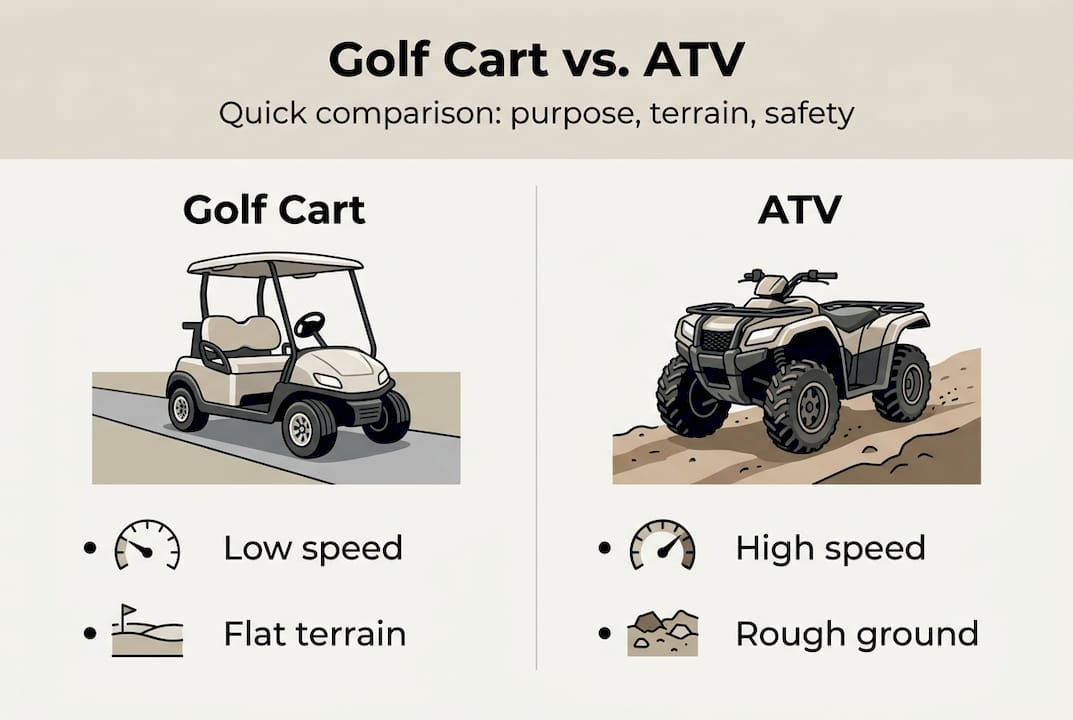
| Feature | Golf cart | ATV |
|---|---|---|
| Top speed | 15 to 25 mph | 50 to 70+ mph |
| Terrain | Flat, paved, mild inclines | Rough, off-road, trails |
| Passenger capacity | 2 to 6 passengers | 1 to 2 riders |
| Power source | Electric or gas | Primarily gas |
| Rollover protection | Optional or built-in | Minimal on most models |
| Cost range | $5,000 to $15,000+ | $5,000 to $12,000+ |
Here’s a quick breakdown of where each vehicle genuinely shines:
Best use cases for golf carts:
- Golf course transportation and turf management
- Resort, hotel, and campus shuttle service
- Neighborhood and HOA community travel
- Warehouse and light industrial yard use
- Hunting and fishing in low-terrain environments
Best use cases for ATVs:
- Off-road trail riding and recreation
- Agricultural land management and crop inspection
- Search and rescue or emergency response access
- Hunting in dense or rough terrain
- Snow removal and seasonal outdoor work
The core takeaway here is that these vehicles have different strengths, and choosing based on the wrong priorities leads to buying something that doesn’t serve your actual needs.
Safety by the numbers: Injury and fatality risks
Now that we understand their design intent, it’s time to confront the numbers on safety, which may surprise you. The difference in risk between these two vehicle types isn’t marginal. It’s dramatic.
ATVs account for 669 average fatalities and over 93,000 ER visits annually in the U.S., while golf carts result in approximately 48 fatalities and nearly 18,000 ER visits per year. The leading causes of ATV deaths include rollovers, high-speed collisions, and riders being thrown from the vehicle. Golf cart incidents, while less frequent, often involve rollovers on hills, falls from moving carts, and collisions with pedestrians.

| Safety metric | Golf cart | ATV |
|---|---|---|
| Annual ER visits | ~17,900 | ~93,000 |
| Annual fatalities | ~48 | ~669 |
| Primary hazard | Rollovers, pedestrian contact | Rollovers, ejection, speed |
| Protective gear typical | Minimal | Helmet recommended |
The fatality rate for ATVs is roughly 14 times higher than for golf carts on a per-vehicle basis. That’s not a small risk difference. It’s a fundamental safety gap that should influence your decision if you plan to carry passengers, operate around children, or use the vehicle on business property where liability matters.
Golf carts aren’t without risk, though. Rollovers on slopes and falls from open-sided carts are real hazards. Reviewing golf cart safety standards before you buy helps you identify models with the right protective features for your environment.
Pro Tip: Even on a golf cart, seatbelts reduce ejection risk dramatically on hillier terrain. On an ATV, a proper helmet and protective riding gear are not optional. They are your most important purchase after the vehicle itself.
Street legality and regulations: Where can you drive?
Safety aside, where you can actually use each vehicle may be a deal-breaker. Let’s clarify the rules.
Golf carts have a significant legal advantage in many parts of the United States. As low-speed vehicles (LSVs), they can be street-legal on roads 35 mph or less in many states, provided they meet specific equipment requirements. ATVs, on the other hand, are typically not permitted on public paved roads regardless of local speed limits.
Where golf carts are typically allowed:
- Public roads posted at 35 mph or under (when registered as an LSV)
- Private property including resorts, campuses, and commercial lots
- Designated golf cart communities and retirement villages
- Some state and local parks with approved paths
Where ATVs are typically allowed:
- Private property with owner permission
- Designated off-road parks and sanctioned trail systems
- Some rural county roads where local ordinance permits
- Agricultural land in active farming use
The full golf cart street legal requirements vary by state and even by municipality, so what’s permitted in one county may not be allowed three miles away. Some states require registration, headlights, taillights, turn signals, mirrors, and a valid driver’s license to operate an LSV golf cart on public streets.
If you’re considering a scooter or other vehicle alongside these options, understanding all your street-legal options together helps you compare the full picture before committing.
Pro Tip: Never assume your golf cart qualifies as street-legal just because your neighbor drives one on the road. Always verify your local ordinances and confirm your vehicle meets the equipment requirements before driving on any public street.
Practical applications: Best picks for work, play, and specialty needs
Knowing the rules, we’re ready to figure out which vehicle truly fits your needs in action.
The right choice comes down to your specific environment, your passenger or cargo needs, and how often you’ll actually push the vehicle to its limits. Most buyers overestimate how often they’ll need rugged terrain performance. Here’s a practical breakdown by scenario.
Top 3 scenarios where a golf cart wins:
- Hospitality and property management. Resorts, event venues, and large campuses benefit from quiet, low-emission transport. Golf carts carry multiple passengers comfortably and won’t disturb guests. The benefits for golf courses and hospitality operations are well-documented, including lower fuel costs and easier maintenance.
- Neighborhood and retirement community travel. In LSV-friendly communities, a golf cart replaces short car trips. It’s cheaper to operate, easier to park, and far less intimidating to drive than an ATV.
- Light cargo hauling on flat property. Warehouses, nurseries, and farms with paved or compacted surfaces benefit from electric golf carts that can carry moderate loads quietly and repeatedly throughout a workday.
Top 3 scenarios where an ATV wins:
- Agricultural and large-acreage property work. Checking fence lines, moving equipment across uneven land, or inspecting crops across rough terrain is where ATVs genuinely outperform. A UTV for utility work with a dump bed or snow plow attachment extends usefulness across seasons.
- Recreational trail riding. If off-road adventure is the point, a golf cart simply isn’t built for it. ATVs handle mud, rocks, inclines, and narrow trails where a golf cart would fail immediately.
- Emergency response access. Search and rescue teams and rural emergency responders rely on ATVs to reach locations that no other vehicle can access quickly.
Pro Tip: If your primary use is moving people or light cargo on property you own, a golf cart almost always makes more financial sense. An ATV costs more to insure, burns more fuel, and poses higher liability risk in commercial or family settings.
The surprising truth most buyers overlook
Let’s cut through the myths and share a perspective most sales guides miss. The biggest mistake we see buyers make isn’t choosing the wrong brand or the wrong engine size. It’s choosing the wrong vehicle category because they want to feel prepared for everything.
Buyers often gravitate toward ATVs because they feel more capable. But golf cart safety tips and real usage data tell a different story: most buyers who purchase ATVs for property use end up using them at low speeds, on relatively even terrain, far less often than they expected. Meanwhile, the higher injury rate, increased fuel cost, and restricted street access quietly add up.
The honest question to ask yourself is: what does 90% of my actual use look like? If the answer involves paved paths, guests, or light loads, a golf cart covers that 90% more safely and more affordably. ATVs make sense when rough terrain and high-output work are genuinely part of your regular routine. Profile your real needs honestly before you let perceived ruggedness drive the purchase.
Ready to compare or buy? Explore top golf carts and ATVs
Armed with this understanding, you’re ready to shop smart. Import Junkies carries a range of vehicles built for exactly the scenarios covered in this article, from nimble electric golf carts to heavy-duty utility ATVs.

If you need quiet, multi-passenger transport with street-legal potential, check out the 48V electric golf cart as a capable four-seater option. For serious off-road or utility work, the 300cc 4x4 ATV models are built to handle demanding terrain and seasonal tasks. You can browse all utility vehicles to compare specs, pricing, and configurations side by side before you decide.
Frequently asked questions
Are golf carts safer than ATVs?
Yes. Golf carts generate far fewer injuries and fatalities than ATVs. Golf carts average 48 fatalities and roughly 17,900 ER visits per year, while ATVs see 669 fatalities and over 93,000 ER visits annually.
Can you drive an ATV or golf cart on the street?
Golf carts can often qualify as LSVs and operate legally on roads posted at 35 mph or under, but ATVs are not street-legal on most public roads in the U.S.
Which is better for work, an ATV or golf cart?
Golf carts are the better choice for hospitality, campus transport, and light hauling on flat property. ATVs excel in agriculture, rough terrain tasks, and large-acreage utility work where ground conditions demand more power.
Do you need a license to drive a golf cart or ATV?
It depends on your state. Golf carts operated as LSVs often require a valid driver’s license and vehicle registration, while ATVs generally do not require a license but are restricted from public roads in most states.
Recommended
- Electric Golf Cart vs Gas: Which Wins? – Saferwholesale || Import Junkies || Great Sports
- Why choose electric golf carts? Benefits for golfers and courses – Saferwholesale || Import Junkies || Great Sports
- News – Saferwholesale || Import Junkies || Great Sports
- 200cc UTV With Snow Plow ATV Gas Golf Cart Utility Vehicle Snow Master – Saferwholesale || Import Junkies || Great Sports


