


 Location
 Login
Login
TL;DR:
- Most buyers overpay for utility vehicles because they lack knowledge of where to find deals and what questions to ask.
- Setting a clear budget, understanding use cases, inspecting thoroughly, and negotiating effectively can save significant money.
Most buyers spend more than they need to on a utility vehicle, not because good deals don’t exist, but because they don’t know where to look or what questions to ask. Whether you’re a farmer needing a reliable workhorse, a small business owner hauling equipment, or an outdoor enthusiast who wants to explore trails on the weekend, this guide is built for you. You’ll learn how to set a realistic budget, find the right source, inspect a UTV before you commit, and avoid the mistakes that quietly drain your savings before the vehicle even leaves the lot.
Table of Contents
- Know what you need and set your budget first
- Shop smart: Where to find affordable utility vehicles
- Inspect before you buy: What to check and how to negotiate price
- Common pitfalls and how to avoid them
- Why most buyers overpay and the mindset shift that saves the most
- Affordable options at Import Junkies
- Frequently asked questions
Key Takeaways
| Point | Details |
|---|---|
| Set a realistic budget | Factor in all costs beyond price so you’re not caught off guard later. |
| Shop smarter sources | Used vehicles and surplus sales can save thousands if you check title and fees. |
| Inspect thoroughly | A structured inspection is your best protection and negotiation tool. |
| Avoid common traps | Never skip paperwork or underestimate reconditioning and hidden fees. |
Know what you need and set your budget first
Once you understand the challenge of finding a real deal, the first step is getting clear on what you actually need and what you can spend without stretching yourself thin.
Start by identifying your core use case, because the right vehicle for plowing a snowy driveway is very different from the right one for hauling feed on a farm or taking the family out on weekend trails. Here are the most common use cases and what each demands from a UTV:
- Recreation and trail riding: You want decent suspension, enough ground clearance, and ideally a two-seat or four-seat configuration.
- Farm and property work: Payload capacity, a dump bed, and four-wheel drive matter most here. You may not need speed, but you need torque and durability.
- Small business hauling or landscaping: Look for a flat cargo bed, reliable engine output, and easy parts access.
- Snow plowing: You’ll want a front plow mount, four-wheel drive, and enough power to push wet snow without overheating.
- General ranch or estate use: A mid-range utility vehicle handles most jobs well without overbuilding for any one task.
Once you know your use case, you can get into price reality. Affordable UTVs fall into recognizable tiers: under $10,000 for solid mid-range options, under $7,000 for good used machines, and under $5,000 for entry-level or heavily used units.
| Price tier | What you typically get |
|---|---|
| Under $5,000 | Older models, higher mileage, limited warranty, may need reconditioning |
| $5,000 to $7,000 | Mid-age used UTVs, basic features, reliable for light to moderate work |
| $7,000 to $10,000 | Newer used or entry-level new, better specs, cleaner condition |
| Over $10,000 | New or lightly used, full warranty, modern features |
Beyond the sticker price, smart buyers account for total ownership cost. A used UTV can cost a fraction of a new one, but you still need to budget for fuel, ongoing maintenance, insurance, safety gear, and any accessories you’ll need from day one. A vehicle sitting at $6,500 can easily climb past $8,000 once you factor in an oil change, new tires, a tow hitch, insurance for the first year, and a trailer to move it.
Before you start browsing listings, review our utility vehicle checklist so you know exactly what to prioritize for your situation.
Pro Tip: Set your maximum budget, then carve out an extra 10% specifically for unexpected costs. That buffer is what keeps a great deal from turning into a financial headache.
Shop smart: Where to find affordable utility vehicles
Now that you know your budget, the next step is finding the right buying source that fits your price point and your tolerance for risk.
Each buying channel has real advantages and real drawbacks. Buying used and taking advantage of depreciation is one of the most reliable ways to get strong value. A UTV that sold new for $14,000 two years ago might list for $8,500 with low hours and one careful owner. That depreciation is your gain.
Here’s how the main buying sources compare:
| Source | Pros | Cons |
|---|---|---|
| New dealer | Warranty, financing, full support | Highest price, limited negotiation |
| Used dealer | Inspected stock, some warranty | Still marked up, negotiation possible |
| Private seller | Lowest prices, direct history from owner | No warranty, need to verify title yourself |
| Online auction | Potentially very cheap | Title risks, condition unknown, fees add up |
| Surplus/government sales | Great prices on working vehicles | Often sold as-is, paperwork can be complex |
Surplus and auction vehicles can be genuinely affordable, but they carry risks that catch buyers off guard. Unclear titles, unpaid liens, hidden auction fees, and transport costs can all push your final price well above the winning bid. Always calculate your total walk-away cost before you bid, not after.
Hidden fees to watch for in any transaction include:
- Auction buyer’s premium: Often 5% to 15% on top of the hammer price.
- Sales tax and registration: These vary by state and can add hundreds.
- Transport or trailer fees: If the vehicle isn’t local, getting it home costs money.
- Dealer documentation fees: Sometimes called “doc fees,” these can range from $100 to $500.
- Reconditioning fees: Some dealers bundle in prep charges you didn’t negotiate for.
Stay current with UTV buying tips on our blog, and take a look at specific models like our 800cc UTV deals to see what strong value at a competitive price actually looks like.
Pro Tip: Private sellers often list lower than dealers because they don’t have overhead to cover. But always verify the title is clean and that the seller’s name matches the title before you hand over any money.
Inspect before you buy: What to check and how to negotiate price
Once you’ve found a utility vehicle in your price range, due diligence isn’t optional. This is where you protect your investment and create the leverage you need to negotiate a better deal.
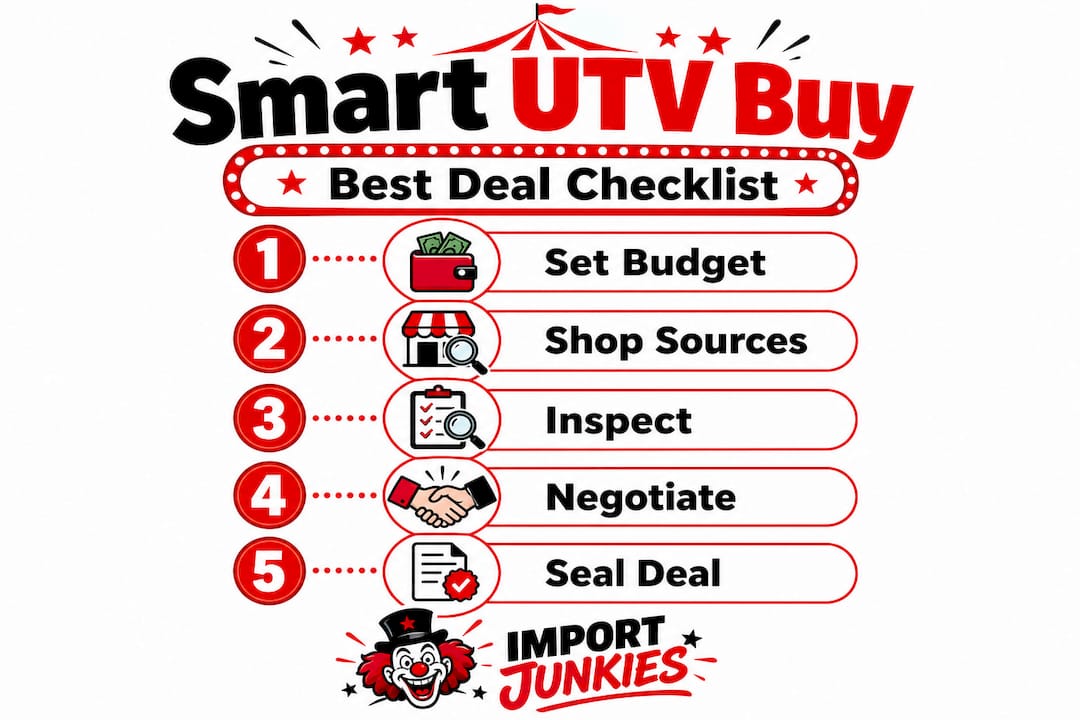
Follow this step-by-step inspection process before you commit:
- Check all fluids: Engine oil, coolant, brake fluid, and differential fluid. Dark, gritty oil signals neglect. Milky coolant means water got where it shouldn’t.
- Inspect the brakes: Press the pedal or lever and feel for a firm response. Spongy brakes mean air in the line or worn pads. Both cost money to fix.
- Review service records: A vehicle with documented oil changes and filter replacements tells you it was cared for. No records at all is a red flag, not a dealbreaker, but worth pricing in.
- Verify ownership documents: The title should match the seller’s ID. Check for liens, brands (like salvage or rebuilt), and that the VIN on the title matches the vehicle.
- Request a cold start: Ask to see the vehicle started from completely cold. Cold starts reveal misfires, smoke, and rough idling that a warm engine can hide.
- Look at the frame and undercarriage: Check for cracks, unusual welds, or rust that goes beyond surface-level. Deep structural rust is expensive.
- Test the four-wheel drive: Engage it yourself and confirm it shifts in and out properly on both low and high range.
- Check the tires: Look for even wear. Uneven wear often points to alignment or suspension issues.
For more thorough guidance, our detailed inspection steps walk you through the process visually, and our UTV maintenance advice explains what ongoing care should look like once you own one.
“A structured inspection covering fluids, ownership paperwork, and a cold start not only reveals hidden issues but gives you real, documentable leverage to negotiate the price down.” A thorough pre-purchase inspection is one of the most powerful tools a buyer has.
Once you’ve completed your inspection, use what you found to build your counteroffer. Found evidence of worn brake pads? Get a quote and subtract that cost from the asking price. Records are missing? That uncertainty has a value too. Present your findings calmly and specifically, not as complaints, but as factual cost items you’re accounting for.
Pro Tip: Before any negotiation, set your maximum offer including estimated reconditioning costs. If the seller won’t meet that number, be ready to walk away. Walking away is not a failure. It keeps your budget intact for the right vehicle.
Common pitfalls and how to avoid them
Even with all the right steps, it’s easy to stumble. These are the traps that cost buyers the most money, and most of them are completely avoidable.
- Ignoring the title status: Buying a vehicle with a salvage title, a lien, or mismatched ownership is a serious legal and financial risk. Always clear this up before paying anything.
- Forgetting reconditioning costs: A vehicle priced at $5,000 that needs $1,500 in work is really a $6,500 vehicle. Add those costs upfront, not after you’ve already bought it.
- Skipping transport planning: If the vehicle is 200 miles away, you need a trailer or delivery service. That’s a real cost that belongs in your budget.
- Overlooking registration and taxes: Depending on your state, these fees can add several hundred dollars to your total. Factor them in before you finalize the deal.
- Rushing because of artificial urgency: Sellers often create pressure by suggesting another buyer is interested. Take the time you need. A good deal will survive a day of consideration.
- Buying based on appearance alone: A clean, freshly washed UTV can hide serious mechanical problems. Looks don’t tell you what’s happening under the hood or in the drivetrain.
Auction and surplus purchases carry specific edge risks: unclear title history, undisclosed liens, and fees that only appear at the end of the transaction. These vehicles can be excellent deals, but they require buyers to do more homework, not less.
Many reliable used UTVs are available for under $10,000, and some very capable machines fall under $7,000. But those savings disappear fast if you skip the inspection, miss a title issue, or forget to account for transport and taxes. Our full utility vehicle pitfalls guide breaks down each of these risks in more detail, with practical steps to avoid each one.
Why most buyers overpay and the mindset shift that saves the most
Stepping back, it’s worth examining why so many buyers walk away from a purchase having spent more than they intended, even when they were trying to save money.
The most common reason is rushing. Buyers get excited about a specific vehicle, start picturing themselves using it, and then lose their objectivity. Once you’re emotionally invested, you’re more likely to overlook problems, accept a higher price to avoid losing the deal, and add on extras you didn’t originally need.
Dealers understand this well. Listing prices are often set with room to negotiate, but the negotiation only works in your favor if you’ve already established your walk-away number before the conversation starts. If you’re figuring out your limit in the middle of a conversation with a motivated seller, you’ve already lost some leverage.
Another pattern we see repeatedly is buyers confusing features with value. A UTV with power steering, a stereo, and LED light bars might feel like a better deal than a stripped-down workhorse at the same price. But if your primary use is hauling material on a property, you’re paying for things that don’t help you get the job done. Decide on your must-haves before you start browsing. Write them down. Then evaluate every vehicle against that list, not against its curb appeal.
Patience is the most underrated tool in a buyer’s toolkit. Waiting two weeks for a better listing is not indecision. It’s discipline. The right vehicle at the right price shows up more often than buyers realize when they’re not in a rush to fill the driveway. Read more on making smart utility vehicle buying decisions before you start shopping, and you’ll approach every listing with a much clearer head.
The buyers who consistently get the best deals share one trait: they were willing to walk away from any single vehicle. That willingness keeps your judgment sharp and your budget intact.
Affordable options at Import Junkies
Ready to put these strategies to work? Here’s where to find affordable utility vehicles right now.
At Import Junkies, we sell directly to the public at wholesale pricing, which means you’re not paying a traditional dealer’s markup. Two options worth a close look right now are our 400cc 4x4 UTV with snow plow, which includes a dump bed and four-wheel drive for year-round property work, and the MSA 300cc 4x4 ATV, built for buyers who need a capable utility-style vehicle at a competitive price point.
Both vehicles come ready to work and are priced with real buyers in mind. If neither is exactly what you need, browse our full inventory to see current listings across UTVs, ATVs, and specialty utility vehicles. Our team is available to answer questions and help you match the right vehicle to your specific use case and budget.
Frequently asked questions
What is the cheapest price I can expect for a reliable used UTV?
Many reliable used UTVs fall in the under $10,000 range, with capable options available under $7,000 and even under $5,000 depending on the age, brand, and overall condition of the machine.
How do I know if a utility vehicle is a good deal?
A real deal balances a low price with verified paperwork, a clean title, and realistic reconditioning costs. According to auction buyer guidance, your walk-away number must always include fees and any work the vehicle needs before it’s road-ready.
Should I buy from a dealer, private seller, or auction?
Dealers offer peace of mind and sometimes financing, private sellers often have lower prices and direct vehicle history, and auctions can yield the lowest prices but require buyers to verify title status and account for all fees before bidding.
What are the most important inspection points when buying used?
Check all fluids, brakes, ownership documents, and maintenance records, and always request a cold start to catch issues that a warm engine might conceal during a standard test drive.
Recommended
- The ultimate utility vehicles checklist for smart buyers – Saferwholesale || Import Junkies || Great Sports
- Utility Vehicles Explained: Uses, Types, and Right Fit – Saferwholesale || Import Junkies || Great Sports
- Utility trucks vs. golf carts: which delivers more value? – Saferwholesale || Import Junkies || Great Sports
- Low Speed Electric Vehicle Buying Guide – Saferwholesale || Import Junkies || Great Sports


