


 Location
 Login
Login
TL;DR:
- UTVs are purpose-built off-road vehicles designed for heavy loads, multiple passengers, and rugged terrain, surpassing ATVs in safety and versatility. They feature car-style controls, side-by-side seating, and a roll cage, making them ideal for work, hauling, and family recreation. Choosing the right UTV depends on specific needs, terrain, and workload, with many models available to suit various applications.
If you’ve ever looked at a UTV sitting next to an ATV and assumed they’re basically the same machine with different branding, you’re not alone. That’s one of the most common misconceptions in the off-road world. UTVs, which stands for Utility Terrain Vehicles, are purpose-built platforms designed to handle heavy loads, carry multiple passengers, and take on rugged terrain with a level of safety and versatility that ATVs simply weren’t built for. Whether you’re managing a farm, running a construction crew, or planning weekend trail rides with the family, this guide breaks down everything you need to know before buying.
Table of Contents
- Understanding UTVs: definition and key features
- UTV vs. ATV: how do they compare?
- Common uses for UTVs: work and recreation
- Choosing the right UTV: what really matters
- Why most people underestimate what a UTV can do
- Find your ideal UTV today
- Frequently asked questions
Key Takeaways
| Point | Details |
|---|---|
| UTVs are multi-purpose | They are designed for both demanding work tasks and outdoor adventures. |
| Distinct from ATVs | UTVs have side-by-side seating and advanced safety for multiple passengers. |
| Configuration matters | Choose features based on whether you need utility power or recreational speed. |
| Safety is a major focus | Features like roll cages and seat belts make UTVs reliable for families and teams. |
| Multiple buying options | A range of UTV models exists for everything from job sites to trail riding. |
Understanding UTVs: definition and key features
Now that we’ve set the stage for why UTVs matter, let’s break down precisely what a UTV is and what features set it apart from other off-road vehicles.
A UTV, also called a “side-by-side” or SxS, is an off-road vehicle designed to carry multiple passengers in a row, seated next to each other rather than in a single-file straddle position. That side-by-side seating arrangement is actually where the nickname comes from, and it completely changes how the vehicle handles, who can ride it, and what tasks it can take on. Unlike ATVs, which require the rider to physically shift body weight to steer, UTVs use a steering wheel and foot pedals that work much like a car. You sit in a fixed seat, buckle up with a seat belt, and operate the vehicle using familiar controls.
Here’s what you’ll find on nearly every UTV:
- Steering wheel and foot pedals for car-style control
- Two to six seats arranged side-by-side, depending on the model
- Roll cage (also called a ROPS, or Roll-Over Protection System) for structural safety
- Seat belts on every seat
- Cargo bed or dump bed for hauling materials
- Tow hitch for pulling trailers or equipment
- Four-wheel drive capability on most models
- Independent suspension on higher-end models for smoother off-road performance
“UTVs are used for both work and recreation, with emphasis on hauling and towing capability and transporting people compared with many ATVs.”
The roll cage is one feature worth paying close attention to. It’s a reinforced metal frame that surrounds the cab and protects occupants if the vehicle rolls over. Combined with seat belts, this changes the safety profile of UTVs significantly compared to earlier off-road designs. Many older off-road vehicles offered little to no occupant protection, while modern UTVs treat cab safety as a core engineering priority.
If you want a broader look at how UTVs fit within the overall category of off-road vehicles, the breakdown of utility vehicle types on our blog is a solid starting point.
Pro Tip: When shopping for UTVs, always check the listed towing and hauling ratings separately. Towing capacity (how much you can pull) and payload capacity (how much you can carry in the bed) are two different numbers, and both matter depending on your intended tasks.
UTV vs. ATV: how do they compare?
With a solid understanding of what defines a UTV, it’s helpful to see how they stack up against their closest mechanical cousins: ATVs.
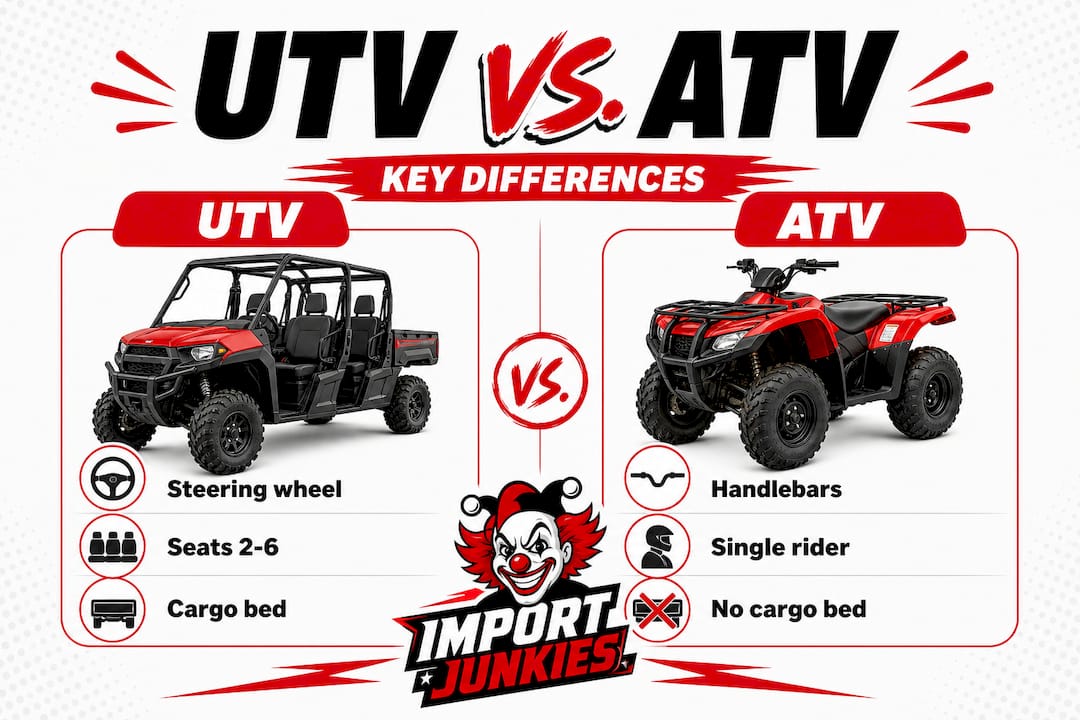
ATVs, which stands for All-Terrain Vehicles, are designed around a single-rider experience. You straddle the seat like a motorcycle, steer with handlebars, and shift your body weight as part of the control system. They’re lighter, narrower, and generally faster to maneuver through tight spaces. ATVs are excellent for solo trail riding, quick property checks, and situations where agility matters more than cargo capacity.
UTVs, by contrast, seat multiple passengers and use car-style controls, which makes them far more practical for teams, families, and work crews. You can bring a coworker, a tool bag, and a trailer all at once. That’s just not something an ATV was built to do efficiently.
Here’s a direct comparison to make the differences easy to see:
| Feature | UTV (Side-by-Side) | ATV |
|---|---|---|
| Seating capacity | 2 to 6 passengers | 1 (sometimes 2) |
| Control style | Steering wheel and pedals | Handlebars and body weight |
| Roll cage | Standard on most models | Not standard |
| Seat belts | Standard | Not standard |
| Cargo bed | Yes, most models | No, small racks only |
| Towing capacity | 1,000 to 2,500+ lbs | 300 to 1,500 lbs |
| Best use | Work, hauling, family recreation | Solo trails, tight terrain |
| Width | Wider (typically 50 to 64 inches) | Narrower (45 to 50 inches) |
The safety advantages of the side-by-side design are real. Because passengers are secured with belts inside a roll cage, UTVs reduce the risk of occupant ejection during a rollover. ATVs have a different risk profile because the rider is exposed and must rely on personal protective equipment along with riding skill.
That said, ATVs remain the better choice when solo agility and narrow trail access are your priorities. Neither vehicle is universally better. The right one depends on your specific needs.
For a full breakdown of how the UTV and ATV comparison plays out in real-world purchasing decisions, we’ve covered that topic in depth on our blog.
Key scenarios where UTVs outperform ATVs:
- Transporting two or more workers across a large property
- Hauling materials like gravel, mulch, or equipment parts
- Hunting with a partner and gear
- Snow removal with a mounted plow attachment
- Family recreation where passengers of varying skill levels ride together
Common uses for UTVs: work and recreation
Understanding what a UTV is becomes more meaningful when you know just how many industries and activities rely on these vehicles every day.

On the work side, UTVs have become standard equipment across several industries. UTVs are primarily used for work and often feature high hauling and towing capacity that makes them genuinely useful, not just convenient. Construction crews use them to move tools and materials across job sites. Farmers and ranchers use them for feeding livestock, checking fences, and transporting equipment. Landscapers load the cargo bed with mulch, soil, or plants. Golf courses use electric UTV models to maintain fairways and transport equipment without disturbing turf. Even municipalities use UTVs for park maintenance and snow removal on paths too narrow for full-size trucks.
On the recreation side, the market has grown significantly. Trail riding in UTVs has become a popular family activity because you can bring kids and less experienced passengers along safely. Hunters use UTVs to move through fields and forests quietly, haul harvested game, and carry camp gear. Adventure riders use sport-oriented UTVs on sand dunes and mountain trails. The cabin protection and storage options mean you’re covered for both a full work day and a weekend adventure.
Here are some of the most practical UTV applications, ranked by how commonly they appear across industries:
- Farm and ranch management: Moving feed, checking fences, transporting workers across large acreage
- Construction and job site work: Hauling tools, materials, and crew members between areas
- Hunting and outdoor recreation: Quiet access to remote areas, game transportation, gear hauling
- Snow removal: Mounted plow systems convert UTVs into capable snow-clearing machines
- Golf course and grounds maintenance: Turf-friendly electric models keep courses in shape
- Landscaping and property care: Moving materials and equipment with dump bed convenience
- Trail riding and family recreation: Side-by-side seating lets the whole family enjoy off-road adventures together
For property owners who need to make a decision based on specific terrain and workload, our guide to property maintenance with UTVs goes into much more detail on what to look for.
| Application | Key UTV feature needed | Recommended capacity |
|---|---|---|
| Farm use | High towing and payload | 1,500 lbs tow minimum |
| Snow removal | Plow mount compatibility | 4WD required |
| Trail riding | Suspension quality | Sport or hybrid model |
| Construction site | Cargo bed size | Dump bed preferred |
| Golf course | Electric motor, turf tires | 4-seat electric model |
Pro Tip: If your UTV will see heavy use in mud or water crossings, look specifically for models rated for those conditions. Not every UTV has sealed electrical systems or adequate ground clearance for regular wet terrain work. Check the manufacturer’s terrain ratings before buying.
You can also get a wider view of the full off-road category through our off-road vehicle guide, which covers how UTVs compare to other vehicle types you might be considering.
Choosing the right UTV: what really matters
With so many different uses for UTVs, choosing the right one depends on a few critical factors that most buyers don’t think through carefully enough before making a purchase.
The first step is being honest about your primary goal. Are you buying a UTV mainly for work, mainly for recreation, or for a mix of both? That answer shapes every decision that follows. A work-focused UTV prioritizes cargo bed capacity, towing ratings, and durability. A sport-focused UTV prioritizes suspension travel, speed, and handling. A hybrid model tries to balance both but will always involve some compromise in one direction or the other. As one industry resource notes, capability differences come largely from configuration, cargo and towing ratings, and cabin protection choices.
Here’s a practical checklist to work through before you finalize a purchase:
- How many passengers do you need to carry regularly? A two-seat model won’t work if you routinely need to move a crew of four.
- What’s your heaviest regular haul? Match the payload capacity to your real-world load, not your best-case scenario.
- What terrain will you cover most often? Flat farm roads need different suspension than rocky mountain trails.
- Do you need four-wheel drive? Most work and recreation scenarios in challenging terrain do require it.
- What’s your power source preference? Gas-powered UTVs offer longer range and higher towing capacity. Electric models are quieter, lower maintenance, and better for turf-sensitive environments.
- What safety features are non-negotiable? Roll cage, seat belts, and occupant protection should always be on your required list.
- Will you add accessories later? Plan for plow mounts, roof options, windshield additions, or storage upgrades from the start.
Pro Tip: Use our buyer’s checklist for UTVs to map your specific needs to the right configuration before you buy. Going in without a clear framework often leads to regret when a feature you needed wasn’t included in the model you purchased.
If you’re planning to modify or upgrade your UTV after purchase, reviewing UTV modification tips before you buy can actually help you select the right base model for your planned builds.
Why most people underestimate what a UTV can do
With all these considerations in mind, let’s step back and look at why UTVs are still so misunderstood, and what you can do to avoid the most common mistakes buyers make.
The biggest underestimation is treating a UTV like a glorified ATV with a passenger seat. It’s not. The engineering decisions behind the side-by-side design open up an entirely different category of use. When you combine a roll cage, proper seat restraints, a cargo bed, and a tow hitch into one vehicle, you’ve created something that can substitute for a small work truck in many situations. That’s not an exaggeration. Ranchers and construction crews use UTVs daily in conditions where a full-size truck either won’t fit or isn’t cost-effective to operate.
The second underestimation is around configuration. Buyers often grab a model because of price or appearance without considering how the specific setup matches their actual work. A sport model with minimal cargo capacity sitting unused on a farm property is money that isn’t working for you. A heavy-duty work model with a dump bed being used only for weekend trails is overkill in a different direction. Neither outcome is smart buying.
Real-world factors like weather, terrain type, and crew size should directly drive your UTV decision. If you’re in a region with hard winters, a gas-powered 4WD model with plow capability may outperform an electric unit in cold-weather performance. If you primarily ride in summer heat across open fields, an electric model may cost far less to operate over three to five years than a gas alternative. These aren’t abstract considerations. They have direct dollar values attached to them.
The versatility of utility vehicles often surprises buyers who start with a narrow use case and discover how many adjacent tasks their UTV handles naturally. The vehicle earns its value fastest when it’s actually being used. Know your terrain, know your payload requirements, and buy the configuration that matches your reality, not just your wishlist.
Find your ideal UTV today
Ready to take the next step and explore UTVs built for your needs? Here’s where you can start your search.
At Import Junkies, we stock UTVs across a range of configurations, from gas-powered work machines to electric models built for turf and trail. Whether you need serious towing power or quiet electric operation, we have options that fit real budgets and real work schedules.

If you need a capable gas-powered workhorse with serious utility, check out our high-performance 400cc UTV with snow plow and dump bed included. For buyers who want low-maintenance electric operation with multi-passenger seating, our electric utility UTV is a strong contender. Browse, compare specs, and make an informed purchase at your own pace, no dealership pressure required.
Frequently asked questions
What does “UTV” stand for?
UTV stands for Utility Terrain Vehicle, and these vehicles are designed for off-road use, work tasks like hauling and towing, and recreational riding with multiple passengers.
How is a UTV different from an ATV?
A UTV seats multiple passengers side-by-side and uses a steering wheel and foot pedals, while an ATV is typically single-rider with handlebars and a straddle seat requiring body-weight steering.
What are common features to look for in a UTV?
Look for a sturdy roll cage, seat belts on every seat, strong towing and payload ratings, a cargo or dump bed, and car-style controls. These features are what make UTVs useful for work and recreation.
Can UTVs be used for daily work tasks?
Yes, UTVs are specifically engineered for daily work use. They boast high hauling and towing capacity that makes them practical for moving crews, materials, and equipment across job sites and large properties every day.
Are there different types of UTVs for sport and utility?
Yes. Capability differences come largely from configuration, with sport models prioritizing suspension and speed while utility models focus on cargo beds, towing ratings, and heavy-duty durability.
Recommended
- The ultimate utility vehicles checklist for smart buyers – Saferwholesale || Import Junkies || Great Sports
- Your guide to every type of off-road vehicle – Saferwholesale || Import Junkies || Great Sports
- Utility Vehicles Explained: Uses, Types, and Right Fit – Saferwholesale || Import Junkies || Great Sports
- Purpose of Utility Trikes: Work, Recreation, Versatility – Saferwholesale || Import Junkies || Great Sports


