


 Location
 Login
Login
TL;DR:
- Registering an off-road vehicle involves submitting proof of ownership, completing applications, paying fees, and passing inspections, with requirements differing by state. Proper documentation, including a Manufacturer’s Certificate of Origin or title and VIN verification, is essential to avoid delays. Understanding specific state rules and inspection obligations ensures legal operation on trails and roads.
Off-road vehicle registration is the official process of submitting proof of ownership, completing state-required applications, paying fees, and sometimes passing inspections to receive legal authorization to operate your ATV, UTV, or dirt bike on public trails or roads. Every state handles this process differently, and skipping steps or submitting the wrong documents can delay your registration by weeks. Whether you’re registering a dirt bike in Colorado, licensing an ATV in Pennsylvania, or working through the off-road vehicle registration process in Wisconsin, the core requirements follow a predictable pattern. This guide breaks down exactly what you need, state by state, so you can get your vehicle registered without the runaround.
What documents do you need to register your off-road vehicle?
The off-road vehicle registration process starts with paperwork, and missing even one document sends you back to square one. Most states require the same core set of materials, though the exact forms vary by jurisdiction.
Here is what you need to gather before visiting your state DMV or Parks and Wildlife department:
- Proof of ownership. This is either a Manufacturer’s Certificate of Origin (MCO), a title, or a bill of sale. MCO documents and titles are the two most commonly accepted forms of proof across all 50 states. Unfamiliarity with these documents is one of the most common reasons the registration process stalls.
- Vehicle Identification Number (VIN). You need the full VIN from your vehicle’s frame or title. Some states require a physical VIN inspection before they accept your application.
- Valid government-issued ID. A driver’s license works in most states. You do not need a driver’s license to register an off-road vehicle, but you do need to prove your identity.
- Completed application form. Colorado uses form DR 2395 for off-highway vehicle registration. Pennsylvania uses its own DCNR forms. Check your state’s DMV or parks department website before you go.
- Proof of payment or tax documentation. Some states require proof that sales tax was paid on the vehicle, especially for private party purchases.
Pro Tip: If you bought your vehicle new from a dealer, ask for the MCO at the time of purchase. Dealers sometimes hold onto it, and retrieving it later adds unnecessary delays to your registration.
The MCO is critical for proof of ownership and successful registration. Owners who arrive without it, or who confuse it with a bill of sale, often face a second trip and a longer wait.
How does registration vary by state and vehicle type?
No two states handle the off-road vehicle registration process the same way. Fees, inspection requirements, registration types, and exemptions all differ significantly depending on where you live and how you plan to use your vehicle.
The table below compares registration rules across five states commonly referenced by off-road riders:
| State | Registration type | Fee | Key requirement |
|---|---|---|---|
| Pennsylvania | General (2-year) | $20 for two years | Limited on-property use is free and does not expire |
| Colorado | Street-use dirt bike | $50 inspection fee | VIN and compliance inspection required, including lamp circuit testing |
| Wisconsin | Public use dirt bike | $30 registration fee | Required for legal use on designated trails and public highways |
| Idaho | OHV on roads | Varies | Riders 15 and younger must be supervised and complete an approved safety course |
| Michigan | Street-converted OHV | Varies | Must be titled as assembled vehicles with annual renewal and No-Fault insurance |
Pennsylvania’s tiered system is worth understanding in detail. If you only ride on your own property, limited on-property registration is free and never expires. The moment you want to ride on public trails or state land, you move to the general registration category at $20 for two years. Pennsylvania also exempts vehicles used solely for farming or business from standard ATV registration requirements entirely.
Michigan takes a stricter approach to street conversions. Any off-road vehicle converted for on-road use must be titled as an assembled vehicle, carry valid No-Fault insurance, and go through annual renewal. That is a significantly higher compliance burden than simply registering for trail use.
Pro Tip: Before you buy an off-road vehicle, look up your state’s registration rules for that specific vehicle type. Some states treat UTVs differently from ATVs, and a vehicle that qualifies for simple trail registration in one state may require a full street-legal inspection in another. The state-by-state registration guide at Importjunkies covers these distinctions in detail.
Registration fees also serve a broader purpose. Fees fund trail maintenance, law enforcement, and conservation efforts that benefit every off-road rider. Paying your registration is not just a legal obligation. It directly supports the trails you ride on.
What are the steps to register an off-road vehicle?
The steps to register an off-road vehicle follow a consistent sequence regardless of your state. The details change, but the process does not.
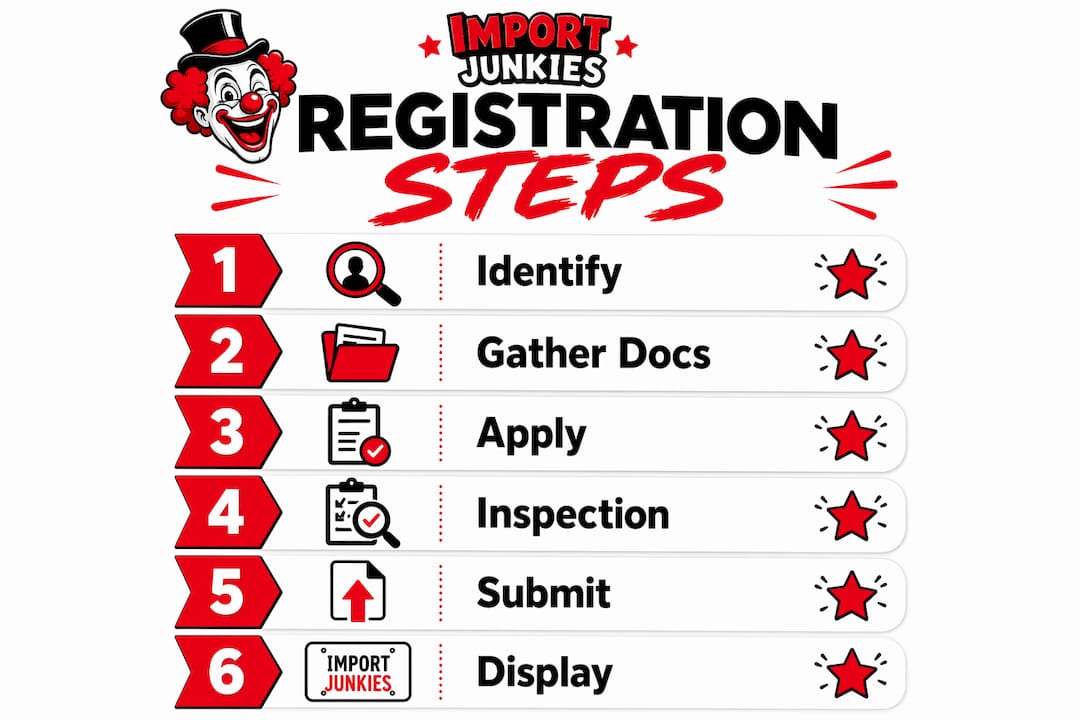
Step 1: Identify your vehicle type and intended use. Determine whether your ATV, UTV, or dirt bike will be used on private property only, public trails, or public roads. This single decision controls which registration category applies to you and what fees you will pay.
Step 2: Gather all required documents. Collect your proof of ownership (MCO or title), VIN, valid ID, and any tax documentation. If your vehicle was purchased privately, get a notarized bill of sale. Missing documents at this stage cause the majority of registration delays.

Step 3: Complete the registration application. Download or pick up the correct form from your state DMV or parks department. Colorado uses form DR 2395 for off-highway vehicles. Pennsylvania uses DCNR-specific forms. Fill out every field completely. Incomplete applications are returned without processing.
Step 4: Undergo required inspections or VIN verifications. Some states require a physical VIN inspection before they will process your application. Colorado requires a $50 VIN and compliance inspection for dirt bikes being registered for street use, which includes lamp circuit testing. Schedule this early since inspection appointments can book out several days.
Step 5: Submit your application and pay fees. Most states accept applications in person at a DMV office or by mail. Some states, including Colorado, offer online registration options for renewals. Pay the required fee at submission. Keep your receipt as proof of payment until your decals or plates arrive.
Step 6: Display your registration decals correctly. Once your registration is approved, you will receive physical decals. Improper decal placement can result in fines even when your registration is valid. Most states specify exact placement locations, typically the upper rear of the vehicle away from tires. Read the placement instructions that come with your decals before you stick them on.
Pro Tip: If you plan to convert your off-road vehicle for street use, research the requirements before you buy. States like Michigan require specific DOT-approved components such as turn signals and mirrors. Knowing this upfront lets you factor conversion costs into your purchase decision rather than discovering them after the fact.
For a deeper look at what makes a vehicle legally road-ready, the street legal vehicle guide at Importjunkies covers VIN checks, lighting requirements, and inspection standards across different vehicle types.
What mistakes should you avoid when registering off-road vehicles?
The off-road vehicle registration process has several predictable failure points. Knowing them in advance saves you time, money, and frustration.
- Submitting incomplete or incorrect paperwork. The most common delay in registering a dirt bike or ATV is missing documentation. A bill of sale without a notarized signature, or an MCO with a name mismatch, will stop your application cold.
- Letting your registration lapse. Annual renewals are easy to forget, especially for seasonal vehicles. Late fees add up quickly, and riding with an expired registration can result in fines or impoundment depending on your state.
- Placing decals in the wrong location. Valid registration does not protect you from a fine if your decal is in the wrong spot. Follow the placement instructions precisely.
- Skipping the conversion requirements for street use. DOT-compliant components like turn signals and mirrors are required in most states before an off-road vehicle can be registered for road use. Attempting to skip this step leads to rejected applications or legal liability.
- Ignoring age and supervision rules. Idaho requires riders 15 and younger to be supervised by an adult and complete an approved safety course before operating OHVs on roads. Ignoring these rules puts minors at legal and physical risk.
Riders should start registration preparation early and verify exact state rules to avoid delays or penalties. Waiting until the day before a trail ride to sort out your paperwork is a reliable way to miss the ride entirely.
One less obvious mistake: some owners attempt to register off-road vehicles through LLCs to work around restrictive local rules. This approach is legally questionable and does not exempt the vehicle from local regulations. It adds complexity without solving the underlying compliance problem.
Key takeaways
Registering an off-road vehicle requires the right documents, the correct application for your state and vehicle type, and strict attention to inspection and decal requirements.
| Point | Details |
|---|---|
| Documents come first | Gather your MCO or title, VIN, valid ID, and tax documentation before starting any application. |
| State rules vary significantly | Pennsylvania offers free limited registration; Colorado requires a $50 inspection for street-use dirt bikes; Wisconsin charges $30 for public trail use. |
| Decal placement matters | Placing decals incorrectly can result in fines even when your registration is fully valid. |
| Street conversions add steps | Converting an off-road vehicle for road use requires DOT-approved components and, in states like Michigan, a special assembled vehicle title with insurance. |
| Start early | Registration delays are almost always caused by missing paperwork or skipped inspections. Preparing in advance prevents them. |
What I’ve learned from watching buyers skip this step
I’ve seen a consistent pattern with off-road vehicle buyers: they spend weeks researching engine specs and suspension setups, then treat registration as an afterthought. That’s where things go sideways. A buyer picks up a used ATV without a clean title, or grabs a dirt bike without confirming the VIN matches the paperwork, and suddenly they’re stuck with a vehicle they can’t legally ride anywhere.
The state-specific nuances matter more than most people realize before they’re in the middle of the process. Pennsylvania’s free limited registration sounds great until you discover it only covers private property use. Colorado’s $50 inspection fee is reasonable, but if you show up without the right lighting components already installed, you fail and reschedule. These are not complicated problems. They’re just problems that catch people off guard because they didn’t look them up first.
My honest advice: treat registration research the same way you treat spec research. Do it before you buy, not after. Know whether your intended vehicle qualifies for simple trail registration or requires a full street-legal conversion in your state. If you’re buying new from a dealer, confirm they provide the MCO at the time of sale. If you’re buying used, verify the title is clean and the VIN matches before money changes hands.
The off-road vehicle safety and licensing context is worth reading if you’re newer to this space. Getting registered correctly is the foundation for everything else.
— Gary
Ready to find your next off-road vehicle?
Importjunkies carries a wide selection of ATVs, UTVs, and utility vehicles built for riders who want to get out and use them, not spend months sorting out paperwork problems. Every vehicle sold through Importjunkies comes with documentation support to help you move through the registration process without the usual friction.
If you’re looking for a capable utility vehicle that handles both work and recreation, the 400cc 4x4 UTV with Snow Plow is one of the most practical options in the current lineup. For buyers interested in electric options, the 48V Electric Golf Cart UTV offers a low-maintenance alternative with strong utility credentials. Browse the full catalog at Importjunkies and reach out to the team with any questions about documentation or registration requirements for specific models.
FAQ
What documents are required to register an ATV or dirt bike?
Most states require proof of ownership (MCO or title), the vehicle’s VIN, a valid government-issued ID, a completed application form, and proof of sales tax payment. Missing any one of these documents will delay or reject your application.
How much does off-road vehicle registration cost?
Costs vary by state and vehicle type. Pennsylvania charges $20 for a two-year general ATV registration, Wisconsin charges $30 for public use dirt bike registration, and Colorado charges a $50 VIN and compliance inspection fee for street-use dirt bikes.
Do I need a driver’s license to register an off-road vehicle?
You do not need a driver’s license to register an off-road vehicle in most states, but you do need a valid government-issued ID to prove your identity during the registration process.
Can I register an off-road vehicle for street use?
Yes, but it requires additional steps. States like Michigan require the vehicle to be titled as an assembled vehicle with annual renewal and No-Fault insurance. Most states also require DOT-approved components like turn signals and mirrors before approving street-legal registration.
What happens if I ride with an expired or improperly displayed registration?
Riding with an expired registration can result in fines or vehicle impoundment depending on your state. Even with a valid registration, placing your decal in the wrong location on the vehicle can result in a separate fine, so follow the placement instructions that come with your decals precisely.
Recommended
- How to register a utility vehicle: step-by-step U.S. guide – Saferwholesale || Import Junkies || Great Sports
- Your guide to every type of off-road vehicle – Saferwholesale || Import Junkies || Great Sports
- Why Off-Road Vehicles Matter for Outdoor Adventures – Saferwholesale || Import Junkies || Great Sports
- Must-Have Recreational Vehicles 2026: Top Picks Guide – Saferwholesale || Import Junkies || Great Sports


