


 Location
 Login
Login
TL;DR:
- Off-road vehicle terminology explains vehicle performance limits and legal requirements for trails. Knowing terms like approach angle, drivetrain, and GVWR helps ensure proper vehicle choice and safe recovery. Most beginners focus on horsepower, but low-speed torque and geometry are crucial for obstacle navigation and trail legality.
Off-road vehicle terminology is the set of specialized terms that define how vehicles perform, what they can handle, and whether they are legal on public trails. Knowing this language matters whether you are buying your first ATV or planning a technical 4x4 trail run. The vocabulary covers everything from engine displacement and drivetrain configurations to approach angles and recovery gear. Without it, you risk buying the wrong vehicle, misreading trail conditions, or failing a permit check. This guide covers the core off-road vehicle terms you need, organized so you can use them right away.
What are the main types of off-road vehicles?
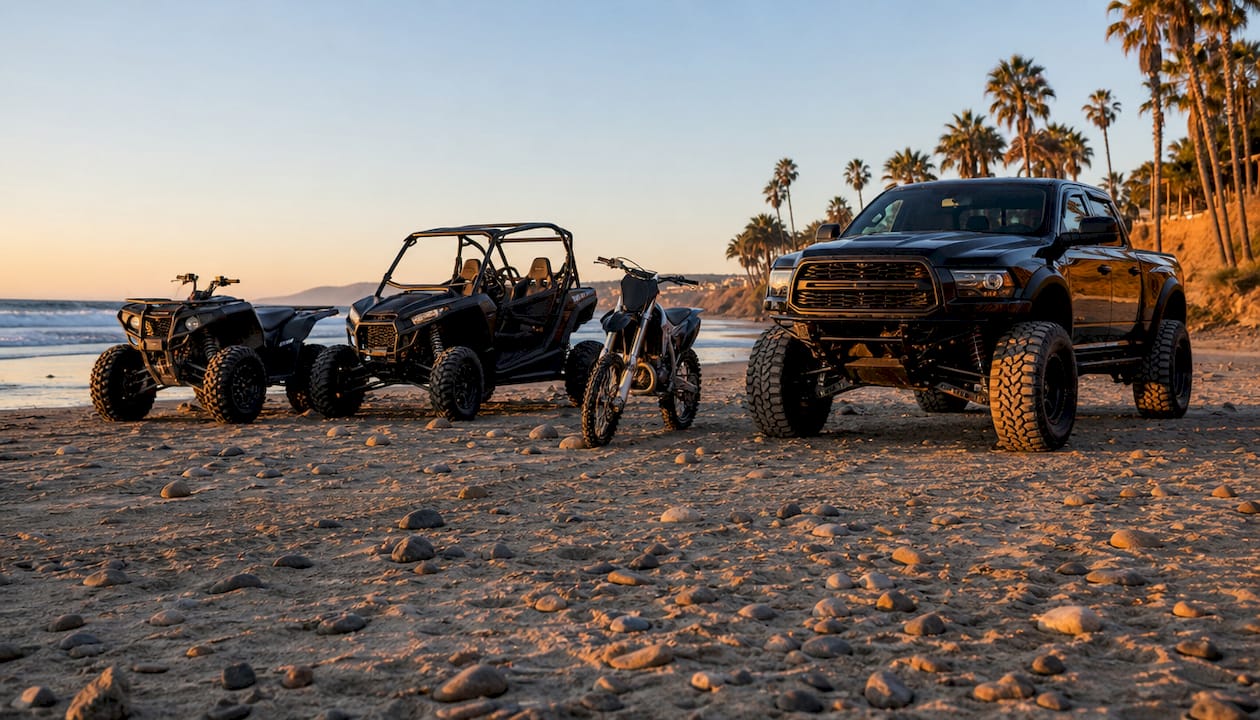
Off-road vehicles fall into four main categories: ATVs, UTVs, dirt bikes, and off-road trucks. Each category has distinct specs, use cases, and legal requirements. Understanding the differences is the first step in any off-road terminology guide.
| Vehicle Type | Engine Size | Drivetrain | Typical Use |
|---|---|---|---|
| ATV (All-Terrain Vehicle) | 49–1,000 cc | 2WD or 4WD | Trail riding, sport, utility |
| UTV (Utility Terrain Vehicle) | 400–1,000 cc | 4WD or AWD | Work, group recreation |
| Dirt Bike | 50–650 cc | 2WD (rear drive) | Sport, motocross, trails |
| Off-Road Truck / 4x4 | 2,000+ cc | 4WD, body-on-frame | Rock crawling, overlanding |
ATV engine displacement ranges from 49 to 1,000 cc, with sport models reaching speeds around 80 mph and utility models topping out near 70 mph. That gap in speed reflects a real difference in purpose. Sport ATVs prioritize agility; utility ATVs prioritize load capacity and traction.
UTVs, sometimes called side-by-sides, carry two or more passengers in a cab-style frame. They are the go-to choice for work on farms, ranches, and construction sites. You can read a full breakdown of UTV specs and categories in Importjunkies’ complete UTV guide.
Off-road trucks use body-on-frame construction, which is the preferred build for serious terrain. That design separates the cab from the chassis, allowing the frame to flex over uneven ground without stressing the body. Unibody designs, common in soft-roaders and crossovers, cannot flex the same way and are better suited for light gravel or mild trails.
What do approach angle, departure angle, and breakover angle mean?
Vehicle geometry terms define the physical limits of what a vehicle can drive over without damage. These three angles are the most critical measurements in off-road vehicle definitions.
- Approach angle is the maximum angle of an obstacle the front of the vehicle can climb without the front bumper or fascia making contact. A steeper approach angle means the vehicle can tackle taller ledges and steeper inclines.
- Departure angle is the same measurement for the rear of the vehicle. A low departure angle means the rear bumper will drag on steep descents or when exiting a ditch.
- Breakover angle is the angle of a ridge or peak the vehicle can straddle without the underside of the frame or rocker panels touching the ground. This matters most on sharp crests and V-shaped ditches.
Approach, departure, and breakover angles directly determine how well a vehicle handles obstacles without damage. Ignoring these numbers when buying a vehicle is one of the most common mistakes beginners make.
Ground clearance works alongside these angles. Soft-roaders average about 8.0 inches of ground clearance, while purpose-built off-roaders can exceed 12.9 inches. More clearance means more room between the underside of the vehicle and rocks, roots, or ruts.
Pro Tip: Before you hit a new trail, look up the vehicle’s approach and departure angles in the owner’s manual. Then compare them to the trail’s listed obstacle ratings. Most trail databases rate obstacles by height, so you can match numbers directly.
How do drivetrain and suspension terms affect off-road performance?
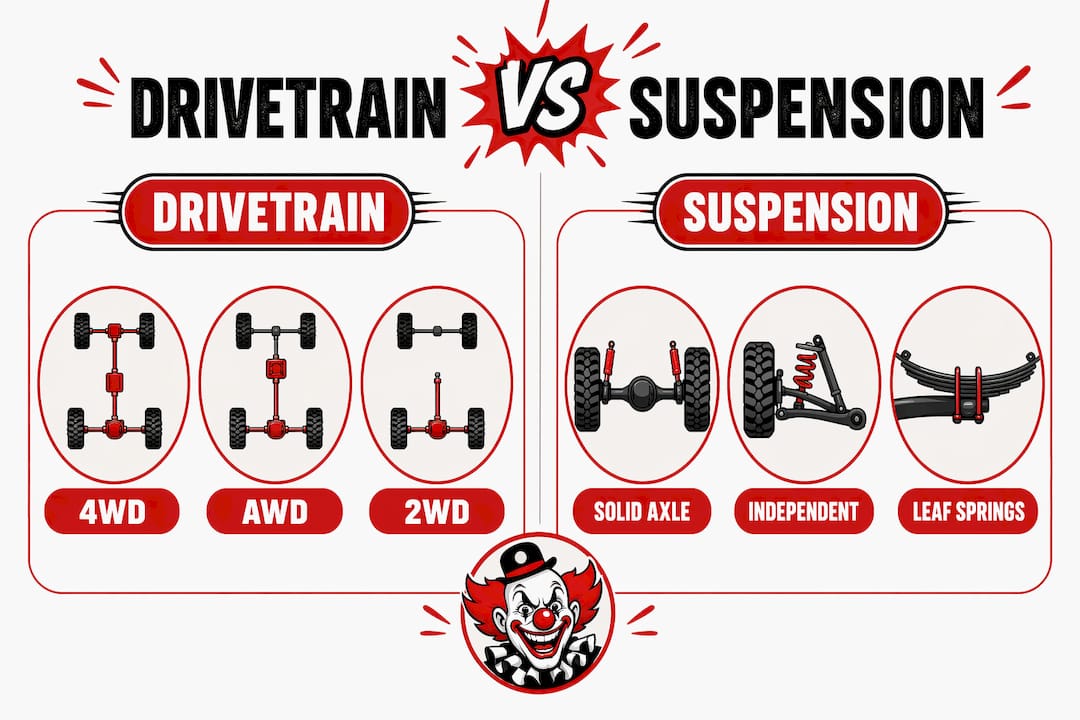
Drivetrain and suspension terms describe how power reaches the wheels and how the vehicle absorbs terrain. Getting these wrong in a purchase decision means money parked in the garage.
4WD vs. AWD
Four-wheel drive (4WD) is a driver-selectable system that locks power to all four wheels. It is designed for low-speed, high-traction situations like rock crawling or mud. All-wheel drive (AWD) distributes power automatically across all wheels, but it is tuned for on-road stability and light off-road use. Soft-roaders use AWD on unibody platforms for light terrain, while true off-roaders use body-on-frame 4WD for tough terrain. The trade-off is fuel economy and ride comfort.
Suspension types
Solid axle suspension connects both wheels on an axle with a single rigid beam. When one wheel drops into a hole, the other lifts slightly, keeping both tires in contact with the ground. Independent suspension (IFS or IRS) lets each wheel move on its own, which improves on-road comfort but can reduce articulation on extreme terrain.
Torque vs. horsepower
Torque is more critical than horsepower for off-road performance because it delivers low-speed pulling power over obstacles. Horsepower measures how fast an engine can do work, which matters on a racetrack. Torque measures rotational force, which is what moves a vehicle through mud or up a rock face at 3 mph.
Key drivetrain components you will encounter in off-road vehicle phrases:
- Locking differentials: Force equal power to both wheels on an axle, preventing wheel spin on slippery surfaces.
- Transfer case: The gearbox that splits power between front and rear axles in a 4WD system.
- Low-range gearing: A secondary gear ratio that multiplies torque for crawling at very low speeds.
- Skid plate: A metal plate protecting the transfer case or differential from rock strikes.
Pro Tip: When comparing two vehicles with similar horsepower, always check the torque figure and the RPM at which it peaks. A vehicle that produces peak torque at 2,000 RPM will outperform one that peaks at 5,000 RPM on a slow, technical trail.
What off-road accessories and recovery gear terms should you know?
Recovery and protection gear have their own vocabulary. Knowing these terms helps you buy the right equipment and use it safely.
- Winch: An electric or hydraulic device mounted to the front or rear of a vehicle that uses a steel cable or synthetic rope to pull the vehicle out of a stuck position. Winch capacity is rated in pounds.
- GVWR (Gross Vehicle Weight Rating): The maximum total weight of the vehicle, including passengers, cargo, and fuel, as specified by the manufacturer. This number is critical for matching a winch.
- Skid plates: Thick steel or aluminum panels bolted under the engine, transmission, and fuel tank to protect them from rock strikes. They are measured by thickness and coverage area.
- Rock sliders: Steel tubes welded or bolted along the rocker panels to protect the vehicle’s sides when sliding over boulders.
- Tow hooks and recovery points: Rated anchor points on the frame used to attach recovery straps or shackles. They must be frame-mounted, not bumper-mounted, to handle recovery loads.
- Snatch block: A pulley that redirects a winch cable, effectively doubling pulling capacity or changing the pull angle.
Winch capacity should be 1.5 times the vehicle’s GVWR for safe recovery. An undersized winch can overheat, snap a cable, or simply fail to move the vehicle. That is a dangerous situation in a remote location.
Pro Tip: Always choose synthetic rope over steel cable for a winch if your budget allows. Synthetic rope is lighter, safer when it snaps, and easier to handle with bare hands.
What legal and operational terms apply to off-road vehicles?
Legal terminology defines where you can ride, what your vehicle must have, and what permits you need. Skipping this section is how riders get fined or lose trail access for everyone.
- OHV (Off-Highway Vehicle): A broad legal category covering vehicles not designed for regular highway use. ATVs, UTVs, and dirt bikes typically fall under this classification.
- Street-legal ATV: An ATV that has been modified and certified to meet state motor vehicle requirements, including lights, mirrors, turn signals, and a horn. Requirements vary by state. Importjunkies covers the full process in their street-legal vehicle guide.
- OHV registration sticker: A permit required in most states to operate an OHV on public land. All OHV users in Colorado must obtain registration stickers or permits for trail legality, and the same requirement applies to both residents and non-residents.
- Designated OHV route: A trail or road officially approved for motorized vehicle use by a land management agency such as the Bureau of Land Management (BLM) or the U.S. Forest Service.
- Speed limit on OHV routes: Public land areas enforce specific speed limits. Glen Canyon National Recreation Area enforces a 15 mph speed limit on OHV routes, with 304 unpaved miles of designated roads. Exceeding posted limits can result in fines and permit revocation.
Permits fund trail maintenance and conservation. Proper registration is required and also critical for trail conservation. Without permit revenue, land agencies close trails permanently. For a full state-by-state breakdown, Importjunkies publishes a 2026 registration guide covering current requirements.
Key Takeaways
Mastering off-road vehicle terminology is the single most effective way to choose the right vehicle, stay legal on public trails, and recover safely when things go wrong.
| Point | Details |
|---|---|
| Vehicle categories matter | ATVs, UTVs, dirt bikes, and 4x4 trucks each have distinct specs and legal classifications. |
| Geometry angles define limits | Approach, departure, and breakover angles determine what obstacles a vehicle can safely navigate. |
| Torque beats horsepower off-road | Peak torque at low RPM is the key powertrain spec for crawling and obstacle clearance. |
| Winch sizing is safety-critical | Select a winch rated at 1.5 times your vehicle’s GVWR to handle real recovery loads. |
| Permits protect trail access | OHV registration stickers and permits are legally required and fund the trails you ride. |
What I’ve learned from watching beginners get the terminology wrong
Most beginners focus on horsepower when shopping for an off-road vehicle. That is the wrong number to lead with. After spending years around off-road vehicles and watching buyers make the same mistakes, the pattern is clear. A vehicle with strong low-end torque and proper geometry angles will outperform a higher-horsepower machine on a technical trail every single time.
The second most common mistake is ignoring geometry specs entirely. Buyers look at engine size and price, then wonder why their vehicle high-centers on a trail rated for stock vehicles. Approach and departure angles are not marketing numbers. They are the difference between driving out of a situation and needing a recovery strap.
Legal terminology is where I see the most avoidable consequences. Riders show up to public land without the right permits, get turned away, or face fines. The rules are not complicated once you read them. The problem is that most people skip that step. Checking your state’s OHV registration requirements before you load the trailer takes 10 minutes and saves a ruined trip.
The off-road community rewards people who know the language. When you can talk about breakover angles, locking differentials, and GVWR with confidence, other riders take you seriously and share better trail information. Terminology is not just academic. It is how you communicate capability and safety in a group setting.
— Gary
Ready to put your knowledge to work with the right vehicle?
Importjunkies carries a wide range of off-road vehicles and utility machines built for riders who know what they need. From capable ATVs to multi-passenger UTVs, the catalog covers entry-level and serious builds at direct-to-public pricing.

If you want a lifted electric utility vehicle with real off-road clearance, the 48V Lifted Renegade+ 2.0 is worth a close look. For riders who need a gas-powered workhorse with 4x4 capability, the 400cc 4x4 UTV with snow plow covers both trail and utility duty. Browse the full Importjunkies catalog at importjunkies.com and filter by vehicle type, drivetrain, and engine size to match what you have learned here.
FAQ
What is the difference between an ATV and a UTV?
An ATV is a single or double-rider vehicle the operator straddles like a motorcycle, while a UTV seats two or more passengers side by side in a cab-style frame. UTVs generally offer more cargo capacity and stability; ATVs offer more agility on tight trails.
Why does torque matter more than horsepower off-road?
Torque delivers rotational force at low speeds, which is what moves a vehicle through mud, over rocks, or up steep inclines. Horsepower measures high-speed output, which has little practical value at crawling speeds on technical terrain.
What is an OHV registration sticker and do I need one?
An OHV registration sticker is a permit issued by a state or land management agency that legally authorizes your vehicle to operate on designated public trails. Most states require them for both residents and non-residents, and riding without one can result in fines.
How do I calculate the right winch capacity for my vehicle?
Multiply your vehicle’s Gross Vehicle Weight Rating (GVWR) by 1.5. That result is the minimum winch capacity you need for safe recovery. An undersized winch risks cable failure or motor burnout during a real recovery situation.
What does street-legal mean for an off-road vehicle?
A street-legal off-road vehicle meets state motor vehicle requirements for public road use, including headlights, taillights, turn signals, mirrors, and a horn. Requirements vary by state, so check your local DMV rules before modifying any OHV for road use.
Recommended
- Why Off-Road Vehicles Matter for Outdoor Adventures – Saferwholesale || Import Junkies || Great Sports
- What is an off-road utility truck? A guide for buyers – Saferwholesale || Import Junkies || Great Sports
- Benefits of Off-Road Vehicles for Adventure and Work – Saferwholesale || Import Junkies || Great Sports
- Off Road Vehicle Financing Made Simple – Saferwholesale || Import Junkies || Great Sports


