


 Location
 Login
Login
TL;DR:
- Scooters and mopeds differ mainly in engine size, speed, and legal classification, impacting licensing and insurance.
- Choosing the correct vehicle depends on your commute length, speed needs, and local regulations, not just price or appearance.
A scooter is defined as a two-wheeled motorized vehicle with an engine ranging from 50cc to 250cc or more, capable of reaching speeds up to 75 mph, while a moped is legally capped at engines no larger than 50cc and top speeds around 28 to 30 mph. The differences between scooters and mopeds go well beyond looks. Engine output, speed capability, legal classification, and licensing requirements all separate these two vehicle types in ways that directly affect what you can ride, where you can ride it, and what paperwork you need to do it. Understanding these distinctions before you buy saves you from fines, insurance gaps, and the wrong vehicle for your commute.
What are the key mechanical differences between scooters and mopeds?
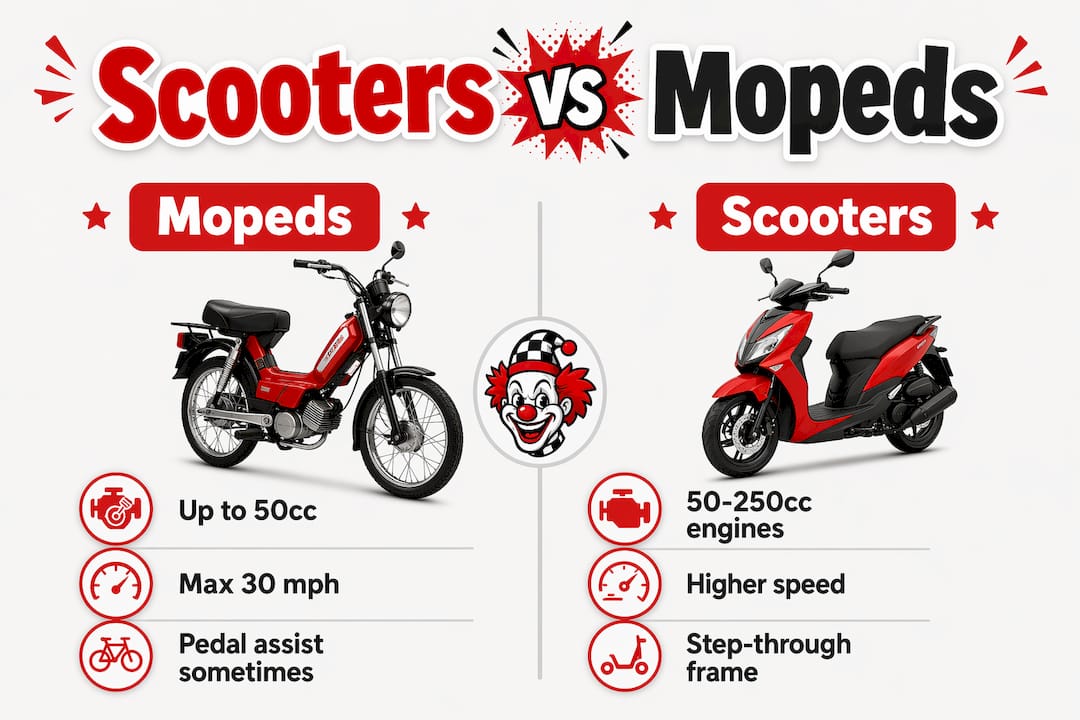
The mechanical gap between these two vehicle types is more significant than most buyers expect. Under Illinois Vehicle Code, a moped is capped at 50cc, 2 horsepower, and a maximum speed of 30 mph. That legal ceiling is not a suggestion. It determines your license class, your insurance category, and where you are legally permitted to ride. Scooters, by contrast, cover 50cc to 250cc and reach speeds between 60 and 75 mph, putting them in a completely different performance and regulatory tier.
Regulations are also shifting. Japan revised its moped classification in April 2026, expanding the engine cap to 125cc while adding a strict 4 kW power output ceiling and a 30 km/h speed limit. This change shows that engine displacement alone is no longer the only metric that defines a moped. Power output is becoming equally relevant, and that trend is likely to influence other markets over time.
Design features also separate the two categories in practical terms. Both scooters and mopeds typically use step-through frames and automatic transmissions, which makes them accessible to riders without a manual gear-shifting background. Historically, mopeds included pedals that allowed riders to assist the engine, though modern mopeds have largely dropped this feature. Scooters tend to offer more under-seat storage, larger wheels, and more refined suspension, which reflects their higher-speed design intent.
| Feature | Moped | Scooter |
|---|---|---|
| Engine size | Up to 50cc (125cc in Japan 2026) | 50cc to 250cc and above |
| Top speed | Up to 30 mph | 60 to 75 mph |
| Power output | Low (≤2 hp or ≤4 kW) | Higher, varies by model |
| Transmission | Automatic | Automatic (most models) |
| Storage and comfort | Minimal | More under-seat storage, larger build |
Pro Tip: Always check the manufacturer’s type-approval documentation before purchasing. A vehicle marketed as a “moped” may not meet your state or country’s legal definition, which affects your license requirement and insurance eligibility.
How do licensing, registration, and insurance requirements differ?
This is where the scooter vs moped comparison gets most buyers into trouble. The assumption that a smaller, slower vehicle requires less paperwork is often correct, but the details vary enough by location that you cannot rely on general rules. In British Columbia, mopeds require a driver’s license, registration, and insurance, treating them as full motor vehicles under provincial law. Electric scooters in the same province face a different set of rules entirely, with legal operation restricted to specific pilot communities.
In the United States, state-level rules govern both vehicle types. A moped in most states requires only a standard driver’s license or a basic moped permit, with no motorcycle endorsement needed. A scooter with an engine above 50cc typically requires a motorcycle endorsement or a dedicated motorcycle license, depending on the state. The licensing gap matters because riding a scooter on a moped permit is a legal violation, not just a technicality.
Here is what you need to verify before you ride either vehicle:
- Engine displacement and power output: Confirm the exact specs against your state’s legal moped definition.
- License class required: Check whether a moped permit, standard driver’s license, or motorcycle endorsement applies.
- Registration: Most mopeds and all scooters above 50cc require registration with your state’s DMV.
- Insurance: Liability insurance is mandatory for scooters in most states and for mopeds in many. Skipping it creates financial exposure that far exceeds the cost of a policy.
- Riding zones: Legal ownership does not guarantee access to all roads or bike lanes. Some jurisdictions restrict mopeds from highways and high-speed arterials.
The RCMP has explicitly warned that misclassifying your vehicle can result in fines or seizure. That warning applies equally to U.S. riders who assume a vehicle’s name reflects its legal category. A scooter-style vehicle with a 150cc engine is not a moped, regardless of how the seller describes it. You can review street legal requirements for scooters to understand what documentation and specs actually determine legal status.
What are the practical advantages of mopeds versus scooters?
The right choice between these two vehicles depends almost entirely on how and where you plan to use it. Mopeds are purpose-built for short, low-speed urban trips. Their lower engine output keeps fuel costs and maintenance expenses down, and their simpler mechanical design means fewer components that need servicing. If your commute is under five miles, stays on city streets with speed limits at or below 30 mph, and involves frequent stops, a moped handles that use case efficiently and affordably.
Scooters cover more ground. Their higher engine output allows highway on-ramps, suburban arterials, and longer commutes that a moped simply cannot handle safely. A 150cc or 200cc scooter can sustain 55 to 65 mph without strain, which opens up commuting routes that are off-limits to mopeds. The added under-seat storage on most scooters also makes them more practical for daily errands, grocery runs, or carrying a laptop bag.
Cost of ownership breaks down differently for each vehicle type:
- Purchase price: Mopeds generally cost less upfront. Entry-level models start below $1,000 in many markets, while capable scooters typically start between $1,500 and $4,000.
- Fuel efficiency: Both vehicle types are fuel-efficient, but mopeds with smaller engines often achieve better mileage per gallon on short trips.
- Insurance premiums: Moped insurance is typically cheaper due to lower speed and power ratings. Scooter insurance costs more, especially for models above 150cc.
- Maintenance: Mopeds have simpler drivetrains and fewer parts, which generally reduces service costs. Scooters with larger engines and more features require more involved maintenance schedules.
- Resale value: Scooters from recognized brands tend to hold value better, particularly models with EFI (electronic fuel injection) and modern safety features.
Electric versions of both vehicle types are growing in availability. Electric mopeds and scooters eliminate fuel costs entirely, though charging infrastructure and battery replacement costs factor into long-term ownership math. The Wizzer electric moped is one example of how electric powertrains are being applied to traditional moped-style designs, combining pedal assist with a 500-watt motor for urban commuting.
How to compare scooters and mopeds when choosing your ride
Choosing between these two vehicle types requires a structured approach. Buying based on appearance or price alone leads to licensing problems, insurance gaps, and a vehicle that does not fit your actual riding environment. Work through these steps before committing to a purchase.
- Define your commute. Measure the distance, identify the road types (city streets, arterials, highways), and note the posted speed limits. If any part of your route requires speeds above 30 mph, a moped is not a legal or safe option.
- Check your state’s legal definitions. Look up the exact engine size, horsepower, and speed thresholds that define a moped in your state. Do not rely on the seller’s description or the vehicle’s name.
- Verify type-approval status. In Japan, only type-approved 125cc models with the 4 kW power cap qualify for moped licensing. Similar type-approval requirements exist in EU markets under Regulation 168/2013. Confirm the vehicle you are considering has the correct certification for your jurisdiction.
- Compare total ownership costs. Add up purchase price, registration fees, insurance premiums, expected fuel or charging costs, and typical maintenance intervals. A cheaper moped can cost more over three years if insurance and repair costs are higher than expected.
- Assess riding comfort and storage needs. Sit on both vehicle types before buying. Check whether the seat height, handlebar position, and footboard space work for your body. Confirm that under-seat storage fits what you typically carry.
- Review insurance options. Engine size and power output determine your insurance class, not the vehicle’s name or styling. Get quotes for both categories before deciding.
Pro Tip: When test riding, pay attention to braking distance and low-speed stability. A scooter with larger wheels and a longer wheelbase will feel more planted at speed, while a moped’s lighter weight makes it easier to maneuver in tight urban traffic.
For a detailed breakdown of how to evaluate engine specs and model types side by side, the step-by-step scooter comparison guide at Importjunkies covers the evaluation process in practical terms.
Key takeaways
Scooters and mopeds differ primarily in engine size, speed capability, and legal classification, and choosing the wrong one for your commute creates real licensing and insurance consequences.
| Point | Details |
|---|---|
| Engine size defines legal class | Mopeds cap at 50cc and 30 mph; scooters run 50cc to 250cc and reach 75 mph. |
| Licensing varies by vehicle and location | Scooters above 50cc typically require a motorcycle endorsement; mopeds often need only a standard license. |
| Name does not equal legal status | A vehicle called a “moped” may legally be a scooter based on its specs and local definitions. |
| Regulations are evolving | Japan’s 2026 update added a 4 kW power cap to mopeds, showing that power output now matters as much as displacement. |
| Match vehicle to commute first | Short city trips favor mopeds; longer or faster routes require a scooter’s higher output and speed range. |
Gary’s take on the scooter vs moped decision
Most buyers I talk to have already decided based on price or looks before they check a single legal requirement. That is the wrong order of operations. The scooter and moped features that matter most are not visible from a product photo. They are in the spec sheet and your state’s vehicle code.
The regulatory picture is also moving faster than most consumers realize. Japan’s 2026 reclassification of 125cc models as mopeds under a strict power cap is not an isolated event. It reflects a broader push by governments to align vehicle categories with actual performance rather than engine displacement alone. That shift will eventually reach U.S. markets in some form, and buyers who understand the underlying logic of classification will adapt more easily.
My honest advice: if your commute is short and slow, a moped is the more practical and affordable tool. If you need real road speed and flexibility, a scooter is worth the additional licensing step and insurance cost. Do not let the price difference push you toward a vehicle that does not fit your actual riding conditions. A moped sitting unused because it cannot keep up with traffic is money parked in the garage.
— Gary
Find your next ride at Importjunkies

Importjunkies carries a range of scooters and light vehicles built for real-world commuting and recreational use, with competitive pricing and direct-to-public wholesale access. If you are ready to move past the research phase, the ZINGER 200 gas scooter is a 200cc EFI model with LED lighting that sits well above moped thresholds, making it a capable daily commuter. For buyers who need more utility alongside personal transport, Importjunkies also offers the Snow Master VX utility vehicle, a 400cc 4x4 UTV built for heavier-duty work. Browse the full catalog at Importjunkies to find the right fit for your commute and budget.
FAQ
What is the main difference between a scooter and a moped?
The primary difference is engine size and speed. Mopeds are legally capped at 50cc and 30 mph in most U.S. states, while scooters range from 50cc to 250cc and can reach 75 mph, placing them in a higher licensing and insurance category.
Do you need a motorcycle license to ride a scooter?
In most U.S. states, scooters with engines above 50cc require a motorcycle endorsement or license. Mopeds typically require only a standard driver’s license or a basic moped permit, though requirements vary by state.
Can a moped go on the highway?
No. Mopeds are restricted from highways and high-speed roads in most jurisdictions due to their 30 mph speed cap. Legal riding zones for mopeds are limited to city streets and roads with lower posted speed limits.
Are electric scooters classified the same as gas scooters?
Not always. Electric scooters are often regulated separately from gas-powered scooters and mopeds. In British Columbia, for example, electric scooters are only legal in specific pilot communities, while gas mopeds are treated as standard motor vehicles requiring full registration and insurance.
Does the name “moped” on a vehicle mean it legally qualifies as one?
No. Regulated engine size and power determine insurance and legal class, not the vehicle’s name or styling. Always verify the spec sheet against your jurisdiction’s legal definition before purchasing.
Recommended
- Street legal scooters explained: Requirements, types, and tips – Saferwholesale || Import Junkies || Great Sports
- How to compare scooters: a step-by-step guide to smart choices – Saferwholesale || Import Junkies || Great Sports
- How to buy electric scooters: 5 steps to avoid mistakes – Saferwholesale || Import Junkies || Great Sports
- Best Scooters for Beginners: Your 2026 Buying Guide – Saferwholesale || Import Junkies || Great Sports


