


 Location
 Login
Login
TL;DR:
- ATVs are essential tools in golf course maintenance when used with proper tires, traffic management, and operator training. They improve efficiency by transporting materials, navigating difficult terrain, and towing equipment while minimizing turf damage with careful operational practices. Proper vehicle selection, clear routes, and operator awareness are critical to balancing maintenance productivity and turf preservation.
ATVs carry an undeserved reputation on golf courses. Many superintendents assume that putting an all-terrain vehicle on turf is a shortcut to compaction, ruts, and angry greenkeepers. The reality is more nuanced. The role of ATVs in golf course maintenance spans everything from hauling fertilizer to navigating rough terrain that a standard cart simply cannot reach. Used correctly, with the right tires and traffic patterns, ATVs are one of the most efficient tools your maintenance crew has access to. This guide breaks down exactly how they contribute, where they fall short, and how to get the most out of them without sacrificing turf quality.
Table of Contents
- Key Takeaways
- The role of ATVs in golf course maintenance tasks
- Turf health when using ATVs on golf courses
- ATVs vs. UTVs, golf carts, and specialized equipment
- Integrating ATVs effectively and safely
- The future of golf course maintenance vehicles
- My take on ATVs and turf preservation
- Find the right utility vehicle for your course
- FAQ
Key Takeaways
| Point | Details |
|---|---|
| ATVs are genuine work tools | They transport materials, spread inputs, and access terrain that golf carts and UTVs cannot reach efficiently. |
| Tire choice changes everything | Turf tires with shallow tread reduce surface damage significantly compared to standard off-road tires. |
| Traffic management protects turf | Routing vehicles away from stressed greens and wet areas prevents weeks of visible turf damage. |
| Not all tasks suit an ATV | Heavy-duty jobs like tree removal require compact articulated loaders that offer more power with less ground pressure. |
| Electric vehicles are gaining ground | New electric and tracked utility vehicles are reducing both turf impact and operating costs on modern courses. |
The role of ATVs in golf course maintenance tasks
ATVs earn their place on a golf course primarily through versatility. A standard four-stroke ATV can carry seed, fertilizer, top-dressing material, and hand tools across the full course in a fraction of the time it would take a crew on foot. That time savings compounds across a full maintenance season, cutting hundreds of labor hours that can be redirected to actual turf work.
Here is where ATVs for golf maintenance contribute most directly:
- Material transport: Seed, granular fertilizer, mulch, and waste removal across all 18 holes, including rough areas and wooded edges.
- Spraying and spreading: Many ATVs accept spray tank attachments or broadcast spreaders, letting one operator cover large areas quickly.
- Terrain navigation: Steep banks, naturalized rough areas, and maintenance paths too narrow for a full-size UTV are natural territory for a compact ATV.
- Equipment towing: Lightweight drag mats, aerators, and turf rollers can be pulled behind an ATV without the fuel cost of a larger vehicle.
- Waste and debris removal: Clippings, broken branches, and collected leaf debris can be hauled without making multiple trips with a smaller cart.
Compared to manual labor, ATVs reduce physical strain and dramatically speed up repetitive transport tasks. Compared to a full-size utility vehicle, they offer better maneuverability in tighter areas around tee boxes and approaches. The honest comparison with manual labor is not just efficiency. It is also consistency. An ATV operator can apply a spreader load at the same pace across an entire hole, which matters for even fertilizer distribution.
Pro Tip: If your course uses ATVs for spreading tasks, look for models with a rear rack rated for at least 150 lbs. Many compact ATVs cap at 100 lbs, which limits the spreader size you can mount.
Turf health when using ATVs on golf courses
This is where the conversation gets serious. Vehicle traffic produces multi-component stress on turfgrass, including reduced vigor, soil compaction, and erosion on slopes. ATVs, with their aggressive tread patterns and concentrated weight, can make this worse if managed carelessly.
Soil compaction eliminates the air and water space that root systems depend on. When an ATV repeatedly travels the same line across a fairway, the pressure builds up over time and weakens the grass from below, often before any visible surface damage appears. By the time you see it, the root system is already compromised.
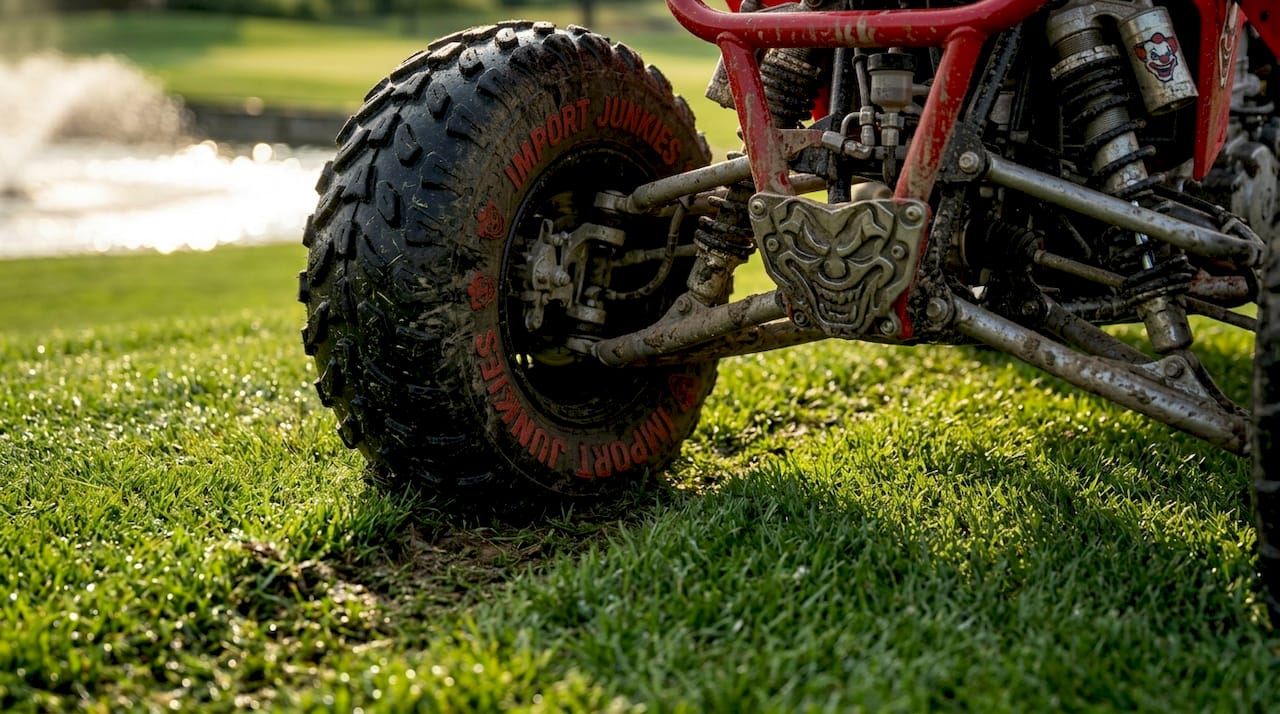
Tire selection is the single biggest variable you can control. Turf tires with shallow, dense tread minimize rutting and visible surface disruption compared to aggressive off-road knobby tires. An ATV wearing standard trail tires on a wet fairway in spring is a liability. The same ATV with purpose-built turf tires on a dry surface in summer is a legitimate work vehicle.
Beyond tires, your operational rules matter just as much:
- Avoid all vehicle traffic on wet or recently irrigated turf whenever possible.
- Tracking on stressed turf can produce damage that lasts weeks, not days.
- Follow USGA-aligned traffic patterns: stay on paths near tees and greens and spread vehicle lines across approaches rather than repeating the same route.
- Restrict ATV access to collars, fringe, and green complexes during heat stress or drought stress periods.
“The most dangerous time to put any vehicle on a golf course is when the turf looks fine on the surface but is already under heat or water stress. The damage from one pass can show up ten days later and take weeks to recover.” — Adapted from golf course superintendent observations on stressed turf vehicle management.
Equipment maintenance experts consistently point out that tire choice is as critical as vehicle selection itself when it comes to minimizing turf impact. That is worth repeating to any operator on your crew who thinks all tires are essentially the same.
ATVs vs. UTVs, golf carts, and specialized equipment
Not every task calls for an ATV. Understanding the full range of golf course vehicles and where each one fits helps you build a maintenance fleet that covers your needs without redundancy or turf damage.
| Vehicle Type | Turf Impact | Payload Capacity | Best Use Case |
|---|---|---|---|
| ATV | Moderate (tire-dependent) | 100–300 lbs | Rough terrain access, material transport, spreading |
| UTV / Side-by-Side | Moderate to high | 500–1,500 lbs | Crew transport, heavy hauling, towing |
| Golf Cart | Low to moderate | 200–400 lbs | Light transport on fairways and paths |
| Tracked Zero-Turn Mower | Low | N/A (mowing only) | Slope and wet-area mowing with minimal compaction |
| Compact Articulated Loader (ATX) | Low for weight class | 800–2,000 lbs | Tree removal, heavy material handling near sensitive turf |
Compact articulated loaders like the Vermeer ATX 850 enable tree removal on golf courses with articulated steering and compact dimensions that protect both turf and underground irrigation lines. For heavy-duty tasks, this class of equipment outperforms an ATV while doing less damage per pound of machine weight. That is a combination standard ATVs simply cannot match when the job involves large logs or deep-rooted stumps.
For day-to-day transport between holes, a well-specified utility vehicle with turf tires will carry more than an ATV and keep two or three crew members together, reducing the total number of vehicle passes on the grass. More trips mean more compaction. When you can consolidate into one vehicle, you should.
Pro Tip: When comparing an ATV to a light UTV for a specific task, count the number of trips each vehicle would require to complete the job. The vehicle that finishes in fewer passes often causes less cumulative turf damage, even if its per-pass footprint is larger.
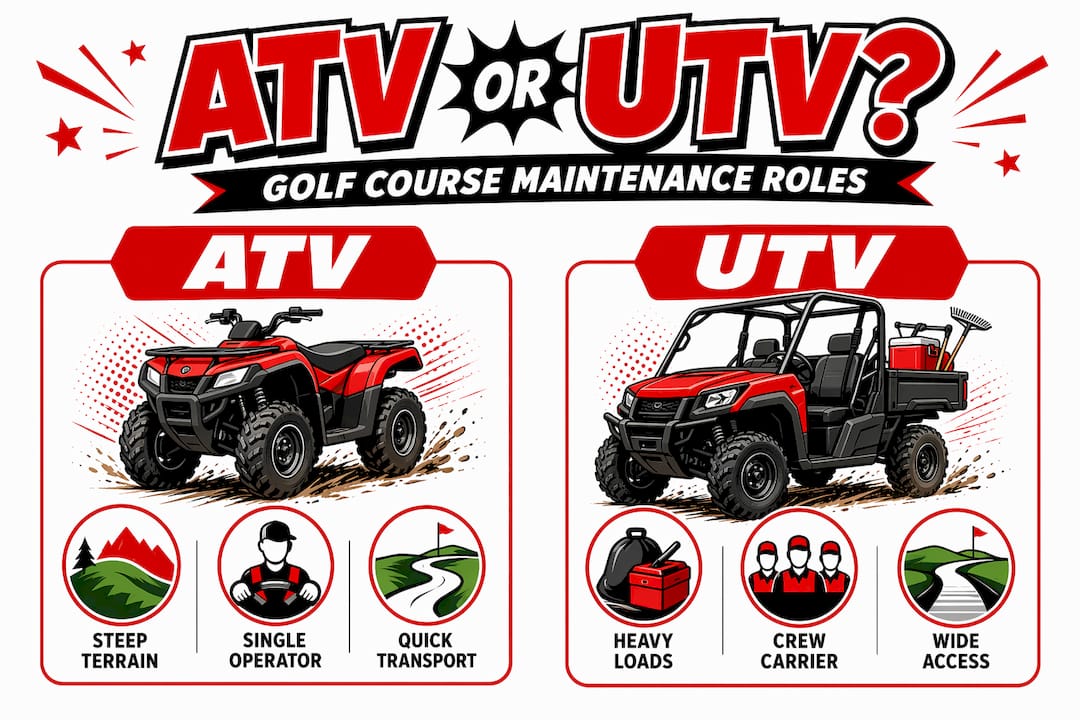
The role of utility vehicles in golf is not one-size-fits-all. ATVs excel at terrain access and single-operator tasks. UTVs win on volume and crew transport. Golf carts keep things light on high-traffic areas. Tracked and articulated equipment handles the jobs where power matters more than agility.
Integrating ATVs effectively and safely
Getting value from ATVs for golf maintenance without damaging what you are trying to maintain comes down to four practical areas: vehicle selection, traffic control, operator training, and seasonal awareness.
-
Select the right ATV. Look for models with a flat rear deck, a payload capacity matching your heaviest task, and the option to fit turf tires from the factory or aftermarket. Four-wheel drive helps on slopes without requiring aggressive tread if you pair it with turf-specific rubber.
-
Build traffic control into your daily plan. Map out permanent and rotating ATV routes that stay away from green collars, tee decks, and any area showing stress. Post those routes for your crew and update them seasonally. Spreading vehicle lines across an approach rather than following the same tire track each day is one of the highest-return habits you can build into standard operating procedure.
-
Train every operator specifically on turf awareness. Knowing how to drive an ATV and knowing how to drive an ATV on a golf course are different skills. Operators need to understand what stressed turf looks like, why turning radius matters on soft ground, and why accelerating or braking hard on grass causes more damage than steady movement.
-
Inspect tires and suspension before each season. Low tire pressure increases the contact patch and actually reduces ground pressure per square inch, which is beneficial. However, worn or cracked turf tires lose the tread characteristics that prevent marking. Replace them before the season, not after the damage appears.
-
Respect seasonal limits. Spring and fall bring the most vehicle-related turf complaints on most courses. Turf coming out of dormancy or heading into it has less tolerance for compaction. Restrict ATV access to essential routes during these windows.
Pro Tip: Set a simple rule for your crew: if your boot heel sinks more than a half-inch when you step on the fairway, no ATV traffic until it firms up. It is a practical field test that requires no equipment and takes two seconds.
A full vehicle maintenance checklist that includes tire pressure checks, chassis inspections, and attachment integrity reviews will catch problems before they translate to turf damage or safety issues. Build it into your weekly routine.
The future of golf course maintenance vehicles
The role of ATVs in golf course maintenance is shifting alongside advances in vehicle technology. Several trends are worth watching as you plan your equipment purchases for the next few seasons.
- Electric ATVs and UTVs produce less vibration and noise, which matters in residential course settings, and their lower operating costs over time offset the higher upfront price. The 48V electric golf UTV category is growing rapidly because of both environmental requirements and noise ordinances near course boundaries.
- Tracked zero-turn mowers now feature advanced suspension systems and excellent turf stability on slopes and wet terrain, reducing the need to send wheeled ATVs into damage-prone areas.
- Smart vehicle integration is beginning to enter the market, with GPS-based traffic logging that shows superintendents exactly where vehicle passes are accumulating and where compaction risk is rising.
- Low-pressure tire technology continues to improve, with specialized turf tires offering better load distribution than what was available even five years ago.
These advances mean the best golf course maintenance fleets five years from now will likely include fewer traditional gas-powered wheeled ATVs and more electric, tracked, and GPS-guided alternatives. The core principles of traffic management and turf sensitivity will remain the same. The tools will just be more precise.
My take on ATVs and turf preservation
I’ve spent a lot of time looking at how maintenance crews actually use ATVs versus how they are supposed to use them, and the gap is larger than most superintendents want to admit. The written protocol says “avoid wet turf.” The daily reality is that a crew member with six tasks before 10 a.m. is not always stopping to check soil firmness before driving across a fairway.
What I’ve learned is that the best protection for your turf is not a better ATV. It is a culture of awareness among your operators. When a crew member understands that one careless pass during heat stress can produce visible damage that takes three weeks to recover and draws complaints from members, that person drives differently. The vehicle matters. The tires matter. But behavior is what determines outcomes on most courses.
I’ve also seen courses where the superintendent insisted on no ATVs near greens, ever, and ran a fleet of properly managed UTVs instead. They had fewer turf incidents overall, not because of the vehicle choice itself, but because the clear rule made every operator more deliberate about where they were driving. Sometimes the value of a policy is as much about creating mindful habits as it is about the specific rule.
My practical advice: buy the right vehicle, fit turf tires, build clear traffic routes, and spend thirty minutes training every operator before the season starts. That combination will outperform any equipment upgrade you make without addressing the human factor.
— Gary
Find the right utility vehicle for your course

If you are evaluating vehicles for your maintenance fleet, Importjunkies carries a range of ATVs and UTVs built for utility work, including models suited for turf-sensitive applications. The 400cc 4x4 utility vehicle with a dump bed gives you genuine hauling capacity across rugged terrain, while compact ATV options like the MSA 300cc 4x4 offer four-wheel drive and versatility for tighter course environments. Importjunkies sells direct to the public at wholesale pricing, so you can spec the right machine for your course without paying a dealer markup. Browse current inventory or reach out directly for guidance on which configuration fits your maintenance tasks.
FAQ
What is the primary role of ATVs in golf course maintenance?
ATVs are used mainly for transporting materials like seed, fertilizer, and tools across the course, and for accessing terrain that larger vehicles cannot reach efficiently. They also support spreading, towing light equipment, and debris removal.
Do ATVs damage turf on golf courses?
They can, particularly when used on wet or stressed turf or fitted with aggressive off-road tires. Soil compaction from vehicle traffic weakens root systems over time, but turf tires and proper traffic routing significantly reduce that risk.
What tires should ATVs use on golf courses?
Turf tires with shallow, dense tread patterns are the right choice. Purpose-built turf tires minimize visible tread marks and surface disruption compared to standard off-road knobby tires.
When should ATVs be restricted from golf course turf?
Restrict ATV traffic whenever turf is wet, recently irrigated, under heat stress, or coming in and out of seasonal dormancy. Tracking on stressed turf can cause damage that remains visible for several weeks.
How do ATVs compare to UTVs for golf course maintenance?
ATVs offer better maneuverability in tight spaces and on rough terrain but carry less payload than UTVs. A utility vehicle comparison between the two generally favors UTVs for crew transport and heavy hauling, while ATVs work better for single-operator tasks across varied terrain.
Recommended
- Optimize Golf Course Vehicles: Essential Maintenance Checklist – Saferwholesale || Import Junkies || Great Sports
- Electric bikes for golf courses: Boost play and sustainability – Saferwholesale || Import Junkies || Great Sports
- Best UTV for Property Maintenance – Saferwholesale || Import Junkies || Great Sports
- How electric vehicles transform golf facility operations – Saferwholesale || Import Junkies || Great Sports


