


 Location
 Login
Login
TL;DR:
- Selecting the correct auto lift depends on your ceiling height, floor condition, vehicle weight, urgency of use, and budget.
- Two-post lifts provide full undercarriage access for repairs, while four-post lifts are ideal for storage and quick servicing.
Auto lifts are specialized equipment designed to raise vehicles off the ground for safe, efficient access during repair and maintenance work. There are nine primary types of automotive lifts, and choosing the wrong one can waste anywhere from $2,000 to $15,000. Whether you run a professional shop or work out of a two-car garage on weekends, the right lift depends on your ceiling height, floor specs, vehicle weight, and how you actually use the space. This guide covers every major category, including two-post, four-post, scissor, portable, and in-ground lifts, so you can buy with confidence.
1. What are the main types of auto lifts?
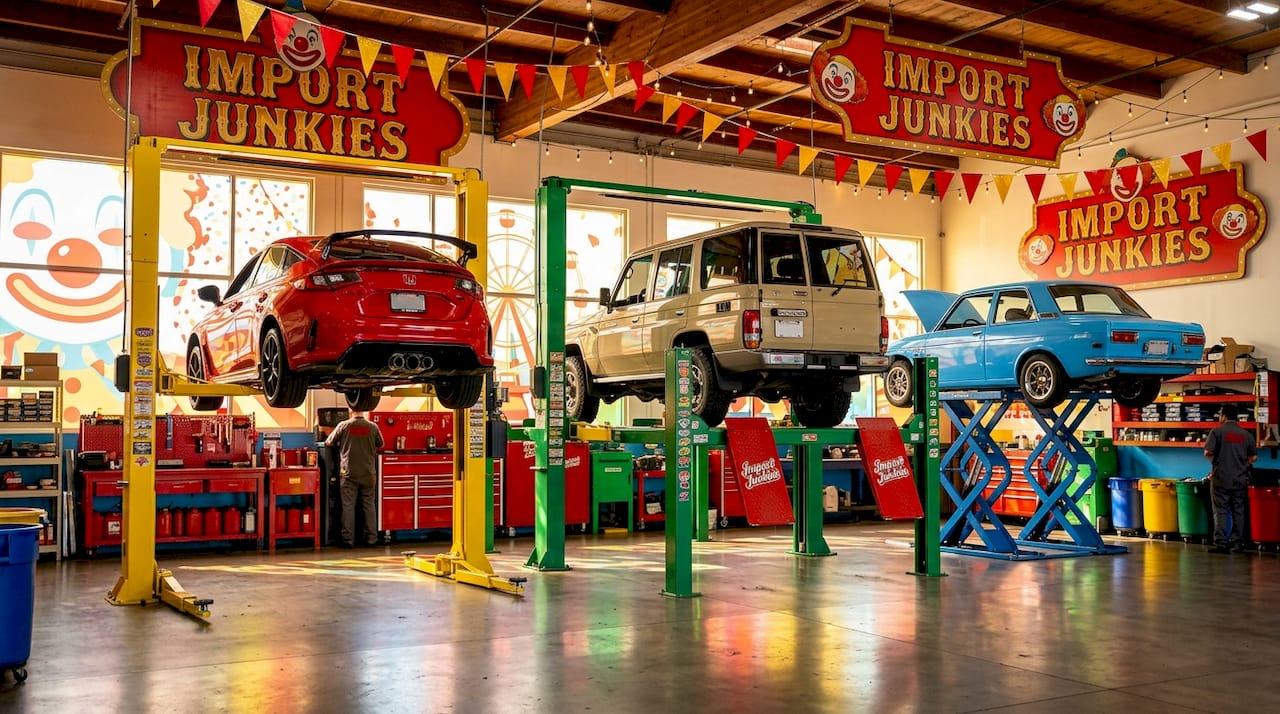
The nine recognized categories of automotive lifts are two-post, four-post, scissor, portable, single-post, in-ground, alignment, mobile column, and overhead or platform lifts. Each serves a distinct purpose, and no single type covers every use case. Professional garages mostly rely on two-post lifts for repair work, while DIY users and small garages benefit most from scissor or portable options.
Here is a quick breakdown of each category:
- Two-post lifts: Best for full undercarriage access during brake, suspension, and exhaust work.
- Four-post lifts: Designed for vehicle storage and quick service without full undercarriage access.
- Scissor lifts (low-rise and mid-rise): Compact options that work well in low-ceiling garages. Mid-rise scissor lifts offer up to 2.1 meters of lifting height, making them practical where vertical clearance is limited.
- Portable lifts: Brands like QuickJack and MaxJax offer flexible, movable solutions for home garages and shared spaces.
- Single-post lifts: Compact column lifts used in tight commercial bays.
- In-ground lifts: Flush-mounted systems that preserve garage aesthetics at a premium cost.
- Alignment lifts: Specialized platforms built for wheel alignment service.
- Mobile column lifts: Freestanding units that move around the vehicle, used for buses, RVs, and heavy trucks.
- Overhead or platform lifts: Ceiling-mounted or elevated platform systems for specialty applications.
Pro Tip: Before you research prices, write down your ceiling height, floor thickness, and the heaviest vehicle you plan to lift. Those three numbers will eliminate at least half the options immediately.
2. Two-post vs. four-post lifts: features, cost, and fit
Two-post and four-post lifts are the two most common car lift systems in both professional and home garages, but they serve different primary functions. Understanding that difference before you buy prevents a costly mismatch.
Two-post lifts grip the vehicle by its frame or pinch welds using swing arms, leaving the entire undercarriage exposed. This makes them the standard choice for brake jobs, exhaust replacement, and suspension work. The trade-off is that two-post lifts require a concrete floor rated at a minimum of 4,000 PSI, significant vertical clearance, and professional installation. Ceiling height must account for the full raised vehicle height, not just the post height. A full-size truck raised on a two-post lift in a standard 10-foot garage ceiling will not clear. Budget $2,500 to $5,000 for a quality two-post unit, plus installation.
Four-post lifts use a drive-on ramp design, which means the vehicle sits on platforms rather than being cradled by swing arms. This makes them faster to load and ideal for long-term storage. The GSI 8,000 lb four-post lift is a strong example of a heavy-duty storage-focused unit that some users can self-install with basic mechanical skills. Four-post lifts typically cost $2,000 to $4,500 and require less ceiling clearance than two-post models.
| Feature | Two-post lift | Four-post lift |
|---|---|---|
| Primary use | Repair and maintenance | Storage and quick service |
| Undercarriage access | Full | Limited |
| Installation | Professional required | Often DIY-capable |
| Ceiling clearance needed | High | Moderate |
| Typical price range | $2,500 to $5,000 | $2,000 to $4,500 |
| Best for | Mechanics and repair shops | Enthusiasts and storage |
3. Scissor and portable lifts for small or home garages
Scissor lifts and portable lifts solve the same core problem: how do you get a vehicle off the ground when you do not have the ceiling height, floor space, or budget for a full two-post or four-post system?
Low-rise scissor lifts sit nearly flat on the floor and raise the vehicle just enough for tire and brake work, typically 24 to 30 inches. Mid-rise scissor lifts push that to around 40 inches, which is enough for most undercarriage tasks. The electric mid-rise scissor lift with 8,000 lb capacity from Importjunkies is a practical example of a unit that handles most passenger cars and light trucks without requiring a ceiling over 10 feet.
Portable lifts like QuickJack and MaxJax are popular with home mechanics because they store flat and deploy when needed. However, portable lifts require anchoring in many configurations, and the hydraulic line setup and calibration take more time than most buyers expect. The setup process is significantly more involved than a standard floor jack, and skipping calibration steps creates real safety risk.
- Portable lift capacity typically ranges from 3,500 to 7,000 lbs.
- Low-rise scissor lifts work well for sports cars and lowered vehicles.
- Mid-rise units are the better choice if you need to work standing up.
- Both types require a level, solid concrete floor for safe operation.
Pro Tip: If your garage floor has cracks or uneven sections, fix those before installing any lift. A compromised floor is the most common cause of lift instability, regardless of the lift type.
4. Specialized lifts for commercial and heavy-duty applications
Once you move beyond standard passenger vehicles into commercial trucks, buses, RVs, or custom projects, the lift requirements change significantly. Standard residential lift designs are not engineered for these loads, and using them outside their rated capacity is a safety violation.
In-ground lifts are installed flush with the floor, which preserves the clean look of a high-end garage or showroom. They are the most expensive option, often running $10,000 to $30,000 installed, and require excavation and waterproofing. The payoff is a completely unobstructed workspace with no posts in the way.
Alignment lifts are purpose-built platforms that allow free movement of the steering and suspension during wheel alignment service. They are standard equipment in tire shops and alignment centers, and they are not a substitute for a general-purpose repair lift.
Mobile column lifts are freestanding units that position around a vehicle independently. They are the standard solution for lifting buses, RVs, and heavy commercial trucks where a fixed lift cannot accommodate the vehicle’s length or width.
Custom-engineered residential lifts represent the far end of the spectrum. Complex hydraulic systems for custom projects can include velocity fuses, chain leveling for load variance, and computer load modeling, with travel speeds around 96 inches per minute and capacities exceeding 12,000 lbs. These projects require licensed engineering review, not just a product purchase.
Heavy-duty industrial lifts from manufacturers like Advance Lifts often carry warranties up to 10 years and include features like 90-degree load rotation for engine and drivetrain components. For long-term professional use, warranty terms and hydraulic design quality matter as much as raw capacity numbers.
5. How to choose the right auto lift for your garage
Matching a lift to your specific situation comes down to five concrete factors: ceiling height, floor condition, vehicle weight, intended use, and budget. Getting any one of these wrong leads to either a lift you cannot safely install or one that does not do the job you bought it for.
- Measure your ceiling height first. The ceiling must clear the full raised height of your tallest vehicle, not just the lift’s post height. A truck on a two-post lift can easily require 12 feet of clearance.
- Know your vehicle weight. Experts recommend a safety margin of 80 to 100% above the vehicle’s actual weight. For a vehicle weighing 5,000 lbs, you need a lift rated at 9,000 to 10,000 lbs minimum.
- Account for EVs specifically. Heavier electric vehicles like the GMC Hummer EV weigh around 9,000 lbs, which means an 18,000 lb capacity lift is the correct safety spec. Buying a 10,000 lb lift for an EV is a mistake that costs more to fix than it saved upfront.
- Check your floor. Two-post lifts require 4,000 PSI concrete at adequate depth. Older garage slabs often do not meet this spec without reinforcement.
- Match the lift to the work. If you primarily do oil changes and tire rotations, a mid-rise scissor lift handles that efficiently. If you rebuild suspensions and replace exhaust systems, a two-post lift is the correct tool.
Pro Tip: Always buy one capacity tier above what you think you need. Vehicles are getting heavier every year, and a lift that is undersized for your next vehicle purchase is money wasted.
Key takeaways
Selecting the right auto lift requires matching lift type to your ceiling height, floor spec, vehicle weight, and primary use before comparing prices.
| Point | Details |
|---|---|
| Two-post lifts lead for repair work | Full undercarriage access makes them the standard choice in professional garages. |
| Four-post lifts suit storage and service | Drive-on design is faster to load and often DIY-installable for home garages. |
| Scissor and portable lifts save space | Mid-rise scissor lifts reach up to 2.1 meters and work in low-ceiling garages. |
| Safety margins are non-negotiable | Use a lift rated 80 to 100% above your vehicle’s actual weight for safe operation. |
| EVs require higher capacity ratings | A 9,000 lb EV needs an 18,000 lb rated lift to meet the recommended safety margin. |
What I’ve learned after years of watching people buy the wrong lift
The most common mistake I see is buyers shopping by price first and ceiling height second. A $1,800 two-post lift is a bad deal if your garage ceiling is 9.5 feet and your daily driver is a full-size pickup. You end up with a lift you cannot safely use, and returning a 1,000-pound piece of equipment is not a simple process.
For most professional garages, a quality two-post lift in the 10,000 lb range covers the majority of vehicles without issue. The GSI commercial 10,000 lb two-post lift is the kind of unit that makes sense for a serious shop because the capacity handles light trucks and most SUVs with room to spare.
For DIYers with a single-car or two-car garage, I consistently recommend a mid-rise scissor lift over a portable lift. The setup is simpler, the stability is better, and you are not dealing with hydraulic line connections every time you want to use it. Portable lifts are genuinely useful for specific situations, like working in a shared space or taking a lift to a track day, but they are not the right everyday solution for most home mechanics.
The EV factor is real and growing. If you own or plan to own an electric vehicle, build your lift purchase around that weight class now. Buying a lift that works for your current car but not your next one is money parked in the garage doing nothing.
— Gary
Find the right lift at Importjunkies

Importjunkies carries a range of automotive lifts suited to both professional mechanics and serious home garage users. The GSI commercial 10,000 lb two-post lift is built for repair shops and advanced enthusiasts who need full undercarriage access and heavy-duty capacity. For storage-focused setups, the GSI 8,000 lb four-post lift delivers drive-on convenience with solid durability. If space is the constraint, the compact scissor lift table offers an affordable entry point for smaller garages. Browse the full product specs and pricing at Importjunkies to find the unit that fits your space and your work.
FAQ
What is an auto lift?
An auto lift is a mechanical or hydraulic device designed to raise a vehicle off the ground for maintenance, repair, or storage. The nine main types include two-post, four-post, scissor, portable, in-ground, alignment, single-post, mobile column, and overhead platform lifts.
How much weight capacity do I need in a car lift?
Experts recommend selecting a lift rated 80 to 100% above your vehicle’s actual weight. For a 5,000 lb vehicle, a 9,000 to 10,000 lb capacity lift is the correct spec.
Can I install a two-post lift myself?
Two-post lifts require professional installation in most cases because they demand a concrete floor rated at 4,000 PSI minimum and precise ceiling clearance calculations. Improper installation creates serious safety risk.
Are portable lifts safe for regular home garage use?
Portable lifts like QuickJack and MaxJax are safe when used correctly, but they require anchoring, hydraulic calibration, and a level concrete surface. Setup is more involved than most buyers expect, and skipping any step increases risk.
What lift do I need for an electric vehicle?
Heavy EVs like the GMC Hummer EV weigh around 9,000 lbs, which means an 18,000 lb capacity lift is the recommended safety spec. Standard 10,000 lb lifts do not meet the 80 to 100% safety margin for vehicles in this weight class.
Recommended
- What Is a Portable Car Lift? a DIY Buyer’s Guide – Saferwholesale || Import Junkies || Great Sports
- GSI - 8000 lb 4 Post Auto Lift Heavy Duty Automotive Portable Storage – Saferwholesale || Import Junkies || Great Sports
- GSI - Commercial 10,000 LB Automotive Lift 2 Post Vehicle Lift Car Aut – Saferwholesale || Import Junkies || Great Sports
- GSI - Automotive Lift 2 Post Car Vehicle Lift Commercial 10,000 LB GSI – Saferwholesale || Import Junkies || Great Sports


