


 Location
 Login
Login
TL;DR:
- Choosing the right recreational vehicle requires matching it to your primary use, land restrictions, and passenger needs. Accurate category selection, considering operational costs, and understanding legal definitions ensure compliance and satisfaction. Proper research, testing in real conditions, and consulting local authorities help avoid costly mistakes and narrow your ideal options.
Picking the right recreational vehicle feels straightforward until you’re standing in front of a dealer website or scrolling through listings and realize that an ATV, a UTV, a side-by-side, and a utility vehicle all seem to mean different things depending on who you ask. Add golf carts, towable RVs, and motorhomes to the mix, and the picture gets complicated fast. This guide cuts through the overlap by breaking down each major category, explaining what it’s actually designed to do, and giving you a practical framework to match the right vehicle to your specific situation before you spend a dollar.
Table of Contents
- How to match a recreational vehicle to your needs
- All-terrain vehicles (ATVs): Types and purposes
- UTVs, golf carts, and utility vehicles: Features and legal definitions
- RVs and campers: Motorized vs. towable models
- Which vehicle type is best for your scenario?
- What most buyers overlook when choosing recreational vehicles
- Ready to find your perfect recreational vehicle?
- Frequently asked questions
Key Takeaways
| Point | Details |
|---|---|
| Choose by purpose | The best recreational vehicle is one matched to your core activity, whether it’s work, sport, or travel. |
| Understand regulations | Legal definitions and land use rules are essential for compliance and safe operation of any vehicle type. |
| Compare capabilities | ATVs, UTVs, golf carts, and RVs each have unique strengths and limitations for different scenarios. |
| Consider ownership costs | Maintenance, transportation, and storage add important expenses beyond sticker price. |
| Test before you buy | Whenever possible, try the vehicle in its actual environment to avoid costly surprises. |
How to match a recreational vehicle to your needs
Before digging into specific kinds of vehicles, let’s clarify the main factors you should consider when making a choice.
The single most important step is defining your primary use case. Are you maintaining a large property, heading out on weekend trail rides, hunting in remote terrain, or planning cross-country camping trips with the family? Each of those activities points toward a different vehicle category entirely. As ATV research consistently confirms, the first step is matching the vehicle to its primary job, because category determines capability and ownership constraints from the start.
Here’s a quick checklist of practical questions to work through before you ever browse inventory:
- Where will you use the vehicle most often: private land, public trails, campgrounds, or paved paths?
- How many passengers do you need to carry regularly?
- Do you need to haul, tow, or plow in addition to riding?
- What is your realistic storage and transport setup at home?
- What is your state’s licensing requirement for this category?
- Are there local land-use rules that restrict certain vehicle types in your area?
That last point matters more than most buyers realize. Public land rules can restrict where off-road vehicles operate and require permits, which means “vehicle type” is not just a purchase category. It directly affects your compliance planning before you even hit the trail.
Pro Tip: Before finalizing any purchase, call your county parks office or contact the land management authority for the area where you plan to ride. A five-minute conversation can save you hundreds of dollars in permits, fines, or a wasted purchase.
“The right vehicle for your neighbor may be completely wrong for your property, your terrain, and your local regulations. Match function to situation first, then refine by features.”
For broader context on how different vehicle types compare at a high level, our off-road vehicle guide is a useful starting point before diving deeper.
All-terrain vehicles (ATVs): Types and purposes
With these criteria in mind, let’s explore the full range of all-terrain vehicles and how each sub-type meets different needs.
ATVs fall into several purpose-based categories: sport, utility/work, recreational/trail, youth, and multi-purpose. The differences between them go beyond engine size. They affect how the vehicle handles, what attachments it can support, and who should be operating it.
Here’s a breakdown of the key distinctions:
| ATV category | Primary use | Best features |
|---|---|---|
| Sport | Racing, aggressive trail riding | High horsepower, responsive suspension, lightweight frame |
| Utility | Property work, hauling, plowing | High torque, rack capacity, towing hitch |
| Recreational/trail | Casual riding, mixed terrain | Balanced power, easy controls, comfortable ergonomics |
| Youth | Kids learning to ride | Speed limiters, smaller frame, safety features |
| Multi-purpose | Work and weekend riding | Versatile attachments, mid-range power output |
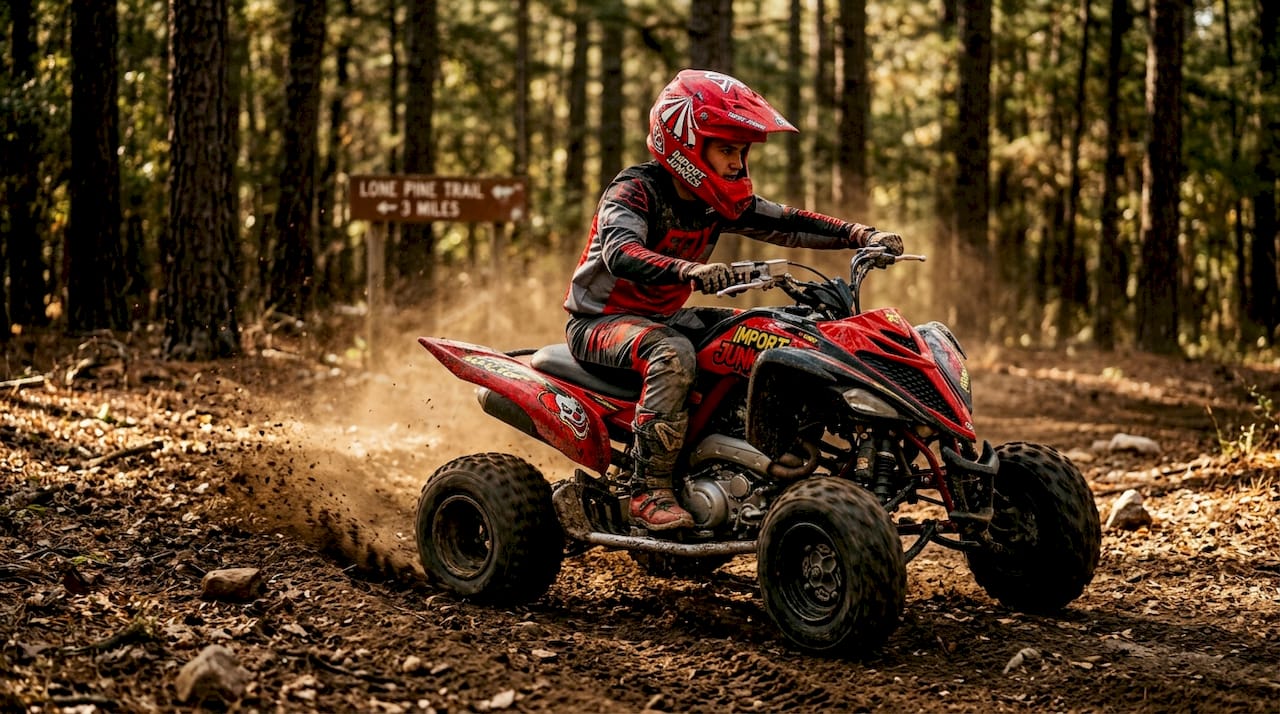
Sport ATVs are built for performance. They prioritize speed, tight turning radius, and suspension travel for rough, fast terrain. These are not ideal for property work because they typically lack rear cargo racks and towing capacity.
Utility ATVs are the workhorses of the category. They can plow snow, haul feed, tow trailers, and handle heavy loads across uneven ground. If you manage acreage or work outdoors professionally, this sub-type deserves serious consideration. A specific example of a capable utility-style ATV is the 4x4 ATV with snow plow, which bridges the gap between ATV versatility and UTV-level utility.
Recreational and trail ATVs sit in the middle. They are not stripped down for racing, and they are not overbuilt for heavy work. They handle well on moderate terrain, which makes them an excellent first ATV for adults who want to explore trails on weekends without committing to a dedicated sport or utility machine.
Youth ATVs come with built-in safety features including throttle limiters and automatic transmissions, which are important for riders who are still developing their skills and judgment. Frame size and seat height are intentionally smaller.
Pro Tip: If you’re purchasing for someone who will alternate between weekend riding and property maintenance tasks, look at multi-purpose or utility models rather than sport. A sport ATV will feel great on the trail but underperform as a work tool. You can also find unconventional options like utility trikes that offer three-wheel stability for specific hauling or recreational scenarios.
UTVs, golf carts, and utility vehicles: Features and legal definitions
ATVs are just the beginning. Here’s how utility vehicles, UTVs, and golf carts fit into the bigger picture, including how state and manufacturer definitions impact your options.
One of the most common points of confusion involves UTVs and ATVs being used interchangeably in casual conversation. They are not the same. State regulatory definitions and manufacturer guidance treat them as distinct vehicle categories with different steering, seating configurations, and legal treatment. This distinction is not just technical. It affects registration, where you can legally operate the vehicle, and what safety equipment is required.
Here is a side-by-side comparison to make those differences clear:
| Vehicle type | Seating configuration | Steering | Legal status | Ideal environment |
|---|---|---|---|---|
| ATV | Straddle seat | Handlebars | Regulated as OHV | Off-road trails, private land |
| UTV/side-by-side | Side-by-side seats | Steering wheel | Regulated as OHV or SxS | Off-road, heavy property work |
| Golf cart | Bench or forward seats | Steering wheel | Not classified as ATV | Golf courses, resorts, communities |
| Utility truck | Truck-style cab | Steering wheel | Varies by state | Commercial, agricultural, resort use |
UTVs, often called side-by-sides, carry two or more passengers in a car-style configuration. They are built for serious work: hauling materials, towing equipment trailers, and operating over rough terrain with a full cab. Common add-ons include dump beds, cab enclosures, and winches. If you’re managing a large property and need to carry tools and a coworker at the same time, a UTV is usually the right answer. You can review specific applications in our guide on property maintenance UTVs.
Golf carts are a different animal entirely. Most states explicitly exclude them from ATV or OHV classifications. They are designed for low-speed, low-impact environments: golf courses, retirement communities, resorts, and campgrounds with paved or packed-surface paths. Electric golf carts dominate the market because they are quiet, low-maintenance, and inexpensive to charge. Gas models offer extended range but require more upkeep. If you’re deciding between a golf cart and an ATV for general property use, our comparison on golf carts vs. ATVs walks through the key trade-offs in detail.
Utility trucks are a step above golf carts in terms of payload capacity and durability. They are commonly used in agricultural settings, large commercial facilities, and resorts where moving heavy cargo efficiently matters. For a direct comparison of what each brings to a working environment, see our breakdown of utility trucks versus golf carts.
“Calling a UTV an ‘ATV’ at a trailhead or on a permit application can create real compliance problems. These categories carry different legal weight depending on your state and the land management authority.”
RVs and campers: Motorized vs. towable models
For those focused on travel and overnight comfort, recreational vehicles offer diverse options. Here’s how to pick between motorized and towable models.
The RV category is among the broadest in the recreational vehicle market. Industry sources categorize RVs into motorhomes by class and towable RVs, which include travel trailers, fifth wheels, pop-ups, and truck campers. The practical split that matters most to buyers is motorized versus towable.
Motorized RVs are self-contained vehicles with their own engine. They break down into three classes:
- Class A: The largest motorhomes, built on bus or commercial truck frames. Full kitchen, bathroom, sleeping, and living space. Requires significant driving skill and dedicated storage.
- Class B: Campervans built on standard van platforms. Easy to drive and park. Limited interior space but excellent fuel efficiency relative to other motorhome classes.
- Class C: A middle ground built on a cutaway truck chassis with an over-cab sleeping area. More livable than Class B with easier driving than Class A.
Towable RVs require a separate tow vehicle, which is either a truck or an SUV with adequate towing capacity. A practical way to think about towable RVs is that drivability and towing requirements vary significantly by model type and weight. The main categories include:
- Travel trailers: The most popular type, available in a wide range of sizes and price points.
- Fifth wheels: Tow with a pickup truck and a specialized hitch mounted in the bed. More spacious than travel trailers and more stable at highway speeds.
- Pop-up campers: Lightweight and foldable, ideal for casual campers who want minimal setup and easy towing with a standard vehicle.
- Truck campers: Slide into the bed of a pickup truck. Compact, capable of reaching remote locations that wheeled trailers cannot.
Towable RVs represent over 60% of the U.S. RV market, and for good reason. They cost less upfront than motorhomes, and when your tow vehicle needs service, your living space stays functional. The trade-off is that you need a capable tow vehicle and you cannot detach easily once you’ve set up camp.
Ownership considerations for RVs include insurance costs (which scale with vehicle value and motorized status), storage fees when not in use, and licensing requirements. Class A motorhomes often require a non-commercial driver’s license endorsement in certain states, so check local requirements before purchasing.
Which vehicle type is best for your scenario?
Now that you’ve seen the distinctions, here’s how they map to common real-world use cases:
| Scenario | Best vehicle type | Why it fits |
|---|---|---|
| Property maintenance on 10+ acres | UTV | High payload, towing capacity, passenger seating |
| Weekend trail riding solo | Sport or trail ATV | Maneuverability, off-road suspension, light weight |
| Hunting on remote terrain | Utility ATV or UTV | Quiet, load-carrying, 4x4 capability |
| Golf course or resort transport | Golf cart | Low speed, quiet, minimal maintenance |
| Family camping road trips | Class C motorhome or travel trailer | Comfort, living space, accessibility |
| Light property errands | Multi-purpose ATV or golf cart | Cost-effective, easy to operate |
As vehicle category research confirms, category determines expected capability, whether that’s hauling and towing on UTVs or the towing requirements tied to towable RVs. Getting that category match right from the start avoids costly trade-ins or underused equipment sitting idle.
Before you finalize your shortlist, answer these three questions:
- What is the single most common task this vehicle will perform?
- Will it be used on private land only, or do you need public trail or road access?
- How many people need to ride at the same time?
For a more structured buying process, our utility vehicles checklist gives you a step-by-step framework for evaluating any vehicle against your specific requirements.
What most buyers overlook when choosing recreational vehicles
Reviewing the options is helpful, but let’s address what most people miss until after they’ve made a purchase.
The biggest mistake we see is buying for specs rather than fit. A buyer sees a 700cc engine, four-wheel drive, and a 1,200-pound towing capacity and assumes it’s the right vehicle. Then they use it once a month on a small lot and realize they bought far more machine than their situation ever needed. More features are not inherently better. The right vehicle is the one that matches your actual conditions, not your ideal scenario.
Overlooked costs compound the problem. Maintenance schedules, trailer or rack accessories, storage fees, insurance, and permit costs add up quickly. A UTV that costs $8,000 at purchase can easily cost another $2,000 in its first year once you account for tires, oil changes, registration, and a proper storage cover. Factor those in before comparing sticker prices.
Local rules change the right answer entirely. You might decide on a sport ATV based on online research, then discover your state park system prohibits ATVs over a certain engine displacement on designated trails. Or you might learn your HOA restricts golf cart use to specific hours. Those conditions are not visible in a product listing, but they are completely visible to your local land authority or property manager.
Finally, test-drive whenever you can in conditions that actually reflect your intended environment. Riding a golf cart on a smooth showroom floor tells you nothing about how it handles a grass incline. If you’re comparing golf carts and ATVs for mixed-terrain use, that real-world test matters far more than any spec sheet comparison.
Ready to find your perfect recreational vehicle?
If this breakdown helped clarify what category fits your situation, the next step is putting that knowledge to work with real inventory. At Import Junkies, we carry a wide selection of ATVs, UTVs, golf carts, utility trucks, and more, all available to browse and purchase directly online at competitive wholesale prices.

Whether you need a capable 4x4 utility-style ATV for property work and winter conditions, or you’re looking at utility vehicles built for maintenance tasks on larger properties, our product pages include detailed specs, pricing, and images to make comparison straightforward. Reach out to our team with any questions about which model fits your specific terrain and workload. We’re here to help you buy smart, not just buy fast.
Frequently asked questions
What is the main difference between an ATV and a UTV?
ATVs use handlebars and a straddle seat designed for one rider, while UTVs feature a steering wheel and side-by-side seating for two or more passengers. State regulations treat them as distinct legal categories with separate requirements.
Are golf carts considered ATVs by law?
No. Most states specifically exclude golf carts from ATV classifications by legal definition. Under Minnesota OHV regulations, golf carts and electric-assisted bicycles are not classified as ATVs.
What types of RVs are easiest to drive for beginners?
Class B motorhomes (campervans) and smaller towable travel trailers are the most beginner-friendly options due to their compact footprint and simpler handling. Motorhome classes differ significantly in size, maneuverability, and skill requirements.
Do you need a special license to drive a UTV or side-by-side?
Most states do not require a special license for UTV operation on private property, but public land regulations may require additional permits or registrations depending on the area.
Can you use ATVs and UTVs on public land everywhere?
No. Access to public land trails is governed by local and federal land management agencies, and restrictions vary widely by region. Always verify local trail rules before planning a ride on public land.
Recommended
- Your guide to every type of off-road vehicle – Saferwholesale || Import Junkies || Great Sports
- Utility Vehicles Explained: Uses, Types, and Right Fit – Saferwholesale || Import Junkies || Great Sports
- Utility trucks vs. golf carts: which delivers more value? – Saferwholesale || Import Junkies || Great Sports
- Golf carts vs. ATVs: Choosing the best utility vehicle – Saferwholesale || Import Junkies || Great Sports


