


 Location
 Login
Login
TL;DR:
- Vehicle classification categories depend on size, weight, and use, affecting fees, registration, and legal operation. Different systems like EPA, FHWA, and UK MOT classify vehicles separately, so knowing the actual specifications is essential. Verifying proper classification prevents costly fines, insurance issues, and ensures legal compliance for your vehicle.
Vehicle classes are defined categories that group vehicles by size, weight, intended use, and interior volume to guide purchasing decisions, registration requirements, and legal compliance. The U.S. EPA, the Federal Highway Administration (FHWA), and the UK’s MOT system each apply their own classification frameworks, and understanding vehicle classes across these systems directly affects what you pay, what you can legally operate, and what a vehicle can actually do for you. Whether you’re shopping for a compact car, a utility truck, or an electric golf cart, knowing how the classification system works puts you in control of the buying process.
What are vehicle classes and how are they defined?
Vehicle classes are defined by a combination of interior volume, gross vehicle weight rating (GVWR), body style, and intended use. No single agency controls all classifications. The EPA handles passenger cars, the FHWA handles commercial trucks, and the UK MOT system governs inspection classes for vehicles registered in Britain. Each system serves a different purpose, but all of them affect real money and real legal obligations.
The key distinction most buyers miss is this: classification is not the same as marketing segment. A vehicle marketed as a “crossover SUV” may fall into the same EPA volume class as a mid-size sedan. A “light-duty pickup” may sit in FHWA Class 1 or Class 2 depending on its GVWR. Relying on a manufacturer’s label without checking the actual specs is how buyers end up with the wrong vehicle for their needs.
Registration class codes function as financial documents, not just descriptive labels. They dictate fees, insurance obligations, and inspection requirements. Getting the classification wrong at registration can trigger fines and coverage gaps.
How are passenger cars classified by size and interior volume?

The EPA classifies passenger vehicles based on total interior passenger and cargo volume. Passenger car volume classes range from “Two-seaters” at the low end to “Large” cars with over 120 cubic feet of combined interior volume. This scale gives you a concrete, measurable way to compare vehicles that marketing terms like “compact” or “full-size” often obscure.
| EPA Passenger Car Class | Interior Volume (cu ft) | Typical Examples |
|---|---|---|
| Two-seater | Any size | Sports cars, roadsters |
| Minicompact | Under 85 | Small coupes, city cars |
| Subcompact | 85–99 | Hatchbacks, entry sedans |
| Compact | 100–109 | Mid-range sedans, small SUVs |
| Mid-size | 110–119 | Family sedans, crossovers |
| Large | 120+ | Full-size sedans, large SUVs |
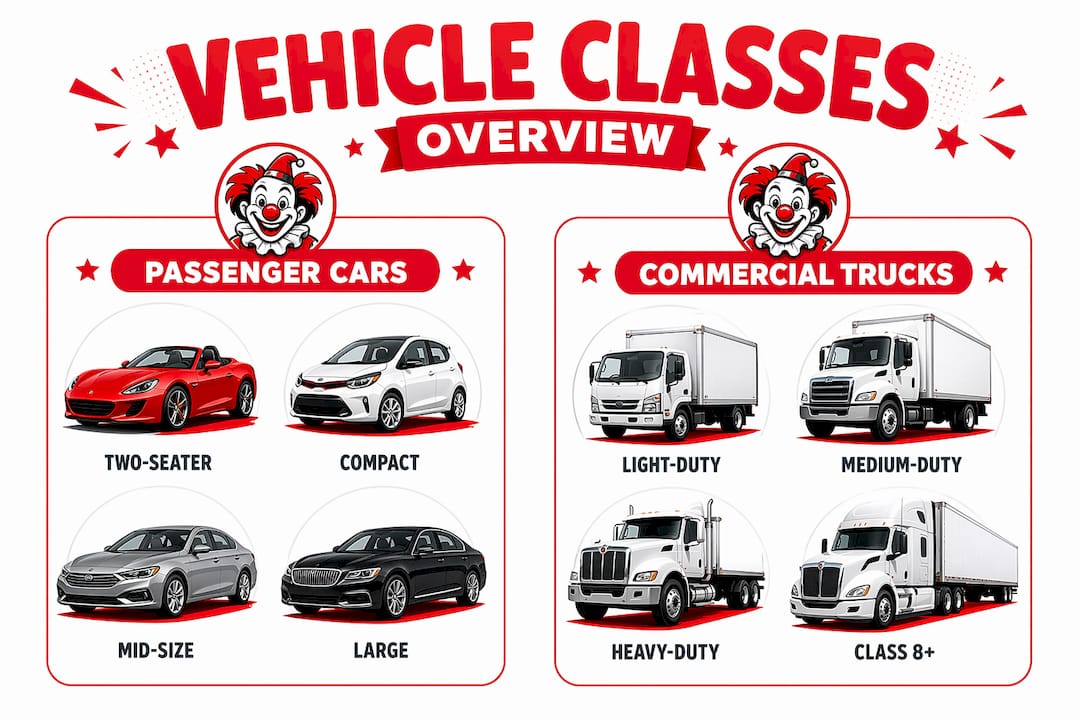
European markets use A through E segments (and beyond) to classify passenger cars by size and price tier. The A-segment covers city cars like the Smart ForTwo, while the D-segment covers executive sedans like the BMW 3 Series. These segments roughly parallel EPA classes but are not interchangeable. If you’re comparing a European import to a domestic vehicle, check the actual volume figures rather than assuming segment labels align.
Sedans, hatchbacks, and SUVs all appear across multiple EPA classes. A compact SUV and a mid-size sedan can share the same EPA class if their interior volumes match. That overlap is exactly why Kelley Blue Book editors advise evaluating cargo volume, towing capacity, and safety features over segment names when choosing a vehicle.
Pro Tip: Look up the EPA’s official fuel economy data at fueleconomy.gov. Every listed vehicle includes its EPA size class, which gives you a classification anchor that no marketing brochure can override.
How does GVWR determine commercial truck classification?
GVWR is the maximum weight a vehicle is rated to carry safely, including passengers, cargo, and fuel. It is not the vehicle’s curb weight. GVWR is the absolute key metric for legal classification of trucks and commercial vehicles in the United States.
The FHWA divides commercial trucks into eight classes based on GVWR:
| FHWA Class | GVWR Range | Typical Vehicles |
|---|---|---|
| Class 1 | 0–6,000 lbs | Small pickups, minivans |
| Class 2 | 6,001–10,000 lbs | Full-size pickups, large vans |
| Class 3 | 10,001–14,000 lbs | Large cargo vans, medium pickups |
| Class 4 | 14,001–16,000 lbs | City delivery trucks |
| Class 5 | 16,001–19,500 lbs | Bucket trucks, large walk-ins |
| Class 6 | 19,501–26,000 lbs | School buses, beverage trucks |
| Class 7 | 26,001–33,000 lbs | City transit buses, refuse trucks |
| Class 8 | 33,001+ lbs | Semi-trailers, heavy fire apparatus |
Class 8 trucks exceed 33,001 lbs and include semi-trailers and heavy fire apparatus. These vehicles require commercial driver’s licenses, specialized insurance, and are subject to federal safety regulations that do not apply to lighter classes. The EPA excludes heavy-duty vehicles from its passenger car volume classification scheme entirely.
Light-duty vehicles (Classes 1–2) cover most consumer pickups and vans. Medium-duty (Classes 3–6) covers delivery and service fleets. Heavy-duty (Classes 7–8) covers freight and industrial transport. Your GVWR label is stamped inside the driver’s door jamb. That label is the most reliable classification source you have.
Pro Tip: Before buying any used truck or van for commercial use, photograph the door jamb GVWR label and cross-reference it with your state’s commercial vehicle registration thresholds. A single class difference can change your annual fees significantly.
What are UK MOT vehicle classes and why do they matter?
The UK MOT system assigns vehicles to classes 1 through 7 based on vehicle type, seating capacity, and design gross weight. Most private passenger vehicles require a Class 4 test, which covers cars and light vehicles with up to 8 passenger seats and a design weight up to 3,000 kg.
The classes most buyers encounter are:
- Class 1 and 2: Motorcycles, with and without sidecars
- Class 3: Three-wheeled vehicles under 450 kg unladen
- Class 4: Cars, taxis, and light vans up to 8 seats and 3,000 kg design weight
- Class 5: Larger passenger vehicles with more than 8 seats
- Class 7: Light goods vehicles from 3,000 kg to 3,500 kg design weight
Statutory maximum MOT fees are capped by class. Class 4 tests are capped at £54.85, while Class 5 and Class 7 tests are capped at £58.60. That difference matters when you’re budgeting annual ownership costs for a commercial van versus a passenger car.
Class 7 involves stricter inspection criteria than Class 4, including additional load and brake checks. Test stations must be authorized to test specific classes. If you bring a Class 7 vehicle to a station only certified for Class 4, the test will be refused. Knowing your vehicle’s MOT class before booking saves you time and avoids unexpected fees.
How vehicle classification affects ownership costs and registration fees
Vehicle classification directly determines what you pay to own and operate a vehicle legally. Registration class codes summarize weight, fuel source, body type, and intended use. Those codes then drive fee schedules, tax obligations, and required inspections at the state and federal level.
The GVWR stamped in your driver’s door jamb is the key to correct classification. Misclassification can cause fines and insurance issues that cost far more than any registration fee difference. If your vehicle is registered in the wrong class, your insurer may deny a claim on the grounds that the vehicle was improperly documented.
Electric vehicle owners face an additional cost layer. Roughly 40 U.S. states now impose annual EV surcharges averaging $140 to offset road maintenance funding gaps caused by EVs not paying fuel taxes. Plug-in hybrids typically pay lower surcharges due to partial fuel use. If you’re buying an electric utility vehicle or golf cart for regular road use, factor that annual surcharge into your total cost of ownership.
Key ownership cost factors tied to vehicle class:
- Registration fees scale with GVWR class in most states
- Commercial vehicle classes trigger additional licensing and inspection requirements
- EV surcharges apply based on fuel source classification, not just vehicle size
- Insurance premiums reflect vehicle class, body type, and intended use
- Incorrect classification at registration can void coverage and trigger penalties
For a step-by-step breakdown of how to register a utility vehicle correctly, the Importjunkies registration guide walks through the U.S. process in plain language.
How body styles relate to vehicle classification
Body style and vehicle class are related but not the same thing. An SUV, a minivan, and a crossover can all fall into the same EPA size class if their interior volumes match. A pickup truck and a cargo van can share the same FHWA class if their GVWRs align. The body style tells you what a vehicle looks like. The class tells you what it weighs, how much it holds, and what rules apply to it.
- Sedans and coupes typically fall into EPA compact through large classes based on interior volume. They rarely exceed FHWA Class 1 for GVWR purposes.
- SUVs and crossovers span EPA compact to large classes. Full-size SUVs like the Ford Expedition or Chevrolet Suburban often reach FHWA Class 2 due to GVWR.
- Minivans sit in EPA mid-size to large classes and typically fall in FHWA Class 1 or 2.
- Pickup trucks range from FHWA Class 1 (small pickups) to Class 3 (heavy-duty work trucks like the Ram 3500).
- Utility vehicles and golf carts often fall outside standard EPA passenger car classes. Many qualify as low-speed vehicles (LSVs) under federal motor vehicle safety standards, which carry their own registration and road-use rules.
Consumer-facing vehicle classifications often blur between body styles for marketing purposes. A manufacturer may call a vehicle a “sport utility” to justify a higher price point, even when its interior volume and GVWR place it squarely in the compact car class. Focus on the specs, not the name.
Pro Tip: When comparing utility vehicles versus golf carts for property or business use, check the utility trucks vs. golf carts comparison at Importjunkies. The classification differences affect what you can legally operate on roads and what registration you’ll need.
Key Takeaways
Vehicle classes are legally binding categories that determine registration fees, inspection requirements, and insurance obligations, making them the most practical spec a buyer can check before purchasing.
| Point | Details |
|---|---|
| EPA classifies by interior volume | Passenger cars range from two-seaters to large cars with over 120 cubic feet of interior volume. |
| FHWA classifies trucks by GVWR | Eight classes from 0–6,000 lbs (Class 1) to 33,001+ lbs (Class 8) determine commercial vehicle rules. |
| UK MOT classes affect fees and inspections | Class 4 covers most passenger cars; Class 7 covers light goods vehicles with stricter checks and higher fee caps. |
| GVWR is the classification anchor | The door jamb label is the most reliable source; misclassification triggers fines and insurance gaps. |
| EV surcharges add to ownership costs | About 40 U.S. states charge EV owners an average of $140 annually to replace lost fuel tax revenue. |
Why I think most buyers underestimate vehicle classification
Most buyers treat vehicle classification as paperwork. They sign the registration form, pay the fee, and move on. That’s a mistake I’ve seen cost people real money, and it’s entirely avoidable.
The biggest misconception I run into is the confusion between curb weight and GVWR. Buyers look at a truck’s listed weight and assume that’s what determines its class. It isn’t. GVWR includes everything the vehicle is rated to carry. A truck that looks like a Class 1 vehicle on paper can be a Class 2 the moment you load it to its rated capacity. That difference changes your registration fees, your insurance requirements, and in some states, whether you need a commercial license to drive it.
Marketing language makes this worse. Manufacturers use terms like “mid-size,” “full-size,” and “heavy-duty” to position products, not to describe regulatory classifications. A truck marketed as “heavy-duty” may still fall in FHWA Class 2. A vehicle sold as a “utility vehicle” may qualify as an LSV under federal standards, which opens up road-use options that a standard ATV classification would not.
My advice is simple: always check the door jamb label before you buy a used vehicle, and always verify the EPA class or FHWA class before you register. For electric vehicles, call your state DMV and ask specifically about EV surcharges before you finalize your purchase. That $140 annual fee is not large, but it’s the kind of detail that signals whether you’ve done your homework or not.
— Gary
Find the right classified vehicle at Importjunkies
Importjunkies carries a wide selection of vehicles that span multiple classification categories, from electric golf carts and utility UTVs to ATVs and cargo trucks. If you’ve worked through the classification framework above and know what class of vehicle fits your needs, the next step is finding one that delivers on specs, not just marketing labels.

The 48V Electric Golf Cart 4 Seater Renegade Edition is a strong example of a utility-class electric vehicle that fits the LSV category for many buyers. Importjunkies sells direct to the public at wholesale pricing, with full product specs listed so you can verify classification details before you buy. Browse the full catalog at importjunkies.com to find vehicles matched to your use case and registration requirements.
FAQ
What is a vehicle class?
A vehicle class is a defined category based on size, weight, interior volume, or intended use that determines regulatory requirements, fees, and inspection standards. The EPA, FHWA, and UK MOT each use different classification systems for different purposes.
How do I find my vehicle’s GVWR class?
Check the label inside your driver’s door jamb. That label shows the GVWR, which determines your FHWA truck class and directly affects registration fees, licensing requirements, and insurance obligations.
What is the difference between Class 4 and Class 7 in the UK MOT system?
Class 4 covers most passenger cars and light vehicles up to 8 seats and 3,000 kg design weight. Class 7 covers light goods vehicles from 3,000 kg to 3,500 kg and involves stricter brake and load checks with a higher statutory fee cap.
Do electric vehicles have a different vehicle class?
Electric vehicles fall into the same size and weight classes as combustion vehicles. However, roughly 40 U.S. states impose annual EV surcharges averaging $140 because EVs do not pay fuel taxes that fund road maintenance.
Why does vehicle classification matter when buying a used vehicle?
Misclassification at registration can trigger fines and void insurance coverage. Verifying the correct class before purchase protects you from unexpected fees and ensures the vehicle meets the legal requirements for your intended use. The Importjunkies buyer’s guide covers key classification checks for utility vehicle purchases.
Recommended
- Your guide to every type of off-road vehicle – Saferwholesale || Import Junkies || Great Sports
- Low Speed Electric Vehicle Buying Guide – Saferwholesale || Import Junkies || Great Sports
- The ultimate utility vehicles checklist for smart buyers – Saferwholesale || Import Junkies || Great Sports
- How to get utility vehicles for less: a buyer’s guide – Saferwholesale || Import Junkies || Great Sports


