


 Location
 Login
Login
TL;DR:
- Vehicle direct sales allow manufacturers to sell vehicles directly to consumers without dealerships, offering fixed pricing and a streamlined online experience. State franchise laws limit where these sales are legal, with EV brands like Tesla benefiting from more permissive regulations. Buyers should consider local service options and legal restrictions before choosing the direct-to-consumer model.
Vehicle direct sales is defined as a model where manufacturers sell vehicles straight to buyers, cutting out dealership intermediaries entirely. This approach, also called direct-to-consumer (DTC) vehicle selling, has gained real traction with the rise of electric vehicle brands and shifting buyer expectations. 76% of Americans view traditional dealership pricing as dishonest, which explains why so many buyers are actively seeking alternatives. For individuals and small business owners, understanding how direct auto sales work, where they are legal, and what they actually cost is the first step toward making a smarter purchase.
What is vehicle direct sales and how does it work?
Vehicle direct sales is the practice of a manufacturer selling a vehicle directly to the end buyer through its own platform, showroom, or website, with no franchise dealer involved. The manufacturer sets a fixed price, controls the ordering process, and manages delivery. True direct sales occur primarily with EV manufacturers like Tesla, Rivian, and Lucid, since traditional automakers remain legally bound to their franchise dealer networks. That distinction matters because it affects your pricing, your negotiation options, and who handles your paperwork.

The direct-to-consumer vehicle deal replaces the multi-step dealer negotiation with a single online platform controlled by the manufacturer. You configure your vehicle, select financing, and schedule delivery without ever stepping into a dealership. Manufacturers control the entire customer journey, including financing, delivery logistics, and service messaging. That consistency is a genuine advantage for buyers who want predictability.
How does direct selling differ from traditional dealership sales?
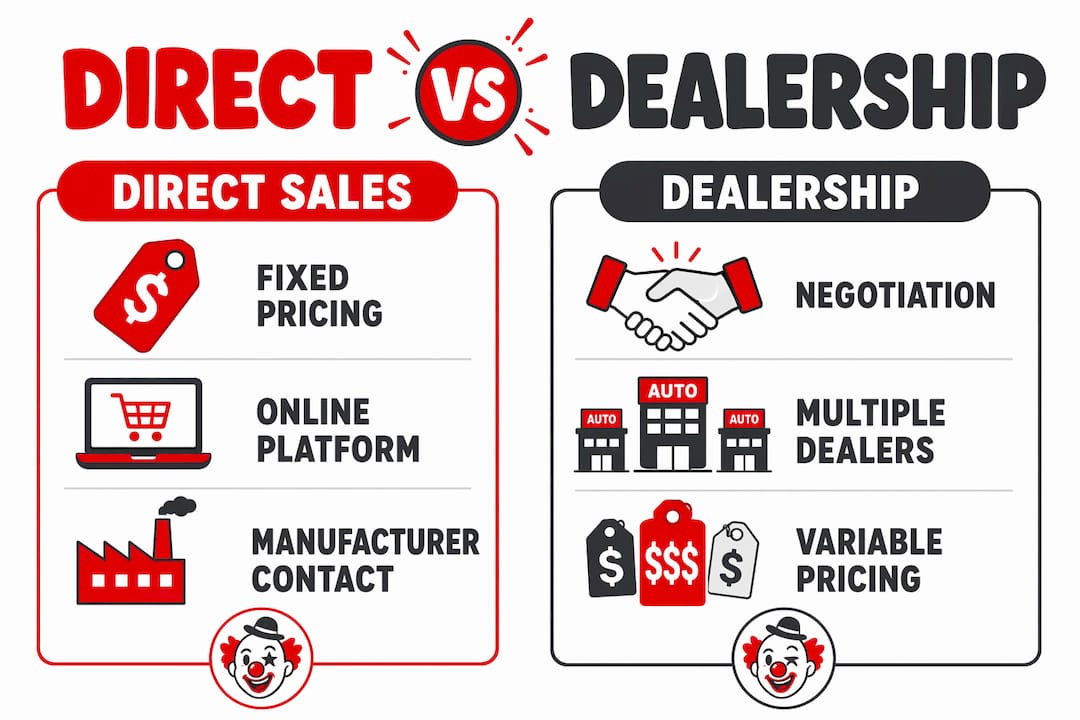
The traditional dealership model uses franchise dealers as middlemen. Dealers buy vehicles from manufacturers at wholesale prices and resell them at retail, adding their own markup and negotiating with each buyer individually. Pricing varies from one dealer to the next, and the final number depends heavily on your negotiating skill and local market conditions.
Direct vehicle selling flips that structure. The manufacturer publishes one price for every buyer in every location. There is no room to negotiate down, but there is also no risk of paying more than the next person. Online configuration tools replace the showroom floor, and manufacturer-owned service centers replace the local dealer’s service bay.
One common misconception is worth clearing up. Factory ordering a vehicle from a legacy brand like Ford or GM still runs through a franchise dealer. You configure the vehicle online, but the dealer handles the transaction, the financing, and the delivery. That is not direct sales. True direct sales exclude the dealer from every step.
Pro Tip: Before assuming you are buying direct, confirm whether the transaction is processed by the manufacturer or a local dealer. The presence of a dealer in the paperwork means it is not a true direct-to-consumer vehicle deal.
| Feature | Direct sales model | Traditional dealership model |
|---|---|---|
| Pricing | Fixed, manufacturer-set | Variable, negotiable |
| Ordering process | Online platform | In-person or dealer website |
| Financing | Manufacturer or third-party | Dealer finance office |
| Service | Manufacturer-owned centers | Franchise dealer service bays |
| Negotiation | None | Standard practice |
What laws affect vehicle direct sales in your state?
Franchise laws are the single biggest barrier to direct auto sales in the United States. These laws were created in the 20th century to prevent manufacturers from undercutting or bullying the dealer networks they had built. The logic was sound at the time. Dealers had invested heavily in local infrastructure, and manufacturers could theoretically destroy that investment by selling direct at lower prices.
Legal frameworks from the 1930s still shape how vehicles are sold today, and they are only slowly being updated for modern markets. Most states prohibit manufacturers from selling directly to consumers if they also operate a franchise dealer network in that state. EV-only manufacturers like Tesla and Rivian have used that loophole effectively, since they never established franchise networks in the first place.
The state-level picture is uneven. Over a dozen states allow direct EV manufacturer sales, while many others block them outright or permit only limited exceptions. Washington state passed legislation in april 2026 allowing certain EV manufacturers direct sales exceptions, signaling a slow but real shift in the regulatory environment. State franchise laws vary widely, which means buyers sometimes need to purchase in a neighboring state and then register the vehicle at home.
Here is what the current state landscape generally looks like for direct EV sales:
- States that broadly permit direct EV sales: California, Texas (Tesla only), Florida, New York, and Washington (as of 2026)
- States with partial or conditional exceptions: Colorado, Virginia, and several others with case-by-case manufacturer approvals
- States that largely prohibit direct manufacturer sales: Michigan, Connecticut, and others with strict franchise protection laws
Pro Tip: Check your state’s motor vehicle dealer licensing laws before placing a direct order. Some states allow you to buy in a direct-sales-friendly state and register the vehicle at home, but the process adds steps and potential fees.
What are the real benefits and challenges of direct vehicle purchases?
The advantages of direct vehicle sales are concrete and measurable. Fixed pricing removes the stress of negotiation and eliminates dealer markups that can add thousands of dollars to a vehicle’s cost. You know exactly what you are paying before you click “order.” For small business owners buying multiple utility vehicles or golf carts, that cost predictability is genuinely valuable when building a budget.
The benefits of purchasing vehicles directly also include a faster, more convenient buying process. You configure, finance, and order from one platform. Delivery comes to your door or a nearby service center. There is no back-and-forth with a finance manager, no add-on packages you did not ask for, and no pressure to buy an extended warranty on the spot.
The challenges are real, though. Direct sale EVs often rely on proprietary diagnostics and manufacturer-only service centers, which limits where you can get repairs done. If the nearest service center is two hours away, that matters. Return policies in direct sales are also stricter than what you might negotiate at a dealership. And without local dealer competition, there is no price pressure that might push the manufacturer to offer a better deal.
Who benefits most from direct vehicle selling:
- Tech-comfortable buyers who prefer online transactions over in-person negotiation
- Small business owners who need consistent pricing across multiple vehicle purchases
- Buyers in states where direct sales are fully legal and service infrastructure is nearby
- Buyers prioritizing price transparency over local dealer relationships
Who should think carefully before going direct:
- Buyers in states with restrictive franchise laws
- Anyone who needs a local service option within a short drive
- Buyers who want to test drive before committing
How to buy a vehicle directly: a practical step-by-step process
Buying a vehicle through direct sales is straightforward once you know the process. Follow these steps to avoid common mistakes.
- Confirm the manufacturer sells direct in your state. Check the manufacturer’s website and your state’s motor vehicle laws. Some manufacturers list state availability directly on their order pages.
- Configure your vehicle online. Use the manufacturer’s platform to select your model, trim, color, and options. The price updates in real time, so you see the final number before committing.
- Review financing options. Most direct-sale manufacturers offer their own financing or connect you to third-party lenders. Compare rates against your bank or credit union before accepting the first offer.
- Handle your trade-in separately if needed. Direct-sale platforms often accept trade-ins, but you may get a better value by selling your current vehicle privately or through a third-party appraisal service first.
- Schedule delivery and confirm registration requirements. Delivery comes to your home or a designated service center. Confirm who handles title and registration in your state, since some direct-sale manufacturers manage this and others leave it to the buyer.
- Locate the nearest service center before you order. This step is easy to skip and costly to ignore. Know where you will take the vehicle for maintenance and warranty work before the purchase is final.
Pro Tip: For small business owners buying utility vehicles or low-speed electric vehicles, check whether the manufacturer offers fleet pricing or volume discounts. Direct-sale platforms sometimes list these options separately from standard retail pricing.
You can also read more about where the EV market is heading to understand how direct sales will fit into the broader vehicle buying picture in the coming years. Understanding automotive customization options is also worth your time if you plan to modify a direct-purchase vehicle after delivery.
Key Takeaways
Vehicle direct sales removes dealer intermediaries, giving buyers fixed pricing and manufacturer-controlled service, but state franchise laws still limit where and how you can buy direct.
| Point | Details |
|---|---|
| Core definition | Direct sales means the manufacturer sells to you with no dealer involved at any step. |
| Legal constraints | Franchise laws block most traditional automakers from selling direct; EV brands have more flexibility. |
| Pricing advantage | Fixed manufacturer pricing eliminates dealer markups and removes negotiation pressure. |
| Service risk | Confirm a manufacturer service center is within a practical distance before ordering. |
| State variation | Over a dozen states allow direct EV sales; others require cross-state purchase and home registration. |
Why direct sales will reshape how small buyers think about vehicles
The honest truth about vehicle direct sales is that most buyers are not ready for what it actually requires. The price transparency is real and the convenience is real, but the trade-off is a level of self-sufficiency that traditional dealerships quietly handled for you. Registration paperwork, service scheduling, and trade-in logistics all land on your plate.
What I find genuinely interesting is how this model is accelerating for specialty and utility vehicles, not just passenger cars. Golf carts, low-speed vehicles, and electric utility trucks are increasingly sold direct by importers and wholesale retailers, and that segment has far fewer legal complications than the franchise-protected passenger car market. Small business owners buying a fleet of electric utility vehicles for a campus, resort, or warehouse have real options right now, without waiting for state legislatures to update 1930s-era laws.
The hybrid model is coming. Dealerships will not disappear, but their role will shift toward service and local support rather than sales transactions. Manufacturers that control the customer experience directly, as OEM-controlled DTC platforms already demonstrate, build stronger brand loyalty and gather better data on buyer preferences. That is a structural advantage that traditional dealer networks cannot easily replicate.
My advice for small business owners: do not wait for the passenger car market to sort itself out. The direct-sale model for utility vehicles, golf carts, and electric specialty vehicles is already mature and accessible. Buy where the friction is lowest and the pricing is clearest.
— Gary
Electric vehicles available now at Importjunkies
Importjunkies operates as a direct-to-public wholesale retailer, which means you get manufacturer-level pricing without the dealership markup on every order.
The 48V Electric Golf Cart 4 Seater Renegade Edition is a strong option for small business owners and individuals who want a capable utility vehicle at a transparent price. Importjunkies also carries the LSV Four Passenger Electric Coco Truck, a low-speed vehicle with AC and heat built in, suited for campus, resort, or property use. Every vehicle ships with clear pricing, no negotiation required, and direct customer service support for questions before and after purchase.
FAQ
What is vehicle direct sales in simple terms?
Vehicle direct sales is when a manufacturer sells a vehicle straight to the buyer with no dealership involved. The manufacturer sets the price, manages the order, and handles delivery.
Are all electric vehicles sold through direct sales?
Not all EVs use direct sales. Brands like Tesla, Rivian, and Lucid sell direct, but many EV models from legacy automakers still go through franchise dealers.
Can I buy a vehicle directly from the manufacturer in any state?
No. State franchise laws vary widely, and some states prohibit direct manufacturer sales entirely. Buyers in restricted states sometimes purchase in a neighboring state and register the vehicle at home.
Does factory ordering count as direct vehicle selling?
Factory ordering from legacy brands still runs through a franchise dealer. The dealer processes the transaction even if you configure the vehicle online, so it is not a true direct sale.
What is the biggest risk of buying a vehicle through direct sales?
The biggest risk is limited local service access. Direct-sale EVs often require manufacturer-only service centers, and if the nearest one is far away, routine maintenance and warranty work become inconvenient.
Recommended
- Golf cart features: a complete buyer’s guide for 2026 – Saferwholesale || Import Junkies || Great Sports
- Future of Electric Vehicles 2026: What You Need to Know – Saferwholesale || Import Junkies || Great Sports
- How to get utility vehicles for less: a buyer’s guide – Saferwholesale || Import Junkies || Great Sports
- Must-Have Recreational Vehicles 2026: Top Picks Guide – Saferwholesale || Import Junkies || Great Sports


