


 Location
 Login
Login
TL;DR:
- Hybrid scooters combine electric and gasoline power, making them suitable for areas with limited charging infrastructure. They excel in urban stop-and-go riding but often involve higher purchase and maintenance costs than electric or gas-only models. Their benefits depend heavily on route pattern and access to qualified service centers.
A hybrid scooter is a two-wheeled vehicle that pairs an electric motor with a gasoline engine, giving you electric-only operation, engine-assisted power, or both at once depending on the design. For U.S. buyers, that combination matters most in two situations: when public charging infrastructure is too sparse to rely on a pure electric model, or when the upfront cost of a full EV is a stretch. As Vartak et al. (2025) put it, hybrid powertrain scooters are a “transitional solution” that bridges traditional combustion engines and fully electric models. The IJSRED technical review confirms they can operate in gasoline-only, electric-only, or blended modes depending on architecture.
Quick snapshot of what you get:
- Reduced range anxiety compared to pure electric scooters
- Lower city emissions compared to gasoline-only models
- Higher upfront cost and more complex servicing than either alternative
- Best fit: urban commuters, delivery riders, and buyers in areas with limited charging
Table of Contents
- How does a hybrid scooter drivetrain work?
- How do hybrid scooters compare to electric and gas models?
- Who actually benefits from a hybrid scooter?
- What should you check before buying a hybrid scooter?
- What does it actually cost to own a hybrid scooter?
- U.S. safety, registration, and legal checkpoints
- Glossary of terms you will encounter when shopping
- Key Takeaways
- The case for hybrids is real, but the fine print matters
- Importjunkies has the scooters and utility vehicles worth considering
- Research sources and further reading
How does a hybrid scooter drivetrain work?
Not all hybrids are built the same, and the architecture you choose directly affects performance, fuel savings, and what it costs to service.
Mild hybrid: A small assist motor (typically 1–2 kW) helps the engine during starts and handles idle-stop functions. It cannot propel the scooter on electric power alone, but it delivers modest efficiency gains of roughly 10–20% in city riding. Honda’s PCX HYBRID uses a version of this approach, with a 48V lithium-ion battery and an ACG starter that provides motor assist for sharper throttle response.
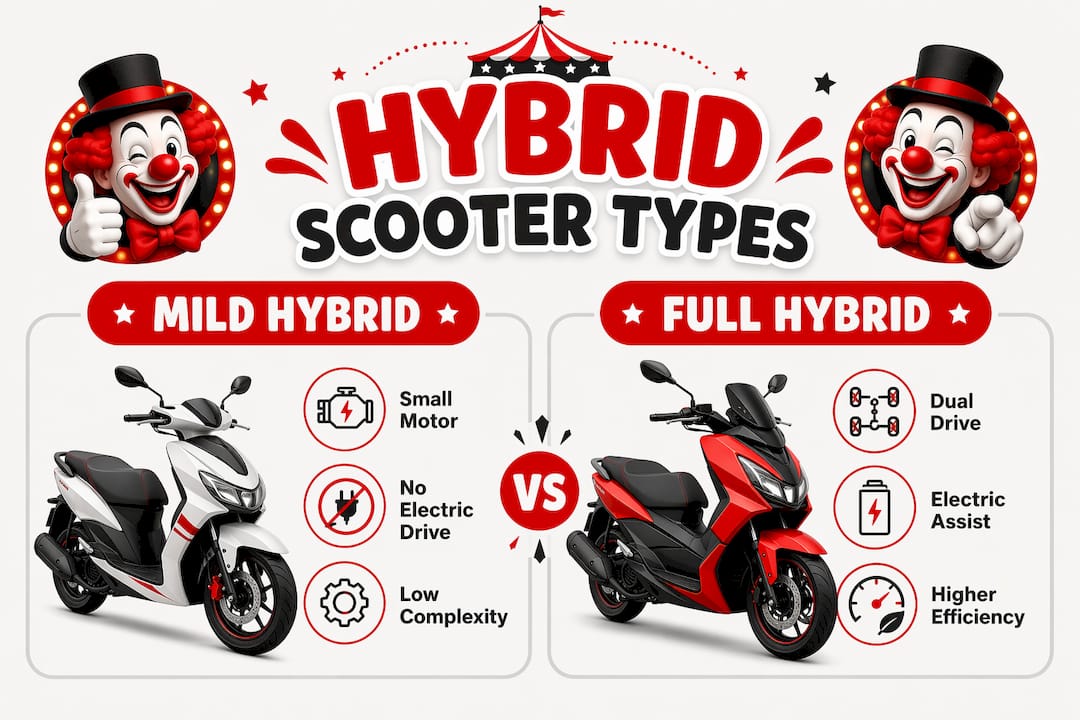
Full hybrid (parallel): Both the engine and the electric motor can mechanically drive the rear wheel, either separately or together. This gives you genuine electric-only creep at low speeds and blended power for acceleration, making it the most versatile layout for mixed city and highway use.
Series hybrid / range extender: The gasoline engine runs a generator to charge the battery; only the electric motor drives the wheel. This layout excels in stop-and-go delivery routes because the engine always runs at its most efficient speed, regardless of vehicle speed.
Plug-in hybrid (PHEV): You can charge the battery externally, giving you a short electric-only window before the engine takes over. Typical plug-in scooter electric-only range runs 10–50 km (roughly 6–31 miles) depending on the model and battery size.
Regenerative braking recovers kinetic energy during deceleration and feeds it back to the battery. In stop-and-go traffic, this meaningfully extends electric range; on a steady highway run, the benefit shrinks considerably.

Pro Tip: Match the architecture to your route. Series hybrids are the strongest choice for delivery loops with frequent stops; parallel hybrids suit mixed-speed commuting where you occasionally hit 45–55 mph.
| Architecture | Electric-only capable | Best use case | Service complexity |
|---|---|---|---|
| Mild hybrid | No | General commuting, cost-conscious buyers | Low |
| Full hybrid (parallel) | Yes (limited) | Mixed city/highway commuting | Moderate |
| Series / range extender | Yes | Stop-and-go delivery routes | Moderate–High |
| Plug-in hybrid (PHEV) | Yes (6–31 miles) | Short urban trips, limited charging areas | High |
How do hybrid scooters compare to electric and gas models?
The honest answer is that hybrids occupy a middle ground, and whether that middle ground is worth it depends on your specific riding pattern.
Pure electric scooters offer the lowest operating costs, zero tailpipe emissions, and near-silent operation. The trade-off is real: limited range, dependence on charging infrastructure, and higher purchase prices for capable models. If you want a deeper look at electric scooter performance, Importjunkies covers the full breakdown.
Gasoline scooters are simpler to service, cheaper to buy, and can travel long distances without stopping. Fuel costs and emissions are the obvious downsides, and city fuel economy suffers in heavy traffic.
Hybrid scooters reduce range anxiety without abandoning the fuel network, and they cut urban emissions relative to gasoline models. The cost is real: higher purchase price than comparable gas models, and a drivetrain that combines a battery, motor, and engine, meaning more components that can need attention. Industry analysis consistently flags that mild, full, and plug-in hybrids differ substantially in service needs and total cost of ownership, so the “hybrid” label alone tells you very little.
Hybrids genuinely outperform both alternatives in one scenario: urban delivery or commuting with frequent stops, where regenerative braking and electric assist deliver the largest real-world efficiency gains. Aggressive riding at sustained highway speeds largely erases those efficiency advantages.
| Factor | Pure electric | Hybrid | Gasoline |
|---|---|---|---|
| Purchase price | Moderate–High | High | Low–Moderate |
| Operating cost | Lowest | Low–Moderate | Moderate |
| Range flexibility | Limited by charging | High | High |
| Tailpipe emissions | Zero | Reduced | Higher |
| Service complexity | Low | Moderate–High | Low |
| Best environment | Urban, short trips | Urban/mixed, limited charging | Long-range, rural |
Who actually benefits from a hybrid scooter?
Hybrids are not the right call for every buyer. They make the most sense for four specific profiles.
- Daily city commuter with mixed routes. Short electric-only legs handle the congested downtown stretch; the engine covers the occasional longer leg without hunting for a charger.
- Small-business delivery rider. Consistent stop-and-go loops maximize regenerative braking returns, and the fuel tank eliminates mid-shift charging delays. Removable battery packs on some PHEV models allow overnight charging at a depot.
- Riders in areas with limited charging infrastructure. If your zip code has few public chargers, a hybrid lets you cut emissions on short trips while keeping the gasoline fallback for longer runs.
- Recreational riders who want quiet starts. Electric-mode operation in residential areas or parks, with the engine available when the ride extends beyond the battery’s range.
Pro Tip: If your daily round trip is consistently under 20 miles and you have reliable home charging, a pure electric scooter may serve you better at a lower total cost. Hybrids earn their premium when your route is unpredictable or charging is genuinely inconvenient.
For buyers weighing scooters against mopeds or other light vehicle classes, vehicle classification affects registration and insurance, so confirm the category before you buy.
What should you check before buying a hybrid scooter?
Use this checklist when evaluating any listing or dealer quote.
- Drivetrain type. Confirm whether it is mild, full parallel, series, or plug-in. This determines electric-only capability, service requirements, and realistic efficiency gains.
- Battery specs. Note the chemistry (lithium-ion is standard), capacity in kWh, expected cycle life, and whether the pack is removable or fixed. Removable packs simplify charging but can add cost.
- Engine displacement and fuel system. Most hybrid scooters run 50–150cc engines. Check manufacturer-recommended service intervals for oil changes and spark plugs.
- Charging options. For plug-in models, confirm onboard charging rate and whether a standard 120V household outlet is sufficient or a dedicated circuit is needed.
- Warranty coverage. Get separate warranty terms for the battery, electric motor, combustion engine, and power electronics. These components age differently.
- Curb weight. Battery and motor packages can add 50–100 pounds over a comparable gas scooter. Heavier curb weight affects handling, tire wear, and braking distances.
- Dealer and service network. High-voltage hybrid systems require specialized diagnostic tools. Confirm a qualified service center is within a reasonable distance before committing.
Pro Tip: Ask the dealer specifically whether their technicians are trained and equipped for high-voltage battery diagnostics. A mild hybrid can often be serviced by a general small-engine mechanic; a series or plug-in hybrid usually cannot.
For a structured step-by-step comparison framework, Importjunkies has a dedicated guide that walks through evaluating competing listings side by side.
What does it actually cost to own a hybrid scooter?
Total cost of ownership covers more than the sticker price. Here is where hybrid costs diverge from simpler alternatives.
Fuel and electricity: Hybrids reduce fuel spend in city riding, but the savings depend heavily on how much of your riding falls in stop-and-go conditions versus highway. Aggressive riding frequently erases the advertised efficiency gains.
Battery replacement: Lithium-ion packs degrade over time. Replacement costs vary by pack size and chemistry; this is a line item you should budget for, especially on plug-in models with larger packs.
Engine service: Oil changes, air filter replacements, and spark plug intervals still apply. Hybrid scooters carry both a combustion engine and a high-voltage electrical system, so annual maintenance touches more components than either a pure electric or a gasoline model alone.
Tires, brakes, and suspension: Heavier curb weight accelerates wear on these components. Factor in slightly shorter replacement intervals compared to a lighter gasoline scooter.
| Cost category | Pure electric | Hybrid | Gasoline |
|---|---|---|---|
| Fuel / electricity | Lowest | Low–Moderate | Moderate–High |
| Battery replacement | Moderate | Moderate–High | None |
| Engine service | None | Moderate | Low–Moderate |
| Tire / brake wear | Low | Moderate | Low |
| Overall annual cost | Lowest | Moderate | Low–Moderate |
Pro Tip: Charging discipline matters. Consistently charging to 80% rather than 100% and avoiding deep discharges extends lithium-ion pack life, which is the single largest variable cost in hybrid ownership.
U.S. safety, registration, and legal checkpoints
Laws vary significantly by state, so treat this as a checklist of what to verify, not legal advice.
- Vehicle classification: The U.S. Department of Transportation defines scooters and mopeds by speed capability and engine size. Confirm whether your hybrid scooter is classified as a moped, motorcycle, or motorized scooter with your state DMV before purchase. Classification determines license requirements, registration, and where you can legally ride. Importjunkies covers street-legal requirements by vehicle type in detail.
- Registration and title: Most hybrid scooters above 50cc require a title, registration, and license plate. Verify with your state DMV.
- Insurance: Liability insurance is required in most states for registered scooters. Check whether your insurer covers hybrid powertrains specifically, as some policies exclude high-voltage battery components.
- Helmet laws: Requirements vary by state. DOT-certified helmets meet federal safety standards; SNELL or ECE 22.06 certification adds an additional layer of impact testing.
- Battery safety: Confirm the battery pack has a certified Battery Management Unit (BMU) and an accessible emergency disconnect. This matters for both daily safety and emergency responder access.
- Visibility and lighting: Adequate lighting is both a legal requirement and a practical safety measure. Resources on vehicle lighting standards can help you evaluate whether a scooter’s stock lighting meets your state’s requirements or needs supplementing.
- State incentives: Some states offer rebates or tax credits for hybrid or low-emission two-wheelers. Check your state energy office or DMV website for current programs.
Glossary of terms you will encounter when shopping
- Mild hybrid: A system where a small electric motor assists the engine but cannot drive the scooter independently.
- Full hybrid (parallel hybrid): Both the engine and motor can drive the wheels, enabling genuine electric-only operation at low speeds.
- Series hybrid: The engine powers a generator; only the electric motor drives the wheel. Common in delivery-focused designs.
- Plug-in hybrid (PHEV): A hybrid with an externally chargeable battery, providing a defined electric-only range before the engine activates.
- Range extender: A gasoline engine used solely to generate electricity for the motor, extending total range beyond the battery alone.
- kWh (kilowatt-hour): The unit measuring battery energy capacity. Higher kWh generally means longer electric-only range.
- Regenerative braking: A system that converts braking energy into electricity and stores it in the battery, improving efficiency in stop-and-go riding.
- Battery Management Unit (BMU): Electronics that monitor battery charge, temperature, and health to protect the pack and optimize performance.
- Displacement (cc): Engine size in cubic centimeters. Affects power output, fuel consumption, and often vehicle classification under state law.
- Curb weight: The total weight of the scooter as delivered, including fluids but excluding rider and cargo. Relevant to handling and component wear.
Key Takeaways
Hybrid scooters deliver the most value for urban riders and small-business operators in areas where charging infrastructure is limited and stop-and-go riding patterns maximize regenerative braking returns.
| Point | Details |
|---|---|
| Architecture determines value | Mild, series, and plug-in hybrids differ substantially in electric-only capability, efficiency gains, and service costs. |
| Weight adds up | Battery and motor packages add extra weight over a comparable gas scooter, affecting handling and component wear. |
| Plug-in electric range is limited | Most PHEV scooters offer a limited electric-only operation range before the engine activates. |
| Service network matters | Series and plug-in hybrids require technicians trained for high-voltage systems; confirm availability before buying. |
| Importjunkies for next steps | Importjunkies offers direct-to-consumer pricing on scooters, electric bikes, and utility vehicles with buyer guides to help you compare options. |
The case for hybrids is real, but the fine print matters
Hybrid scooters get marketed as the best of both worlds, and in the right conditions, that is accurate. But the category is broad enough that two scooters both labeled “hybrid” can have almost nothing in common in terms of performance, service needs, or real-world efficiency. A mild hybrid is essentially a gasoline scooter with a smarter starter motor. A plug-in series hybrid is closer to an electric scooter with a fuel-powered backup generator. Treating them as equivalent is how buyers end up disappointed.
The buyers who get the most from a hybrid are the ones who match the architecture to their actual route, confirm a qualified service center is nearby, and go in with realistic expectations about efficiency gains. Stop-and-go city riding with regenerative braking is where hybrids earn their premium. Highway cruising largely is not.
Importjunkies has the scooters and utility vehicles worth considering
If you have worked through this guide and you are ready to compare real listings, Importjunkies sells scooters, electric bikes, golf carts, and utility vehicles directly to the public at wholesale pricing, with no middleman markup. The catalog covers everything from entry-level commuter scooters to electric utility vehicles suited for small-business operations, with detailed specs, images, and pricing on every listing.

Whether you are a daily commuter narrowing down your options or a small-business owner evaluating utility vehicles for a delivery fleet, the Importjunkies storefront gives you direct access to the full range. Browse the full catalog at Importjunkies to compare models, check current pricing, and reach the customer service team with specific questions.
Research sources and further reading
The following sources informed this guide. Academic and peer-reviewed sources are noted; industry overviews are from trade and manufacturer publications.
- Vartak et al. (2025), “Advancements in Electric Vehicles: Hybrid,” IJFMR — Peer-reviewed academic paper on hybrid powertrain scooters, urban mobility, and infrastructure challenges.
- IJSRED Technical Review: Hybrid Scooter — Academic review covering hybrid scooter operating modes, performance, and efficiency caveats.
- AAPEFI: Five Hybrid Engine Architectures for Scooters and Motorcycles — Industry overview of mild, parallel, series, and plug-in architectures with practical selection guidance.
- AAPEFI: Gasoline-Electric Hybrid Scooters in 2025 — Market overview covering plug-in range figures, pricing trends, and 2025–2026 model availability.
- AAPEFI: Hybrid vs. Gasoline Motorcycles and Scooters — Industry analysis of rider profiles and trade-offs between hybrid and gasoline models.
- Springer: Hybrid Categories and Implications — Academic chapter on hybrid system categories and their implications for maintenance and total cost of ownership.
- Importjunkies: Electric Scooters — How They Work, Types, and Benefits — Importjunkies internal buyer guide covering electric drivetrain basics and vehicle categories.
Recommended
- How to compare scooters: a step-by-step guide to smart choices – Saferwholesale || Import Junkies || Great Sports
- Scooter types guide: Choose the right model in 2026 – Saferwholesale || Import Junkies || Great Sports
- Electric scooters: How they work, types, and benefits – Saferwholesale || Import Junkies || Great Sports
- Best Scooters for Beginners: Your 2026 Buying Guide – Saferwholesale || Import Junkies || Great Sports


